Reflective Trim Umbrellas: Safety Specs for OEM Buyers
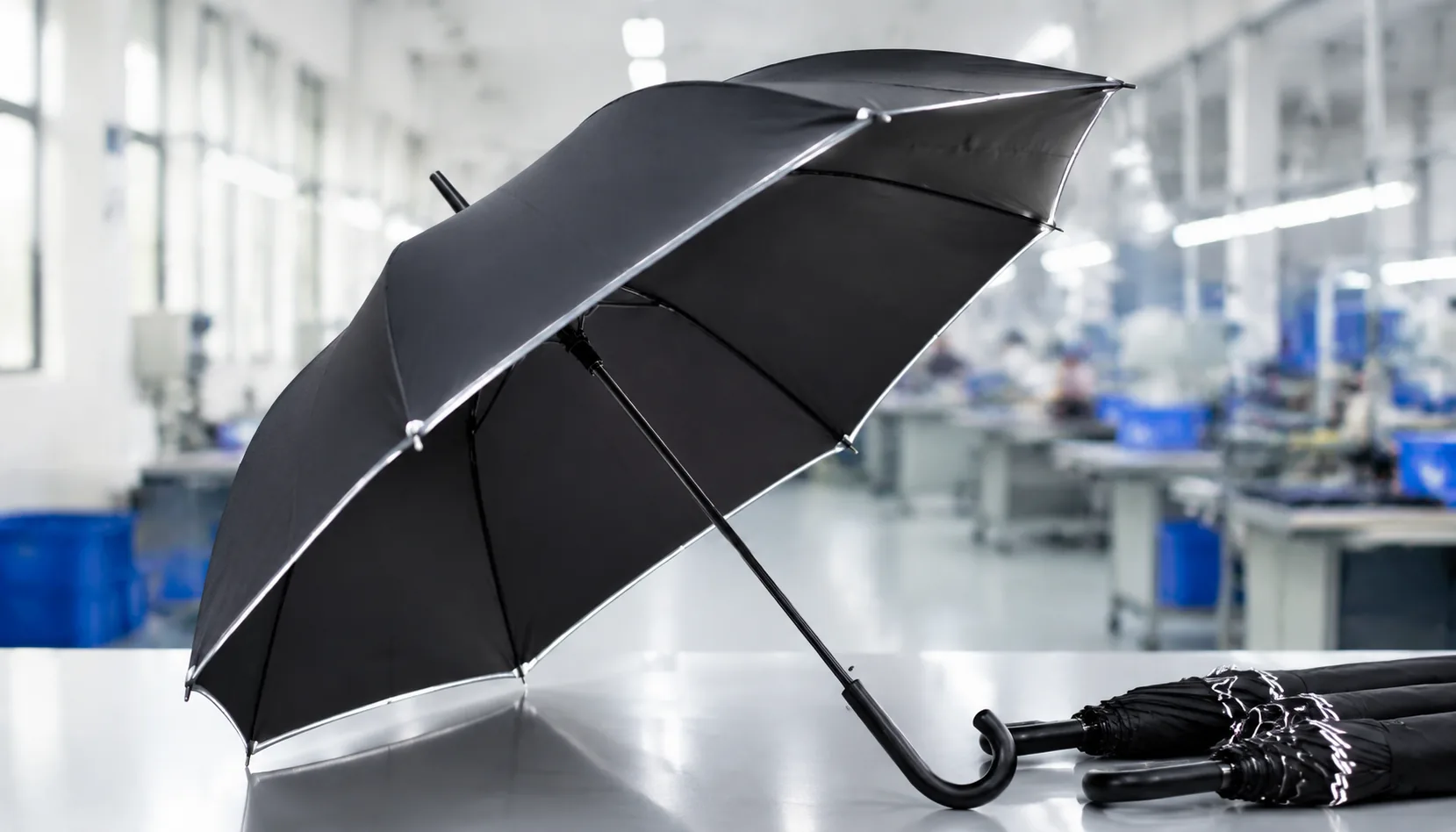
For OEM buyers, reflective trim umbrellas look simple on a spec sheet, but small choices in tape width, stitch placement, fabric coating, and rib tension decide whether the umbrella passes inspection or comes back with complaints. On our Songxia factory floor, we check how reflective trim behaves after canopy sewing, folding, heat packing, and repeated opening, because commuter, campus, and event orders need visibility without sacrificing durability, lead time, or cost control.
Visibility Goals and Buyer Use Cases
Reflective trim adds the most value when the umbrella user is moving near vehicles, bicycles, forklifts, or crowded pedestrian flows. For commuter giveaways, a 23" auto-open or 21" auto-open-close model with reflective edge piping gives visibility at the canopy perimeter, where headlights catch the motion first. For school programs, I prefer a 23" or 27" manual safety umbrella with fiberglass ribs, rounded tips, and 190T pongee because children are hard on frames and often walk in groups at dusk. Security teams and event marshals usually need 27" or 30" golf umbrellas with 8K or 10K fiberglass ribs, a straight EVA handle, and reflective bands on alternating panels so the umbrella reads clearly from the front, side, and rear.
The practical target is 360-degree recognition, not just a bright logo facing one direction. A reflective piping umbrella works because the trim follows the outer arc of the canopy; when the user tilts it against rain, that arc remains exposed to vehicle headlights from low angles. Printed silver ink on the top panel can look good in a sample room, but it may disappear when the canopy is angled away, covered by rainwater, or viewed from behind. For safety umbrellas OEM programs, we normally ask buyers to define the use case first: roadside staff need high-angle and low-angle visibility, outdoor event teams need crowd identification, and school routes need consistent edge reflection more than large branding.
Daytime visibility and nighttime visibility should be specified separately. In daylight, color contrast does most of the work, so orange, lime, yellow, or bright royal blue 190T/210T pongee panels help the umbrella stand out before the reflective material is even activated. At night, reflective piping or segmented reflective tape should be checked under headlights from roughly 30, 60, and 90 degrees, not only straight-on. For branded safety umbrellas, keep the logo on one or two panels and let the trim handle the safety function; overloaded print can stiffen the canopy and reduce water runoff. Good commuter umbrella specs also include wind resistance, such as fiberglass ribs and a vented double canopy for 50+ mph testing, because a safety feature is useless if the frame inverts in the first storm.
Canopy Fabric, Reflective Tape, and Print Layout
For reflective trim umbrellas, I normally push OEM buyers toward 210T pongee when the program needs a cleaner retail finish, tighter panel registration, or large logo printing. 190T pongee is acceptable for promotional safety umbrellas OEM orders where budget matters, but it has a looser hand feel and shows more puckering if the operator pulls the reflective tape too hard during sewing. A 23-inch auto-open straight umbrella with 8K fiberglass ribs can use either fabric, but 210T holds the canopy crown smoother after water-repellent coating and gives better edge stability when reflective piping is added around the perimeter. For commuter umbrella specs, 190T is still practical on compact 21-inch auto-open-close models because packed weight and cost are more sensitive, but I would avoid very wide reflective bands on thin panels because they can wrinkle after folding cycles.
Reflective tape placement has to follow the seam structure, not the artwork wish list. The safest positions are outer canopy edge piping, seam-line strips between panels, and short vertical accents near the rib line, because those areas are already supported by stitching and frame tension. A reflective piping umbrella should not have tape floating across the middle of a panel unless the fabric is stabilized, since pongee stretches slightly on the bias and the tape does not; that mismatch creates waves after the first rain test or wind test. On double-canopy vented umbrellas, keep reflective tape on the lower canopy edge or panel seams, not across the vent overlap, because extra stiffness can reduce airflow and hurt windproof performance. Our standard practice at ZheBrella is to test tape adhesion and stitch tension after opening-closing cycles before approving bulk sewing.
Logo layout needs a hierarchy before sampling: choose whether visibility, brand size, or low unit cost is the priority. Reflective piping reduces usable print area along the panel edge by roughly 12–18 mm, and seam-line reflective strips can remove another 8–12 mm of safe clearance on each side. For panel logos, keep artwork at least 20 mm away from rib seams and 30 mm away from the canopy hem to avoid distortion during sewing and final stretching. Screen printing works well for one- or two-color branded safety umbrellas, while heat transfer handles gradients but must be tested against reflective tape heat sensitivity. Sleeve branding is often the cleanest secondary logo position when the canopy is already crowded with piping and safety messaging; on 190T or 210T pongee sleeves, keep the print under about 180 mm wide so it does not wrap into the seam or closure strap area.
Frame Choices for Daily Commuter Durability
For daily commuter programs, 8K steel ribs still make sense when the buyer needs a cost-stable, tough straight umbrella and the target user is walking from train station to office, not fighting coastal gusts every week. A 23" or 27" auto-open stick umbrella with 8K steel ribs, a steel shaft, and 190T or 210T pongee canopy will feel solid in the hand and hold reflective piping cleanly along the panel seams. The tradeoff is weight: a steel-frame 23" auto-open usually lands around 430–520 g depending on handle and runner, and once bent, steel ribs rarely spring back perfectly. For reflective trim umbrellas sold as safety umbrellas OEM, I prefer steel on entry-level branded safety umbrellas where the order priority is price, consistent printing registration, and AQL 2.5 reliability rather than premium wind recovery.
Fiberglass ribs are the better choice when the commuter umbrella specs call for wind tolerance, lighter carry, and fewer rib deformation complaints after real street use. On 23" and 27" straight umbrellas, 8K fiberglass ribs with a metal shaft can survive repeated inversion better than full steel; a well-built double-canopy vented windproof model should handle 45–50+ mph lab gusts if the joints, tips, and runner are not under-specified. Fiberglass also pairs well with reflective piping because the canopy edge flexes instead of pulling hard against the stitched trim when wind loads the panels. The cost is higher, and cheap fiberglass with rough pultrusion or weak rivets will fail at the joint, not in the rib itself. For retail or transit-agency branded safety umbrellas, I would specify fiberglass ribs, 210T pongee with water-repellent coating, and a slightly larger ferrule and tip set to control canopy flutter.
Mixed steel-fiberglass frames are often the practical middle ground for compact folding reflective trim umbrellas, especially 21" and 23" auto-open or auto-open-close builds. Folding umbrellas already carry more failure points: telescopic shafts, stretchers, springs, sliders, and plastic link parts all add risk compared with a manual straight umbrella. Steel stretchers give the folding frame crisp opening force, while fiberglass outer ribs improve recovery when the canopy flips. That said, auto-open-close mechanisms add weight and stress; a 3-fold auto-open-close with reflective piping, POE logo patch, and 210T pongee can easily reach 350–430 g, and weak springs or undersized sliders show up quickly in cycle testing. For high-volume OEM commuter orders, our standard practice is to cycle-test mechanisms at least 300–500 opens before shipment approval, then inspect runner lock, rib rivets, tip stitching, and reflective trim alignment under AQL 2.5.
Quality Checks Buyers Should Specify
Reflective trim alignment should be treated as a critical visual and safety point, not a decoration check. On a reflective piping umbrella, the tape or piping must track evenly along each panel seam, with no twisting, waviness, or offset where the canopy panels meet at the tips and crown. For 8K and 10K commuter models, I recommend specifying a maximum alignment deviation of 2 mm at panel joints and no more than 3 mm over the full rib length. Inspectors should check the umbrella open on a light table or under angled LED light because reflective tape defects are easy to miss under flat warehouse lighting. For reflective trim umbrellas, buyers should also require a night-visibility check from 20 to 30 meters, especially when ordering branded safety umbrellas for road crews, campuses, or public transit campaigns.
Tape adhesion and stitching are where many safety umbrellas OEM orders fail after the first rain season. Reflective tape should pass a dry rub and wet rub test, plus a cross-hatch or peel check if it is heat-applied to 190T or 210T pongee. Sewn reflective piping needs consistent stitch density, usually 8 to 10 stitches per inch, with no skipped stitches, loose bobbin thread, or needle damage along the coated fabric. Canopy tension should be checked with the umbrella fully open: panels must sit smooth without sagging between ribs, but not so tight that the fabric pulls away from rib tips after cycle testing. For fiberglass ribs, check that the trim does not distort when the frame flexes; for steel ribs, check rust marks around stitch holes after a 24-hour humidity hold. Our standard practice at ZheBrella is to inspect reflective trim before final packing, because cartons hide edge damage very well.
Opening and closing cycle tests should be written into the commuter umbrella specs, not left to the factory’s internal habit. Manual and auto-open models should complete at least 300 cycles, while auto-open-close folding umbrellas should be tested for 500 cycles because the spring load is harder on runner parts, rib joints, and canopy seams. After cycling, inspectors should recheck canopy tension, rib symmetry, runner lock strength, tip attachment, and whether the reflective trim has cracked, lifted, or shifted. Water repellency should be tested after the cycle test, not only on fresh fabric; a Teflon-coated canopy should still bead cleanly after spray testing, with no leakage through reflective stitch lines. Final shipment inspection should follow AQL 2.5 for major defects and AQL 4.0 for minor appearance defects, with trim misalignment, poor adhesion, failed open-close function, leakage, and broken ribs classified as major defects.
MOQ, Lead Time, and Packing for Safety Programs
MOQ on reflective trim umbrellas is driven less by the umbrella body and more by the reflective material setup. Standard silver-gray reflective piping on a 23" auto-open straight umbrella can usually start around 500–1,000 pcs if the canopy is stock 190T pongee in black, navy, or safety yellow. Colored reflective tape, segmented reflective strips, or EN-style high-intensity tape often pushes MOQ to 2,000 pcs because the tape supplier has roll minimums and we need stable heat-press or sewing tension across the batch. Custom panels add another layer: one-color screen printing on 1–2 panels is easy at 500 pcs, but all-over sublimation, alternating panel colors, or matched PMS canopy fabric normally needs 1,000–3,000 pcs depending on 190T versus 210T pongee availability. Sleeves are commonly forgotten; a printed sleeve with reflective piping, barcode label, and hang tag can have its own 500–1,000 pc minimum even when the umbrella frame is already approved.
For safety umbrellas OEM programs, plan samples in two stages instead of rushing straight to bulk. A plain construction sample normally takes 5–7 days when using available 8K steel or fiberglass frames, while a branded sample with reflective piping, panel logo, sleeve artwork, and Teflon or UPF 50+ coating is more realistic at 10–15 days after artwork approval. Bulk lead time is typically 25–35 days for stock-frame manual or auto-open umbrellas, and 35–50 days for custom 10K windproof frames, double-canopy vented builds, or multiple print positions. Our standard practice at ZheBrella is to freeze reflective tape, canopy fabric, handle, sleeve, and carton mark before issuing the pre-production sample, because late sleeve or carton changes delay final inspection more often than sewing does. For AQL 2.5 inspection, leave 2–3 days before vessel cutoff or courier pickup, especially when each umbrella needs individual sleeve insertion and retail labeling.
FOB and DDP planning changes the packing decision. Under FOB Ningbo or Shanghai, buyers often optimize carton size for sea freight, usually 24 pcs per master carton for 23" straight umbrellas or 12 pcs for 27"–30" golf umbrellas, with each unit in a polybag plus sleeve. For DDP event delivery, the better choice is often smaller cartons of 12 or 24 pcs with clear outer labels by department, campus, branch, or event zone; it costs slightly more per unit but saves labor during distribution. A reflective piping umbrella for commuter programs should also be packed so the reflective edge is not crushed: avoid over-tight carton compression, keep ferrules aligned, and use stronger 5-ply cartons for long inland trucking. Branded safety umbrellas shipped to hospitals, utilities, schools, or transit agencies often need carton marks, SKU labels, and mixed-color packing lists prepared before final QC, not after the goods are already sealed.
Frequently Asked Questions
Can reflective trim be added to both folding and straight umbrellas?
Yes, but straight umbrellas usually allow cleaner reflective piping because the canopy has fewer fold stress points. For compact umbrellas, buyers should approve a pre-production sample to check tape folding and panel tension.
Does reflective trim replace safety certification?
No. Reflective trim improves visibility, but buyers should still define the target market, labeling needs, and any local safety requirements. QC should verify reflective placement and sewing quality, not just appearance.
Where should reflective trim be placed on an OEM commuter umbrella?
For commuter use, reflective piping is usually placed around the canopy edge so it is visible from multiple angles. Buyers can also add reflective panels, straps, or sleeve trim, but edge piping is the most cost-effective option for bulk production.
What MOQ is typical for custom reflective trim umbrellas?
A typical MOQ is around 500 to 1,000 pieces per style for standard reflective piping with logo printing. Custom reflective tape width, special fabric colors, or private-mold handles may require a higher MOQ.
What QC checks should buyers request for reflective safety umbrellas?
Buyers should check reflective tape adhesion, trim alignment, night visibility, canopy waterproofing, frame open-close performance, and logo print accuracy. For import orders, it is common to request pre-production samples and AQL inspection before shipment.
Looking to Launch Your Custom Umbrella Line?
ZheBrella is a Zhejiang-based OEM/ODM umbrella manufacturer with 17 years of export experience. Free design, low MOQ from 100 pieces, windproof construction, full-color print.
Get Free Quote Now »People Also Search For
Related Articles
Reflective Safety Umbrellas: OEM Specs for Urban Programs
Specify reflective safety umbrellas with piping, panels, frames, and QC checks for commuter, campus, and corporate safet...
Read More »
Reflective Safety Umbrellas: OEM Specs for Commuters
Specify reflective umbrellas with 190T/210T pongee, fiberglass ribs, reflective trim, AQL 2.5 QC, and realistic MOQ and ...
Read More »
Reflective Safety Umbrellas: Buyer Specs for Night Use
Specify reflective safety umbrellas with trim placement, frame options, fabric weight, print limits, QC checks, MOQ, and...
Read More »