Reflective Safety Umbrellas: OEM Specs for Urban Programs
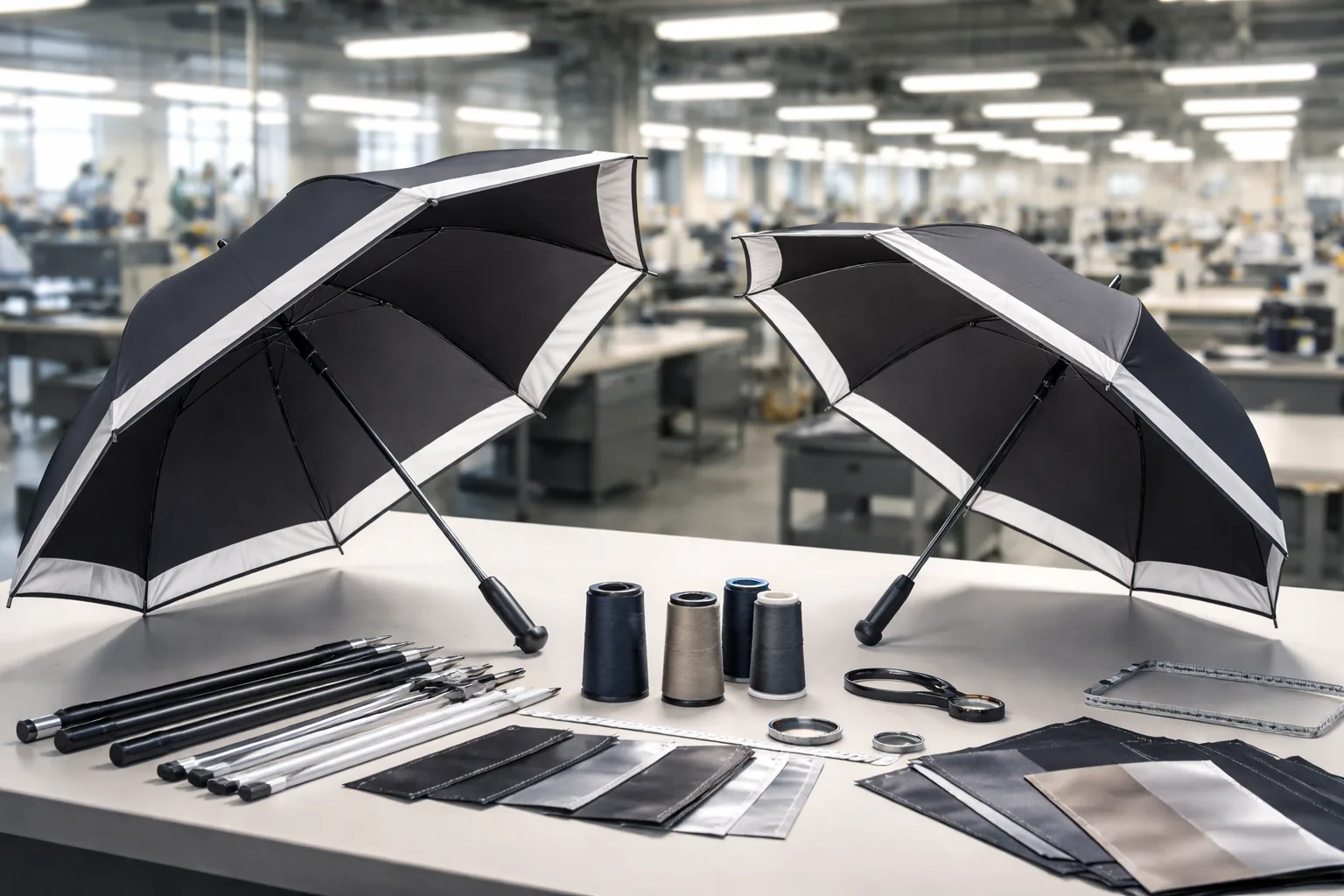
For commuter, campus, and corporate safety programs, the risk is not just low visibility in rain; it is inconsistent reflectivity, weak frame choices, and late-stage QC surprises across large OEM runs. On our Songxia production floor, reflective safety umbrellas are specified from the trim outward: piping width and placement, panel fabric and coating, rib and shaft strength, handle durability, and inspection points that confirm the sample standard survives bulk production.
Define the Use Case and Visibility Requirement
Start by separating decoration from safety function: reflective safety umbrellas for a city program need visible geometry, not just a silver logo. For night commuting, campus escorts, roadside survey teams, transit volunteers, and rainy urban events, I normally specify umbrella reflective piping on every canopy panel edge or at least every other seam, because moving arcs are easier for drivers to catch than a flat mark. On a 23" or 27" stick umbrella, 8K fiberglass ribs with reflective edge binding give better perimeter recognition than one large reflective patch hidden by walking angle. For folding urban commuter umbrellas, 21" auto-open-close is convenient, but the reflective layout must still show from the side, rear, and front when the user tilts the canopy into wind.
Reflective print areas should be treated like placement engineering. A 50 mm reflective band near the canopy skirt gives 360-degree visibility when the umbrella is carried upright, while reflective panels on two opposite gores help when it is angled forward in heavy rain. For roadside staff, I prefer 210T pongee with Teflon water-repellent finish, fiberglass ribs, and a double-canopy vented windproof structure tested around 50+ mph, because a flipped umbrella removes the safety surface exactly when traffic risk is highest. For campus safety or event marshals, reflective ink or heat-transfer film can be combined with a colored canopy, but buyers should request reflectivity samples after wet rubbing and folding tests, not just a studio photo.
A reflective umbrella OEM brief should state the observation distance and viewing direction: 30 m pedestrian visibility for campus use is different from 80–100 m vehicle approach visibility for roadside crews. Our standard practice at ZheBrella is to confirm rib count, canopy size, reflective material width, and print process before quoting MOQ, because reflective film, screen ink, and sewn piping have different labor and scrap rates. For custom safety umbrellas, I also ask whether the umbrella will be used with high-vis vests, backpacks, or event uniforms; if the umbrella is the main warning object, specify continuous perimeter piping plus two or four reflective print zones rather than relying on a small logo. That is the difference between branded rain gear and a real visibility tool.
Choose Canopy Fabric and Reflective Materials
For reflective safety umbrellas used in city transit, I usually start with 190T pongee when the buyer needs a sharp logo at a controlled cost, and move to 210T pongee when the program needs better hand feel, stronger tear resistance, and a more retail-grade surface. A 190T polyester pongee canopy is lighter and prints cleanly with screen printing or heat transfer, especially on solid navy, black, or safety yellow panels. A 210T pongee has tighter yarn density, so it resists pinholes better after repeated wet-dry cycles and gives sublimation graphics a smoother edge, but it adds cost and a little packed bulk. Both fabrics should use a water-repellent finish, normally PU or Teflon-style coating, with a practical rain rating proven by spray testing rather than just claimed in a spec sheet. For urban commuter umbrellas, I would avoid cheap 170T polyester because the fabric stretches around rib tips and reflective trim becomes wavy after sewing.
Reflective material choice matters more than most buyers expect because umbrella panels curve, fold, and rub against each other every day. Silver reflective tape gives the strongest night visibility and works well as umbrella reflective piping along the canopy edge, on alternating panel seams, or around a vented double-canopy layer. For OEM production, 10 mm to 15 mm tape is easier to sew neatly than very wide tape, and it should be tested after at least 20 open-close cycles to check cracking at fold lines. Reflective ink is cleaner for logos, arrows, municipal slogans, or sponsor marks, but it is less bright than tape when hit by car headlights. A good reflective umbrella OEM spec often combines both: sewn silver tape for 360-degree visibility and reflective ink for branding. On darker 190T or 210T pongee, we run adhesion and wash-rub checks before bulk cutting because failed reflective ink is expensive to rework after canopy sewing.
Daytime safety should not be ignored, especially for school, municipal, construction, and transit authority programs where the umbrella is used under sun as often as rain. UPF 50+ coating can be added to 190T or 210T pongee, but buyers should confirm whether the coating is silver, black, or clear because it affects color tone, print hand, and inside appearance. A silver UV backing improves heat reflection but can make the canopy feel stiffer, while black coating gives better shade and a more premium underside on 23 inch and 27 inch straight umbrellas. For custom safety umbrellas, our standard practice at ZheBrella is to approve fabric color, coating, reflective trim width, and print method on one pre-production sample before AQL 2.5 inspection, not after bulk sewing. Typical OEM lead time is 25 to 35 days after artwork approval, longer if the buyer needs custom-dyed pongee or certified reflective tape documentation.
Specify Frame Strength and Umbrella Size
Frame strength should be specified before artwork, because reflective safety umbrellas fail in the field when the rib package is underbuilt for the route, not when the logo is slightly off-center. For city giveaway programs, an 8K frame is the practical baseline: 8 ribs, usually steel shaft with fiberglass or steel ribs, enough for normal sidewalk gusts and a target finished weight around 330–420 g on a 21"–23" folding model. A 16K build doubles the rib count and gives a rounder canopy, better fabric tension, and less flutter around umbrella reflective piping, but it adds cost, sewing time, and bulk. On a 23" auto-open folding umbrella, moving from 8K fiberglass ribs to 16K can add 80–140 g and make the closed bundle harder to fit into a backpack side pocket. I only recommend 16K for premium retail, transit authority staff issue, or high-wind waterfront programs where durability matters more than pocket size.
Fiberglass ribs are the better choice for custom safety umbrellas that will see crosswinds between buildings, because they flex and recover instead of taking a permanent bend. Steel ribs are cheaper and feel rigid in the hand, but once a commuter flips the canopy on a subway exit stairwell, a thin steel rib often kinks near the stretcher joint. A good reflective umbrella OEM spec for urban commuter umbrellas is fiberglass ribs with a steel or aluminum shaft, reinforced runner, and nickel-plated spring hardware tested through at least 500 open-close cycles. For wind claims, ask for a real test condition: a double-canopy vented 8K fiberglass stick umbrella can reasonably survive 45–50 mph controlled wind, while a compact 3-fold 21" model should be quoted more conservatively at 30–35 mph. If the supplier says “windproof” with no rib material, no rib count, and no test speed, treat it as decoration language.
Size decides whether the umbrella gets carried daily or left in a drawer. A 21" folding umbrella is the most packable option, often 26–30 cm closed length, but the arc is tight for winter coats and backpacks; it works for student, pedestrian, and last-mile commuter kits. A 23" folding format gives noticeably better shoulder coverage while staying under about 35 cm closed length, which is why our standard practice at ZheBrella is to use 23" as the default for municipal reflective safety umbrellas unless the buyer needs a very low unit weight. A 27" stick umbrella is less portable, usually 85–95 cm long when closed, but it gives stronger shaft geometry, smoother auto-open action, and a wider print field for reflective panels. For police aides, parking teams, stadium staff, and event marshals, the 27" stick format with 8K or 16K fiberglass ribs is the safer choice; for retail commuter packs, choose 21"–23" folding and control the weight before adding extra reflective tape.
Plan Branding Without Reducing Safety Performance
Logo placement on reflective safety umbrellas has to start with the reflective map, not the artwork file. On urban commuter umbrellas, we normally keep umbrella reflective piping on the outer canopy edge, rib-line seams, or a double band 30–50 mm above the hem; no brand print should cross those zones because ink, heat-transfer film, or embroidery backing can dull the return reflection. The safest canopy positions are the middle third of alternating panels, usually 120–180 mm above the lower seam on a 23" or 27" umbrella, with at least 15 mm clearance from stitching and reflective tape. For dark 190T or 210T pongee canopies, white, silver, safety yellow, or light gray logos hold contrast better than black-on-navy artwork, especially under sodium streetlights and vehicle headlights.
Print registration is where many reflective umbrella OEM projects go wrong. Reflective trims are sewn after panel cutting but before final canopy setting, so artwork must be registered to the cut panel template, not just centered visually on the finished umbrella. On 8K and 10K frames, panel width changes toward the tip, and a logo placed too close to a seam can distort when the canopy is tensioned over steel or fiberglass ribs. Our standard practice at ZheBrella is to allow a 3–5 mm print tolerance for screen printing and heat transfer, then keep small text away from seam allowances, bartacks, and vent openings on double-canopy windproof designs. If the program uses sublimation on light fabric, reflective material should be added after printing so heat and pressure do not flatten the glass-bead or microprismatic surface.
Branding does not have to live only on the canopy. Sleeves are excellent for larger program marks because they do not interfere with nighttime visibility when the umbrella is open; woven labels, one-color screen prints, or reflective sleeve strips all work if packed cleanly. Handles can carry molded, laser-etched, pad-printed, or epoxy-domed logos, but the grip area should remain comfortable on manual, auto-open, and auto-open-close models. Wrist straps are another safe branding area, especially for custom safety umbrellas issued by transit agencies, schools, security teams, or event staff. For reflective safety umbrellas with dark canopies, I prefer a restrained canopy logo plus branded sleeve and strap, then reserve the perimeter for visibility. That layout passes inspection more consistently under AQL 2.5 because the inspector can verify reflectivity, seam alignment, and print defects without arguing whether branding has compromised the safety function.
Set QC, MOQ, Lead Time, and Shipping Terms
QC has to start with the reflective material, not the umbrella frame. For reflective safety umbrellas, we specify umbrella reflective piping or panel tape by width, color, and retroreflective grade, then test adhesion after stitching, folding, and wet rubbing. A cheap reflective strip can look acceptable on the approval sample and still crack after 300 open-close cycles if the backing is too stiff for 190T or 210T pongee. Our standard practice at ZheBrella is to run cross-hatch adhesion checks on heat-applied reflective logos, seam pull checks on sewn piping, and a dark-room beam test from 30 to 50 meters before packing. Water repellency is checked separately because reflective coatings and Teflon treatment do not always like each other; we use spray rating checks, 24-hour canopy aging, and random leak tests at the top notch, tips, and stitched reflective seams.
Mechanical inspection matters just as much for custom safety umbrellas used in city programs, because commuters break umbrellas by rushing through subway exits, bus stops, and crosswalk wind tunnels. For auto-open models, we cycle the shaft and runner at least 50 times during inline QC and pull higher-risk lots to 300-cycle checks, especially on 23 inch and 27 inch frames. Rib alignment is checked on the open canopy by measuring tip height variation, panel tension, and runner lock position; bent steel ribs and poorly seated fiberglass ribs usually show up as one sagging panel or a twisted vent layer. For urban commuter umbrellas, I prefer fiberglass ribs with a steel shaft for cost-controlled durability, or full fiberglass for windproof specs above 45 to 50 mph. Final inspection should follow AQL 2.5 for major defects, with critical defects at zero tolerance for sharp tips, failed locks, broken springs, and detached reflective parts.
MOQ depends on how much of the umbrella is customized. A basic reflective umbrella OEM order with stock black or navy 190T pongee, one-color screen print, and standard reflective edge can often start around 500 to 1,000 pieces per design. Custom safety umbrellas with dyed canopy fabric, molded handles, matched reflective piping, UPF 50+ coating, or retail packaging are usually 2,000 to 5,000 pieces because fabric dyeing, handle injection, and carton printing all have their own minimums. Samples normally take 5 to 7 days for stock components and 10 to 15 days when reflective tape placement, auto-open-close mechanism, or printed sleeve approval is involved. Bulk production is typically 25 to 35 days after sample approval and deposit, or 40 to 50 days in peak season before rainy-month promotions. For shipping, quote both FOB Ningbo/Shanghai and DDP if the buyer needs landed cost control; umbrellas are bulky, so carton size, handle shape, and packing ratio can change freight cost more than a small fabric upgrade.
Frequently Asked Questions
Can reflective safety umbrellas use auto-open mechanisms?
Yes. Auto-open is common for commuter and corporate programs, but buyers should specify cycle testing and spring tension checks because added reflective trim can slightly affect canopy folding.
Is reflective piping better than reflective panel printing?
Reflective piping gives consistent edge visibility from multiple angles. Reflective panel printing offers larger branding or safety graphics but needs adhesion and wash-rub testing before bulk production.
What reflective options can be specified for OEM safety umbrellas?
Common options include reflective piping around the canopy edge, reflective panel inserts, logo prints using reflective ink, and reflective straps on the sleeve. For urban commuter programs, 360-degree edge piping is usually the most visible and cost-effective choice.
What fabric and frame specs are recommended for commuter safety umbrellas?
A typical OEM spec uses 190T or 210T pongee fabric with silver or gray reflective piping, a fiberglass rib frame, and a steel or aluminum shaft. For city programs, 23-inch 8-rib straight umbrellas or compact 3-fold umbrellas are the most common formats.
How should reflective umbrellas be checked before bulk shipment?
QC should include reflective brightness under direct light, piping alignment, seam strength, frame open-close testing, water repellency, and logo placement. Buyers often request AQL inspection with function tests on 2.5% to 4.0% of the shipment depending on order size.
Looking to Launch Your Custom Umbrella Line?
ZheBrella is a Zhejiang-based OEM/ODM umbrella manufacturer with 17 years of export experience. Free design, low MOQ from 100 pieces, windproof construction, full-color print.
Get Free Quote Now »People Also Search For
Related Articles
Reflective Trim Umbrellas: Safety Specs for OEM Buyers
Specify reflective umbrellas for commuter, campus, and event programs with trim placement, fabric, frame, MOQ, QC, and p...
Read More »
Reflective Safety Umbrellas: OEM Specs for Commuters
Specify reflective umbrellas with 190T/210T pongee, fiberglass ribs, reflective trim, AQL 2.5 QC, and realistic MOQ and ...
Read More »
Reflective Safety Umbrellas: Specs for Commuter Programs
Plan reflective umbrella orders with fabric, tape placement, windproof frames, print limits, AQL 2.5 checks, MOQ, and FO...
Read More »