Reflective Safety Umbrellas: Specs for Commuter Programs
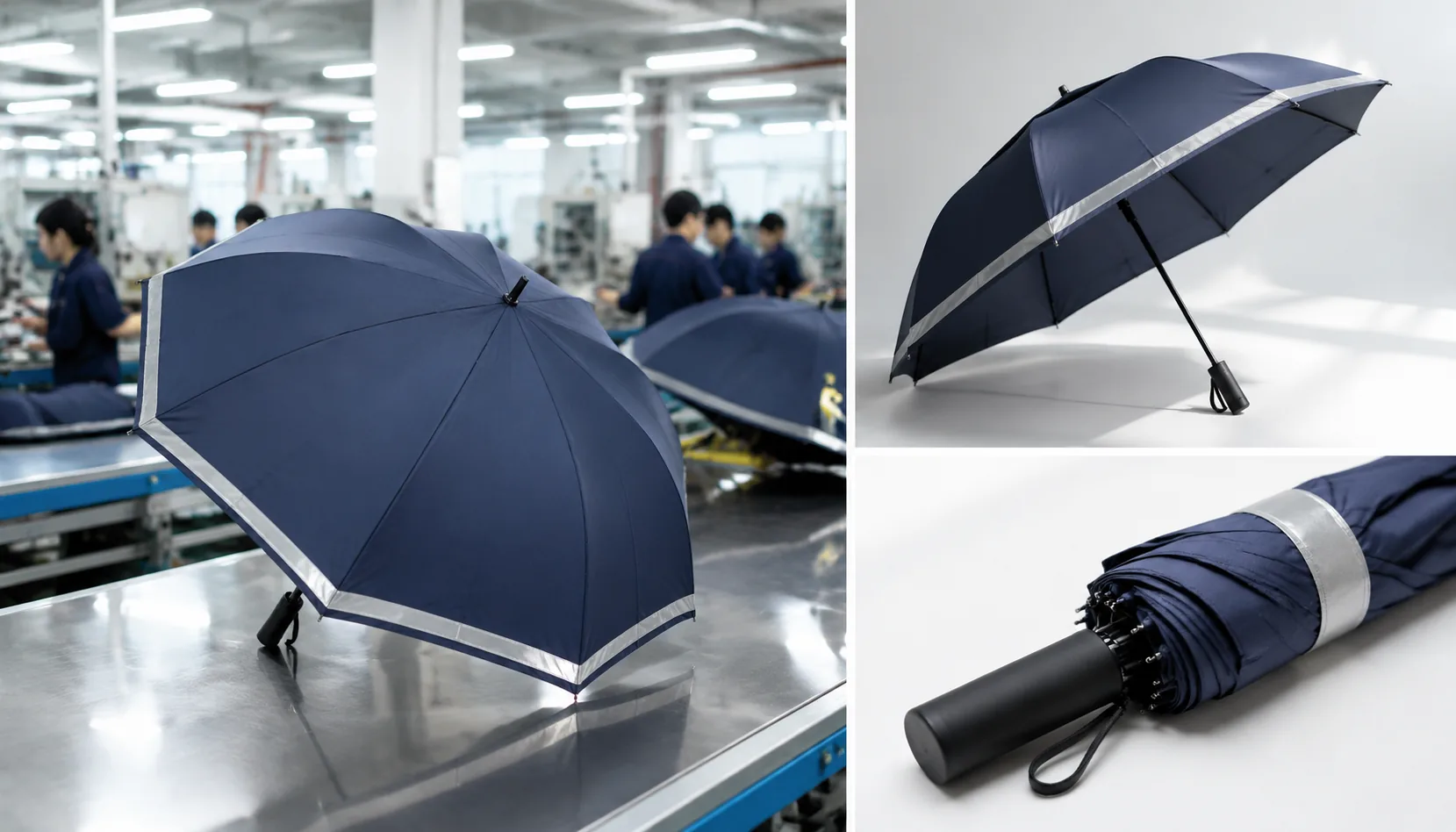
For commuter programs, a reflective umbrella has to do more than look bright in a sample room; it must stay visible after rain, folding, printing, and carton transit. As a reflective safety umbrellas supplier, we check tape adhesion, panel alignment, frame strength, print clearance, and AQL 2.5 results on the production line before discussing MOQ, FOB, or DDP delivery. The right spec prevents late rework, weak night visibility, and umbrellas that fail in the first storm.
Use Cases for Reflective Safety Umbrellas
Commuter retail is the most common buyer scenario because the umbrella has to work at the exact moment visibility is worst: rain on dark pavement, headlights reflecting off wet roads, and people crossing intersections at dusk. For retail programs, I usually recommend a 23" auto-open straight umbrella or a 21" auto-open-close folding model, both with 190T or 210T pongee and reflective piping on every panel seam. A reflective tape canopy is not decoration; it gives drivers a moving outline from multiple angles, especially when the user tilts the umbrella forward against wind. For a reflective umbrella OEM order, the important decision is whether the reflective material is stitched as edge binding, heat-transferred as a logo strip, or applied as segmented tape. Stitched tape lasts better through repeated wet-dry cycles, while heat transfer gives cleaner graphics for brand programs but needs peel testing after humidity exposure.
Campus safety, transport staff, parking attendants, warehouse gate teams, and security patrols need a tougher build than giveaway umbrellas. These users stand near buses, loading zones, bike lanes, and poorly lit entrances, so the umbrella gets opened and closed many times per shift. I would specify fiberglass ribs over painted steel for better flex recovery, an 8K or 10K frame for normal patrol use, and a double-canopy vent if the site has open courtyards or roadside wind. A windproof safety umbrella for staff programs should survive 50+ mph wind-tunnel testing without rib inversion becoming permanent damage. Reflective panels should be placed where they remain visible when the user carries a radio, clipboard, or backpack. For transit authorities and university buyers, color control also matters: fluorescent yellow, safety orange, and navy with silver reflective tape all read differently under LED streetlights and vehicle headlights.
Outdoor event planners buy commuter safety umbrellas for crowd movement, not just rain protection. Marathon volunteers, parking marshals, festival entrance teams, and emergency wayfinding staff need umbrellas that identify personnel from 30-50 meters away while keeping hands free enough to point, scan tickets, or manage queues. In these programs, a reflective safety umbrellas supplier should discuss handle choice, print placement, and carton planning early, because a 27" golf umbrella with EVA handle ships very differently from a compact 21" folding model for attendee kits. For large events, MOQ often starts around 500-1,000 units depending on fabric color and reflective trim, with 25-35 days for bulk production after sample approval. Our standard practice at ZheBrella is to run AQL 2.5 inspection on frame function, seam tension, reflective tape adhesion, print registration, and sleeve fit before FOB Ningbo or Shanghai shipment.
Canopy Layout: Reflective Tape, Panels, and Print Zones
Reflective performance is decided at the cutting table, not after the umbrella is sewn. For commuter safety umbrellas, the cleanest layout is reflective piping around all eight panel seams plus a 10–15 mm reflective edge band near the canopy perimeter. On a 23" auto-open stick umbrella, that gives visibility from the front, side, and rear without making the canopy look like a traffic cone. Panel strips are stronger visually than small badges: a 20 mm reflective tape canopy strip running from tip to runner direction catches headlights better than a short printed icon. For higher-end retail programs, we usually specify 210T pongee because the tighter weave holds the tape stitch line flatter; 190T pongee is still fine for promotional volume, but the sewing tension must be controlled or the reflective strip will ripple after water-repellent finishing.
Seam layout is where many reflective umbrella OEM projects fail. If the reflective strip crosses a panel seam at a bad angle, the tape edge lifts, the stitch line wanders, and the umbrella looks cheap under headlights. On 8K frames, strips can sit centered on alternating panels or directly over the seam as piping; on 10K and 16K rib counts, the narrower panels require tighter cutting tolerance, usually within ±2 mm, or the reflective pattern will not align when the canopy is stretched. For a windproof safety umbrella with fiberglass ribs and a double-canopy vent, keep the reflective band on the outer lower canopy, not across the vent opening, because airflow movement can fatigue the tape. Edge bands should stop cleanly before the strap position so the closure wrap does not abrade the reflective surface during packing and daily use.
Logo placement should protect the reflective area first and satisfy branding second. Put screen print, heat-transfer, or sublimation logos in the lower third of one or two panels, leaving at least 25–30 mm clearance from reflective piping and edge bands; otherwise the logo ink or transfer film can dull the reflective return. A reflective safety umbrellas supplier should provide a panel artwork template showing ribs, seams, strap, tips, and print-safe zones before sampling, especially for transit agencies, campus programs, and corporate commuter kits. For dark 190T or 210T pongee, silver reflective tape gives the strongest contrast, while black reflective tape looks cleaner in daylight but returns less visible light. In production QC, we check tape alignment before final inspection, then apply AQL 2.5 for stitching defects, skewed panels, open seams, and print contamination on reflective surfaces.
Frame Selection for Daily Commuter Durability
For higher-spec commuter programs, a 16K straight umbrella gives a noticeably rounder canopy and better load distribution than an 8K frame, but it also increases weight and packing volume. I like 16K fiberglass on 27 inch or 30 inch straight builds for municipal safety campaigns, airport staff, utility crews, and event marshals who need visibility plus coverage. If the brief calls for 50+ mph wind-tunnel survival, double-canopy venting matters as much as rib count: the upper vent lets pressure escape before the frame inverts, while the lower canopy keeps rain protection intact. A reflective tape canopy should be laid out so tape seams do not block vent airflow or overload one rib bay. Steel center shafts are still acceptable for stiffness, but aluminum shafts reduce weight on long carry days. When a buyer asks a reflective safety umbrellas supplier for premium commuter safety umbrellas, my recommendation is usually fiberglass ribs, vented double canopy, UPF 50+ or Teflon-coated 210T pongee, and a mechanism matched to real daily handling.
Performance and Quality Tests Buyers Should Request
Reflective performance is the first test I would put in the purchase order, because most failures show up after the umbrella is folded, strapped, and pushed into the sleeve, not when the fabric is lying flat on an inspection table. For commuter safety umbrellas, ask the factory to test the reflective tape canopy after sewing, after 24 hours of curing if heat-transfer film is used, and again after 20 folding-and-sleeve-packing cycles. The reflective trim should not crack, peel, wrinkle, or lose alignment at rib tips and panel seams. If you are working with a reflective safety umbrellas supplier, specify 3M-grade or equivalent reflective material when the program requires strong nighttime visibility, and require adhesion checks on both dry and wet pongee 190T/210T surfaces. I also recommend a dark-room visibility check at 30 to 50 meters using a vehicle-style light source, because a shiny silver strip is not automatically compliant reflective material.
Open-close durability is the second area buyers underestimate. A manual straight umbrella should pass at least 500 open-close cycles; auto-open models should pass 800 cycles; auto-open-close folding umbrellas should be tested to 1,000 cycles because spring fatigue and runner jams are common after mass assembly. For a windproof safety umbrella, rib flex checks must include frame balance, not just one dramatic bend on a sample rib. Fiberglass ribs should recover cleanly without whitening or splitting, while steel ribs should be checked for permanent deformation, loose rivets, and rust-prone scratches near the joints. For 8K and 10K commuter models, I like to see a 50+ mph wind-tunnel or fan-room inversion test, especially on double-canopy vented designs. A reflective umbrella OEM should document whether the test sample uses production ribs, shaft, runner, tips, and handle, not a strengthened showroom frame.
Water repellency and final inspection need to be written into the QC checklist, not discussed after goods are packed. Request a spray rating test on the canopy, plus a 30-minute rain simulation or continuous shower test to check seam leakage, coating consistency, and water pooling near reflective trim. Teflon-coated pongee should bead water cleanly after repeated folding; cheap coating often looks fine on day one but wets out quickly along creases. Final inspection should follow AQL 2.5 for major defects, with clear defect definitions for reflective tape peeling, misaligned panels, weak stitching, bent ribs, loose caps, handle scratches, and sleeve mismatch. Our standard practice at ZheBrella is to inspect packed umbrellas as the customer receives them: carton opened, sleeve removed, umbrella unfolded, opened three times, checked under light, then folded and packed again. That catches the real problems before FOB shipment, not after a distributor receives 5,000 units.
MOQ, Lead Time, and Import Cost Factors
Reflective tape is not just a trim line on a spec sheet; it changes the labor route and the reject risk. A normal 23" 8K pongee commuter umbrella can move from cutting to sewing with standard panel matching, but a reflective tape canopy needs extra positioning, heat pressing or stitch reinforcement, and visual alignment checks before final canopy closing. On 8-panel designs, a single reflective ring or edge band is manageable; on 10K or 16K layouts, every added seam increases handling time because the tape must stay straight across curved panels after tensioning on the frame. For commuter safety umbrellas, I usually tell buyers to budget a visible unit-cost increase when tape width goes from 10 mm to 20 mm, or when the design uses segmented reflective graphics instead of one continuous band. A reflective safety umbrellas supplier should also confirm whether the tape is sewn, heat-applied, or laminated, because each method affects peel resistance, night visibility, and AQL 2.5 inspection failure rates.
MOQ depends less on the umbrella size and more on how customized the reflective work is. A stock black 21" auto-open compact with one silver reflective tape canopy ring may start around 500–1,000 pcs, while a reflective umbrella OEM order with custom 190T or 210T pongee color, logo printing, and panel-by-panel tape placement is usually more realistic at 1,000–3,000 pcs. Samples typically take 7–12 days after artwork and tape position are approved; do not count from the day of inquiry, because reflective layouts need a dieline confirmation and sometimes a nighttime visibility photo before sampling is useful. Bulk production normally runs 35–50 days after deposit and pre-production sample approval. At ZheBrella, our standard practice is to lock the tape material, canopy fabric lot, rib specification, and handle color before opening bulk cutting, because changing any one of those midstream can delay sewing and final assembly by a week.
Import cost planning should be done backward from the event date, not forward from the purchase order date. FOB Ningbo or Shanghai works well when the buyer or distributor already controls the freight forwarder, import bond, customs entry, and last-mile delivery; it gives cleaner factory pricing but leaves ocean delays and destination charges on the buyer’s side. DDP is safer for city agencies, university programs, and corporate commuter campaigns that need cartons delivered to one warehouse before a launch date, but the quoted unit price must include duty, inland trucking, fuel adjustments, and any oversize carton impact from 27" or 30" windproof safety umbrella models. Reflective tape also affects packing because heat-pressed surfaces should not be crushed under excessive carton weight, especially in humid summer shipments. For a hard event deadline, approve samples at least 60–75 days before distribution for sea freight, or expect air freight to erase much of the savings from even a well-negotiated reflective safety umbrellas supplier quote.
Frequently Asked Questions
Does reflective tape limit umbrella logo printing?
It can, because tape needs clean panel space and strong stitching or heat bonding. Buyers should approve a panel map showing logo size, tape width, and seam positions before sampling.
Are reflective safety umbrellas available as folding umbrellas?
Yes, 3-fold auto-open or manual models are common for commuter programs. For better wind resistance, specify fiberglass ribs and test the folded canopy to ensure the reflective trim does not crack or peel.
What reflective tape width is commonly used for commuter safety umbrellas?
Most B2B orders use 1 cm to 2 cm reflective tape along canopy edges, ribs, or selected panels. Wider tape improves nighttime visibility but may limit logo placement and increase unit cost.
Can reflective umbrellas still pass windproof frame requirements?
Yes. A common specification is a fiberglass rib frame with a metal or fiberglass shaft, tested for repeated open-close cycles and moderate wind resistance; buyers should confirm test standards before mass production.
What MOQ and lead time should buyers expect for reflective umbrella OEM orders?
Typical MOQ starts around 500 to 1,000 pieces per design, depending on fabric, tape layout, and printing. Production usually takes 30 to 45 days after sample approval, with FOB Ningbo or Shanghai and DDP options available.
Looking to Launch Your Custom Umbrella Line?
ZheBrella is a Zhejiang-based OEM/ODM umbrella manufacturer with 17 years of export experience. Free design, low MOQ from 100 pieces, windproof construction, full-color print.
Get Free Quote Now »People Also Search For
Related Articles
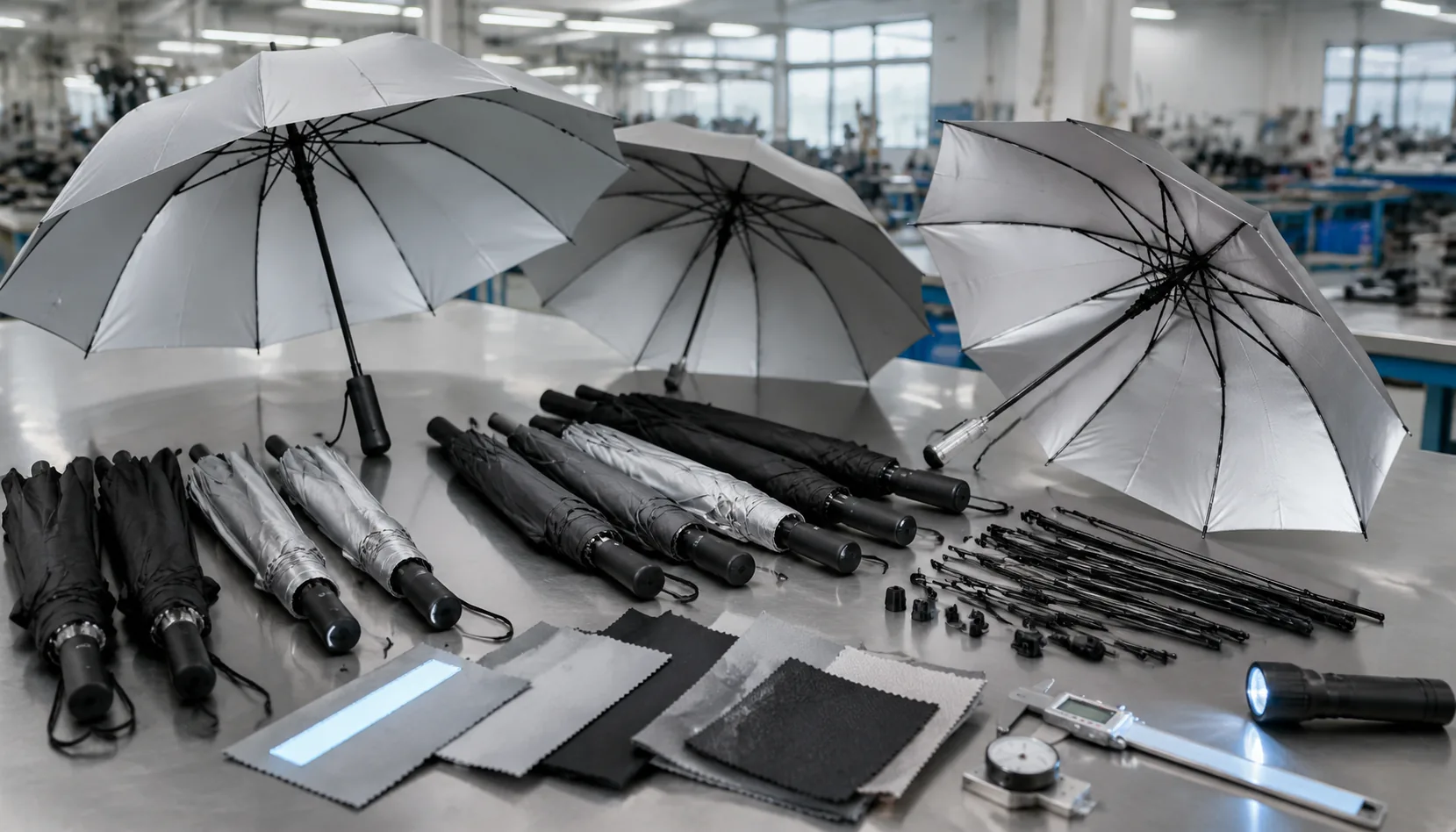
Reflective Umbrellas for Commuters: Buyer Spec Guide
Specify reflective commuter umbrellas with the right fabric, rib count, print placement, and QC checks for safer retail ...
Read More »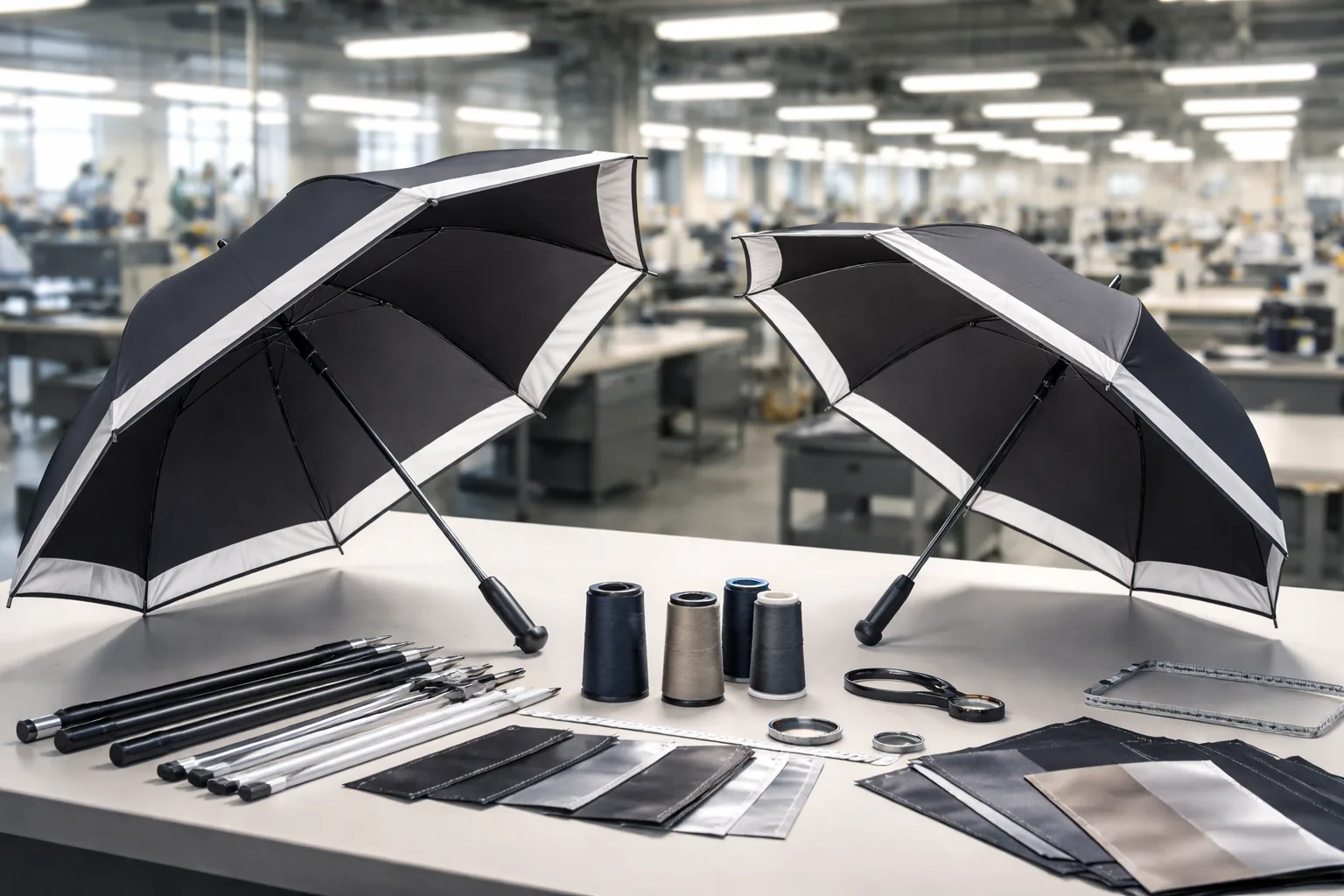
Reflective Safety Umbrellas: OEM Specs for Urban Programs
Specify reflective safety umbrellas with piping, panels, frames, and QC checks for commuter, campus, and corporate safet...
Read More »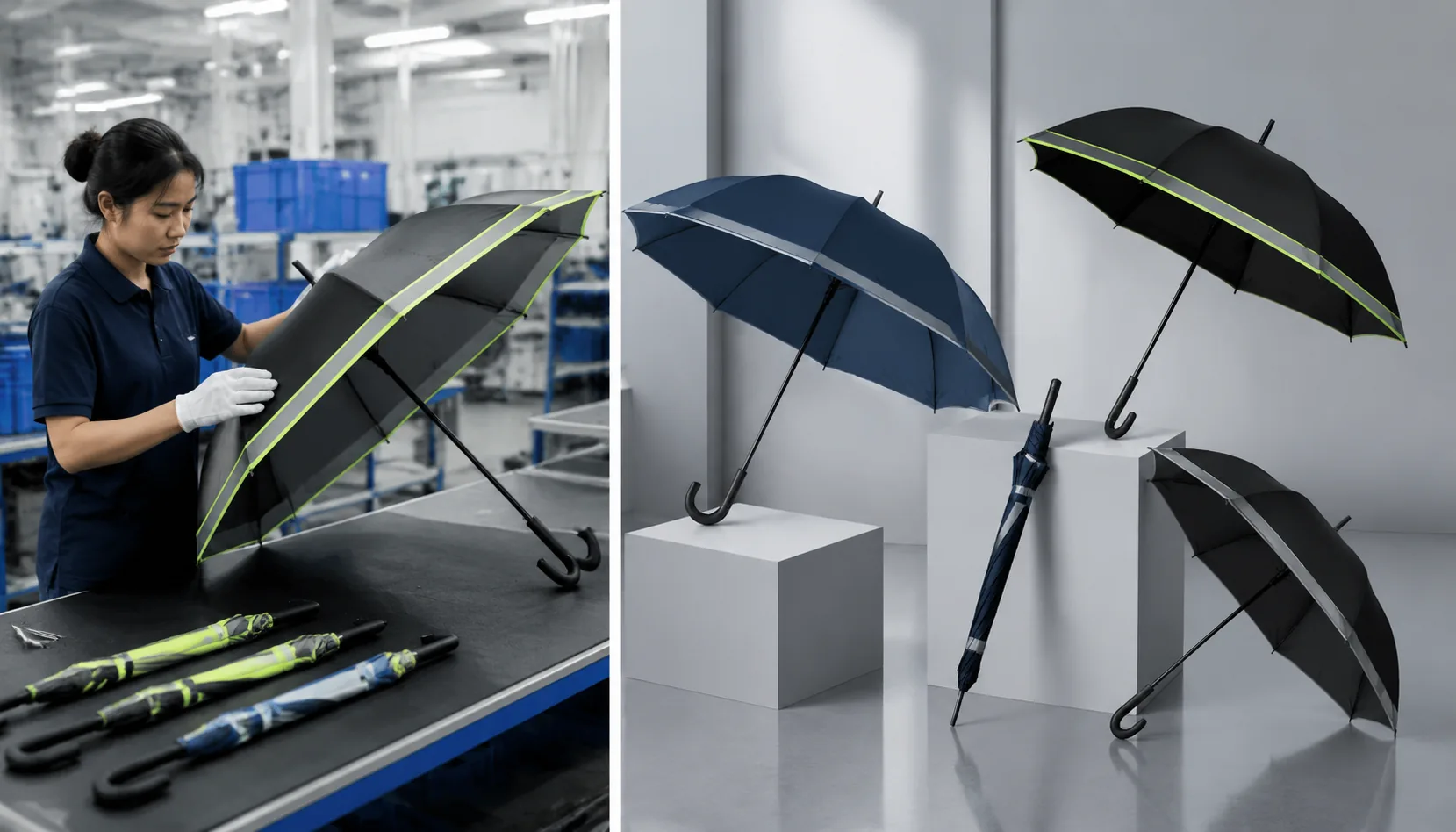
Reflective Commuter Umbrellas: OEM Safety Spec Guide
Specify reflective commuter umbrellas with 190T pongee, fiberglass ribs, safety trim, and QC points for retail or corpor...
Read More »