Reflective Safety Umbrellas: OEM Buyer Spec Guide
For OEM buyers, reflective safety umbrellas can look acceptable in a sample room but fail in real use if the tape cracks, the print hides under folds, or the frame twists after a few wet open-close cycles. On our Songxia production floor, the difference usually comes down to tape grade, pongee coating, rib gauge, panel layout, and QC checks that match the commuter, school, or event program instead of a generic umbrella spec.
Match Reflective Coverage to the Use Case
Reflective piping is the lowest-risk specification when the umbrella is mainly for commuting, because it follows the canopy edge and rib seams without stealing much brand space. On a 23" or 27" commuter umbrella, 10–15 mm silver reflective tape around the perimeter gives a moving outline under headlights, which is often more useful than one large logo that only faces one direction. For commuter umbrellas, I usually keep the main logo on one or two 190T or 210T pongee panels and use reflective edging as the safety feature; it protects the artwork from distortion at seam points and keeps MOQ costs controlled. Reflective umbrella printing on the sleeve can help retail presentation, but it does almost nothing once the user is walking in rain, because the sleeve is in a bag or pocket. Buyers in this category normally care about compact size, auto-open-close reliability, and a clean logo more than maximum reflectivity.
Panel strips are better for campus, factory, and staff-distribution programs where the buyer wants visibility from multiple angles but still needs clear identity. A 25–40 mm reflective strip placed vertically on alternating panels works well on 8K or 10K frames, especially with fiberglass ribs and a black or navy canopy for contrast. The trade-off is that strips cross the visual field of the canopy, so logo placement should shift to the opposite solid panels or to a single large panel below the strip line. For reflective safety umbrellas used by schools, security teams, parking attendants, and hospitals, I would avoid tiny sleeve-only branding and instead specify one heat-transfer logo plus reflective panel strips. Our standard practice at ZheBrella is to test strip adhesion after wet folding, because low-grade reflective tape can crease, peel, or leave pressure marks on pongee after 24–48 hours packed tight.
Full-panel reflective prints are the right choice for road races, traffic-control volunteers, night markets, and emergency-response giveaways, but they are not just a bigger version of normal printing. A full reflective panel changes hand feel, folding thickness, and cost, and it can reduce the soft drape buyers expect from retail umbrellas. On windproof safety umbrellas, I prefer a 27" or 30" double-canopy vented frame with fiberglass ribs, because event users stand in open streets where gusts can exceed 40–50 mph. Full-panel prints should leave seam allowances clean, and logos need simplified artwork because reflective ink and film do not reproduce fine gradients like sublimation. An OEM umbrella supplier should ask whether the buyer wants recognition at 20 feet, vehicle-headlight visibility at 100 feet, or maximum brand area in daylight; those are three different specifications, not one universal safety umbrella.
Choose Canopy Fabric and Coating Specs
Coating should be chosen around the use case, not copied from a generic spec sheet. For rain-first commuter umbrellas, a durable water-repellent face finish plus PU back coating is normally enough; for outdoor staff, school, security, or roadside programs, add UV coating with UPF 50+ so the same umbrella works in sun and rain. Color contrast matters as much as reflectivity: reflective tape on black, navy, charcoal, or deep red reads clearly at night, while silver on pale gray can disappear under weak headlights. If brand rules require low-contrast colors, widen the reflective area or use segmented reflective arcs on every other panel. An OEM umbrella supplier should also check seam placement because reflective strips sewn too close to panel edges can distort during rib tensioning. For AQL 2.5 inspection, I would include coating stains, reflective strip alignment, print cracking, and night-visibility checks under direct light as named criteria, not leave them to general appearance judgment.
Specify Frame Strength for Daily Commuting
Frame strength should be specified around the commuter’s real failure point: ribs twisting under side gusts, not just the canopy diameter. For standard commuter umbrellas, 8K construction is acceptable when the product is a 21" or 23" folding model carried in a bag, especially with fiberglass ribs and a steel or aluminum center shaft. But if the buyer wants reflective safety umbrellas for transit stations, night walking programs, or corporate safety kits, I push toward 10K or 16K ribs because the load is spread more evenly across the canopy. A 16K frame gives a rounder canopy profile and better resistance when wind hits between panels, but it adds cost, sewing time, and usually 40–90 g of weight depending on rib material. Steel ribs are cheap and stiff, but once bent they stay bent. Fiberglass ribs flex back better, resist rust, and perform better in repeated inversion tests, so they are the right choice for windproof safety umbrellas used daily.
Shaft choice depends on format. A 23" stick umbrella can use a 12 mm or 14 mm steel shaft for a firm retail feel, while a 27" or 30" safety model should move to fiberglass or reinforced steel depending on the target price. For folding umbrellas, the weak points are usually the telescopic shaft joints and runner, so I prefer a three-section chrome-plated steel shaft for economy models and a reinforced black metal or aluminum-fiberglass hybrid shaft when the buyer wants lighter carry weight. Auto-open-close mechanisms are convenient for city commuters getting in and out of cars or trains, but they place more shock on the runner and springs than manual-open designs. If reflective umbrella printing is applied around panel edges, keep the frame stable enough that the reflective strip does not distort under tension; uneven rib tension makes a safety umbrella look cheap even when the print itself is correct.
For exposed urban locations—bridges, open parking lots, campuses, ports, and event queues—a double-canopy vented windproof construction is worth the extra grams. The upper vent lets pressure escape instead of turning the umbrella inside out, and with fiberglass ribs we normally target survival around 50+ mph in controlled wind-tunnel checks for well-balanced 23" stick models. The trade-off is weight and packing volume: a single-canopy 8K folding umbrella may sit near 330–380 g, while a 16K double-canopy version can move past 500 g. That matters if the product is meant for daily subway carry. Our standard practice at ZheBrella is to confirm rib count, rib material, shaft diameter, runner type, and target wind rating before quoting, because an OEM umbrella supplier cannot fix an under-specified frame with better fabric alone. Frame, canopy, and reflective layout have to be engineered as one unit.
Confirm Print, Trim, and Mechanism Details
Lock the artwork method before you approve the frame, because reflective layouts change both sewing sequence and print registration. For basic logos on 190T or 210T pongee, screen print is still the cleanest choice for 1–3 solid colors, usually with a 0.3–0.5 mm trap tolerance on curved panels. Heat transfer works better for gradient logos, small text, and retail-style badge graphics, but the film must be tested for adhesion after folding, especially on Teflon-coated fabric. Reflective umbrella printing is different from ordinary silver ink: true reflective film or glass-bead transfer has a thicker hand feel, can crack if placed across a rib fold, and often needs a lower-temperature press window to avoid canopy distortion. For commuter umbrellas, I prefer keeping reflective elements near the outer panel edge or on two opposite gores, where headlights catch them without fighting the rib seams.
Reflective tape should be specified by width, color, stitch type, and placement, not just described as “safety trim.” Common tape widths are 10 mm, 15 mm, and 20 mm; the 15 mm tape is the best balance for 23 inch and 27 inch windproof safety umbrellas because it is visible but does not make the panel edge too stiff. Edge stitching should use polyester thread with consistent tension, otherwise puckering appears after the first rain test. If the design uses tape around all 8K panels, expect slower sewing output and a higher rejection rate under AQL 2.5 because misalignment becomes easy to see. Our standard practice at ZheBrella is to make a pre-production sample with the real reflective material, not a substitute trim, because reflectivity, folding memory, and seam bulk are impossible to judge from a digital mockup.
Confirm the mechanism package at the same time: manual, auto-open, or auto-open-close, plus shaft material, runner type, handle, wrist strap, and sleeve label. A 21 inch folding model with auto-open-close needs a stronger spring and better runner clearance than a manual promotional umbrella; adding reflective trim increases folded bulk, so the sleeve may need 5–8 mm extra width. Straight umbrellas in 23 inch or 27 inch sizes can use EVA, rubberized plastic, or wood-look handles, but safety programs often choose rubberized J handles or straight soft-touch grips for wet commuting. Reflective materials can affect MOQ and cost because tape and transfer film are not always stocked in every shade; custom reflective tape may push MOQ from 500 pieces to 1,000–3,000 pieces and add 3–7 days to sampling. For an OEM umbrella supplier, the real cost driver is not only material price but slower stitching, extra QC under light reflection, and more careful packing to avoid pressure marks.
Set QC, Packing, and Delivery Requirements
For reflective safety umbrellas, QC needs to test both umbrella function and the visibility system, because a perfect canopy with weak reflective tape is still a failed safety product. I would set final inspection at AQL 2.5 for major defects and AQL 4.0 for minor defects, with critical defects at zero tolerance. Major checkpoints should include 100% visual review of reflective panels or tape position, rib alignment after opening, runner smoothness, tip stitching, ferrule tightness, and handle assembly. For manual, auto-open, and auto-open-close commuter umbrellas, pull samples for open-close cycle checks: 200 cycles is a practical baseline for promotional orders, while retail-grade windproof safety umbrellas should be checked at 500 cycles or more. On 8K and 10K fiberglass frames, the ribs should sit evenly without twisting; on steel ribs, watch for burrs and poor riveting that can cut 190T or 210T pongee during repeated use.
Reflective umbrella printing needs its own test list before bulk approval, not just a photo of a sample under flash. For silver reflective tape, we check edge lift after rubbing and bending around canopy seams; for printed reflective ink, we run tape adhesion, dry/wet rub, and basic colorfastness checks so the logo does not smear onto hands or packaging. If the canopy uses black, navy, or fluorescent yellow pongee with Teflon or PU coating, confirm the reflective area still bonds correctly after coating, because some finishes reduce adhesion. Carton drop checks should be written into the spec: common practice is one corner, three edges, and six faces from 60–80 cm depending on carton weight. Inner polybags, hang tags, warning labels, and master carton marks should match the PO exactly, especially for chain-store receiving where one wrong barcode can hold the shipment.
Typical OEM lead time is 7–10 days for pre-production samples after artwork approval, 25–35 days for bulk production on standard 21 inch or 23 inch commuter umbrellas, and 35–50 days for custom molds, special reflective tape layouts, 27 inch golf sizes, or double-canopy vented frames. Add another 3–7 days if third-party inspection, lab testing, or carton rework is required before shipment. FOB Ningbo or Shanghai is usually best when the buyer already has a freight forwarder and wants control over consolidation, insurance, and sailing schedules. DDP pricing is useful for distributors, event planners, and smaller retailers who need landed cost certainty to a warehouse in the U.S. or EU, but the OEM umbrella supplier must confirm duties, HS code, Amazon or retail carton rules, and delivery address type before quoting. Our standard practice at ZheBrella is to lock QC criteria, packing method, and Incoterms before deposit, not after production starts.
Frequently Asked Questions
Can reflective material be printed over with a logo?
Usually the logo is placed beside the reflective strip or on non-reflective panels. Printing directly on reflective tape can reduce reflectivity and may require sample testing.
Are reflective umbrellas available in folding and stick styles?
Yes. Folding models work well for commuter giveaways, while straight stick umbrellas offer larger panels and better visibility for schools, security teams, and events.
What reflective detail is most durable for daily commuter umbrellas: tape or printed ink?
Reflective tape usually holds visibility longer under repeated folding and abrasion, while reflective ink is better for logos and large graphic zones. For commuter programs, many buyers combine 1-2 reflective tape panels with a small reflective print mark to balance durability, branding, and cost.
Which frame specification is a safer choice for school and transit-use safety umbrellas?
A fiberglass rib frame with a steel shaft is a common B2B spec because it improves wind resistance without pushing cost as high as full fiberglass assemblies. For school programs, buyers often request rounded tips, pinch-resistant runners, and a 21 to 23 inch canopy size for easier handling.
What QC points should be written into a purchase order for reflective safety umbrellas?
Include reflective placement tolerance, tape adhesion standard, canopy color matching, opening and closing function, rib symmetry, and carton drop condition. Buyers commonly also require AQL inspection terms, a salt-spray check on metal parts, and opening cycle tests before shipment.
Looking to Launch Your Custom Umbrella Line?
ZheBrella is a Zhejiang-based OEM/ODM umbrella manufacturer with 17 years of export experience. Free design, low MOQ from 100 pieces, windproof construction, full-color print.
Get Free Quote Now »People Also Search For
Related Articles
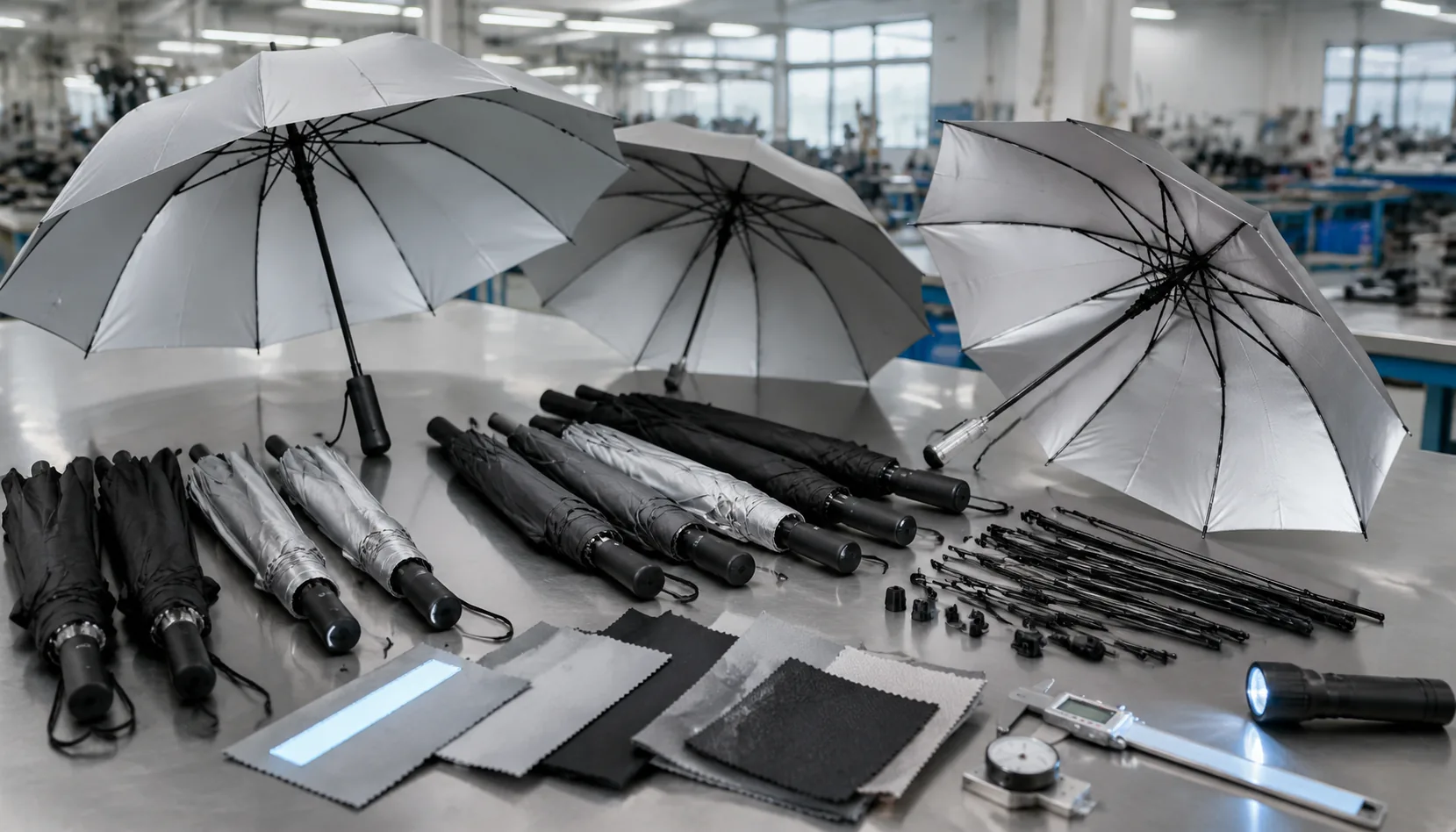
Reflective Umbrellas for Commuters: Buyer Spec Guide
Specify reflective commuter umbrellas with the right fabric, rib count, print placement, and QC checks for safer retail ...
Read More »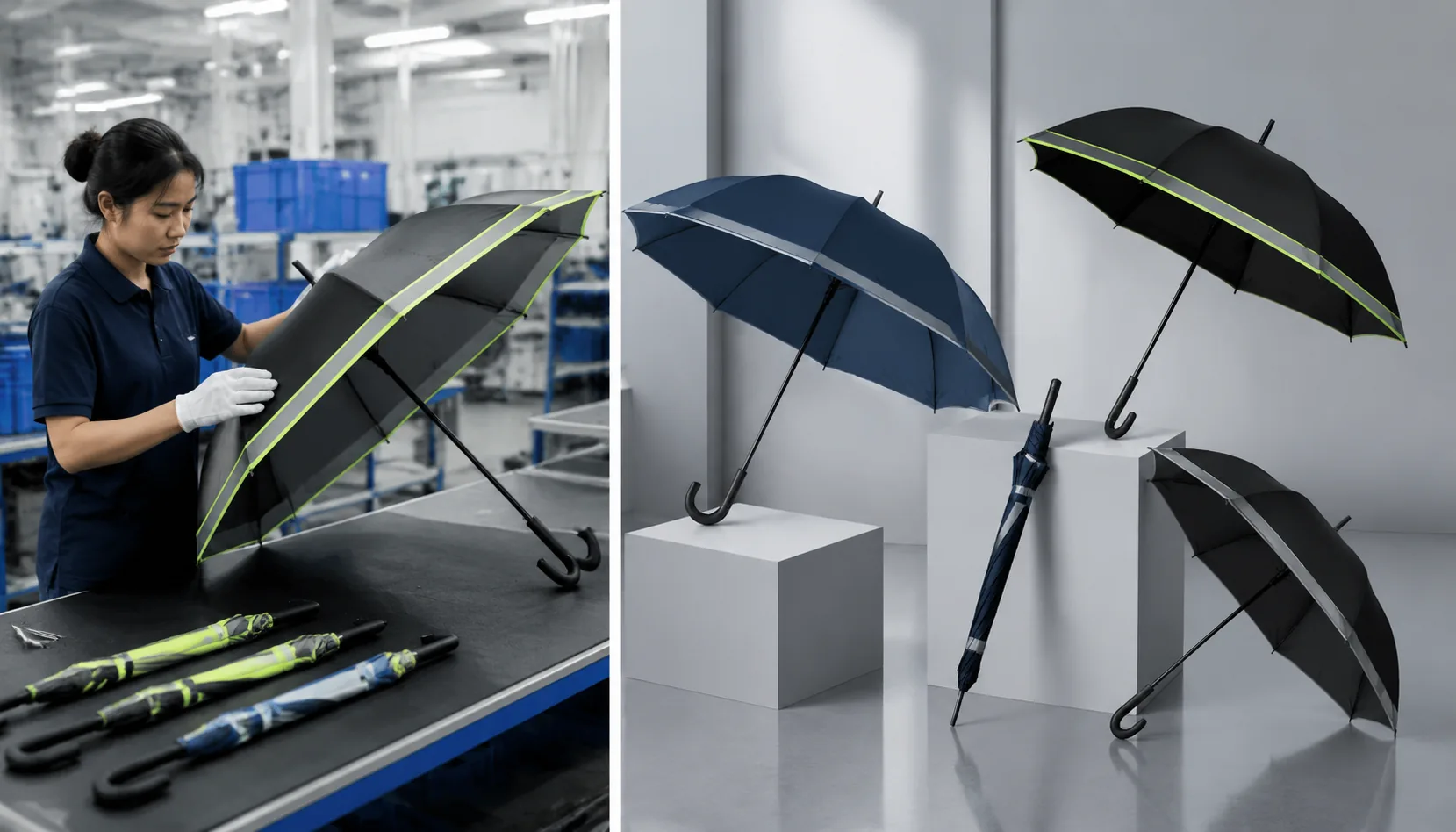
Reflective Commuter Umbrellas: OEM Safety Spec Guide
Specify reflective commuter umbrellas with 190T pongee, fiberglass ribs, safety trim, and QC points for retail or corpor...
Read More »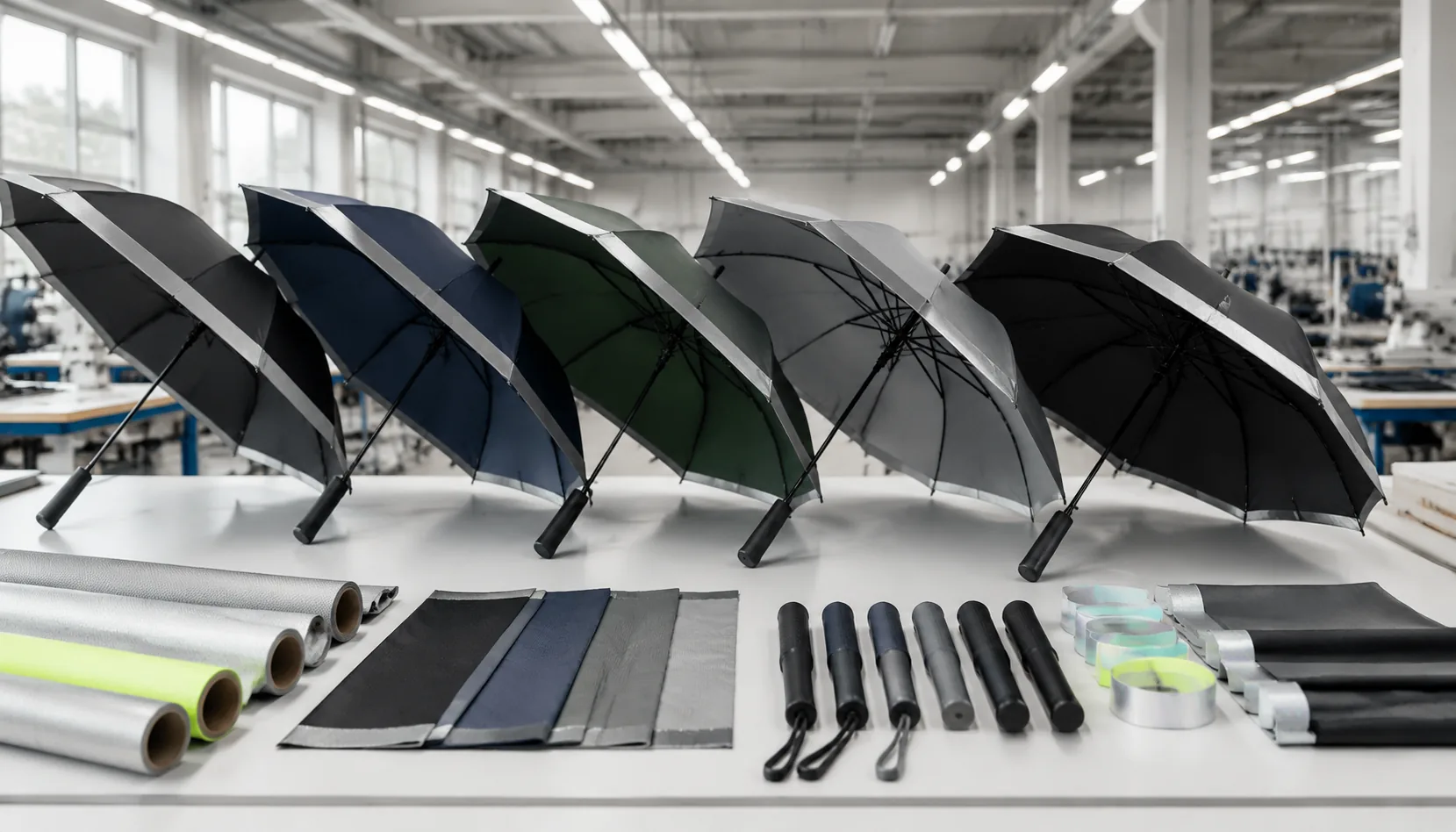
Reflective Safety Umbrellas: Spec Guide for Commuter Lines
Source reflective commuter umbrellas with the right tape, print layout, windproof frame, pongee canopy, AQL checks, MOQ,...
Read More »