Retail Commuter Umbrellas: Specs for Daily Rain Programs
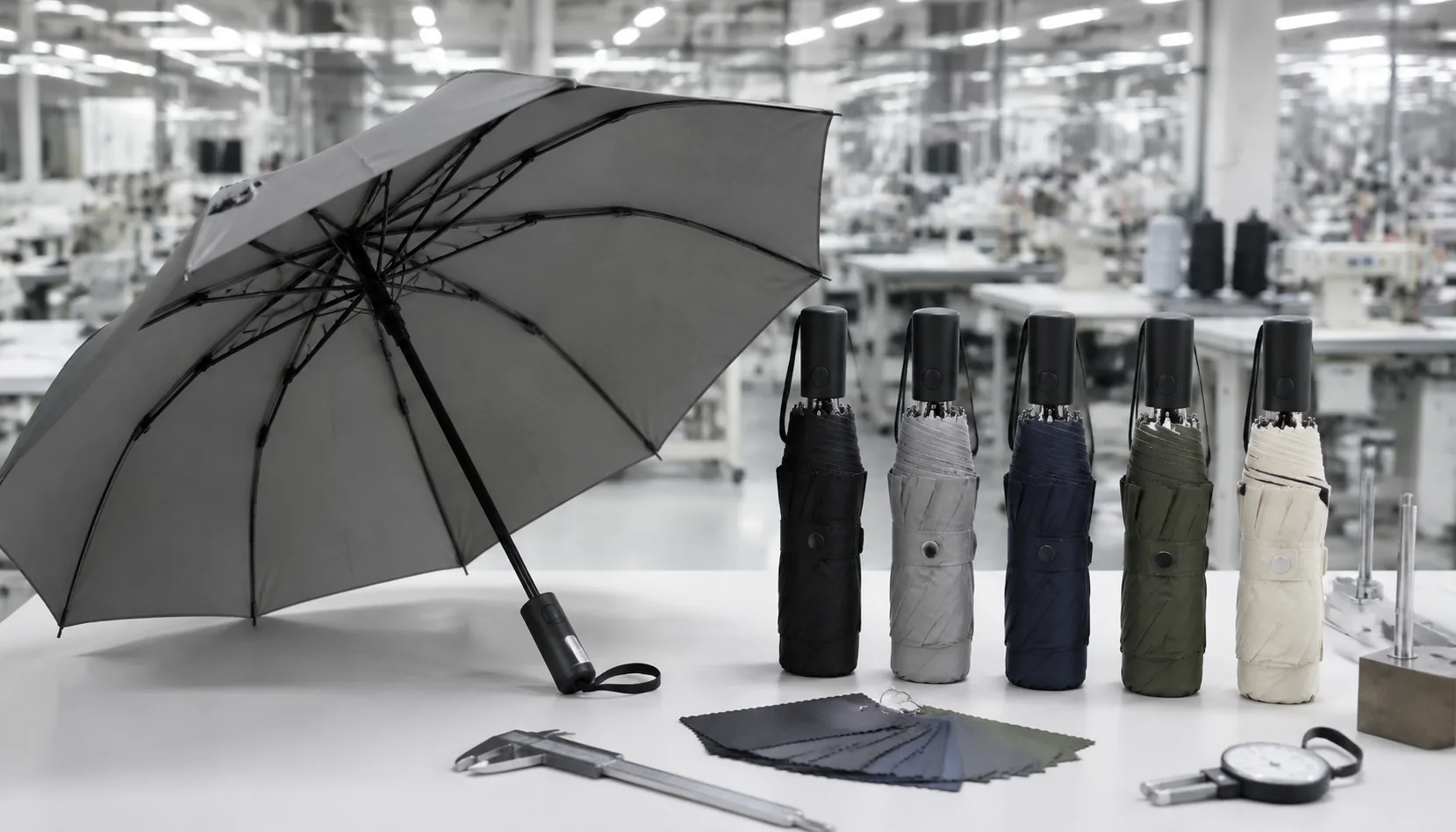
For retail rain programs, the hard part is not choosing a nice-looking umbrella; it is locking a spec that survives daily subway exits, wet office lobbies, and repeat store handling without pushing cost out of range. On our Songxia production floor, retail commuter umbrella specs usually come down to frame count, shaft action, canopy fabric, venting, and the QC points that catch weak ribs, loose tips, and inconsistent auto-open before cartons leave the line.
Start With the Commuter Use Case
The commuter buyer is not shopping like a golf umbrella customer; they are buying something that lives in a tote, backpack side pocket, desk drawer, or campus locker and gets opened half-awake at a subway exit. For city retail, the core user is usually carrying a phone, coffee, access card, or laptop bag, so folded length and one-hand operation matter as much as canopy diameter. A 21" or 23" 3-fold auto-open model is the safe center for most retail commuter umbrella specs: roughly 28-32 cm closed length, 95-102 cm arc, 190T or 210T pongee canopy, and a weight target around 320-420 g depending on shaft and rib material. Go lighter than that with thin steel ribs and the umbrella feels cheap after two weeks of daily rain; go much heavier and it stops being a bag umbrella.
For office and subway users, I usually push buyers away from tiny 5-fold capsules unless the program is built around handbags or travel retail. A compact 5-fold looks good on a planogram, but the short rib segments, smaller runner, and tighter canopy fold create more stress points, especially after wet storage. If the brief is 8K folding umbrella sourcing for daily use, an 8K fiberglass-and-steel hybrid frame is more realistic than all-steel at the same retail price because fiberglass outer ribs recover better when the user turns into wind at a crosswalk. Auto-open is the minimum for commuters; auto-open-close adds convenience but needs better spring, button, and shaft QC or returns climb quickly. For a daily use umbrella OEM project, we test repeated cycling, not just a single open-close sample on the showroom table.
Straight and compact stick umbrellas still have a place, but the buyer profile changes. A 23" straight umbrella with 8K or 10K ribs suits office lobby retail, hotel kiosks, and campus bookstores where users value coverage and durability over bag storage. A 27" stick is too large for most subway customers but works for outerwear retailers or wet-city programs where customers walk 15-25 minutes daily. Compact stick designs can look premium with a wooden or rubberized handle, but they need clear packaging dimensions because they do not disappear into a small backpack. As a commuter rain umbrella supplier, I would rather define the usage first, then choose frame and mechanism: 3-fold auto-open for mass city retail, auto-open-close for higher ASP programs, and straight 23" vented models where repeat daily use and wind exposure are more important than portability. That is the practical starting point for retail umbrella manufacturing, not just a catalog photo choice.
Choose a Frame That Survives Frequent Opening
Mechanism choice should follow the user scenario, not the catalog photo. Manual open is cheapest, lightest, and reliable for retail umbrella manufacturing when the buyer wants a 21" compact unit under tight FOB cost. Auto-open is the safest upgrade for commuters carrying coffee, a phone, or a briefcase; specify a smooth spring, ABS or rubberized handle, and a lock button that passes repeated press testing without sticking. Auto-open-close is convenient and sells well in department stores, but it needs better shaft tubes, stronger compression springs, and tighter AQL 2.5 inspection because the return rate climbs fast when the closing force feels rough. A serious daily use umbrella OEM project should define cycle life, not just style: I usually want 800–1,000 open-close cycles for retail commuter umbrella specs, plus a drop test on the handle and packed carton testing before FOB or DDP shipment. A commuter rain umbrella supplier that avoids these numbers is guessing.
Specify Canopy Fabric, Coating, and Coverage
For retail commuter umbrella specs, canopy fabric is the first cost-performance decision I would lock before arguing about handle shape or sleeve printing. 190T pongee is the normal value-retail choice because it gives a tight enough weave for clean water shedding, accepts screen or heat-transfer logos, and keeps the finished 21" or 23" folding umbrella in a price band that supermarkets and promo channels can repeat. For a smoother hand feel and slightly richer shelf presentation, 210T pongee is worth the upgrade, especially on auto-open or auto-open-close commuter SKUs where the customer expects less crinkle and better drape after repeated closing. In production, the difference is not just touch: 210T cuts cleaner, puckers less at panel seams, and usually gives more consistent color under batch inspection, provided the fabric is relaxed before cutting and the panels are not stacked too high.
Coating should match the actual use case, not just a catalog adjective. A standard water-repellent finish is fine for rain-only programs, but a black coating or certified UPF 50+ treatment makes sense for rain-and-sun commuter lines sold in warmer regions, campus bookstores, pharmacy chains, or travel retail. Black coating improves sun blocking but adds stiffness, so we check folding memory and seam stress carefully on compact 3-fold frames. Silver coating is cheaper but can look promotional and may show scratches after retail handling. Teflon-branded water repellency is an option for higher-tier retail umbrella manufacturing, but buyers should confirm whether the claim applies to finished fabric testing or only mill-side treatment. Our standard practice at ZheBrella is to review coating hand feel, hydrostatic performance, and colorfastness before bulk cutting because coating problems cannot be fixed after sewing.
Coverage is where many daily use umbrella OEM projects get underspecified. A 21" 8K folding umbrella usually opens around 95–98 cm in arc diameter and works for one person walking between train, office, and parking lot; it is the practical baseline for 8K folding umbrella sourcing. A 23" model opens closer to 102–106 cm and gives better shoulder and backpack coverage, but it needs stronger ribs, better runner tolerance, and a sleeve that still fits handbags or side pockets. For straight commuter rain umbrella supplier programs, 27" is common for golf-style retail, while 30" is oversized and less convenient for daily train use. If the SKU promises commuter reliability, I prefer fiberglass ribs or mixed fiberglass tips over all-steel ribs, plus AQL 2.5 inspection on seam leakage, panel alignment, and open-close cycling before FOB or DDP shipment.
Evaluate Windproof Features Without Overspecifying
Urban wind failures usually start at the canopy edge, not the handle, so evaluate windproof features from the top down. A double-canopy vent lets pressure escape when a gust hits between buildings or subway exits; it is useful on 23" and 27" commuter models where canopy area is large enough to catch side wind. For compact 21" folding umbrellas, the vent still helps, but it adds sewing steps, fabric overlap, and bulk in the sleeve. Flexible fiberglass tips or fiberglass outer ribs absorb the first bend better than painted steel, especially on 8K folding frames that get opened and closed several times a day. For retail commuter umbrella specs, I normally look for a clean rib recovery test after inversion, not just a dramatic wind-tunnel claim.
Shaft thickness matters, but bigger is not automatically better. A 3-section steel shaft around 10–12 mm at the lower tube is common for auto-open 21"/23" folding umbrellas; aluminum reduces weight but dents more easily if the umbrella is packed in a laptop bag. Full fiberglass shafts are excellent for golf sizes, but they can make a commuter piece too thick and expensive for a shelf price under mass retail targets. If you are doing 8K folding umbrella sourcing, ask the factory to show tube wall thickness, runner material, spring quality, and rivet setting, because a loose rivet will fail before a rib count advantage matters. A realistic urban target is survival in repeated 35–45 mph gusts, with premium programs tested above 50 mph.
Do not specify 16K ribs just because it sounds stronger. A 16K frame spreads load well and looks solid in store, but it adds weight, slows closing, increases packed diameter, and raises retail umbrella manufacturing cost through more ribs, more tips, more sewing alignment points, and higher AQL inspection time. For a daily use umbrella OEM program, an 8K or 10K frame with fiberglass outer ribs, reinforced rib joints, and a vented 190T or 210T pongee canopy is often the better balance. As a commuter rain umbrella supplier, ZheBrella would usually reserve 16K for premium stick umbrellas, executive gifts, or windy coastal markets, while keeping mainstream commuter SKUs lighter, faster to dry, and easier to merchandise. That is the practical way to write retail commuter umbrella specs without overspecifying the frame.
Build a Retail-Ready Inspection Plan
For a daily use umbrella OEM program, typical MOQ is 1,000 to 3,000 pieces per color for stock fabrics and 3,000 to 5,000 pieces for custom-dyed pongee, special handles, or private molds. Sample approval should include one construction sample, one print proof, and one sealed pre-production sample signed off for fabric shade, rib count, runner type, tips, sleeve, label, and carton marks. A realistic commuter rain umbrella supplier timeline is 7 to 10 days for sampling, 3 to 5 days for buyer comments, then 35 to 50 days for bulk production after deposit and artwork approval. At ZheBrella, our standard practice is to schedule inline inspection around 20% completion and final AQL inspection when 80% packed, leaving time to rework before FOB Ningbo or Shanghai delivery.
Frequently Asked Questions
Is 8K enough for a daily commuter umbrella?
For most retail commuter umbrellas, 8K is sufficient when paired with good rib material and clean assembly. Fiberglass ribs usually improve wind recovery more than simply increasing rib count.
Should commuter umbrellas use 190T or 210T pongee?
190T pongee fits price-sensitive retail and promotional programs. 210T pongee offers a smoother feel and more premium shelf perception, especially with water-repellent finishing.
What specs are most common for retail commuter umbrella programs?
A typical commuter umbrella uses a 21-23 inch 3-fold frame, 8K ribs, auto-open or auto-open-close shaft, 210T pongee canopy, fiberglass or steel-fiberglass ribs, and a matching sleeve. Retail buyers usually request barcode stickers, hang tags, and carton marks for shelf or online fulfillment.
What MOQ should importers expect for custom commuter umbrellas?
For standard colors with logo printing, MOQ is often 500-1,000 pieces per style. For custom canopy colors, special handles, or retail packaging, MOQ may increase to 2,000-3,000 pieces depending on material availability.
Which QC tests matter most for daily use folding umbrellas?
Key checks include open-close cycling, rib strength, shaft locking, water repellency, seam inspection, print adhesion, and carton drop testing. For commuter umbrellas, many buyers require 300-500 open-close cycles and AQL inspection before shipment.
Looking to Launch Your Custom Umbrella Line?
ZheBrella is a Zhejiang-based OEM/ODM umbrella manufacturer with 17 years of export experience. Free design, low MOQ from 100 pieces, windproof construction, full-color print.
Get Free Quote Now »People Also Search For
Related Articles
Hotel Loaner Umbrellas: Durable Specs for Guest Programs
Build hotel loaner umbrellas with durable ribs, 190T or 210T pongee, practical branding, MOQ planning, and QC specs for ...
Read More »
Wooden Handle Umbrellas: Specs for Premium Retail Programs
Source wooden handle umbrellas with the right shaft, ribs, pongee canopy, finish, branding, packaging, MOQ, and QC stand...
Read More »
Reflective Safety Umbrellas: Specs for Commuter Programs
Plan reflective umbrella orders with fabric, tape placement, windproof frames, print limits, AQL 2.5 checks, MOQ, and FO...
Read More »