Beyond China: Evaluating Vietnam and India for Umbrella Sourcing
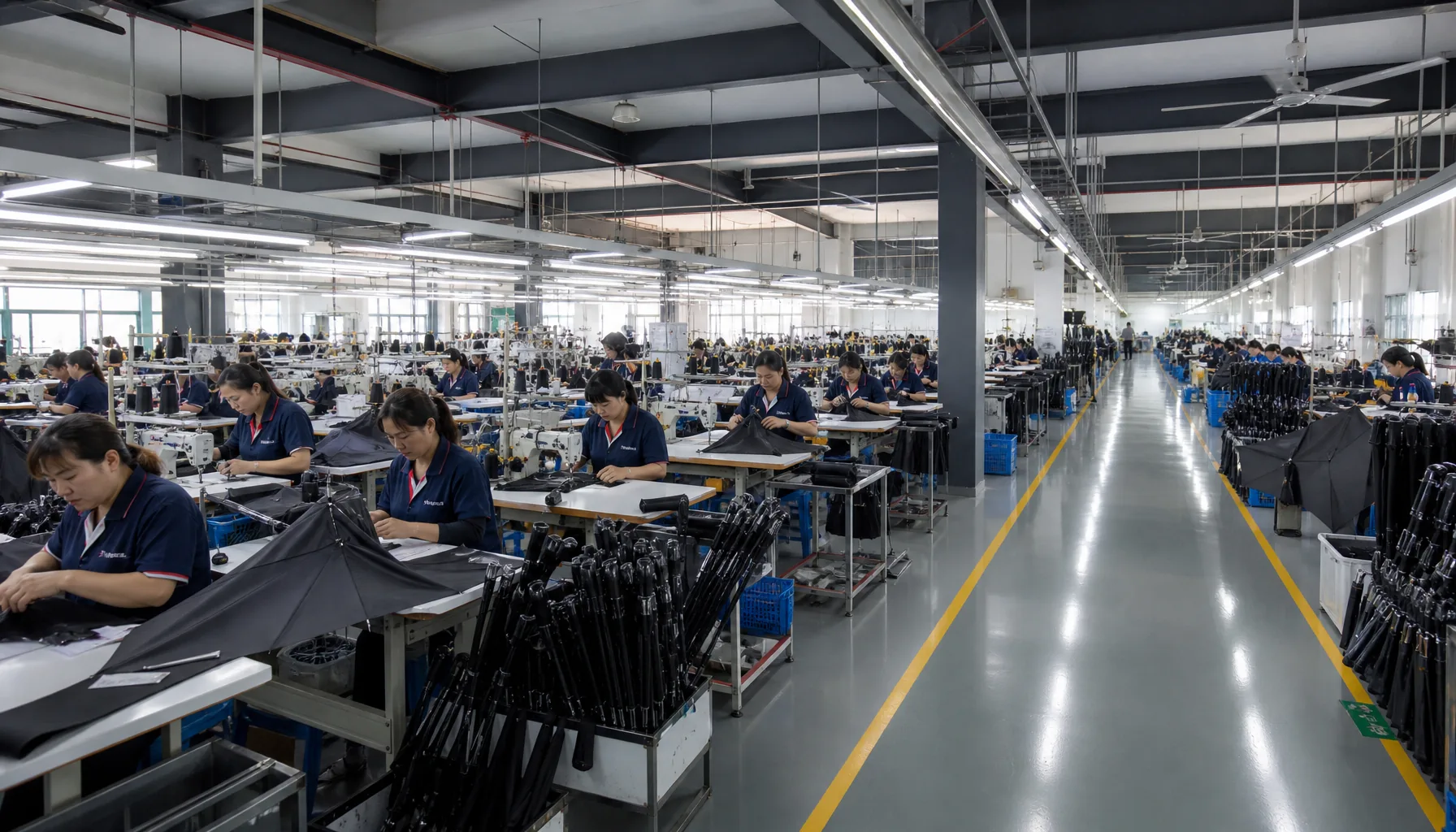
When buyers look beyond China, the first question is not where labor is cheapest, but whether the factory ecosystem can still make a stable umbrella at scale. For umbrella sourcing Vietnam, the answer depends on more than sewing capacity: ribs, frames, resin parts, fabric treatment, printing, and carton supply all have to line up, or the cost savings disappear in rework and delays. On the factory floor, those gaps show up fast in samples, lead times, and quality consistency.
Why buyers look beyond China
Buyers look at umbrella sourcing Vietnam or umbrella manufacturing India for one simple reason: China is still the best at making umbrellas at scale, but that concentration creates tariff and supply risk that procurement teams cannot ignore. When a brand is depending on one country for frames, canopy fabric, printing, and packing, any change in duty rates, customs treatment, or transport cost hits the landed price immediately. In umbrellas, where the product value is often modest and freight can be a big share of total cost, even a small tariff swing can erase margin fast. That is why China plus one umbrella planning has become standard language in sourcing meetings, especially for private label and promotional programs with fixed selling windows.
The other issue is concentration risk inside the manufacturing cluster itself. A lot of buyers assume they are diversified because they are using multiple factories, but if those factories all draw steel tubes, fiberglass ribs, pongee, and printing capacity from the same regional ecosystem, they still have a single-point failure problem. Typhoon disruption, labor tightening before peak season, resin shortages for POE canopies, or congestion at export ports can delay all of it at once. That is why alternative umbrella suppliers in Vietnam or India are not just about labor cost; they are about building a second production lane when one lane gets jammed.
From a production-floor view, umbrella supply diversification works only when the buyer understands the tradeoffs. Vietnam can be useful for certain assembly-heavy programs, while umbrella manufacturing India may fit domestic-regional distribution or labor-intensive lines, but neither market automatically replaces China on rib tooling depth, printing consistency, or the availability of 16K windproof structures and tight AQL control. The smart approach is to split risk by product family: keep complex, high-volume umbrellas in one base, and qualify a second source for simpler 21-inch or 23-inch programs. In practice, umbrella sourcing Vietnam becomes valuable not because it is cheaper in every case, but because it gives procurement a real backup when tariffs, lead times, or policy shifts move against a single-country model.
The reality of the umbrella supply cluster
If you are comparing umbrella sourcing Vietnam against China, the first reality is that the hard parts of the product are still concentrated in Zhejiang, especially in the Shaoxing-Shangyu-Songxia cluster. That is where you find the rib wire drawing, steel tube slitting, ferrule stamping, runner injection, stretcher forming, and the small fastener shops that keep 8K, 10K, 16K, and 24K frames moving. An umbrella is not just fabric and a handle; the frame is a stack of tolerances, and the cluster exists because every sub-supplier is within a few hours’ truck ride. When a runner cracks or a rib spring angle is wrong, we can walk the sample through three neighboring factories and get a corrected tool or fixture the same day. That kind of iteration is hard to copy in a greenfield plant.
Most buyers underestimate how much of umbrella manufacturing India or Vietnam would have to import before they can truly compete on frame quality. Fiberglass ribs, aluminum shafts, steel stretchers, galvanizing, powder coating, and the little locking components are all mature in Zhejiang because the local ecosystem has spent decades building for manual, auto-open, and auto-open-close mechanisms across 21-inch to 30-inch umbrellas. If you want a double-canopy vented windproof model that survives 50+ mph, the fabric spec matters, but the frame geometry matters more. The China plus one umbrella strategy only works if the second country can still source stable components, maintain AQL 2.5, and hold tolerances on open/close cycle life without constant rework. Otherwise you are just moving sewing labor while keeping the real dependency in China.
That is why umbrella supply diversification is slower than it looks on a spreadsheet. Vietnam has growing assembly capacity and India has useful textile and domestic manufacturing depth, but alternative umbrella suppliers still face a component gap: they can cut and stitch pongee 190T or 210T, POE, PVC, or EVA canopies, but they usually lack the dense tooling base for frames, runners, tips, and high-volume finishing. In practice, buyers end up splitting the bill of materials across countries, which adds MOQ friction, extra transit, and more QC points. Our standard practice is to treat the frame set as the critical path item and the canopy as the flexible item, because that is where lead times, FOB/DDP pricing, and defect risk diverge. If you do not secure the frame supply first, umbrella sourcing Vietnam becomes an assembly story, not a sourcing solution.
What Vietnam and India can do today
Vietnam can assemble umbrellas today, but mostly as a labor-and-line-assembly story, not a full upstream manufacturing story. In practice, umbrella sourcing Vietnam works best for basic stick umbrellas, simple folding models, and promotion-grade orders where the buyer can tolerate imported frames, runners, springs, tips, and fabric. The factories I’ve seen there are usually strong on stitching, final assembly, and carton packing, but weaker on rib tooling, frame spring temper control, and consistent vented double-canopy builds. If you need 8K or 10K automatic open-close folding umbrellas with fiberglass ribs, UV-coated 190T pongee, and tight AQL 2.5 standards, you will still be leaning on Chinese or Taiwanese component supply.
The bigger issue is import dependence. A lot of the real value — steel shaft drawing, fiberglass rib pultrusion, impact-resistant hub parts, push-button mechanisms, and coated canopy fabric finishing — still comes from China, sometimes via intermediaries. That means lead times can stretch, landed cost can swing with freight and duty changes, and the factory is not fully in control of quality at the component level. For buyers pursuing China plus one umbrella strategies, Vietnam helps reduce single-country risk, but it does not magically create a complete umbrella ecosystem. If your program needs custom molds, rapid steel-and-fiberglass iteration, or high-volume branded retail packaging, the hidden dependency is often still the Chinese parts chain.
Umbrella manufacturing India is in a similar position, with some differences. India has solid textile capability and a large labor pool, so sewing, screen printing, and local promotion work are straightforward, but the industry is still fragmented and capacity is uneven. You can find alternative umbrella suppliers for low- to mid-spec products, yet large runs of 23-inch or 27-inch auto-open umbrellas, windproof double-canopy styles, or color-consistent POE and EVA rain umbrellas are harder to execute at scale without frequent QA intervention. For umbrella supply diversification, India and Vietnam are useful second sources, but neither is a clean substitute for a mature Chinese cluster when you need fast tooling, stable component supply, and repeatable mass production over tens of thousands of pieces.
Cost, lead time, and quality tradeoffs
If you are comparing umbrella sourcing Vietnam with India, the first thing to understand is that landed cost is not just the factory quote. Vietnam usually prices a little above coastal China on basic promotional umbrellas once you include labor, imported fittings, and smaller-scale automation, but it can be competitive on simpler POE and polyester styles when the order is large enough to absorb setup time. India can look attractive on paper for manual or semi-automatic umbrellas, especially for domestic-market spec, yet the real cost often rises when you add fabric wastage, slower stitching output, and more sorting at inspection. For China plus one umbrella programs, the cheapest unit price is rarely the best outcome if the supplier cannot hold rib tolerances, handle color matching, or keep canopy panels consistent across repeat orders.
MOQ is where the gap becomes obvious. Many alternative umbrella suppliers in Vietnam will still push you toward container-level economics because small runs do not justify cutting, frame setup, and printing screens; 3,000 to 5,000 pieces is common for a practical starting point on a custom run, and some factories want more if the style uses fiberglass ribs or a vented double canopy. In India, MOQ can be lower for plain manual models, but once you ask for 8K or 10K rib counts, auto-open-close mechanisms, or UV-coated pongee 190T/210T, the quote usually comes with looser delivery promises and less stable QC. For umbrella supply diversification, the correct question is not only “what is the MOQ,” but “what is the MOQ at AQL 2.5 after color, panel alignment, and opening force are verified.”
Lead time is where Vietnam sometimes beats India, but neither is as predictable as a well-run coastal China plant with stocked tubing, ribs, and standard handles. For umbrella sourcing Vietnam, a straightforward 23-inch auto-open model might move in 35 to 50 days after sample approval, while India often needs 45 to 70 days, especially if the canopy requires custom dyeing or screen printing. The bigger issue is consistency across repeats: small batch factories can deliver acceptable first lots and then drift on ferrule fit, rib spring tension, or seam straightness on the second and third PO. If you are building a China plus one umbrella strategy, I would treat Vietnam as the stronger backup for simpler promo umbrellas and India as more useful for labor-heavy manual styles, but only if you have a tight spec sheet, pre-production sample signoff, and the patience to reject marginal lots instead of trying to sort quality at destination.
A pragmatic diversification path
The smart move is not an overnight switch from China; it is a staged dual-source plan. In umbrella sourcing Vietnam, I would qualify one backup factory first on a narrow spec: a basic 23" manual stick umbrella with 190T pongee, steel shaft, and fiberglass ribs, then compare it against the current China line on open rate, seam consistency, and panel tension. If the backup can hold AQL 2.5 on color, stitching, and tip finish for three consecutive production runs, then expand to auto-open or auto-open-close models, vented double-canopy builds, and printed promotional units. That sequence protects you from the common mistake of moving high-variation SKUs too early and losing control of cost and defect rate.
For most buyers, China plus one umbrella is the least painful structure because it keeps the incumbent tooling, trim suppliers, and printing capacity intact while building a second lane for risk. This is especially useful when you need seasonal coverage, tariff hedging, or a contingency for fabric, frame, or packaging delays. In practice, the second source should be asked to duplicate a stable article first: 21" compact, 8K fiberglass frame, POE canopy, or a straightforward 27" golf umbrella with a steel shaft and 190T pongee. That lets procurement compare FOB pricing, packaging damage, and lead time in days without pretending the two factories are identical. The goal is not perfect interchangeability on day one; it is predictable fallback capacity.
On umbrella manufacturing India, the biggest advantage is usually market proximity for certain regions and a workable domestic sourcing story, but the qualification burden is still real. Frame metallurgy, resin quality, and panel cutting discipline vary more than many buyers expect, so I would treat India and Vietnam as alternative umbrella suppliers for specific SKUs, not as a blanket replacement. Umbrella supply diversification works best when engineering locks the critical dimensions first: rib gauge, runner travel, canopy hem allowance, and coating type, whether that is Teflon, UV UPF 50+, or plain water-repellent finish. ZheBrella’s standard practice is to freeze the tech pack before any second-source trial, because once buyers start changing panel count, handle style, and print method at the same time, they no longer have a sourcing strategy—they have a troubleshooting project.
Frequently Asked Questions
Can I source umbrellas entirely outside China?
Partially today. Some assembly happens in Vietnam and India, but the umbrella component ecosystem — ribs, frames, runners, springs — is overwhelmingly concentrated in China's Zhejiang cluster. Many 'alternative origin' umbrellas still rely on Chinese components, which has origin and tariff implications you must verify.
Is 'China plus one' realistic for umbrellas?
Yes, as a risk hedge rather than a full exit. Most buyers qualify a secondary supplier for a portion of volume to reduce tariff and concentration risk, while accepting that deep component sourcing remains China-centric for now. Treat it as staged diversification, not an overnight switch.
Which umbrella components are hardest to source outside China?
The hardest items are usually the frame set, ribs, shaft hardware, and automatic open/close mechanisms. Vietnam and India can often handle final assembly and canopy sewing, but many programs still rely on Chinese component supply for consistency and cost.
What MOQ should a buyer expect from Vietnam or India umbrella factories?
For OEM programs, a practical starting point is often 3,000 to 5,000 pieces per style, color, or print, though some factories will go lower on simple models. More complex builds, special handles, or multi-color canopies usually push the MOQ higher.
How long does it take to move part of an umbrella order out of China?
If the factory already has the needed materials, sample approval to first bulk shipment can be around 45 to 60 days. If frames, fabric, or packaging must be sourced separately, plan for 60 to 90 days or more for the first production run.
Looking to Launch Your Custom Umbrella Line?
ZheBrella is a Zhejiang-based OEM/ODM umbrella manufacturer with 17 years of export experience. Free design, low MOQ from 100 pieces, windproof construction, full-color print.
Get Free Quote Now »People Also Search For
Related Articles
How to Compare Umbrella Suppliers on MOQ, Incoterms, and Risk
Use a practical buyer framework to compare umbrella suppliers on MOQ, quote structure, inspection standards, and shippin...
Read More »Building Backup Umbrella Suppliers to De-Risk Tariffs and Delays
How to qualify and maintain a second umbrella supplier without doubling overhead — when dual-sourcing pays off, how to s...
Read More »Tariff-Risk Hedging Through Multi-Country Umbrella Sourcing
How umbrella importers use multi-country sourcing, valuation strategy, and contract terms to hedge tariff volatility — w...
Read More »