Branded Travel Umbrellas for Airlines and DTC Kits

For airline amenity programs and DTC kits, the umbrella has to feel premium without creating headaches in carton weight, cabin storage, or returns. On our Songxia production floor, the difference between a smooth launch and a costly rework usually comes down to early choices: folded length, rib material, fabric coating, logo process, and how each unit is packed. Branded travel umbrellas look simple, but compact hardware leaves very little room for vague specifications.
Define the Travel Use Case First
The first mistake I see in branded travel umbrellas is choosing the smallest folded length before defining where the umbrella will sit in the customer journey. Airline amenity kits usually need a 21" or 23" arc, 3-fold manual or auto-open frame, under roughly 280–330 g, because every gram affects freight and onboard storage. For loyalty gifts, buyers can step up to a 23" or 25" auto-open-close with 8K fiberglass ribs, 190T pongee, and a nicer rubberized handle because perceived value matters more than shaving 30 g. DTC kits are different again: the umbrella has to survive unboxing photos, returns, and daily carry, so I would rather spec a clean 23" 3-fold with 210T pongee, Teflon water-repellent finish, and a sleeve that prints well than chase a novelty pocket size that feels fragile after ten cycles.
Ultra-small 5-fold umbrellas look attractive on a spreadsheet because the folded length can drop to about 6.5–7.5 inches, but they are not automatically better for compact umbrella OEM projects. The shorter shaft sections create more joints, more wobble, and usually a smaller canopy, often around 19"–21", which is fine for a handbag but weak as an airline loyalty item or hotel retail add-on. A 3-fold lightweight folding umbrella at 10–12 inches folded is easier to open, easier to repair in production, and more stable in wind because the shaft overlap is longer and the rib geometry is less compromised. If the client wants airline promotional umbrellas that feel useful after landing in Singapore rain or Seattle drizzle, I usually push them toward a 23" 8K 3-fold with fiberglass-reinforced ribs rather than a 5-fold that only wins on carton dimensions.
Perceived value changes by channel, so the specification should change too. A hotel retail add-on can tolerate 350–420 g if the handle, sleeve, and canopy print make it feel like a $15–25 lobby purchase; a DTC bundle often needs a cleaner custom travel umbrella with matte hardware, barcode-ready packaging, and lower defect exposure under AQL 2.5 because returns are expensive. Airlines often care more about cube, duty, and delivery windows: a 23" 3-fold in 190T pongee packs efficiently, supports one- or two-color logo printing, and can ship FOB Ningbo or Shanghai with realistic production lead times of 25–35 days after artwork approval. Our standard practice at ZheBrella is to lock the use case, target weight, folded length, and opening mechanism before quoting MOQ, because changing from manual to auto-open-close later affects frame cost, carton weight, and drop-test performance.
Balance Compact Size With Frame Strength
The hard part with branded travel umbrellas is not making them small; it is keeping the frame honest after you shrink the shaft, runner, and rib geometry. For airline amenity kits and DTC unboxing sets, the common sweet spot is a 21" or 23" three-fold frame, usually 8K, with an aluminum center shaft to cut weight and steel or fiberglass-reinforced ribs where the load actually bends. Full steel frames feel solid and keep cost down, but a 21" steel 8K umbrella can jump from about 230–260 g to 300 g or more once you add a 190T pongee canopy and molded handle. Aluminum saves weight, but cheap thin-wall aluminum ribs deform after one bad gust. My preference for compact umbrella OEM work is aluminum shaft, steel stretcher, and fiberglass end ribs, because the umbrella flexes instead of taking a permanent set.
Rib count is where buyers often over-spec on paper and underperform in real use. An 8K travel frame is lighter, packs slimmer, and fits better in airline promotional umbrellas where the sleeve must slide into a seatback pouch or gift box. A 10K frame spreads canopy tension more evenly and feels more premium in hand, especially on a 23" custom travel umbrella, but it adds metal joints, sewing points, and roughly 20–40 g depending on rib material. That weight matters when a kit already includes slippers, cosmetics, cables, and printed packaging. For normal city travel, a properly built 8K fiberglass-assisted frame can survive 35–45 mph gusts in field use; a stronger 10K build may handle 45–50+ mph, but only if the runner, rivets, and rib tips are not downgraded to hit a low FOB target.
Double-canopy windproof designs are useful, but they are often the wrong answer for a lightweight folding umbrella in a travel kit. A vented double canopy needs extra fabric layers, more sewing operations, larger binding, and a deeper folded profile; even on a 21" frame, the packed diameter can become too bulky for slim DTC cartons or airline amenity pouches. It also complicates logo placement because the upper vent panel can distort screen printing if tension is uneven. Our standard practice at ZheBrella is to reserve double-canopy construction for 23" and larger retail travel umbrellas where wind resistance is a selling point, not for ultra-compact kit inserts. For branded travel umbrellas that must stay portable, a single 190T or 210T pongee canopy with Teflon water repellency, fiberglass tips, and a tested auto-open or manual runner usually gives the best balance of size, strength, and repeatable AQL 2.5 quality.
Select Fabric, Coating, and Print Placement
For branded travel umbrellas, fabric choice should start with pack size and hand feel, not just a quoted denier. 190T pongee is the normal workhorse for a lightweight folding umbrella because it closes smaller, dries reasonably fast with a DWR finish, and keeps the finished weight down on 21" and 23" three-fold frames. 210T pongee has a tighter weave and a slightly richer touch, so it suits airline business-class amenity kits, DTC welcome kits, and retail travel sets where the buyer will notice stiffness, drape, and opacity. In production, I would not put 210T on a weak steel 6K frame just to sound premium; pair it with fiberglass ribs, a stable runner, and preferably an auto-open-close mechanism if the target user is a frequent traveler. For colorfastness, specify ISO 105 washing/rubbing targets or at least require wet rub Grade 3-4 and dry rub Grade 4+, especially for navy, black, red, and saturated airline brand colors.
Coating is where many compact umbrella OEM projects get under-specified. A basic DWR treatment is enough for short urban rain exposure, but it should bead water cleanly after folding and not leave the canopy feeling waxy. For sun-and-rain travel markets, add black UV coating or silver UV coating to reach UPF 50+, but understand the tradeoff: black UV coating improves shade and blocks light better, while silver coating can look more technical and may show creasing if the umbrella is packed tightly in a sleeve. Our standard practice at ZheBrella is to test coated panels before sewing, then check finished canopy leakage and coating scratches during AQL 2.5 inspection. If the umbrella will sit inside an airline kit for months, ask for low-odor coating and carton ventilation time, because fresh DWR or UV-coated pongee packed too quickly can smell chemical when opened by passengers.
Print placement should match the brand promise. Large multi-panel printing looks loud on a travel umbrella and often fights the clean look airlines and DTC luggage brands want. A small-panel logo, usually one-color screen print or heat transfer on one canopy gore, is safer and cheaper, with better alignment control on 8K folding frames. Sleeve branding gives more visible shelf and kit presentation without making the open umbrella look like an event giveaway; it is also easier to color-match and inspect because the sleeve is flat before sewing. For premium custom travel umbrella programs, I like subtle woven labels on the sleeve seam, handle strap, or canopy edge, paired with a tonal logo on the canopy. Airline promotional umbrellas can still carry strong branding, but keep ink coverage modest so the pongee folds cleanly and the logo does not crack along repeated crease lines after 500 open-close cycles.
Specify Mechanism, Handle, and User Experience
Mechanism choice decides whether branded travel umbrellas feel like a useful airline amenity or a cheap giveaway. Manual open is the safest and lightest option for DTC kits, usually keeping a 21" or 23" folding umbrella around 240–300 g with an aluminum/steel shaft and 6K or 8K ribs. Auto-open adds convenience for passengers stepping out of a terminal with luggage, but the spring housing must be controlled; I reject samples where the runner snaps too hard or the canopy hesitates halfway. Auto-open-close is best for premium airline promotional umbrellas, especially when paired with fiberglass ribs, but it adds weight, cost, and more failure points. For production, cycle testing should be written into the spec: 500 cycles for budget manual, 1,000 cycles for standard auto-open, and 1,500+ cycles for auto-open-close before bulk approval.
Pinch-point checks are not paperwork; they prevent complaints from real users. The runner, top cap, push button, and telescopic shaft joints should be tested with wet hands and one-handed operation, not only on a dry inspection table. A good compact umbrella OEM will check button rebound, shaft lock engagement, and runner clearance after repeated open-close cycles because small burrs on plated steel tubes can scrape fingers or jam the mechanism. For branded travel umbrellas going into airline seat-back packs, loyalty gifts, or DTC emergency kits, I prefer a slightly slower but controlled spring over an aggressive pop-open action. Our standard practice at ZheBrella is to include mechanism function under AQL 2.5 inspection, with critical defects assigned to non-locking shafts, exposed sharp edges, cracked buttons, and canopies that invert under normal shake testing.
Handle and storage details matter more than buyers expect because travel umbrellas are handled in tight spaces: jet bridges, rideshares, hotel lobbies, and overhead bins. A matte ABS or rubberized TPR handle gives better grip than glossy plastic, especially on a lightweight folding umbrella with a small 3-fold frame. Wrist straps should be bar-tacked or looped through a reinforced handle hole, not glued into the end cap. Sleeve fit also needs a realistic tolerance; if the sleeve is cut too tight, users will abandon it after the first rain. For a custom travel umbrella with 190T or 210T pongee and Teflon coating, the sleeve should allow insertion after a 20-second shake-off, while mesh inserts or a looser mouth improve drying. PVC or POE clear sleeves look retail-friendly but trap moisture, so I only recommend them when the canopy has strong water repellency and the packing instructions require drying before storage.
Plan MOQ, Sampling, and Delivery Windows
MOQ planning for branded travel umbrellas should start with the parts that actually lock the factory: canopy cloth color, frame finish, handle mold, and printed panel count. For a standard 21" or 23" lightweight folding umbrella using black fiberglass-and-steel mixed ribs, black shaft, and stock 190T pongee, MOQ can stay around 500–1,000 pcs per logo. Once the buyer asks for a custom-dyed canopy, color-matched plastic handle, or plated shaft, the MOQ usually moves to 3,000 pcs because dyeing, injection setup, and trim matching need full-batch economics. For airline promotional umbrellas, I push buyers to confirm packed size and weight early: a 21" 3-fold auto-open-close model may look premium, but a manual 5-fold compact umbrella OEM design can save carton volume and freight on cabin amenity kits or DTC bundles.
Sampling should not be treated as a photo approval. A proper custom travel umbrella sample needs the exact panel fabric, logo method, rib count, opening mechanism, sleeve, care label, barcode sticker, and carton mark before bulk production starts. Printed panels add time because screen printing, heat transfer, and sublimation each have different setup risks: screen print is fast for one- or two-color airline logos, heat transfer handles gradients better, and sublimation works best on white or light 190T/210T pongee. Our standard practice at ZheBrella is 5–7 days for a plain pre-production sample, 7–10 days for printed panels, and another 2–3 days if the client changes Pantone shade or logo placement. Bulk should not start until the buyer signs the physical sample or a detailed video approval with measurements.
Delivery windows need to be built backward from the launch date, not guessed after the PO. For most branded travel umbrellas, allow 25–35 days bulk production after sample approval for stock colors, and 35–50 days for custom-dyed fabric, molded handles, or multiple printed panels. Final inspection should use AQL 2.5 for major defects, checking open-close function, rib alignment, canopy tension, logo registration, sleeve fit, carton drop damage, and water repellency after a spray test. FOB Ningbo or Shanghai is cleaner for buyers controlling their own consolidations, while DDP works better for DTC campaign drops where the umbrella must land at a 3PL before a fixed email launch. Airlines should add buffer for security review, onboard packaging rules, and terminal delivery appointments; missing a flight-service launch by five days is worse than paying for a slightly earlier production slot.
Frequently Asked Questions
What size works best for a branded travel umbrella?
Most travel programs choose a 3-fold umbrella because it balances compact length, usable canopy coverage, and frame durability. A 5-fold model saves space but can feel less sturdy in wind.
Are auto-open-close umbrellas suitable for airline gifts?
They can be suitable when the budget allows stronger springs and cycle testing. For very tight weight or cost targets, a manual compact umbrella may reduce failure risk and simplify inspection.
What folded size works best for airline or DTC travel kits?
Most airline and DTC kits use 5-fold or mini 6-rib umbrellas with a folded length of about 15–18 cm so they fit inside amenity pouches, seatback gift packs, or e-commerce mailer boxes. For a stronger retail feel, a 3-fold umbrella around 21–25 cm is more durable but takes more packing space.
Which print method is best for small logos on compact travel umbrellas?
Silk screen printing is the most common for one- or two-color airline logos on polyester pongee fabric. Heat transfer or digital printing is better for gradients, full-color DTC branding, or small artwork that needs sharper detail.
What MOQ and lead time should buyers expect for branded travel umbrellas?
A typical OEM order starts around 500–1,000 pieces per color for standard compact models, with sampling taking 5–10 days. Bulk production usually takes 25–40 days after artwork, fabric color, and packaging are approved.
Looking to Launch Your Custom Umbrella Line?
ZheBrella is a Zhejiang-based OEM/ODM umbrella manufacturer with 17 years of export experience. Free design, low MOQ from 100 pieces, windproof construction, full-color print.
Get Free Quote Now »People Also Search For
Related Articles
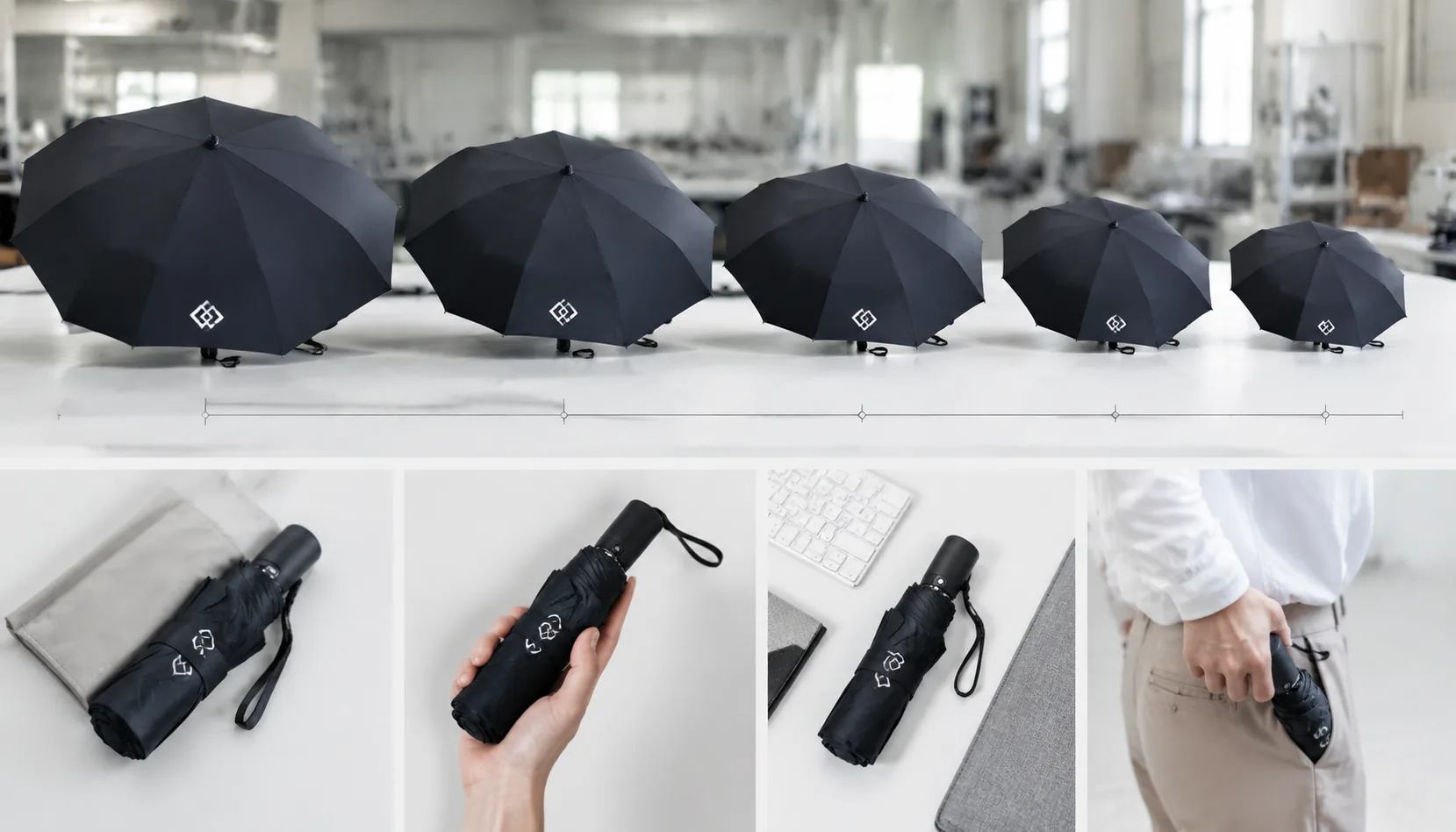
Logo Scale Rules for Compact Folding Promotional Umbrellas
Set practical logo sizes for 3-fold and 5-fold umbrellas, balancing panel width, auto-open frames, rib layout, MOQ, and ...
Read More »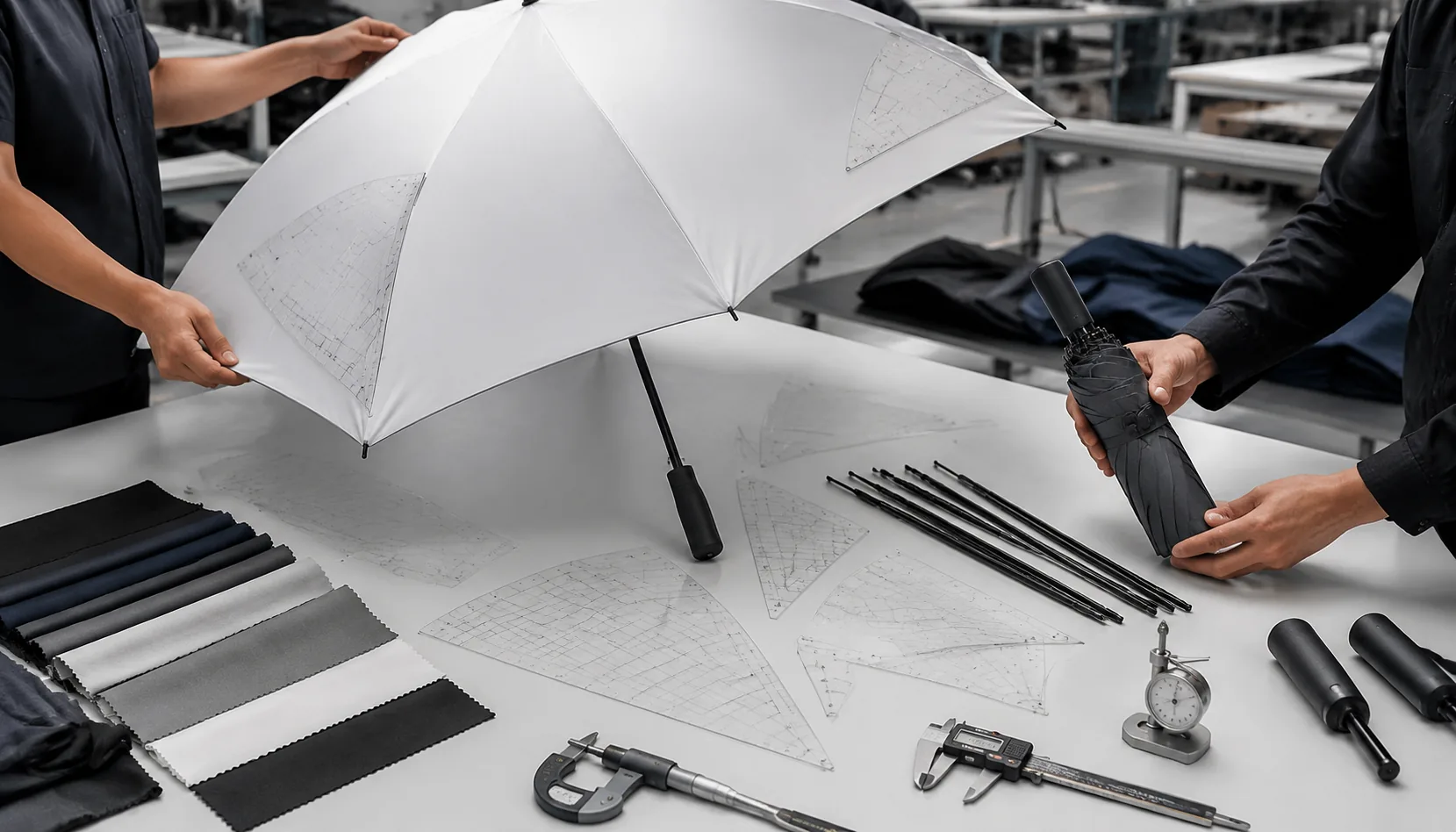
Logo Scaling on Folding and Golf Umbrellas for Brand Teams
Set practical logo sizes across folding, stick, and golf umbrellas while accounting for ribs, panels, print methods, mec...
Read More »
Mini Capsule Umbrellas for Promo Kits: Buyer Spec Guide
Learn how to specify mini capsule umbrellas for promo kits, from 5-fold frames and pongee fabric to printing, MOQ, lead ...
Read More »