Logo Scaling on Folding and Golf Umbrellas for Brand Teams
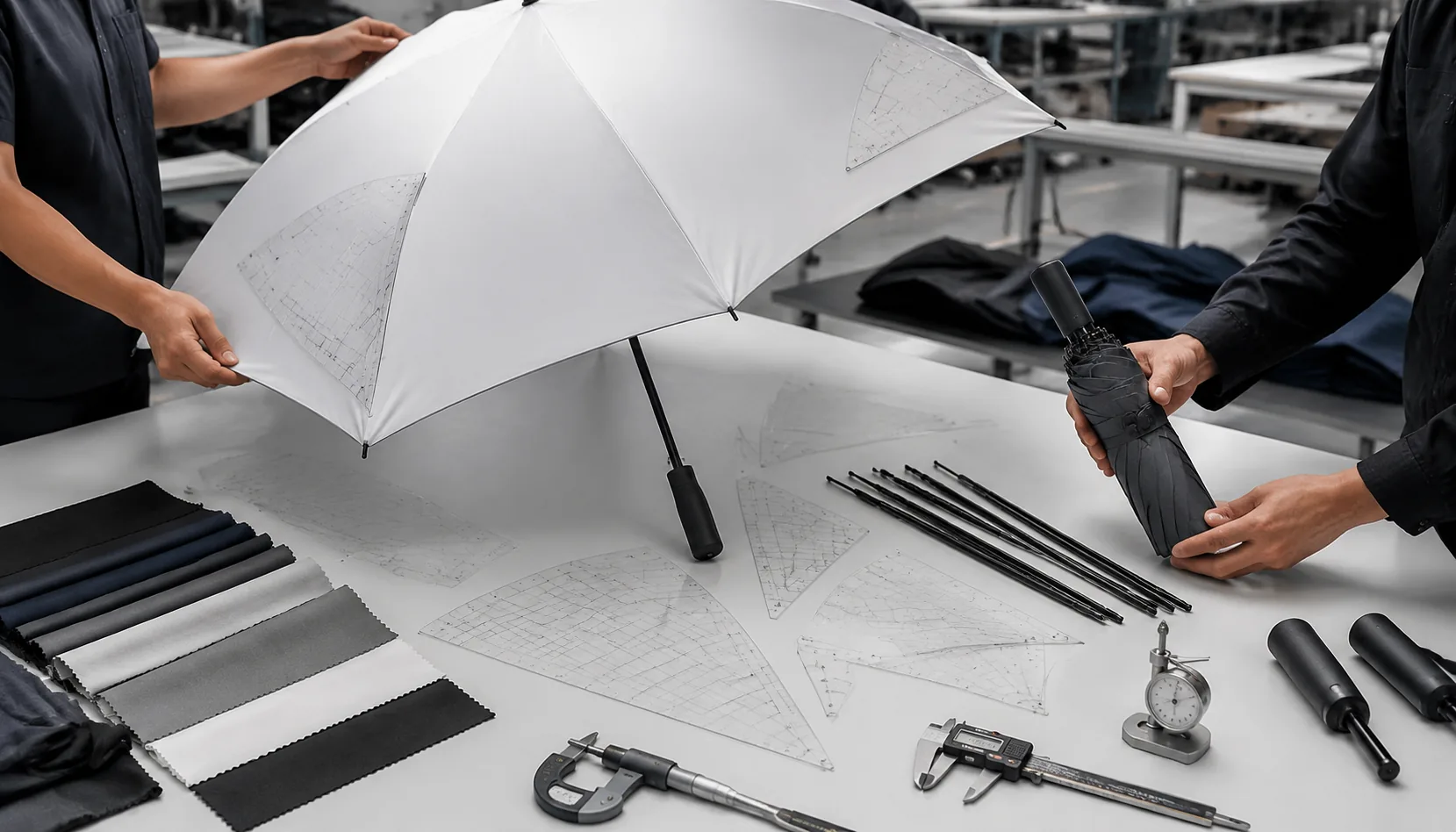
Brand teams often approve umbrella artwork on a flat screen, then discover on the line that ribs, seams, panel taper, and folding mechanisms change how the logo actually reads. A practical umbrella logo size guide has to start with the frame type—folding, stick, or golf—then match the print area to the fabric panel, ink system, curing tolerance, and inspection standard. On our Songxia factory floor, those details decide whether a logo looks premium or comes back as a remake.
Why One Logo Size Does Not Fit Every Umbrella
Logo scale has to start with the actual panel geometry, not the umbrella category name on a quote sheet. A 21-inch compact folding umbrella usually has 8K ribs and narrow triangular panels, so the usable promotional umbrella print area may be only 7–9 inches wide before the artwork begins to distort toward the seam or crown. A 23-inch stick umbrella gives more breathing room, often 9–11 inches on one panel, while a 27- to 30-inch golf umbrella can carry 12–15 inches cleanly if the logo is built with enough line weight. That is why a proper umbrella logo size guide should separate canopy diameter, rib count, and print method. On 190T or 210T pongee, screen printing handles bold marks well, but thin serif text that looks fine on a PDF can fill in after ink gain, especially on darker panels with white underbase.
Panel count changes the math even when the open diameter looks similar. An 8K folding umbrella has fewer, wider visual breaks, but each panel is still short from hem to crown because the frame collapses in sections. A 10K or 16K golf umbrella gives a smoother round appearance, yet each individual panel can become narrower, so a long horizontal brand lockup may need to be split, stacked, or moved to alternate panels. Viewing distance also matters: a folding umbrella logo size for commuter giveaways is usually read at 3–6 feet on a sidewalk, while golf umbrella branding may need to be recognizable from 20–40 feet at a tournament, resort entrance, or outdoor event. For that reason, I prefer larger simple marks on golf models and smaller, cleaner single-panel prints on compact umbrellas rather than forcing the same artwork file onto both.
Use case should control the branded umbrella specifications before anyone approves a virtual mockup. Retail fashion umbrellas often benefit from restrained logo placement, around 3.5–5 inches wide on compact models or 5–7 inches on 23-inch stick umbrellas, because the buyer is carrying the product daily. Promotional events can push larger, especially if the logo is the main purpose of the item, but the print still needs clearance from stitched seams, tips, and the top notch area. For golf and hospitality programs, a 27-inch or 30-inch double-canopy vented frame gives enough surface for larger marks, but the vent overlap can hide artwork if placement is not checked on a real sample. Our standard practice at ZheBrella is to confirm artwork on a panel template, then check one pre-production print before bulk cutting; that is the only reliable umbrella logo size guide when frame size, fabric, and logo shape all change together.
Recommended Print Areas by Umbrella Type
The practical print area starts with the panel, not the umbrella diameter. On a 21" or 23" folding umbrella, a clean front-panel logo usually sits in the 5"–7" wide range, depending on whether the canopy is 190T pongee, 210T pongee, or a coated fabric that shifts under the screen frame. For a 27" or 30" golf umbrella, common front-facing marks often run 8"–11" wide because the walking distance and canopy height justify a larger read. That is the safest baseline for any umbrella logo size guide: size for legibility at arm’s length first, then adjust for panel geometry, seam allowance, and artwork shape. A horizontal wordmark needs different handling than a square badge or circular event logo.
Oversized logos can work, but they need production judgment. Once artwork pushes close to panel edges, the risk is not only distortion; it is also ink buildup near seams, heat-transfer lifting on curved tension points, and poor centering after rib assembly. For folding umbrella logo size, I prefer a conservative mark on one or two panels rather than a stretched graphic fighting the canopy curve. Golf umbrella branding gives more room, but 8K and 16K rib layouts change the visual balance. An 8K golf umbrella has wider panels, so a large logo breathes better. A 16K frame divides the canopy into narrower slices, which can make the same mark look taller, tighter, and more segmented even when the umbrella diameter is unchanged.
Repeat marks should be treated as a pattern system, not eight random logo placements. Small repeat icons, sponsor marks, or retail monograms usually look best when they stay well inside the panel centerline and maintain consistent rotation relative to each rib. For a promotional umbrella print area, we check whether the buyer wants a strong hero panel, alternating panels, or all-panel coverage before choosing screen print, heat transfer, or sublimation. Our standard practice at ZheBrella is to confirm branded umbrella specifications with a panel mockup, fabric swatch, and one pre-production sample when the artwork is oversized, repeated, or placed across multiple panels. That prevents the common mistake of approving a flat PDF that looks balanced on screen but feels crowded once sewn onto a real 8K or 16K canopy.
How Print Method Changes Minimum Detail Size
Minimum detail size is controlled less by artwork software and more by ink behavior on moving fabric. For screen print on 190T or 210T pongee, I do not approve positive text below about 6 pt, reversed text below 8 pt, or line strokes thinner than 0.35 mm on production orders, even if the sample looks acceptable under office lighting. Screen print lays down more ink, so solid logos and one- or two-color icons stay durable, but tiny counters in letters like e, a, and R can fill in when the canopy is tensioned over 8K or 10K ribs. On folding umbrellas, where each panel is narrower and more curved, folding umbrella logo size should be planned around a clean 6–8 inch wide mark rather than a dense legal-line layout. On golf umbrellas, the larger 27 inch or 30 inch canopy gives more room, but the seam-to-rib distortion is still real; golf umbrella branding should keep fine text centered inside the panel, not pushed toward stitched edges.
Digital print handles gradients, multi-color icons, photo logos, and QR codes better than screen print, but it is not automatically sharper on every canopy. On 190T pongee, the slightly more open weave can feather micro-text and diagonal lines, especially with dark ink on white fabric. 210T pongee gives a tighter face and usually cleaner edges, which matters for QR codes, thin sans-serif logotypes, and small sponsor names. My practical QR rule is simple: keep it at least 35 x 35 mm for digital print on 210T and closer to 45 x 45 mm on 190T if the buyer expects reliable phone scanning after rain exposure and folding abrasion. This is where an umbrella logo size guide helps brand teams avoid artwork that looks fine on a PDF but fails during AQL 2.5 inspection. For coated UPF 50+ canopies, especially silver or black-out coatings, ink anchoring and drying temperature must be tested because the coating can reduce absorption and leave edges sitting on the surface.
Heat transfer is the best choice when the brand insists on small lettering, metallic effects, or crisp full-color badges on difficult fabric, but it has its own limits. A transfer film can hold 4–5 pt text and 0.2 mm strokes better than wet ink, yet large transfers on umbrellas may feel stiff and can crease along fold lines after repeated packing. For promotional umbrella print area planning, I normally reserve heat transfer for chest-logo style marks, QR patches, event icons, or fine-line emblems under roughly 100 x 100 mm, not oversized panel floods. On UPF 50+ coated pongee, transfer temperature and dwell time must be controlled tightly; too cool and the edge lifts, too hot and the coating gloss changes around the logo. Our standard practice at ZheBrella is to request vector art, print a fabric strike-off on the exact 190T or 210T material, then test scan distance, rub resistance, and panel distortion before locking branded umbrella specifications for bulk production.
Frame and Mechanism Factors Buyers Should Check
Frame choice changes logo life more than many brand teams expect. Steel ribs are rigid and low-cost, but they transmit shock directly into the canopy when a user snaps the umbrella open or fights wind at a subway exit. That stress shows first around panel seams and print edges, especially on a folding umbrella where the artwork sits across tighter fabric curves. Fiberglass ribs flex and recover better, so the canopy does not jerk as hard under gust load; for repeat-use promotional umbrellas, I prefer fiberglass or at least fiberglass tips on 8K and 10K frames. On a 21" or 23" folding model, the practical folding umbrella logo size is usually smaller because each panel is interrupted by more folds, rib pockets, and crease memory. On a 27" or 30" golf umbrella, the flatter panel gives a larger promotional umbrella print area and cleaner registration for screen print, heat transfer, or sublimation.
Double-canopy windproof construction is excellent for durability, but it affects logo placement. The vent layer creates overlap, stitch lines, and airflow gaps, so artwork should stay on the main lower canopy panel unless the design is intentionally split. For golf umbrella branding, a vented 30" arc frame with fiberglass shaft and ribs can survive 50+ mph wind-tunnel testing when the canopy is balanced correctly, but a large logo printed too close to the vent seam may wrinkle or distort after repeated inversion. I tell buyers to confirm branded umbrella specifications by panel, not just by total umbrella diameter: usable print width, height from seam to seam, safe distance from rib stitching, and whether the logo crosses a vent. A good umbrella logo size guide should separate single-panel, two-panel, and wraparound layouts because the production risks are different. Two-panel logos look bold, but panel-to-panel registration tolerance is usually 2-3 mm even in a well-controlled sewing line.
Auto-open mechanisms add another durability checkpoint because the opening force loads the canopy suddenly. A manual golf umbrella opens more gradually, giving the fabric time to settle; an auto-open folding umbrella launches the runner upward and pulls the 190T or 210T pongee tight in one movement. That is why folding umbrellas have more fabric tension points than golf umbrellas: telescopic shafts, shorter ribs, multiple hinges, and tighter folded creases all concentrate stress around the print zone. If the logo uses thick plastisol ink or a heavy heat-transfer film, it can crack faster near fold lines unless the artwork is sized inside the flatter center of the panel. Our standard practice at ZheBrella is to test logo position on a pre-production sample through 20-30 open-close cycles before approving bulk print. For auto-open-close models, I also check that the printed panel does not rub against rib joints when collapsed, because abrasion can damage metallic ink, reflective transfers, and dark solid-color logos.
Spec Sheet and QC Standards for Repeat Orders
The repeat-order spec sheet should lock the logo as a measured object, not a visual guess. For every SKU, list logo width and height in millimeters, placement from the nearest panel edge and rib seam, print method, ink color by Pantone code, canopy fabric color, and the approved artwork file name with revision date. A folding umbrella logo size may look acceptable at 90 mm wide on a 21" compact panel but undersized on a 23" auto-open frame, while golf umbrella branding often needs 180–240 mm width on a 27" or 30" panel to read from event distance. I also want the promotional umbrella print area defined by panel type: single-panel print, alternating panels, opposite panels, or full-panel coverage. Include photos of the approved pre-production sample from front, angled, and close-up views, because written specs alone do not catch rotation, centering, or ink-density problems.
For branded umbrella specifications, the sheet should name the frame and fabric too: 8K or 10K steel ribs for budget folding models, fiberglass ribs for windproof golf umbrellas, 190T or 210T pongee, POE, PVC, or EVA canopy, plus any Teflon water-repellent or UPF 50+ coating. Ink behavior changes by material; white ink on navy 190T pongee needs different opacity control than heat transfer on transparent POE. Our standard practice at ZheBrella is to attach the signed sample photo to the production traveler, then check bulk panels against it before sewing, not after the finished umbrella is packed. That is the practical difference between an umbrella logo size guide and a usable factory control document: one helps design, the other prevents 3,000 pieces from shipping with the logo 15 mm too close to the hem.
The same spec sheet should also include commercial controls for repeat orders: MOQ by model and print method, expected lead time in days, packing method, carton quantity, and agreed FOB Ningbo/Shanghai or DDP destination terms. For example, a normal repeat order of 1,000–3,000 folding umbrellas with one-color screen print may need 25–35 days after artwork approval, while golf umbrellas with multiple panels, fiberglass frames, and custom color fabric often need 35–50 days. Inspection should be written as AQL 2.5 for major defects, with logo position, print registration, ink adhesion, canopy stains, rib alignment, opening function, and carton marks all listed in the checklist. Without those checkpoints, repeat orders drift: fabric shade shifts, a supplier substitutes ink, or the print operator centers by eye instead of following the measured placement.
Frequently Asked Questions
What is a safe logo size for a folding umbrella panel?
It depends on the canopy diameter and rib count, but compact umbrellas usually need a smaller mark than golf umbrellas. Buyers should approve a scaled artwork proof on the actual panel template before sampling.
Can the same logo file be used for golf and folding umbrellas?
Yes, but it should be resized and sometimes simplified for each umbrella type. Fine text that works on a golf umbrella may fill too much space or lose clarity on a compact folding model.
What logo size is usually safe for folding umbrellas?
For most 3-fold umbrellas, a safe logo width is about 15–20 cm per panel, depending on panel shape and rib position. Larger prints may distort near seams or be interrupted by folds, so factories usually request vector artwork before confirming the final size.
Can golf umbrellas support larger brand graphics than folding umbrellas?
Yes. A standard golf umbrella often allows a logo width of 25–35 cm on one panel, while double-canopy or oversized models may allow more if ribs and vents do not interfere with the print area.
What should buyers check before approving umbrella logo samples?
Check logo position against ribs, color accuracy, edge sharpness, print adhesion, and whether the logo is centered when the umbrella is open. For bulk OEM orders, many factories use a pre-production sample and AQL inspection before mass shipment.
Looking to Launch Your Custom Umbrella Line?
ZheBrella is a Zhejiang-based OEM/ODM umbrella manufacturer with 17 years of export experience. Free design, low MOQ from 100 pieces, windproof construction, full-color print.
Get Free Quote Now »People Also Search For
Related Articles
Scaling Umbrella Logos Across Folding, Stick, and Golf Models
Set logo sizes that translate across folding, stick, and golf umbrellas while protecting readability, print quality, app...
Read More »
Logo Scaling Across Folding, Stick, and Golf Umbrellas
Set logo size rules across 21-inch folding, 23-inch stick, and 30-inch golf umbrellas so brand assets stay consistent th...
Read More »
Scaling Logo Sizes Across Folding, Golf, and Stick Umbrellas
Set practical logo size rules across 21-inch folding, 23-inch stick, and 30-inch golf umbrellas without losing visibilit...
Read More »