Scaling Logo Sizes Across Folding, Golf, and Stick Umbrellas
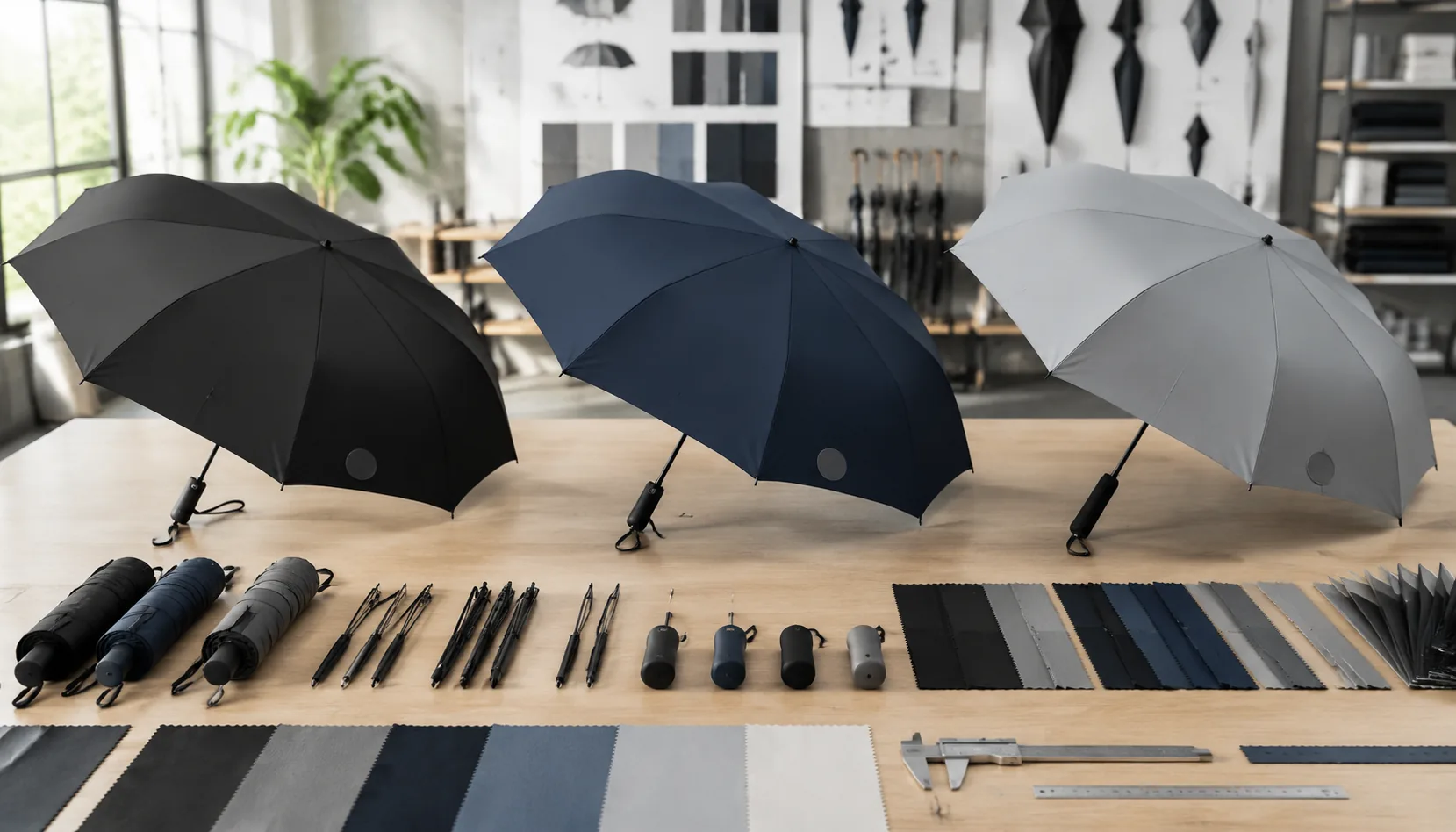
Buyers often approve one logo file and expect it to work across 21-inch folding, 23-inch stick, and 30-inch golf umbrellas, but the panel curve, rib spacing, and viewing distance change the result fast. On our Songxia production floor, we set umbrella logo size standards by canopy type, print method, and seam clearance so the mark stays readable without looking oversized, distorted, or weak after sampling.
Why One Logo File Does Not Fit Every Umbrella
One logo file fails because an umbrella is not a flat poster; it is eight, ten, or sixteen curved fabric panels pulled over ribs at different angles. A 21-inch folding umbrella usually has a tighter canopy arc, shorter panel height, and more visual distortion near the crown, so a wide horizontal logo that looks clean on a PDF can bend into a smile shape after sewing. A 23-inch stick umbrella gives more panel depth and a cleaner viewing face, but the usable print zone still depends on seam allowance, rib tape, and whether the canopy is 190T pongee, 210T pongee, POE, or PVC. On a 30-inch golf umbrella, the same artwork may look too small because the canopy diameter and viewing distance both increase. That is why serious umbrella logo size standards start with finished canopy geometry, not just the customer’s AI or EPS file.
Panel shape and rib count change branded umbrella artwork scaling more than many buyers expect. An 8K folding umbrella has wider panels, so a single-panel logo can often run 7 to 9 inches wide if the artwork is not too tall. A 10K stick umbrella narrows each panel, which may force the same logo down to 6 to 7.5 inches or require a two-panel layout. A 16K golf umbrella creates a premium round silhouette, but each panel is slimmer; oversized artwork can cross seams, wrinkle during heat transfer, or lose registration in screen printing. For folding umbrella branding, I usually keep the mark compact and centered in the lower third of the panel so it remains visible when carried at chest height. For golf umbrella logo size, I often push larger marks to 10 to 13 inches wide, especially for sponsor exposure at tournaments, outdoor retail displays, or roadside events.
Viewing distance is the practical reason umbrella logo templates should be separated by product type. A commuter’s 21-inch auto-open-close folding umbrella is seen from 3 to 8 feet away on sidewalks, so legibility matters more than maximum print area; small text under 0.20 inch high can disappear on dark 190T pongee after a Teflon water-repellent finish. A 23-inch stick umbrella is often used for retail branding, hotels, and corporate gifts, where a 7 to 9 inch logo on one or two panels balances visibility and cost. A 30-inch double-canopy vented golf umbrella is read from 20 to 50 feet away, so thin lines, gradients, and low-contrast marks become weak unless enlarged or simplified. Good umbrella logo size standards also account for print method: screen printing handles solid spot colors well, heat transfer keeps detail but needs careful edge adhesion, and sublimation works best on white polyester panels before assembly.
Recommended Logo Size Ranges by Umbrella Type
For single-panel printing, the safe starting point is 120–160 mm wide on a 21" compact folding umbrella, 150–190 mm on a 23" standard folding umbrella, 180–230 mm on a 27" stick umbrella, and 220–300 mm on a 30" golf umbrella. Those ranges assume 190T or 210T pongee with screen print or heat-transfer logos placed in the lower third of one panel, not crossing a seam. I treat 300 mm as the practical upper limit for most golf umbrella logo size requests unless the artwork is very horizontal and simple; beyond that, the panel curvature starts making straight baselines look slightly bowed when the canopy is open. These are working umbrella logo size standards, not catalog decoration guesses: a 90 mm logo on a golf umbrella looks lost from 10 feet away, while a 240 mm logo on a compact 21" folding model usually fights the rib stitching and looks crowded after tensioning.
Panel count changes the usable logo box more than many buyers expect. On an 8K canopy, each panel is wider, so a single-panel mark can breathe; on a 16K canopy, each panel is narrower and taller, so the same artwork may need a 10–20% width reduction or a more vertical lockup. A 10K frame sits in the middle, often useful for premium stick umbrellas where the buyer wants a refined logo without jumping to oversized golf proportions. For folding umbrella branding, I usually keep critical text at least 25–30 mm away from seam lines and rib pockets because fabric pull varies after final assembly. On double-canopy vented windproof models, the top canopy and lower canopy can shift slightly under wind load, so logos near vent overlaps should be mocked up on the actual umbrella logo templates, not just a flat AI or PDF panel outline.
Curved panel distortion is the main reason branded umbrella artwork scaling should be checked on a pre-production sample, especially for round seals, QR codes, thin serif text, and rectangular sponsor blocks. A logo that measures 200 mm flat on the cutting table will visually compress once the canopy is tensioned over fiberglass or steel ribs, and the distortion is stronger near the outer arc than near the centerline of the panel. For screen printing, keep fine lines above 0.3 mm and avoid tiny reversed text below 8 pt; for heat transfer, test adhesion after open-close cycling on auto-open and auto-open-close frames. Our standard practice at ZheBrella is to confirm artwork using a 1:1 panel template, then inspect the first finished umbrellas under AQL 2.5 criteria for position tolerance, ink coverage, edge sharpness, and consistency across the order before bulk packing for FOB or DDP shipment.
How Fabric and Print Method Affect Minimum Detail
Fabric texture sets the real floor for readable logo detail before any printer touches the canopy. On 190T pongee, the yarn is slightly more open, so very fine strokes below about 0.35 mm can look soft after ink settles into the weave; I avoid small reversed text under 6–7 pt on this cloth. 210T pongee gives a tighter face and cleaner edge, so it is better for compact corporate marks, QR-adjacent graphics, and thin serif lettering, especially on 21" folding umbrella branding where the panel area is limited. RPET pongee behaves close to virgin pongee if the yarn and dyeing are stable, but recycled yarn can show more shade variation between lots, so buyers should approve a strike-off, not only a digital mockup. Coated UPF 50+ fabrics are trickier: silver, black, or PU UV coatings change heat response and hand-feel, and heavy ink layers can crack if the panel is folded tightly around steel ribs or auto-open-close frames.
Screen printing is still the most reliable method for bold logos, spot colors, and repeat orders where Pantone control matters. For umbrella logo size standards, I normally keep positive text at 5 mm high or larger on pongee and line gaps at 0.4 mm or more; on coated UV fabric I prefer 0.5 mm because the surface can resist ink differently. Screen print is economical for 500–1,000 pcs MOQ and above, but every color needs its own screen, so tiny multi-color artwork becomes expensive and registration risk increases across 8K or 10K panels. Digital print is better when branded umbrella artwork scaling includes gradients, photos, complex mascots, or many color transitions, especially for full-panel work on golf umbrellas. The tradeoff is that dark pongee usually needs a white base or sublimation-compatible light fabric; otherwise small logos lose contrast under rain and outdoor glare.
Heat transfer is the cleanest option for very small logos, metallic effects, or fine type on difficult panels, but it is not a universal upgrade. A good transfer film can hold thin lines around 0.25–0.3 mm and crisp lettering on 210T pongee, which helps when umbrella logo templates must be shared across 21" folding, 23" stick, and 27" or 30" golf models. For a golf umbrella logo size, the artwork can often grow to 180–250 mm wide on one panel, so screen print or digital print usually looks more integrated than a transfer patch. On compact umbrellas, where logos may sit around 80–120 mm wide, heat transfer can preserve detail without flooding the weave. Our standard practice at ZheBrella is to test the smallest logo version on the actual fabric, coating, and rib construction, then run tape adhesion, wet rub, and 24-hour folded-storage checks before confirming production artwork.
Building a Cross-SKU Logo Template System
A cross-SKU logo system should start with vector artwork, not a JPG pulled from a website. Require AI, EPS, SVG, or PDF files with outlined fonts, plus Pantone Solid Coated references for spot-color printing and CMYK/RGB values only as secondary guidance. Good umbrella logo size standards are built around printable panel geometry: state the finished logo width in millimeters, the maximum height, and the clear safe margin from ribs, seams, tips, and the lower hem. On a 21" folding umbrella, I usually keep a front-panel logo around 120–150 mm wide; on a 23" stick umbrella, 160–190 mm is safer; on a 27" or 30" golf umbrella, 220–280 mm can work if the logo is not too tall or text-heavy.
Writers should specify separate umbrella logo templates for auto-open folding, stick, and double-canopy windproof models because the same file does not land the same way after sewing and frame tension. Folding umbrella branding has tighter panels, more curvature, and more visual distortion near the ribs, especially on 8K compact frames. Stick umbrellas give a cleaner print window, but wood or J-handle orientation affects which panel faces forward at retail display. Double-canopy vented windproof models need another template because the upper and lower canopy layers overlap; artwork placed too high can disappear under the vent flap or break across seam lines. Our standard practice at ZheBrella is to mark a no-print zone of 20–30 mm from main ribs and at least 35–50 mm from the tip pocket depending on size.
Placement diagrams are not optional; they prevent sampling delays and wrong-panel production. Each template should show panel count, rib positions, seam allowance, print centerline, reading direction when the umbrella is closed, and the approved logo width for each SKU. For branded umbrella artwork scaling, include a master logo ratio table instead of resizing by eye: for example, 100% scale for golf umbrella logo size, 70% for stick, and 55% for compact folding, then adjust after a paper panel mockup. If screen printing, note minimum line weight, usually 0.3–0.5 mm, and avoid tiny reversed text under 8 pt. If heat transfer or sublimation is used on 190T or 210T pongee, add bleed and color-control notes because coating, fabric tension, and canopy color all change the final appearance.
Production Checks for Consistent Brand Appearance
Final inspection should use AQL 2.5 with logo defects classified clearly, not argued carton by carton. Major defects include wrong logo size, visible off-center placement beyond the agreed tolerance, incorrect Pantone shade, upside-down panels, poor registration on multi-color prints, and panel-to-panel mismatch on repeated artwork. Minor defects may include slight ink specks outside the viewing area or a small deviation within the approved tolerance, but buyers should define that tolerance in millimeters before mass production. Multiple SKUs add real lead time: one folding umbrella, one 23" stick umbrella, and one 30" vented golf umbrella often need separate screens, heat-transfer films, or sublimation files, adding 2–5 days for artwork setup and 3–7 days for sample approval. MOQ planning should follow model and print method: small folding models may start around 500–1,000 pcs per design, while golf umbrellas often need higher fabric and frame commitments, especially with custom pongee color, UPF 50+ coating, or branded umbrella artwork scaling across several canopy sizes.
Frequently Asked Questions
Should the same logo width be used on folding and golf umbrellas?
Usually not. A logo that looks balanced on a 21-inch folding umbrella may look too small on a 30-inch golf umbrella, so buyers should scale by canopy size and viewing distance.
What file format is best for logo scaling across umbrella models?
Vector AI, EPS, or editable PDF files are best because they scale without losing edge sharpness. Include Pantone codes and any minimum clear-space rules with the file.
What logo size works best across 21-inch folding, 23-inch stick, and 30-inch golf umbrellas?
A practical shared logo height is usually 5–7 inches for visual consistency, with width adjusted by logo shape. Golf umbrellas can often support larger marks, around 8–10 inches wide, but the artwork should still stay balanced within one panel.
Should buyers use the same artwork file for folding and golf umbrellas?
Use the same vector master file, but create separate scaled layouts for each umbrella size. A logo that looks correct on a 30-inch golf umbrella may appear oversized or distorted on a 21-inch folding umbrella panel.
What file format is needed to keep logos sharp when scaling umbrella artwork?
Vector files such as AI, EPS, or PDF are preferred because they can be resized without quality loss. For raster artwork, use at least 300 DPI at final print size, and confirm the printable area before sampling.
Looking to Launch Your Custom Umbrella Line?
ZheBrella is a Zhejiang-based OEM/ODM umbrella manufacturer with 17 years of export experience. Free design, low MOQ from 100 pieces, windproof construction, full-color print.
Get Free Quote Now »People Also Search For
Related Articles
Scaling Umbrella Logos Across Folding, Stick, and Golf Models
Set logo sizes that translate across folding, stick, and golf umbrellas while protecting readability, print quality, app...
Read More »
Logo Scaling Across Folding, Stick, and Golf Umbrellas
Set logo size rules across 21-inch folding, 23-inch stick, and 30-inch golf umbrellas so brand assets stay consistent th...
Read More »
Logo Scaling on Folding and Golf Umbrellas for Brand Teams
Set practical logo sizes across folding, stick, and golf umbrellas while accounting for ribs, panels, print methods, mec...
Read More »