Logo Scale Rules for Compact Folding Promotional Umbrellas
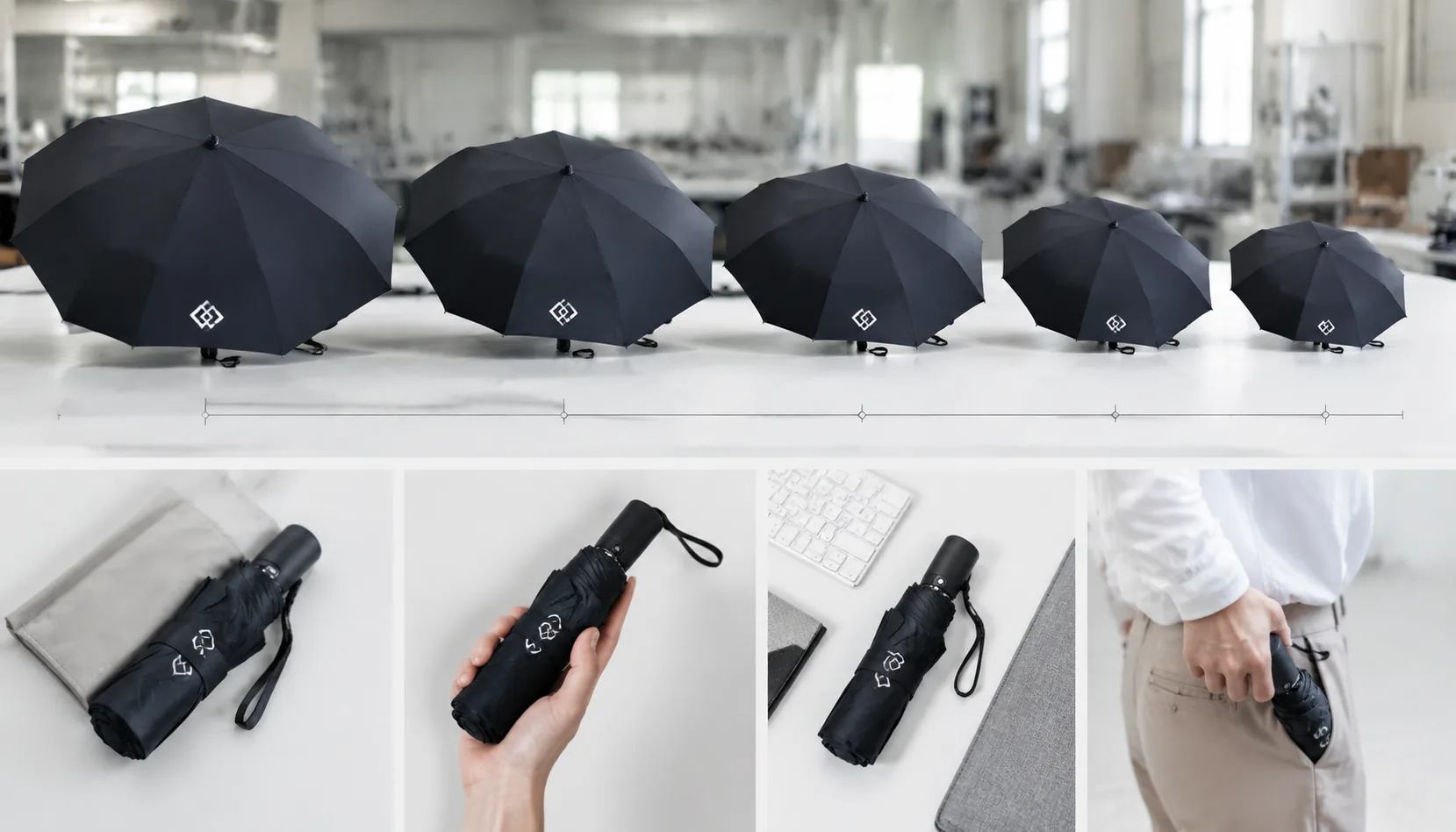
On compact 3-fold and 5-fold promotional umbrellas, a logo that looks clean on a proof can wrinkle, split across ribs, or disappear once the canopy is tensioned and folded. The right folding umbrella logo size depends on usable panel width, frame type, rib spacing, fabric stretch, and whether we are screen printing, heat transfer, or digital printing. On our Songxia production floor, we set scale after checking the actual cut panel and opening curve, not just the catalog diameter.
Start With the Folded and Open Viewing Moments
The first mistake I see in compact umbrella branding is judging the logo only on the open canopy mockup. A 21-inch 3-fold umbrella has two viewing moments: folded in the sleeve on a trade-show table, and open in the rain at arm’s length. Those are completely different scale problems. On the canopy, one panel may give you roughly 11–13 inches of usable print width after seam allowance and rib clearance; on the sleeve, you may have only 2.5–3.5 inches of vertical space before the artwork looks cramped. The strap is even tighter, usually best for a short wordmark, woven label, or one-color icon. If the order includes auto-open umbrella printing, also check where the button, runner, and hand position sit, because the handle logo may be hidden during actual use.
A logo that looks balanced on a 30-inch golf umbrella often feels loud and clumsy on a 21-inch or 23-inch compact model. Golf umbrellas have larger triangular panels, longer rib geometry, and more viewing distance, so a 9-inch canopy logo can look normal. Put that same width on promotional folding umbrellas and it may fight the panel shape, cross too close to the stitch line, or distort over the fold memory of 190T pongee. For a typical compact canopy, I prefer starting around 5–7 inches wide for a main one-panel logo, then scaling down if the mark is dense or has small text. This is where folding umbrella logo size should be based on the actual panel template, not a flat PDF rectangle.
The best umbrella logo scale plan assigns a job to each surface instead of repeating the same artwork everywhere. The canopy carries the brand from 6–10 feet away; the sleeve confirms ownership when packed; the strap helps with quick identification; the handle can take a subtle pad print, deboss, or small metal badge. For compact umbrella branding, a clean one-color canopy print plus a smaller sleeve logo often looks more premium than four oversized marks fighting each other. If you use heat transfer on dark 210T pongee or UV-coated fabric, keep fine lines above about 0.3 mm and avoid tiny legal text. The practical rule: size for the smallest real viewing surface first, then let the open canopy version breathe.
Calculate Safe Print Areas by Panel Size
Safe print area is not the full triangle you see on the cutting table; it is the part of the panel that stays flat after sewing, framing, and repeated folding. For most 21" and 23" compact promotional folding umbrellas, I keep artwork at least 15–20 mm away from stitched seams and 25–35 mm above the rib tip area, because the last few centimeters near the ferrule end are pulled hard when the canopy is tensioned. On 190T or 210T pongee, a small logo can tolerate slight curvature, but solid blocks, QR codes, fine text, and metallic heat transfers show distortion quickly. A practical folding umbrella logo size for a single panel is often 120–160 mm wide on a 23" 8K umbrella, but that may drop to 90–120 mm on smaller 21" frames or narrow-panel builds. If the logo has a tagline under 6 pt after scaling, I would rather split the message across two panels than force it into a fold zone.
Rib count changes the usable print geometry more than many buyers expect. An 8K layout gives wider, more open panels, so compact umbrella branding can carry a horizontal logo with cleaner proportions. A 16K umbrella has more ribs and narrower panels; it looks premium in the hand, but the umbrella logo scale must shrink or become more vertical to avoid seams. A 10K frame sits in the middle and is usually workable for retail marks that need better roundness without losing too much print width. For auto open umbrella printing, also check the spring tension and opening shock: heavy plastisol or oversized heat-transfer graphics near rib paths can crack sooner because the canopy snaps open harder than a manual 3-fold. Our standard practice at ZheBrella is to mark a panel template after the first sewn sample is mounted, not just from the CAD cutting shape, because the mounted canopy tells the truth.
Five-fold umbrellas need the most conservative artwork because every panel is forced into tighter, shorter fold stacks. Even when the open diameter matches a 21" three-fold model, the collapsed length may be only 15–18 cm, which means heavier crease memory across the canopy. For promotional folding umbrellas in 5-fold construction, I usually reduce the safe print area by another 15–25% and avoid printing across the main valley fold line completely. Sublimation handles folds better than thick screen ink, but only on suitable polyester fabric and only if color matching tolerances are agreed before bulk production. If the project requires a large sponsor mark, use a 23" 3-fold 8K or 10K frame instead of pushing the same artwork onto a 5-fold. The cleanest rule is simple: keep the logo centered in the flatter upper-middle panel area, leave breathing room at seams, and approve scale on a real pre-production sample before AQL 2.5 inspection begins.
Adjust Logo Size for Frame and Mechanism Type
For compact umbrella branding, the first mistake is treating every folding frame like a straight-stick umbrella. The folding umbrella logo size has to follow the mechanism, not just the canopy diameter. On a manual 21" or 23" folding frame, the shaft is simpler and the runner travel is shorter, so a centered logo can sit closer to the crown and still stay readable when the canopy opens fully. With auto-open umbrellas, the button housing and spring load push the runner faster, so the print should stay clear of the seam arcs and the stress zone near the tips. On auto-open-close models, the extra slide path changes the umbrella logo scale again, because the fabric folds tighter against the ribs and any artwork too close to the lower panel can get crushed when the canopy snaps shut. That is why promotional folding umbrellas need artwork mapped to the opening geometry, not just to a flat template.
Canopy tension matters as much as frame type. Fiberglass ribs flex more evenly, so they let the panel relax without creating hard crease lines, which is better for compact umbrella branding on sublimation or screen print. Steel ribs can hold shape well, but they also create sharper fold pressure points, especially where the rib tips meet the panel seam, and that can distort a logo after repeated opening. On a tight 100 cm canopy, I usually keep the main mark in the upper-middle panel and avoid placing fine text across the fold line or near the vent seam if it is a double-canopy style. For auto open umbrella printing, the safe approach is to check the open diameter, runner stop position, and the fabric’s natural pull before locking the artwork. In practice, the right folding umbrella logo size is the one that still looks clean after 50 or 100 open-close cycles, not the one that only looks good on a flat mockup.
Select Decoration Methods for Small Canopies
Screen print is still the safest decoration method for promotional folding umbrellas when the mark is 1–3 spot colors, the artwork has solid shapes, and the buyer wants repeatable color at volume. On a 21" or 23" compact canopy made from 190T or 210T pongee, I do not approve hairlines under 0.35 mm for screen print, and reversed text should stay above 1.5 mm stroke height if you expect it to survive ink gain on coated fabric. Practical registration tolerance is about ±1.0 mm panel to panel, tighter on a single-color logo and looser when printing across seams or near rib tips. For most compact umbrella branding, the first question is not “How big can the logo be?” but “How much detail can the fabric and frame keep flat during printing?” A full corporate lockup with tagline, legal line, and gradient icon often fails at small scale; a simplified icon plus wordmark gives a cleaner folding umbrella logo size and fewer rejects during AQL 2.5 inspection.
Heat transfer handles small logos, fine text, and multi-color marks better than screen print, especially when the buyer needs CMYK artwork, shaded graphics, or a retail-style badge on each canopy panel. For transfer film on pongee, I prefer line thickness at 0.20–0.25 mm minimum, with text no smaller than 5–6 pt depending on font weight. Registration is built into the printed transfer, so color-to-color alignment can stay within ±0.3 mm before pressing, but the press position on the umbrella panel still has normal placement variation, usually ±2 mm on compact canopies. Heat transfer is also the better answer for auto open umbrella printing when the frame creates uneven tension during panel loading; the artwork lands as one piece instead of multiple screen passes. The tradeoff is hand feel and edge durability: thick transfer layers can look plasticky, and low-grade glue may crack after repeated folding, especially on 3-fold umbrellas stored damp in sleeves.
Digital print is useful for short runs, photo images, and complex marks where setup charges for screen plates do not make sense, but it is not magic for every umbrella logo scale problem. Direct digital on polyester can reproduce fine color transitions, yet sharpness depends on fabric weave, coating, and ink system; tiny serif text below 5 pt or strokes under 0.20 mm often blur after curing or water-repellent finishing. Sublimation is excellent on white polyester panels before assembly, but it is less practical for dark canopies, PU-coated fabrics, or urgent FOB orders where panels are already cut and sewn. For a reliable folding umbrella logo size, I often ask buyers for two files: the full corporate lockup for reference and a production version with simplified text, expanded strokes, converted outlines, Pantone callouts, and no micro taglines. That small adjustment prevents the common mistake of forcing a billboard logo onto a 7–9 inch printable panel.
Confirm Production Specs Before Ordering
Lock the production sheet before you argue about price, because most logo problems start with loose specs. For promotional folding umbrellas, I want the buyer to confirm open arc or diameter, folded length, rib count, shaft material, frame material, canopy fabric, coating, handle, mechanism, and packing. A common compact order is 21 inch or 23 inch, 8K steel or fiberglass ribs, 190T pongee for budget work, 210T pongee for smoother retail feel, and manual, auto-open, or auto-open-close operation. If the order involves auto open umbrella printing, we also check whether the runner clearance and strap position will interrupt the artwork when the umbrella is closed. Put the folding umbrella logo size in millimeters, not just “small” or “large,” and specify one-panel, two-panel, opposite-panel, strap, sleeve, or handle placement. For compact umbrella branding, a practical one-panel print is often 120 to 180 mm wide, depending on canopy curve and logo shape.
Sample approval should happen before bulk fabric cutting, not after the printer has already burned screens or calibrated heat-transfer films. Our standard practice at ZheBrella is to issue a digital mockup first, then a pre-production sample with actual fabric, actual ink or transfer, and actual logo location. Buyers should approve Pantone color, print method, logo edge sharpness, orientation when opened, and how the mark looks after folding. Screen printing is cost-efficient for 1 to 2 solid colors; heat transfer handles gradients better; sublimation works best on white polyester panels when full-panel artwork is needed. Confirm MOQ by model and print method: many factory programs start around 500 pieces for basic promotional folding umbrellas, while custom dyed fabric, special handles, or 16K frames can push MOQ higher. For umbrella logo scale, also ask for a photo of the printed sample laid flat with a ruler, because canopy curvature can make a 160 mm logo look smaller once tensioned on the frame.
Lead time should be written as checkpoints, not one vague delivery promise. A normal compact folding umbrella order may need 3 to 5 days for artwork confirmation, 5 to 7 days for a physical sample, 20 to 35 days for bulk production after deposit and sample approval, plus inspection, packing, and freight time. Carton packing matters for event deadlines: confirm pieces per carton, carton dimensions, gross weight, individual polybag, sleeve packing, and whether barcode stickers or master carton marks are required. AQL 2.5 final inspection should check frame opening, rib symmetry, fabric stains, print registration, water repellency, and carton count before shipment. FOB quoting covers production and delivery to the China port, usually Ningbo or Shanghai, with the buyer handling ocean or air freight, import duty, and local delivery. DDP quoting includes freight, customs clearance, duty, and last-mile delivery, which is safer for promotional deadlines but must be priced against the real delivery address and required in-hand date.
Frequently Asked Questions
What is a safe logo size for a compact folding umbrella panel?
Many 21-inch folding umbrellas work best with a logo around 12–16 cm wide on one panel, depending on the artwork shape and rib layout. Final sizing should be confirmed on the actual panel template before sampling.
Can small text be printed clearly on compact umbrellas?
Yes, but it depends on the print method and fabric texture. For 190T pongee, avoid very thin strokes and keep legal text or URLs large enough to survive folding, rain exposure, and bulk inspection.
What is a safe logo width for 3-fold and 5-fold compact umbrellas?
For most 3-fold umbrellas, a 12-18 cm logo width per panel is usually safe. For smaller 5-fold umbrellas, 8-12 cm is more practical because the panels are narrower and fold more tightly.
Does an auto-open frame change the recommended print area?
Yes. Auto-open compact umbrellas often have stronger rib tension and more fabric movement near the ribs, so the logo should stay centered within the panel and avoid printing too close to rib seams, typically leaving at least 2-3 cm clearance.
Which print method is better for small logos on promotional folding umbrellas?
Screen printing is cost-effective for simple 1-2 color logos at bulk quantities, often with MOQs around 500-1,000 pieces. Heat transfer or digital printing is better for gradients, fine details, or multi-color artwork, but unit cost is usually higher.
Looking to Launch Your Custom Umbrella Line?
ZheBrella is a Zhejiang-based OEM/ODM umbrella manufacturer with 17 years of export experience. Free design, low MOQ from 100 pieces, windproof construction, full-color print.
Get Free Quote Now »People Also Search For
Related Articles
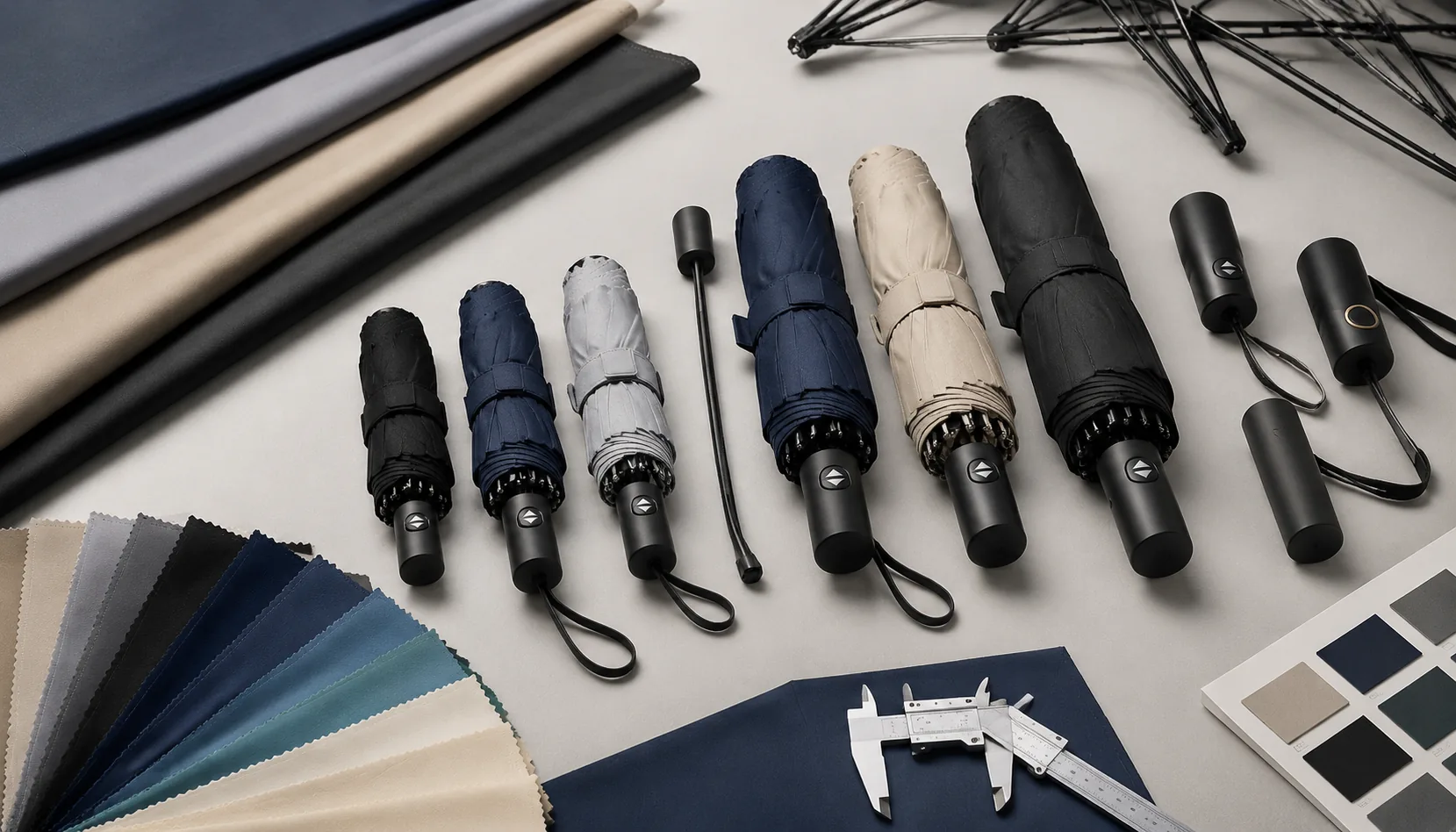
Minimum Logo Sizes for Compact and Folding Umbrellas
Set practical logo size limits for compact and folding umbrellas so artwork stays readable across ribs, panels, folds, a...
Read More »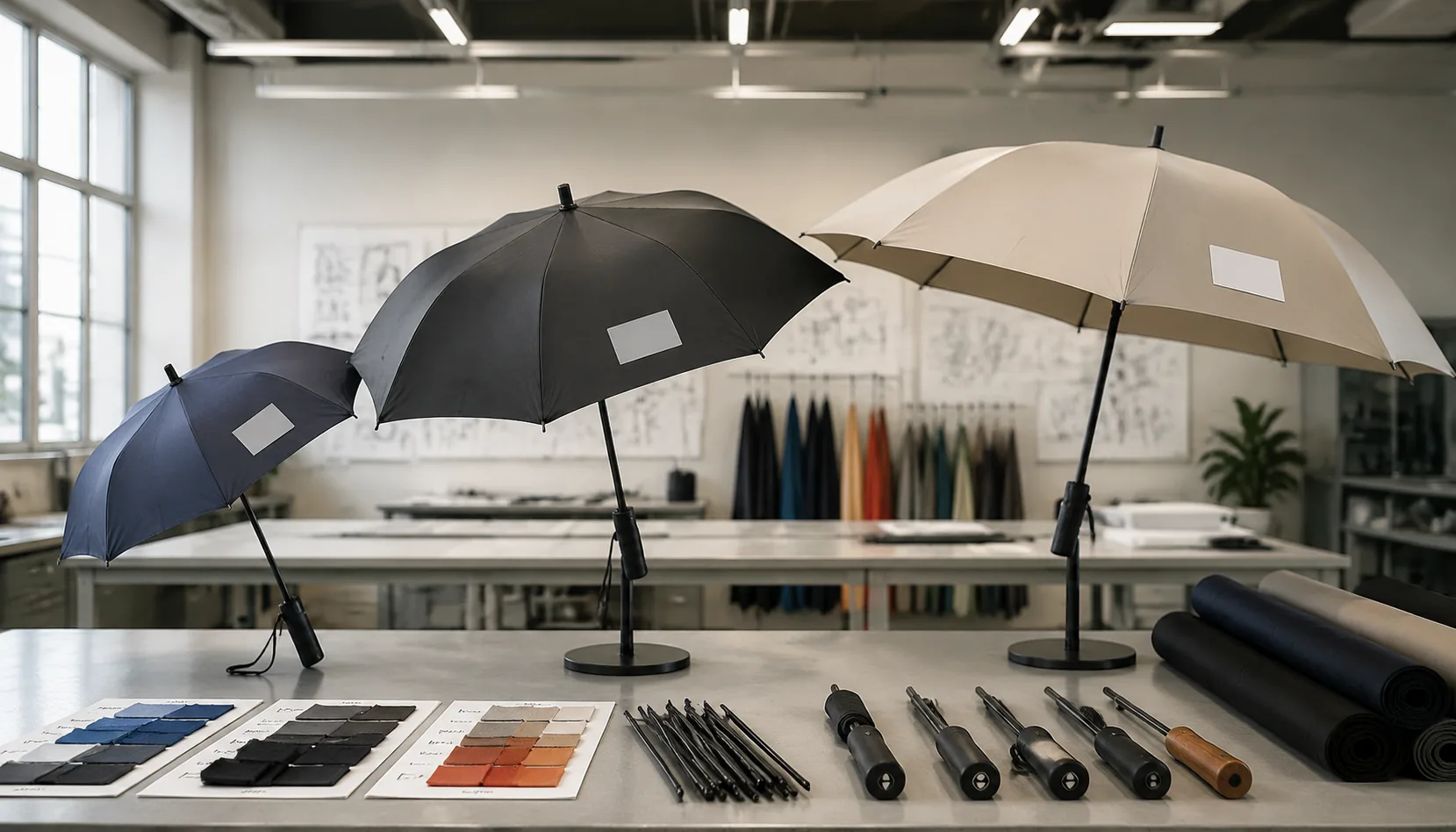
Logo Scaling Rules for Compact, Golf, and Patio Umbrellas
Set practical logo sizes across compact, golf, and patio umbrellas using panel dimensions, viewing distance, print limit...
Read More »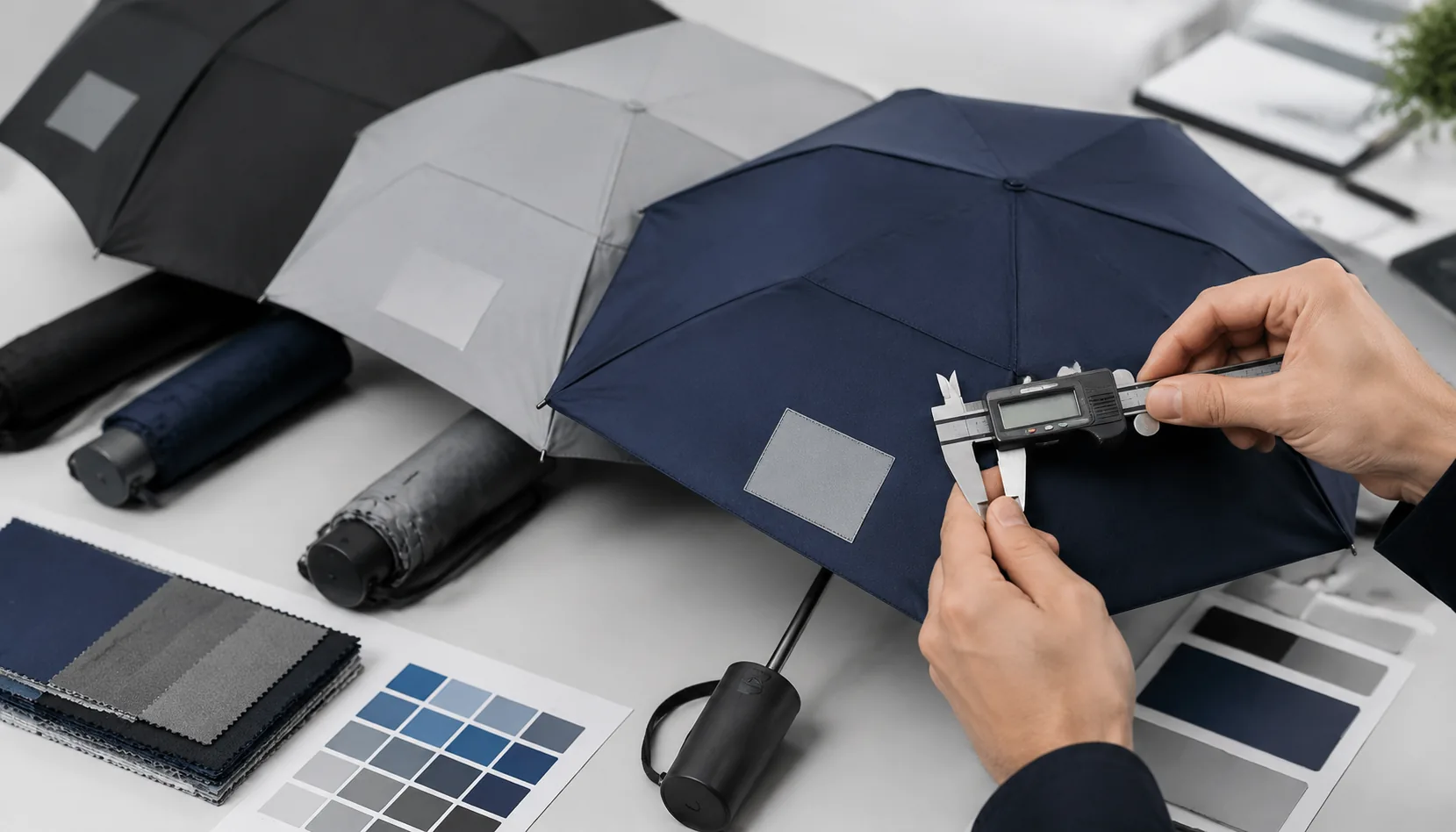
Minimum Logo Size Rules for Branded Compact Umbrellas
Set practical logo size, line weight, fabric, and print specs for compact umbrellas so small branding stays readable in ...
Read More »