Minimum Logo Size Rules for Branded Compact Umbrellas
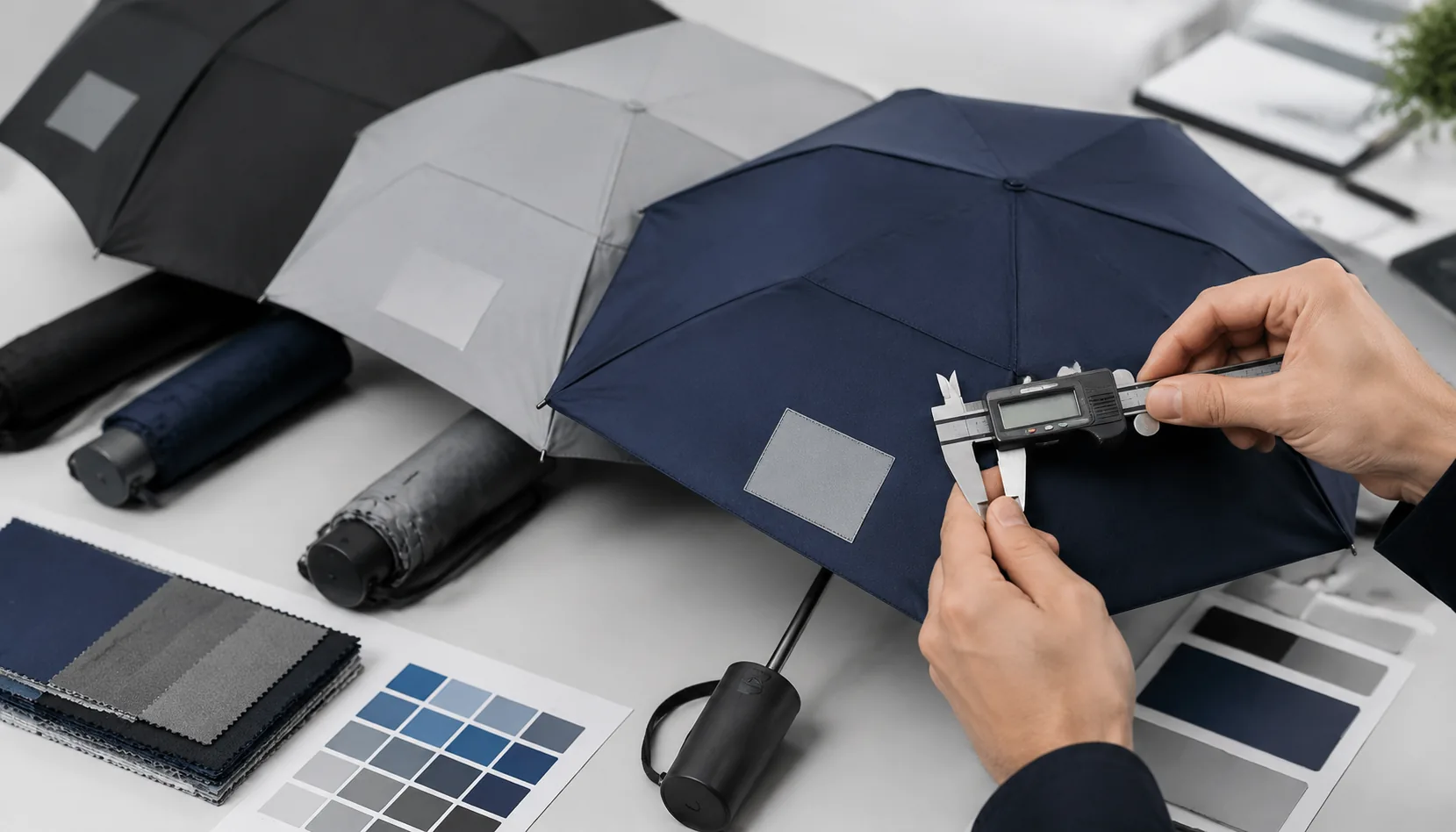
On compact umbrellas, a logo that looks clean on a PDF can turn muddy once the panel is cut, curved, stitched, folded, and heat-pressed in volume. From our Songxia production floor, the real control points are compact umbrella logo size, minimum stroke width, ink behavior on pongee or coated fabric, and how close the artwork sits to ribs and seams. Setting these limits before sampling prevents unreadable marks, reprint waste, and buyer disputes at inspection.
Why Compact Umbrellas Need Different Logo Rules
Compact umbrellas need stricter logo rules because the canopy geometry is working against the artwork from the start. A 23" golf umbrella panel gives a broad, flatter triangle where a 180-220 mm wide logo can sit cleanly without fighting the ribs. On a 21" or 23" 3-fold compact umbrella, the same panel is shorter, more curved, and broken up by tighter seam angles, so the practical umbrella print area is often closer to 120-160 mm wide per panel. If the logo has fine text under 5 mm tall, thin strokes, or a long horizontal lockup, it may look acceptable on a digital mockup but distort once the 190T or 210T pongee is tensioned over the frame. This is why compact umbrella logo size should be approved on a panel template, not copied from golf umbrella artwork.
The folding frame also creates more mechanical interruptions. A standard 3-fold umbrella has ribs, stretchers, runners, and folded fabric layers that force the canopy into sharper curves when opened and thicker creases when closed. A 5-fold frame is even less forgiving: the shorter rib sections make the canopy more segmented, and the packed fabric develops stronger fold memory after heat-transfer or screen printing. For small logo umbrella printing, we usually avoid placing artwork too close to rib seams, panel tips, or the lower canopy edge; a safe clearance is typically 15-20 mm from seams and 25-35 mm from the edge, depending on the logo shape. Dense ink coverage across a fold line can crack sooner, especially on budget polyester with PU coating, while oversized heat-transfer film can feel stiff and stop the panel from collapsing neatly into the sleeve.
Viewing distance is another reason branded compact umbrellas need different promotional umbrella specs. Golf umbrellas are often used at events, entrances, and outdoor hospitality, where the logo is seen from 10-20 meters away; compact umbrellas are mostly seen at arm’s length on sidewalks, transit platforms, and retail displays. That means a compact design should favor bold marks, short words, and high contrast rather than trying to fill the panel with a complicated corporate message. For a 3-fold auto-open compact, I normally treat 140 mm wide as a sensible starting point for a single-panel logo, then adjust after checking rib count, fabric color, and printing method. For a 5-fold travel model, 100-130 mm may be more realistic. The best compact umbrella logo size is not the largest one that fits on paper; it is the largest one that still opens smoothly, folds cleanly, and reads without distortion on the finished canopy.
Set Minimum Sizes for Text, Lines, and Icons
The safe minimum for compact umbrella logo size is usually driven by the weakest element, not the overall artwork box. On a 21" or 23" folding umbrella panel, I like to keep the shortest logo height at 18–20 mm for one-color screen print, 15–18 mm for heat-transfer print, and about 12–15 mm for digital print if the artwork is clean vector art. Below that, letters start filling in when the 190T or 210T pongee shifts under the platen or when the canopy seam tension changes panel geometry. For branded compact umbrellas, do not judge the logo only on a PDF mockup; print a 1:1 paper proof and view it from 1 meter, because that is closer to how people actually see an umbrella in use.
Fine lines need their own rule because ribs, fabric weave, coating, and ink deposit all fight tiny strokes. For small logo umbrella printing, use at least 0.35–0.40 mm line thickness for one-color screen print, 0.25–0.30 mm for transfer print, and 0.20–0.25 mm for digital print on light fabric. Reversed-out lines need more margin: I would not go below 0.50 mm in screen print because wet ink gain can close the gap. If the canopy has Teflon water-repellent treatment or UV coating, run adhesion and rub tests before approving fine detail; coated pongee behaves differently from untreated fabric, especially on dark navy, black, and red panels where opacity requires heavier ink layers.
Text is where promotional umbrella specs often fail, especially when buyers try to force a website, slogan, QR code, and sponsor list into one umbrella print area. For screen print, keep sans-serif text at 7–8 pt minimum, with 9–10 pt safer for multi-line copy; transfer can hold 6–7 pt if the film edge is sharp; digital can print 5–6 pt, but legibility on curved fabric is still limited. Avoid thin serif fonts, tight letter spacing, and icons with enclosed gaps under 0.6 mm. Our standard practice at ZheBrella is to flag artwork during pre-production if the compact umbrella logo size, line weight, or text height falls below method-specific limits, then confirm by strike-off before bulk cutting and AQL 2.5 inspection.
Match Fabric and Color to Logo Legibility
Logo legibility on a folding umbrella starts with the cloth, not the artwork file. For branded compact umbrellas, 190T pongee is common on budget 21" and 23" models because it packs small and prints cleanly enough for most one-color logos. The weave is slightly more open than 210T, so very small text, fine registration marks, and thin serif fonts can lose edge sharpness after screen printing. 210T pongee gives a tighter, smoother surface and is the safer choice when the compact umbrella logo size is already near the lower limit, especially for corporate marks under 70 mm wide. In our sampling room, I push buyers toward 210T when the logo includes small taglines, QR-style blocks, or two-color alignment, because the extra fabric cost is usually less painful than rejecting 500 pieces under AQL 2.5 for muddy printing.
Canopy color changes the usable umbrella print area more than many promotional umbrella specs admit. White, silver, light gray, beige, and pastel pongee accept most Pantone inks with good contrast, but they show pinholes, stitch shadows, and slight ink spread more clearly. Black, navy, bottle green, burgundy, and charcoal hide sewing variation but demand stronger contrast: white, metallic silver, bright yellow, or high-opacity transfer film usually reads better than standard spot-color ink. A 45 mm logo that looks acceptable on a white 21" compact can disappear on navy unless the stroke weight is increased and the clear space is respected. For small logo umbrella printing, I like a minimum contrast ratio that is obvious at arm’s length, not just acceptable under a lightbox in the sample room.
UPF 50+ coated fabrics need extra caution because the coating changes both surface energy and perceived color. Silver-coated and black-glue pongee can make ink sit differently than uncoated 190T or 210T; white ink may look slightly gray, red can deepen, and heat-transfer film may show a harder edge after pressing. Teflon water-repellent finishing also affects adhesion if the print process is chosen too late. Our standard practice at ZheBrella is to run a print test on the actual coated bulk fabric before confirming compact umbrella logo size, especially when the order uses auto-open-close frames, dark canopies, or retail color matching. For repeat programs, keep an approved fabric swatch and printed strike-off with the PO, because a small mill change in coating can shift the same Pantone result enough for a brand manager to notice.
Check Frame Specs Before Finalizing Artwork
Frame geometry decides whether a logo stays clean after 500 open-close cycles, so artwork should not be approved from a flat canopy template alone. On most 21" and 23" branded compact umbrellas, an 8K frame gives eight triangular panels with seams acting like hard borders; a logo placed too close to a seam will skew when the canopy is tensioned. Steel ribs usually pull the fabric tighter and flatter at first, but they can create stronger crease memory along fold lines, especially on 190T pongee. Fiberglass ribs flex more under wind load, so the print may move slightly during gusts, but they reduce permanent deformation after inversion. For compact umbrella logo size, I normally check the usable print zone after the sample is opened, closed, strapped, and reopened, not just after fresh assembly.
Auto-open mechanisms add another constraint because the runner impact and spring force concentrate stress near the rib tips and center cap. If the print sits across a high-stress fold line, heat-transfer film can crack, screen ink can show micro-gaps, and sublimation edges may look wavy once the umbrella is packed into its sleeve. Keep small logo umbrella printing away from the strap path, Velcro contact area, and the first major fold from the top notch to the panel midpoint. A safe promotional umbrella specs sheet should list actual umbrella print area by panel, not only canopy diameter; for example, a 23" 8K compact may have a 120–150 mm wide safe logo zone depending on rib arc and seam allowance.
Windproof double-canopy compact models need even more checking because the upper vent layer and lower canopy do not tension in the same way. A logo printed across the vent overlap can look straight on the cutting table but broken when air lifts the top layer in a 40–50 mph wind test. On double-canopy designs, I prefer logos centered lower on one main panel, with at least 15–20 mm clearance from seams, vent stitching, and fold lines; larger retail marks may need to be split across two panels only if the buyer accepts visible seam interruption. At ZheBrella, our standard practice is to mark the print position on a pre-production sample, cycle it manually and by auto-open, then confirm the final compact umbrella logo size against AQL 2.5 appearance limits before bulk printing starts.
Approve Samples and Inspect Bulk Production
Sample approval is where the compact umbrella logo size becomes a measurable production rule, not a PDF guess. For branded compact umbrellas, I want the buyer to sign off on a physical pre-production sample with the logo measured on the actual curved canopy panel, usually a 21" or 23" 3-fold umbrella in 190T or 210T pongee. A logo that looks safe at 65 mm wide on artwork can distort near a seam or fold line, so we check width, height, edge clearance, and position from the rib line with a ruler, not only by eye. For small logo umbrella printing, we also confirm whether the process is screen print, heat transfer, or sublimation, because each method has a different minimum line thickness and tolerance. Our standard practice at ZheBrella is to keep the approved sample, signed spec sheet, Pantone reference, and photo record together before bulk cutting starts.
Color and adhesion checks should happen before the order leaves the printing table, because reworking a finished compact umbrella is slow and ugly. For logo color, we compare against Pantone C or U references under a light box, then accept a practical tolerance if the canopy is dark navy, black, or coated with Teflon, where ink appearance can shift slightly. On screen-printed logos, I like a cross-hatch tape test after curing; on heat-transfer logos, we rub the edge and bend the folded canopy to see whether the film lifts. A dry rub test with white cotton and a light wet rub test catch weak curing, especially on POE, PVC, or EVA panels. The umbrella print area should also be inspected after folding, because some logos crack only when compressed inside the sleeve for 24 hours.
Bulk inspection has to include both logo and umbrella function, not just carton counts. Under AQL 2.5 for major defects, we check logo size, placement, color, ink pinholes, transfer peeling, and contamination, then test manual, auto-open, or auto-open-close mechanisms across the sampled units. Compact umbrellas fail in boring places: loose runner buttons, weak springs, bent steel ribs, cracked plastic handles, or fiberglass rib tips pulling out after repeated open-close cycles. For promotional umbrella specs, typical MOQ is 500 to 1,000 pieces for stock-color canopies with one-position printing, and 2,000 to 3,000 pieces when custom canopy colors, PMS dyeing, or retail packaging are involved. Distributors should plan FOB Ningbo or Shanghai timelines around sample approval plus 20 to 35 days for production, while DDP needs extra buffer for consolidation, customs, and final event delivery dates.
Frequently Asked Questions
What is a safe minimum logo size on a compact umbrella panel?
For most compact umbrellas, a logo height of about 60-80 mm is safer than very small chest-logo sizing. Fine text and thin lines should be tested on the actual fabric before bulk approval.
Does a 5-fold compact umbrella make logo printing harder?
Yes. A 5-fold frame creates tighter creases and smaller visible panels, so simple artwork, stronger contrast, and transfer or screen printing are usually safer for readability.
What is the smallest practical logo size for a compact umbrella panel?
For most compact umbrellas, a logo should be at least 80–100 mm wide on one canopy panel to stay readable after sewing and fabric tension. Very detailed logos or logos with small text usually need 120 mm or more.
What line weight should artwork use for small umbrella logo printing?
For screen printing, keep positive lines at least 0.4–0.5 mm and reversed-out lines at least 0.6–0.8 mm. Thin strokes may break up on pongee or polyester fabric, especially on dark colors.
Can compact umbrellas be printed with small text or QR codes?
Small text should generally be no shorter than 5–6 mm in height, and QR codes should usually be at least 30–35 mm square after printing. A pre-production sample is recommended before bulk orders when the design includes fine text, QR codes, or dense details.
Looking to Launch Your Custom Umbrella Line?
ZheBrella is a Zhejiang-based OEM/ODM umbrella manufacturer with 17 years of export experience. Free design, low MOQ from 100 pieces, windproof construction, full-color print.
Get Free Quote Now »People Also Search For
Related Articles
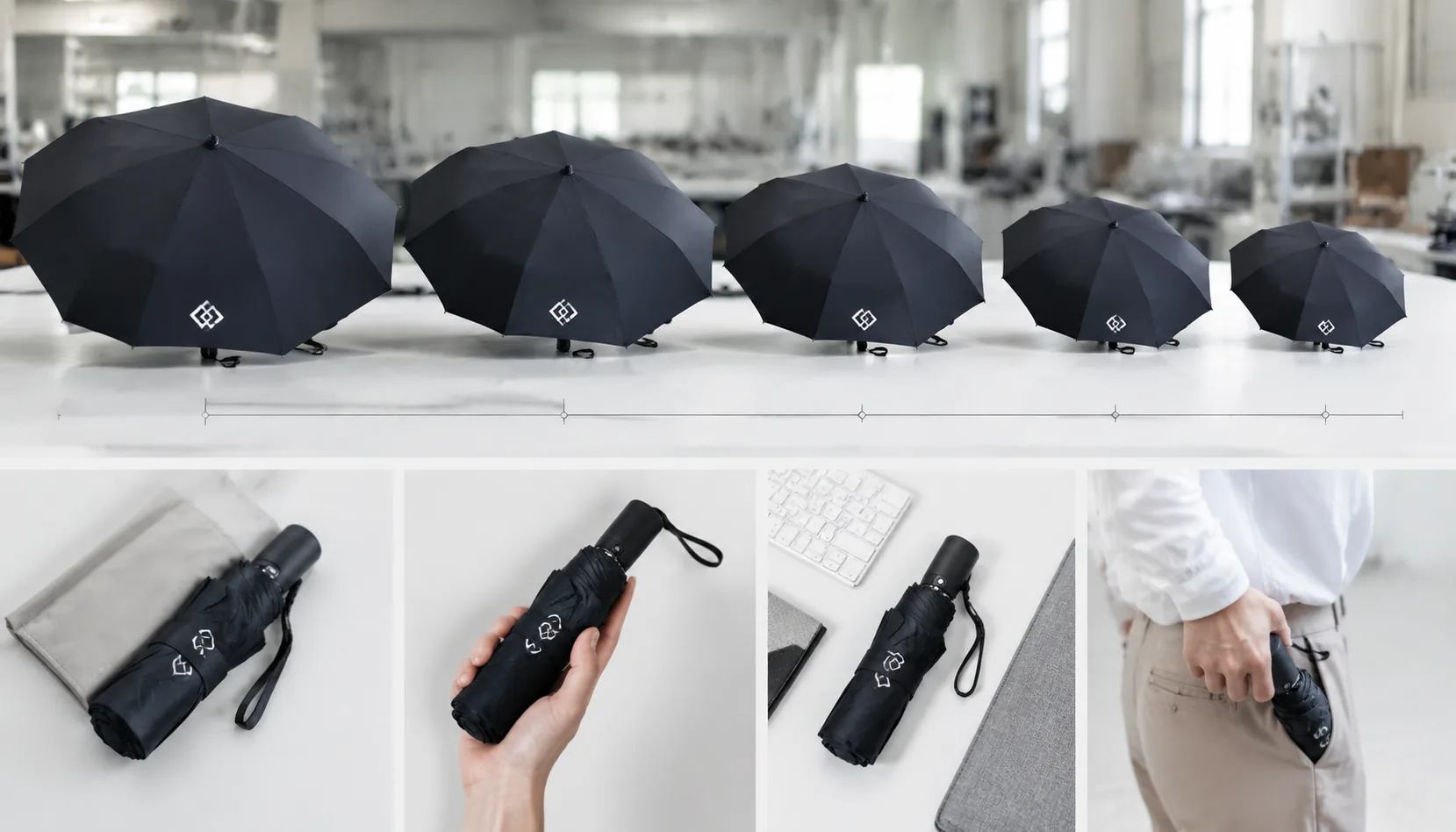
Logo Scale Rules for Compact Folding Promotional Umbrellas
Set practical logo sizes for 3-fold and 5-fold umbrellas, balancing panel width, auto-open frames, rib layout, MOQ, and ...
Read More »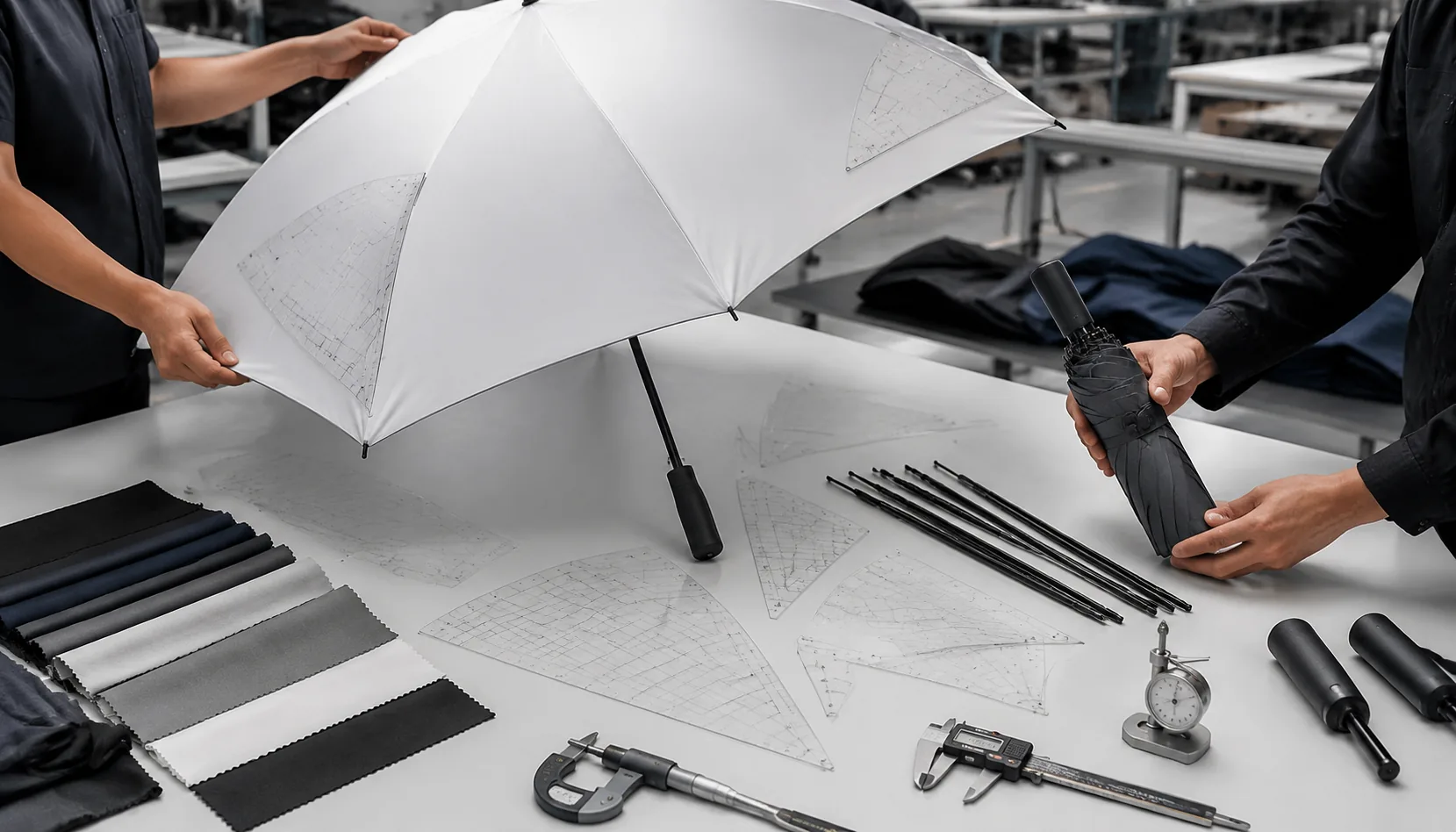
Logo Scaling on Folding and Golf Umbrellas for Brand Teams
Set practical logo sizes across folding, stick, and golf umbrellas while accounting for ribs, panels, print methods, mec...
Read More »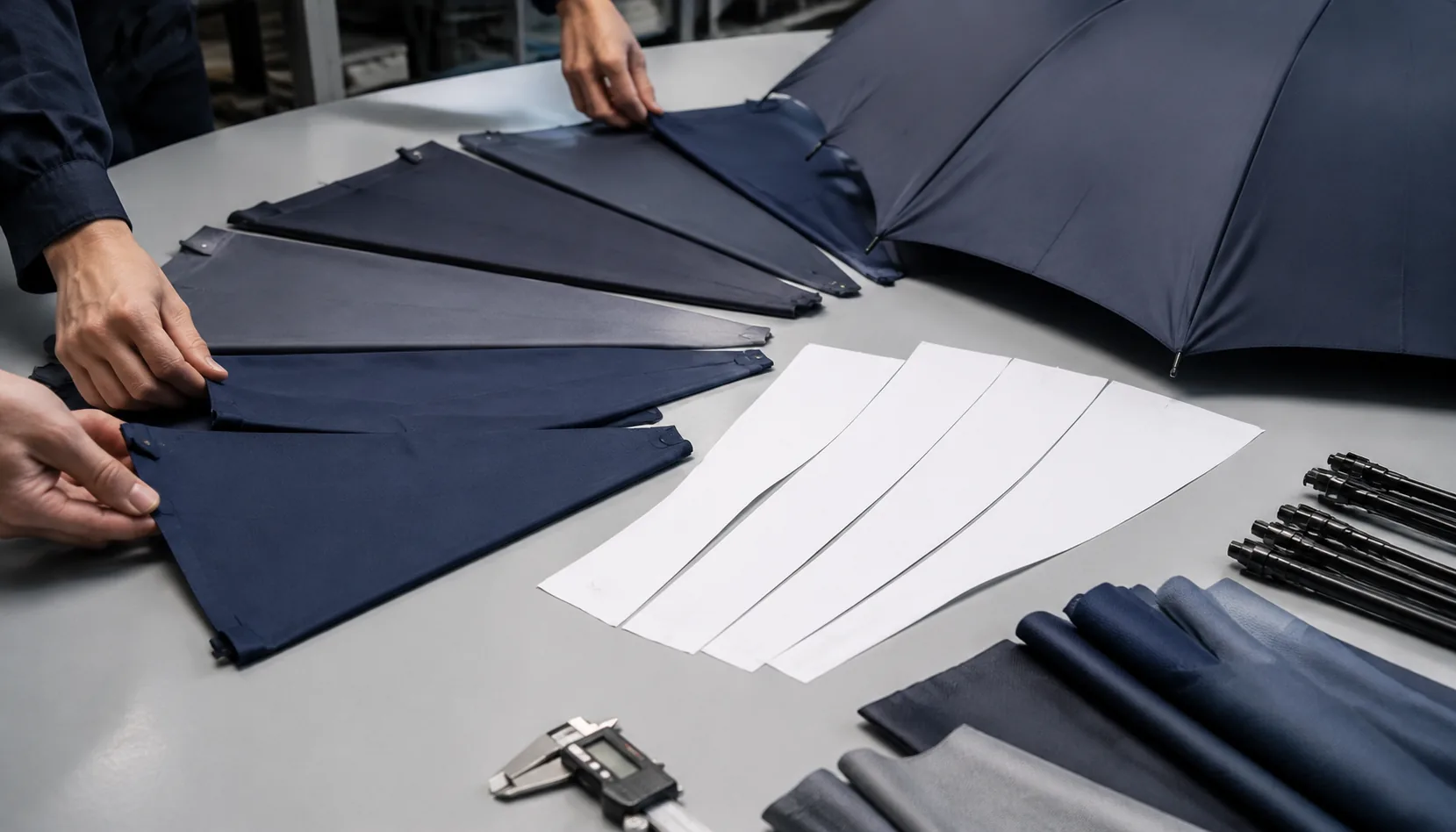
Logo Placement on Umbrella Panels: A Buyer’s Spec Guide
Avoid artwork delays by specifying logo size, panel position, seam clearance, fabric, proofing, and inspection requireme...
Read More »