Branded Umbrellas for City Tours and Walking Guides
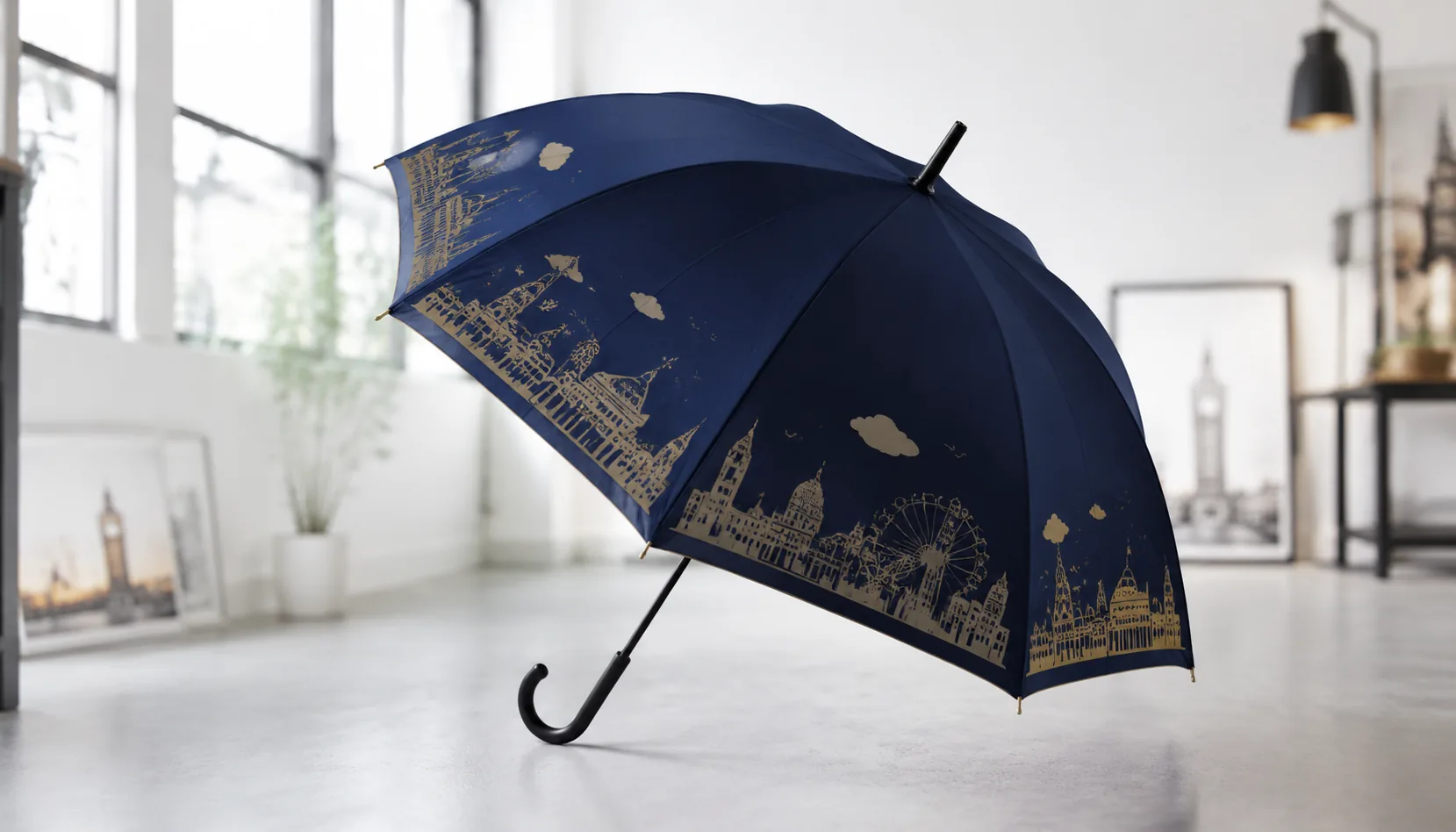
For walking tour operators, an umbrella is more than rain cover: it has to keep guests comfortable, make the guide easy to spot, and survive repeated opening, closing, and curbside wind. When we build city tour umbrellas on the factory floor in Songxia, we look first at canopy diameter, UPF 50+ fabric, rib strength, handle grip, and print placement, because those choices decide whether a branded batch works smoothly across a full season.
Why Walking Tours Need Purpose-Built Umbrellas
Walking routes fail fast when the umbrella is wrong. Guests need compact folding umbrellas they can carry in a backpack or tote, but guides need larger stick umbrellas that stay visible above a crowd and do not collapse every time a stop-and-go pace changes. For city tour umbrellas, the job is not only rain protection; it is also sun shade on exposed streets, waiting areas, and open plazas where a 210T pongee canopy with a UV coating matters more than people expect. In practice, a good tour program usually splits the load: lightweight 21" or 23" folding units for visitors, and 27" or 30" straight umbrellas for the guide so the group can spot the leader from a distance.
Crowded sidewalks create a visibility problem before they create a weather problem. Walking tour guide umbrellas need a taller profile, stronger fiberglass ribs, and a canopy color that reads clearly in traffic, museums districts, and night markets where headcounts change constantly. A guide holding a bright branded stick umbrella is easier to follow than someone waving a lanyard or sign that disappears behind pedestrians, delivery bikes, and street furniture. That is why destination marketing umbrellas work best when they are designed for group management, not just logo placement: the handle, shaft length, canopy size, and print area all support wayfinding, photo recognition, and quick regrouping after a crossing or stop.
For guests, bulk travel umbrellas should be compact enough to hand out at check-in, hotel pickup, or a rain contingency point without adding bulk to the day bag. For operators, branded tourist umbrellas need to survive repeated opening in tight spaces, so auto-open mechanisms and reinforced tips are worth the extra cost. We see the best results when the guest umbrellas are small, light, and easy to pack, while the guide umbrella is oversized enough to anchor the whole group visually. That split gives tour companies a practical tool for weather, shade, and crowd control in one kit, which is what city tour umbrellas are supposed to do in the first place.
Canopy Color, Visibility, and UPF Requirements
For city tour umbrellas, the canopy has to work like a moving signpost first and a rain cover second. I prefer saturated colors that can be seen across a plaza: safety yellow, royal blue, orange, red, lime green, or a strong two-tone panel layout. Black looks premium in a showroom, but it disappears in a crowd and becomes hot under summer sun. For walking tour guide umbrellas, keep the guide’s unit different from the guest units: for example, a 27" auto-open umbrella in yellow for the guide and 23" manual umbrellas in navy for guests. Logos should be high contrast, not subtle tone-on-tone. White ink on navy, black on yellow, or red on white reads much better than metallic gray on charcoal. On 8K steel frames this is fine for low-cost programs, but for repeated outdoor use I would move to fiberglass ribs because dropped umbrellas and gusty street corners expose weak rib joints quickly.
Reflective trim is not only for rainwear; it helps tour groups stay visible during dusk food tours, harbor walks, and old-town routes with mixed pedestrian and scooter traffic. A 5 mm to 10 mm reflective edge tape around the canopy or a reflective logo strip on two panels is usually enough without making the umbrella look like road-safety equipment. For daytime destination marketing umbrellas, specify UV coating with UPF 50+ if the umbrellas will be used in summer, at high altitude, near beaches, or on open-top city routes where shade is limited. A silver underside gives strong sun blocking but changes the look; a clear UV treatment on 190T or 210T pongee keeps the exterior color cleaner. I would avoid PVC for long walking tours because it traps heat and gets stiff in cold weather, while POE is useful only when see-through visibility is more important than shade.
190T pongee is enough for most bulk travel umbrellas when the goal is handout volume, airport transfers, cruise excursions, student groups, or one-season promotional use. It prints cleanly by screen print or heat transfer, dries faster than polyester taffeta, and keeps FOB cost controlled at MOQs around 500 to 1,000 pieces per color. For premium branded tourist umbrellas tied to a museum, hotel concierge desk, city bureau, or paid walking route, I would specify 210T pongee with Teflon water-repellent finishing and UPF 50+ coating. The fabric feels denser in hand, resists wrinkling better after packing, and supports sharper logo edges on large canopy panels. Our standard practice at ZheBrella is to check color panels under daylight and indoor lighting before bulk cutting, because orange, red, and blue can shift noticeably after coating; for retail-facing programs, we also hold canopy inspection to AQL 2.5 before final carton packing.
Frame Specs for Repeated Daily Use
For tour operators, the cheapest 8K steel-rib umbrella is usually the wrong place to save money if guides are opening and closing it 20 to 40 times a day. A standard 23" 8K steel frame with a 190T pongee canopy can work for light drizzle, flat streets, and short promotional handouts, but steel ribs take a permanent bend after repeated inversion. Once one rib is out of line, the canopy tension goes uneven and the umbrella starts looking tired in photos. For city tour umbrellas used by paid guides, I prefer fiberglass ribs with a steel shaft or full fiberglass frame, especially in 8K or 10K construction. Fiberglass flexes back instead of kinking, so it survives gusts around bus stops, waterfronts, bridges, and hotel entrances much better than a budget steel frame.
Auto-open is worth specifying for walking tour guide umbrellas because the guide often has a microphone, tablet, ticket list, or flag in the other hand. A clean auto-open mechanism with a tested spring and runner is faster and safer than a stiff manual runner, but it must be matched to the frame weight; cheap auto-open parts on a 27" canopy fail early at the button or top notch. For 2-3 hour routes, a 23" or 27" straight umbrella is more practical than a compact folding model because it gives a clearer visual marker above the group. Double-canopy vented windproof designs are the better choice in coastal or high-rise cities, where gusts can lift a single canopy. A vented 190T or 210T pongee canopy with fiberglass ribs can realistically handle 40-50+ mph gusts in controlled wind testing when the sewing and rib tips are properly aligned.
Handle choice matters more than many buyers expect for branded tourist umbrellas. A thin plastic J-handle is acceptable for bulk travel umbrellas sold as souvenirs, but guides carrying the same unit all day need a thicker EVA foam grip, rubberized straight handle, or molded crook handle that does not slip when wet. For destination marketing umbrellas, the frame should also support clean branding: a stable 8K or 10K layout gives eight printable panels, while 16K looks premium but adds weight and cost. Our standard practice at ZheBrella is to test guide-use samples for button action, rib recovery, runner smoothness, canopy tension, and handle comfort before quoting production, then inspect bulk orders under AQL 2.5. For most tour programs, MOQ starts around 500-1,000 pieces, with 25-35 days production after artwork approval depending on printing method and frame stock.
Branding Models for Tourism Boards and Operators
Full-panel printing makes sense for festivals, cruise-port welcome teams, and photo-heavy campaigns where branded tourist umbrellas become part of the street scene. Sublimation on white pongee gives the best color range for skyline artwork, while screen printing is more economical for 1–3 spot colors at bulk travel umbrellas quantities. Heritage walks, luxury hotel tours, and private museum routes usually look better with discreet one-panel branding, tone-on-tone ink, woven sleeve labels, or a small handle badge. Our standard practice at ZheBrella is to approve artwork with a strike-off before mass production, then inspect logo placement, color tolerance, seam alignment, sleeve fit, and hang tag attachment under AQL 2.5; normal lead time is about 25–35 days after sample approval, depending on print coverage and MOQ.
Ordering, Packing, and Seasonal Replenishment
Order planning for city tour umbrellas should start with the real constraint: production space fills before the weather changes. For walking-tour operators, DMOs, and cruise excursion teams, I usually advise locking artwork and quantities 45 to 60 days before spring and summer travel peaks. A practical MOQ is 500 pieces for one logo on a standard 23" manual or auto-open stick umbrella, while custom canopy colors, PMS-matched handles, or 27" golf sizes often move better at 1,000 pieces. Mixed-color orders are possible, but buyers should keep the same frame, rib count, canopy fabric, and print method if they want factory pricing to stay clean. For example, 1,200 pieces split across navy, red, and yellow 190T pongee panels is much easier than mixing 21" folding, 23" stick, and 30" golf umbrellas in one PO. Sample approval should include canopy color under daylight, logo placement, print opacity, opening force, and rib alignment, not just a photo of the top panel.
For city tour umbrellas, packing details matter because guides often store cartons in hotel basements, bus depots, visitor centers, or event trailers. A standard 23" straight umbrella typically packs 24 pieces per export carton, around 86 x 25 x 22 cm, with a gross weight near 13 to 16 kg depending on steel or fiberglass ribs. Compact 21" auto-open-close models may pack 50 pieces per carton, closer to 44 x 32 x 30 cm, while 27" golf umbrellas usually ship 24 pieces in longer cartons around 100 x 28 x 24 cm. Ask the supplier to quote carton count, CBM, and gross weight with the proforma invoice, because those numbers drive ocean freight, courier surcharges, and warehouse receiving costs. For walking tour guide umbrellas, individual polybags protect the canopy, but I prefer grouped inner bundles of 12 pieces so staff can issue stock quickly without tearing open a whole carton during morning tour setup.
FOB Ningbo or Shanghai is usually the cleanest term for distributors already consolidating bulk travel umbrellas with other promotional goods, while DDP is better for museums, tourism boards, and event planners that do not want to manage customs clearance. At ZheBrella, normal production after sample approval is about 25 to 35 days for stock fabrics with screen printing, 35 to 45 days for heat-transfer logos or mixed PMS panels, and longer if a new molded handle or special UPF 50+ coating is required. Destination marketing umbrellas should be replenished by forecast, not by panic reorder: review sell-through after the first major holiday weekend, then place a second run before July if walking traffic is strong. Branded tourist umbrellas are seasonal, but rain events are not predictable, so keeping 15% to 20% buffer stock avoids the common problem of guides holding mismatched retail umbrellas in photos. Put AQL 2.5 inspection into the PO, especially for open-close function, print registration, seam strength, and carton drop condition before shipment.
Frequently Asked Questions
Should walking tour operators buy folding or straight umbrellas?
Guides often prefer straight umbrellas because they are easier for guests to spot. Folding umbrellas work better as guest loaners or retail add-ons because they fit into bags and hotel rooms.
Can tour umbrellas include sun protection as well as rain protection?
Yes. A silver-coated or black-coated pongee canopy can reach UPF 50+, making the umbrella useful for sunny city routes as well as rainy days.
What umbrella size works best for walking tour guides?
For guides, a 27-inch to 30-inch golf-style umbrella is easier for guests to spot from a distance. For guest handouts, compact 21-inch to 23-inch folding umbrellas are lighter and easier to carry during long walking tours.
Can walking tour umbrellas use different colors for each route or language group?
Yes. Buyers often assign separate canopy colors or panel prints by route, language, or sponsor. For OEM production, mixed colors are usually possible within the total MOQ, but exact color splits should be confirmed before sampling.
How early should tour operators order branded umbrellas before peak season?
Plan around 45 to 60 days for sampling, production, quality inspection, and export delivery. For peak spring and summer travel seasons, confirm artwork and order quantities at least 8 to 10 weeks before the first scheduled tours.
Looking to Launch Your Custom Umbrella Line?
ZheBrella is a Zhejiang-based OEM/ODM umbrella manufacturer with 17 years of export experience. Free design, low MOQ from 100 pieces, windproof construction, full-color print.
Get Free Quote Now »People Also Search For
Related Articles
Custom Umbrellas for Car Rental and Mobility Operators
Build umbrella programs for car rental desks, premium vehicles, shuttle areas, and loyalty perks with practical specs an...
Read More »
Branded Umbrellas for Cruise Lines and Ferry Operators
Source marine-ready umbrellas for shore excursions, terminals, and onboard retail with windproof frames, 210T pongee, AQ...
Read More »
Branded Umbrellas for Outdoor Recreation Tour Operators
Source umbrellas for tour operators with windproof frames, UPF 50+ shade, compact packing, and lead-time planning for gu...
Read More »