Choosing Print Finish and Ink Type for Promotional Umbrellas
Choosing the right decoration is not just a design decision; it affects how the umbrella looks on day one, how it holds up after rain and handling, and whether the order fits the budget and schedule. The right umbrella print finish depends on the canopy fabric, the ink system, and the brand image you need to project. On the factory floor, those choices also change cure time, color accuracy, MOQ, and overall lead time.
Common print finishes used on umbrellas
Matte, gloss, high-opacity, reflective, and tonal are the main umbrella print finish options, and they behave very differently once you move off a flat swatch and onto a curved 8K or 10K canopy panel. A matte logo print sits down in the fabric and usually reads cleaner on 190T or 210T pongee because it cuts glare and makes small type easier to read at arm’s length. Glossy logo print is the opposite: it catches light, so it works when you want a sharper retail look, but on dark canopies it can start to look busy if the artwork is too detailed. For promotional umbrellas, matte is usually the safest choice because it tolerates mixed lighting, lower-cost artwork, and fast turn printing without calling attention to ink thickness or registration errors.
High-opacity printing is the practical answer when the base fabric is dark, patterned, or UV-coated and you need the brand color to hold. On a UV print on umbrellas program, especially with black, navy, or forest canopies, standard CMYK can look weak unless the white underbase is built correctly; otherwise the logo shifts muddy and loses contrast. That is why premium retail programs often use an opaque spot color system or a heavier ink deposit, while a cheaper promo giveaway may accept thinner coverage as long as the mark is legible from a few feet away. ZheBrella’s standard practice is to match the finish to the canopy color and the viewing distance, not to over-spec the ink and create cracking on fold lines near the ribs and seams.
Reflective printing and tonal effects are more specialized. Reflective printing makes sense for safety-oriented commuter umbrellas, event staff, and outdoor promotions where visibility matters, but it usually costs more and can feel out of place on a fashion retail line unless the brand is going for a technical look. Tonal prints, where the logo is only a shade or two lighter or darker than the canopy, are better for premium corporate gifts because they signal restraint; they work well on POE, matte polyester, and some double-canopy vented windproof styles where the brand wants subtlety instead of billboard graphics. In practice, matte logo print suits giveaways, high-opacity and gloss can work for retail programs, and tonal or reflective printing is best reserved for higher-value promotional umbrellas where the finish is part of the positioning, not just decoration.
Ink selection by canopy material
On pongee, pigment screen ink is still the workhorse when you need a durable umbrella print finish with predictable cost and decent hand feel. 190T and 210T pongee can both take it, but the tighter 210T weave usually gives cleaner edges and less strike-through, while 190T often needs a higher-opacity base or a second pass if the logo has light colors, thin strokes, or large solid areas. That matters on promotional umbrellas because a weak white or pastel print will read muddy once the canopy stretches over the ribs. Our standard practice is to test the actual fabric lot before approving artwork, since coating weight, dye depth, and calendaring change how much the ink sits on top versus bites into the cloth.
Transfer systems make more sense when the artwork has gradients, small type, or a full-color brand build that would be expensive to separate into multiple screens. On polyester canopy panels, heat transfer can hold sharp detail and a more consistent glossy logo print, but the film and adhesive have to survive folding, wet abrasion, and repeated opening cycles. If the buyer wants a matte logo print, we usually steer them toward a lower-gloss transfer film or a pigment system with a flatter binder package, because a high-shine finish can look cheap on a dark canopy. Reflective printing is a separate decision: it works well for safety-oriented promotional umbrellas, but it should be specified as a limited-area accent, not a full-panel solution, because the cost and hand feel are both materially different.
UV print on umbrellas is the right tool for clear POE panels because it cures on the surface fast and can print white underbase, full color, and spot effects without waiting for solvent flash-off. On transparent POE, opacity is the real problem, not color gamut, so a high-opacity white or double-hit build is often required to keep text readable once light passes through the canopy. UV-curable ink can also be used on polyester when the panel is pretreated, but on flexible fabric it is less forgiving than pigment if the umbrella will be packed tightly or rubbed hard in transit. For 190T or lighter 210T constructions, high-opacity ink is the safer choice whenever the logo includes white, pale yellow, or fine negative space, because show-through from the opposite side will otherwise weaken the whole umbrella print finish.
Branding goals versus weather performance
On light-colored canopies, dark ink gives the strongest day-to-day legibility because the contrast stays readable when the umbrella is moving and the panel is wet. That matters for promotional umbrellas used at golf outings, trade shows, and stadium gates, where people see the logo at arm’s length, not on a flat tabletop. A matte logo print usually looks cleaner on pongee 190T or 210T because it cuts glare and keeps type sharp in overcast rain, while a glossy logo print can look heavier and more saturated if the brand wants a more obvious retail-style finish. The practical choice is not just color but umbrella print finish, because rain changes how both the fabric and the ink reflect light.
Light ink on dark fabric works when the goal is a softer, more premium appearance, but it needs enough opacity or it disappears once the canopy is backlit. White, silver, and pale yellow are common because they hold shape against navy, black, or forest green panels, yet they can look weak if the ink layer is too thin or the fabric weave is too coarse. This is where UV print on umbrellas is useful: it can lay down dense color with better edge control on synthetic canopies, especially when the artwork has fine lettering or small registration marks. If the brand wants more impact in low light, a controlled glossy logo print can help, but I would still avoid high-gloss on large solid areas because it shows stitching distortion and water spotting too easily.
Metallic or reflective accents are the right answer when visibility matters more than pure brand color accuracy. Reflective printing on a runner edge, panel tip, or logo outline catches headlights and event lighting, so the umbrella is easier to notice in rain, dusk, or a crowded outdoor queue. That pairing makes the most sense on windproof double-canopy models, because the vented structure already suits outdoor event use and gives the print a larger, flatter visual field than a cheap single-canopy frame that flaps in the wind. For these jobs, I usually recommend a restrained umbrella print finish: matte base artwork for readability, then a reflective accent for safety and distance recognition. It is a better tradeoff than trying to make one oversized glossy logo do everything at once.
Proofing for color and effect control
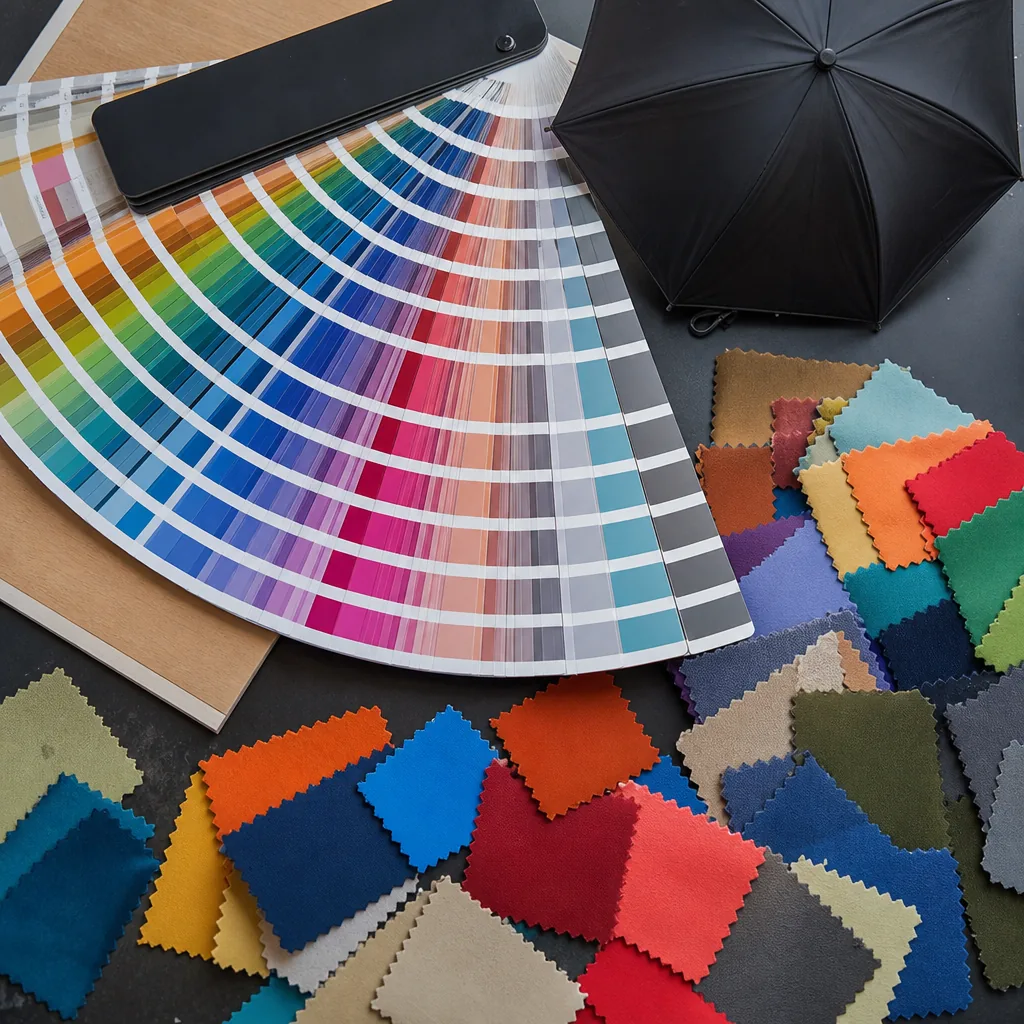
The only reliable way to approve an umbrella print finish is on a physical strike-off, not on a screen render. Lock the Pantone target first, then compare the sample against a printed swatch book under the same substrate and ink system you plan to run in bulk, because pongee 190T, 210T, POE, and PVC all shift color differently. On promotional umbrellas, I ask for a clear approval note on gloss level as well: matte logo print should stay low-sheen with no wet look, while glossy logo print should hold a deliberate shine without flooding the weave. If the job uses UV print on umbrellas, confirm that the white underbase, if any, does not bleach out the top color and that the hand feel stays flat enough for folding and packing. The sample should also define the acceptable umbrella print finish against the actual panel curvature, seam line, and canopy stretch, because a logo can look correct on a flat proof and still fail once sewn.
Edge crispness matters as much as color. Before release to bulk production, inspect the sample under daylight near a window and again under indoor lighting, ideally a 4000K to 6500K source, because reflective printing and metallic effects can swing hard between environments. Look for haloing, pinholes, overspray, and any compression distortion where the panel is tensioned across ribs or near tips. For a matte logo print, check that the boundary stays sharp with no scuffing after a light rub test; for a glossy logo print, verify that the gloss is even across the full mark and does not pool at the edges. On UV print on umbrellas, judge the cure by touch and by bend resistance, not just appearance. I also require a final sign-off on the umbrella print finish at the exact canopy color, because a white or dark ground changes perceived density, saturation, and contrast more than most buyers expect.
Commercial planning for custom print programs
A workable commercial plan starts with the print method, because the umbrella print finish drives both setup cost and production risk. For a simple one-color logo on promotional umbrellas, buyers usually see the lowest MOQ and the shortest approval cycle, while multi-color artwork, full-panel UV print on umbrellas, reflective printing, or a matte logo print with a special overprint pushes up screen setup, alignment checks, and reject risk. Sample cost should be treated separately from mass production: one decorated pre-production sample is often charged at a higher unit price because it carries plate making, ink matching, and labor for a single piece. For planning, ask for three numbers up front: sample fee, MOQ by print method, and mass lead time after art approval. At ZheBrella, we quote these as a package because changing the finish late, such as moving from glossy logo print to a soft-touch matte finish, can change ink type, curing temperature, and drying time.
Shipping terms matter just as much as decoration, because FOB and DDP change who carries the freight, duty, and local delivery burden. FOB is cleaner when the buyer already has a forwarder; DDP is better when the buyer wants landed pricing, but it adds customs and brokerage variables that should be priced into the quote. Print complexity affects cost beyond ink consumption: more colors, tighter registration, wraparound placement, and reflective printing all increase inspection time and the chance of color drift between panels. That is why AQL 2.5 matters on finish defects and color variation. On a practical line, AQL 2.5 means you do not accept visible pinholes, ink cracks, ghosting, or panel-to-panel shade mismatch as routine output; you sample enough units to catch process loss before the whole lot ships. For higher-value programs, specify the ink system, target Pantone references, and acceptable gloss level before production starts, not after the first carton is packed.
Frequently Asked Questions
When should a buyer choose reflective or metallic print on umbrellas?
Use reflective or metallic effects when visibility matters, such as commuter retail, night events, or outdoor promotions. They cost more than standard inks, so they make the most sense on higher-value programs.
Does a glossy print finish last as well as matte on umbrellas?
It can, if the ink system and curing are correct, but gloss often shows scratches and handling marks more easily. For heavy promotional use, a matte or semi-gloss finish is usually safer.
Which print finish is better for premium corporate umbrellas, matte or glossy?
Matte finishes usually suit premium corporate programs because they look cleaner and reduce glare under bright light. Glossy prints can improve color pop for retail-style branding, but they show fingerprints and surface wear more easily on darker canopies.
How does UV print compare with standard screen printing on umbrellas?
UV print gives sharper detail and works well for multi-color logos or small text, especially when you need a flatter, more exact finish. Standard screen printing is usually more economical for larger runs and simple one- to two-color logos, with MOQ often starting around 300 to 500 pieces depending on the factory.
What lead time should a buyer expect for custom print finish testing and bulk production?
Sample approval for ink and finish selection usually takes 5 to 10 days, and bulk production commonly takes 20 to 35 days after approval. If a special reflective or UV-cured finish is required, allow extra time for color matching and adhesion testing on the canopy fabric.
Looking to Launch Your Custom Umbrella Line?
ZheBrella is a Zhejiang-based OEM/ODM umbrella manufacturer with 17 years of export experience. Free design, low MOQ from 100 pieces, windproof construction, full-color print.
Get Free Quote Now »People Also Search For
Related Articles
Metallic and Foil Logo Printing on Promotional Umbrellas
Learn when metallic or foil effects add value to promotional umbrellas, with guidance on print methods, durability, MOQ,...
Read More »
Ink, Fabric, and Logo Sharpness on Branded Umbrellas
See how ink choice, fabric weave, and canopy construction affect logo sharpness, wash durability, and consistency across...
Read More »
White Ink Underbase for Dark Umbrella Canopy Logos
Learn when white underbase improves logo opacity on dark umbrella canopies, with fabric, ink, sampling, MOQ, and QC tips...
Read More »