White Ink Underbase for Dark Umbrella Canopy Logos
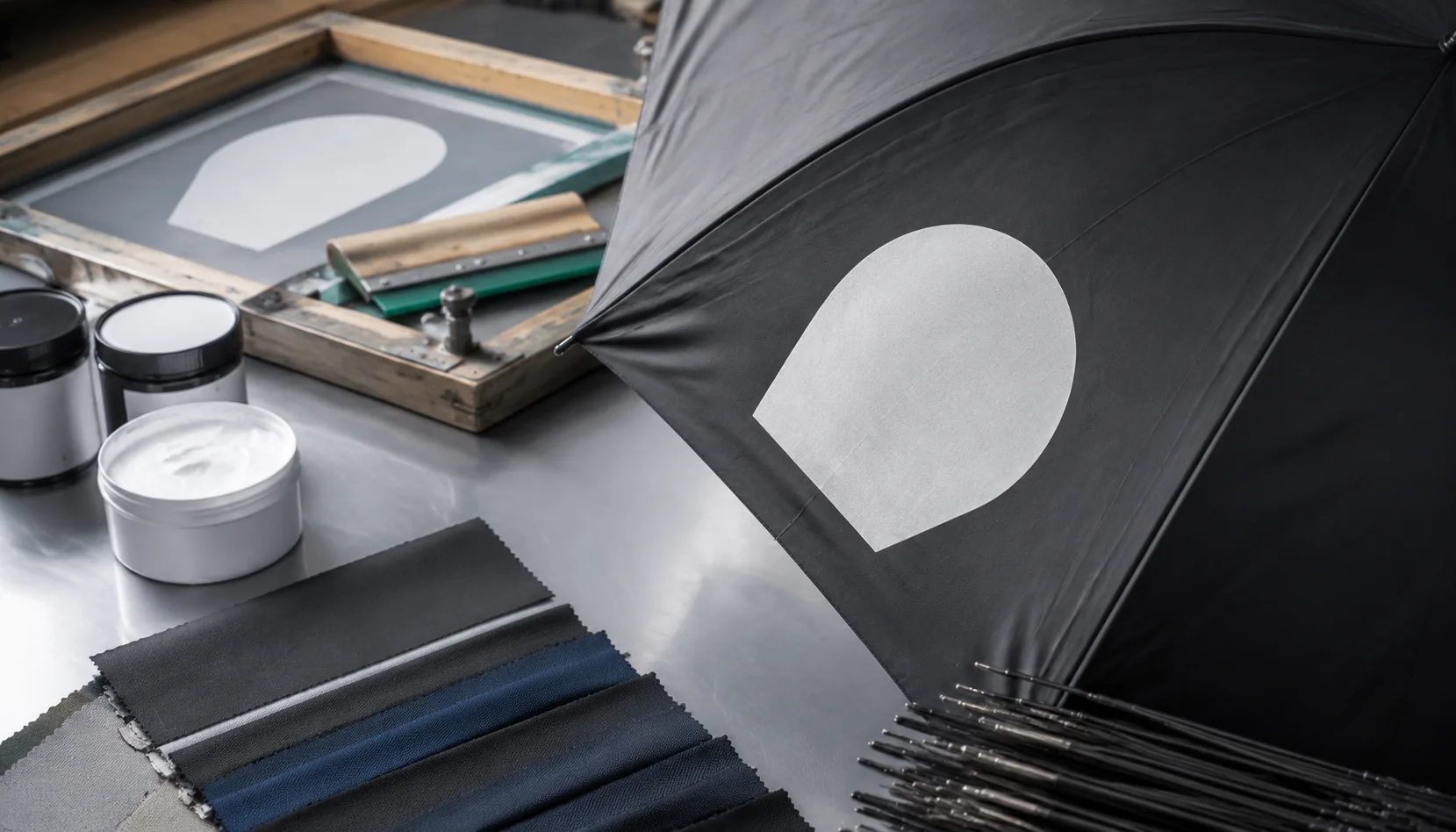
Dark canopy logos look simple on a spec sheet, but on the print table they can turn dull fast as polyester weave, coating, and ink load pull color into the fabric. For white ink underbase umbrella logos, the real question is not whether to add another layer, but when that layer improves opacity without making the print stiff, slow to cure, or risky in folding. We judge it by fabric color, logo detail, ink system, sample wash/rub results, and the buyer’s MOQ and tolerance target.
Why Dark Canopies Need an Underbase
Dark pongee is not a neutral background; it behaves like a color filter sitting under the ink. On navy, black, bottle green, and deep red 190T/210T pongee, a logo printed directly with yellow, light blue, orange, or gray often looks dirty or two shades darker after curing. The problem is worse on water-repellent coated fabric because the ink film stays relatively thin, especially in branded umbrella printing where buyers want a soft hand and clean fold lines. A white ink underbase umbrella logos setup puts an opaque white layer down first, then prints the brand color on top, so the top color reads against white instead of against the canopy. Without that screen print underbase, a Pantone 299C blue on navy can collapse into a dull teal, and a warm red logo on bottle green can turn brownish at normal viewing distance.
Underbase is not only for full-color artwork. White logos on black or navy usually need two hits of white, or one underbase plus one highlight white, because a single pass can look smoky after abrasion testing. Metallic gold and silver also need an underbase on dark canopy logo printing; otherwise the metallic particles reflect less light and the logo loses the premium effect the buyer paid for. Pastels are even less forgiving: mint, cream, baby pink, lavender, and light gray should be treated as underbase-required unless the customer accepts a muted result. For promotional umbrella logos, I always ask whether the brand owner is Pantone-sensitive. If the answer is yes, we print a strike-off on the actual canopy fabric, not on paper or spare white cloth, because the same ink formula behaves differently on 190T pongee versus 210T pongee with heavier PU or Teflon treatment.
The practical production rule is simple: if the logo color is lighter than the canopy, contains white, uses metallic ink, or must match a corporate Pantone within a tight tolerance, plan for an underbase. The tradeoff is cost and registration control. A separate white screen adds setup time, another curing pass, and slightly more ink buildup at fold points, so the artwork should avoid hairline reverses under 0.3 mm and tiny text below about 6 pt. Our standard practice at ZheBrella is to choke the white underbase by roughly 0.1–0.2 mm so it does not peek out around the color layer when the canopy panel shifts slightly on the print table. For AQL 2.5 inspection, we check color consistency after drying, rub resistance, and whether the logo still looks clean when the umbrella is opened under daylight, not only under factory LED lamps.
How Underbase Changes Print Cost and Setup
An underbase adds cost because it is not a color choice; it is a separate production step. For dark canopy logo printing on navy, black, bottle green, or burgundy pongee, we normally burn one extra screen for the white layer, pull one extra ink pass, flash or tunnel-dry it, then print the top colors after the white is stable enough not to smear. On a simple 1-color logo, that can turn the job into effectively a 2-screen setup. On a 3-color retail logo, it becomes 4 screens, with more mesh cleaning, more registration checks, and more test strikes before bulk production. This is why white ink underbase umbrella logos usually price higher than the same artwork printed on white or light gray canopy fabric. The buyer sees only a brighter logo; the factory sees extra screen room time, ink handling, and a slower print line.
Registration is the part buyers underestimate. Umbrella panels are not flat T-shirts; they are triangular cuts of 190T or 210T pongee, often with bias stretch near the edge. If the screen print underbase is 0.5 mm off from the top color, a white halo shows around the artwork, especially on small type, QR codes, thin outlines, and sponsor marks. Our standard practice at ZheBrella is to choke the underbase slightly, usually 0.2-0.4 mm inside the top color, then run a printed panel approval before sewing. For promotional umbrella logos, I prefer underbase only where opacity is needed, not under every fine detail. Heat-transfer can reduce registration risk for complex logos, but it changes hand feel and unit cost, so screen printing still wins on larger MOQs and bold artwork.
Cost also moves with print area, panel count, and umbrella type. One 80 x 120 mm logo on a single folding umbrella panel is a modest surcharge; an 8-panel repeat on a 23 inch stick umbrella or a 30 inch golf umbrella consumes far more ink, drying rack space, and operator time. Golf umbrellas are slower because the print area is larger and the panel curve after sewing makes placement mistakes more visible. Folding umbrellas add handling cost because smaller panels and tighter seam tolerances leave less room for jig error. MOQ matters too: at 100 pieces, screen setup dominates the price; at 1,000 or 3,000 pieces, the extra underbase cost spreads out and becomes mainly ink and labor. For branded umbrella printing quoted FOB or DDP, underbase also affects sampling lead time, often adding 1-3 days before mass production approval.
Best Fabrics and Frames for Clean Registration
For dark canopy logo printing, 210T pongee is usually the safer fabric when the artwork has tight edges, small text, or a white ink underbase umbrella logos specification. The yarn is denser than 190T, so it moves less when the screen print underbase is pulled across the panel and then hit with top colors. A 190T pongee canopy is still common for promotional umbrella logos because it keeps cost down and folds softer on 21" and 23" compact models, but it can stretch slightly more across the bias, especially after water-repellent or Teflon finishing. That movement is small in hand feel, but it shows up as a 0.5–1.0 mm color shadow when white and color layers are not registered carefully. For retail-grade branded umbrella printing, I prefer 210T pongee on dark navy, black, bottle green, and burgundy canopies because the white base lays flatter and the top ink does not sink into the weave as unevenly.
Panel geometry matters as much as fabric. An 8K umbrella gives wider panels, so a 4" to 7" logo can sit comfortably between two rib seams without being squeezed into the panel peak. That is why most golf umbrellas in 27" and 30" sizes print cleaner on 8K layouts when the buyer wants a large chest-style brand mark. A 16K frame has narrower panels and more seam breaks, which looks premium when opened but reduces the safe print zone; the same logo may need to shrink 15–25% or move lower toward the valance arc. On 10K and 16K frames, registration marks should be checked against the actual cut panel, not just the AI/PDF template, because sewing allowance and rib-pocket position change the visible centerline. Our standard practice at ZheBrella is to confirm logo placement on a stitched production panel before bulk printing, not only on flat fabric.
Frame choice changes panel tension after printing, and that affects how clean the logo looks when the umbrella is opened. Fiberglass ribs flex and recover better than steel ribs, so they reduce hard stress lines near the seam and are more forgiving on windproof umbrellas rated around 50+ mph in tunnel-style testing. Steel ribs create a firmer, cheaper structure, but on low-cost manual or auto-open models they can pull the fabric tighter at the rib tips, making a thick white underbase look slightly cracked if the ink film was over-cured or too heavy. Double-canopy vented windproof builds need extra attention because the upper and lower layers move differently; if the print is placed too close to the vent overlap, the logo can distort when the canopy vents in gusts. For clean white ink underbase umbrella logos, keep artwork inside the stable middle third of the panel, avoid seam crowns, and approve samples opened on the final 8K, 10K, or 16K frame.
Sampling and Approval Checks Before Bulk
Logo edges need inspection after the umbrella has been opened and closed, not only while the panel is flat. Ask the factory to cycle the sample 20–50 times using the same mechanism planned for bulk, whether manual, auto-open, or auto-open-close, then inspect the print at rib contact points, fold lines, seam allowances, and the crown area. A screen print underbase that is too heavy may crack along fold memory lines; one that is too light will let the canopy color dull the logo. Check for sawtooth edges, pinholes, misregistration between the white base and top color, and ink bridging over woven texture. Promotional umbrella logos often fail visually at a 1–2 mm offset, especially on 8K and 10K frames where panel tension pulls artwork outward. The approved sample should define the acceptable edge sharpness and underbase trap before bulk, then production inspection can hold the same standard under AQL 2.5 instead of arguing by opinion later.
Bulk QC Points Buyers Should Specify
For bulk orders, buyers should write the QC standard into the PO before artwork approval, not after the first cartons are packed. For white ink underbase umbrella logos on black, navy, forest green, or burgundy 190T/210T pongee, I would specify AQL 2.5 for major defects and AQL 4.0 for minor cosmetic issues, with random sampling pulled after final drying and folding. Major defects should include missing underbase, visible dark fabric bleeding through the logo, wrong logo position, ink transfer to adjacent panels, and any print that fails a tape-rub or wet-rub check. Minor defects can include tiny pinholes outside the main logo field or very slight edge roughness, but only if they are not visible at normal viewing distance of about 3 ft. For dark canopy logo printing, the approval sample should be checked under daylight D65 and warehouse LED lighting because a print that looks solid indoors can look gray and weak outside.
Opacity consistency is the point most buyers under-specify. A screen print underbase should have the same white density across all panels, especially on curved umbrella sections where squeegee pressure changes near seams. I normally ask inspectors to compare production pieces against a sealed pre-production sample and reject any lot where the logo shifts more than one visible shade level or where the brand color on top changes because the underbase is too thin. Registration tolerance should also be written numerically: for most promotional umbrella logos, +/-1.0 mm between the white underbase and top color is acceptable; for fine type under 6 mm high, push that to +/-0.5 mm or simplify the artwork. If the job uses 8K, 10K, or 16K frames, check the same logo location across different rib positions because panel tension can distort the print during curing and final assembly.
Ink cracking checks must happen on real folded umbrellas, not only on flat fabric panels. Open and close samples at least 20 cycles, then inspect the logo area near folds, panel seams, and rib contact points for spider cracks, flaking, or hard ink ridges. This matters more on auto-open-close 21 inch compacts than 27 inch golf umbrellas because the fold radius is tighter and the canopy gets compressed in the sleeve. Carton-level shade grouping should also be specified: do not mix slightly different canopy dye lots or print batches inside one master carton, and mark carton numbers by production batch so retail or event distribution looks consistent. For branded umbrella printing, FOB and DDP quotes should separate frame/canopy cost, setup charge, per-position print charge, extra white underbase charge, and inland or destination delivery. If print charges are buried in one unit price, disputes become messy when artwork changes from one-color to two-color white ink underbase umbrella logos.
Frequently Asked Questions
Does every dark umbrella canopy need a white underbase?
No. Black or very dark one-color logos may not need it, but white, light, fluorescent, or Pantone-critical logos usually benefit from an underbase on dark 190T or 210T pongee.
Will a white underbase make the logo feel thicker?
It can add slight hand-feel because it requires an extra ink layer. A controlled screen mesh, correct curing, and pre-production sample help balance opacity with flexibility.
When should buyers request a white ink underbase for umbrella logos?
Request a white underbase when printing light, bright, or Pantone-critical colors on black, navy, red, or other dark polyester canopies. It is especially useful for yellow, orange, light blue, and white logo elements that may look dull without a base layer.
Does a white underbase affect sampling cost or production lead time?
Yes. A white underbase usually adds one extra screen and one extra print pass, so sample charges and unit costs can increase. For bulk OEM orders, it may add about 1–3 days depending on logo size, color count, and factory workload.
What QC checks should be done for dark canopy logo printing?
Check logo opacity under daylight, color match against the approved Pantone target, edge sharpness, and ink adhesion after folding and rubbing. Buyers should approve a pre-production sample before bulk production, especially for orders over 500–1,000 pieces.
Looking to Launch Your Custom Umbrella Line?
ZheBrella is a Zhejiang-based OEM/ODM umbrella manufacturer with 17 years of export experience. Free design, low MOQ from 100 pieces, windproof construction, full-color print.
Get Free Quote Now »People Also Search For
Related Articles
White Ink Underbase for Logos on Dark Umbrella Canopies
Learn when white ink underbase improves logo opacity on dark pongee canopies, how it affects cost, sampling, AQL checks,...
Read More »
White Ink Underbase for Dark Umbrella Logo Printing
Learn when white underbase is needed on dark umbrellas to improve logo opacity, color accuracy, durability, and buyer ap...
Read More »
White Ink Underbase Printing for Dark Umbrella Canopies
Use white underbase printing to keep logos bright on navy, black, and red canopies, with clear guidance on ink layers, s...
Read More »