White Ink Underbase Printing for Dark Umbrella Canopies
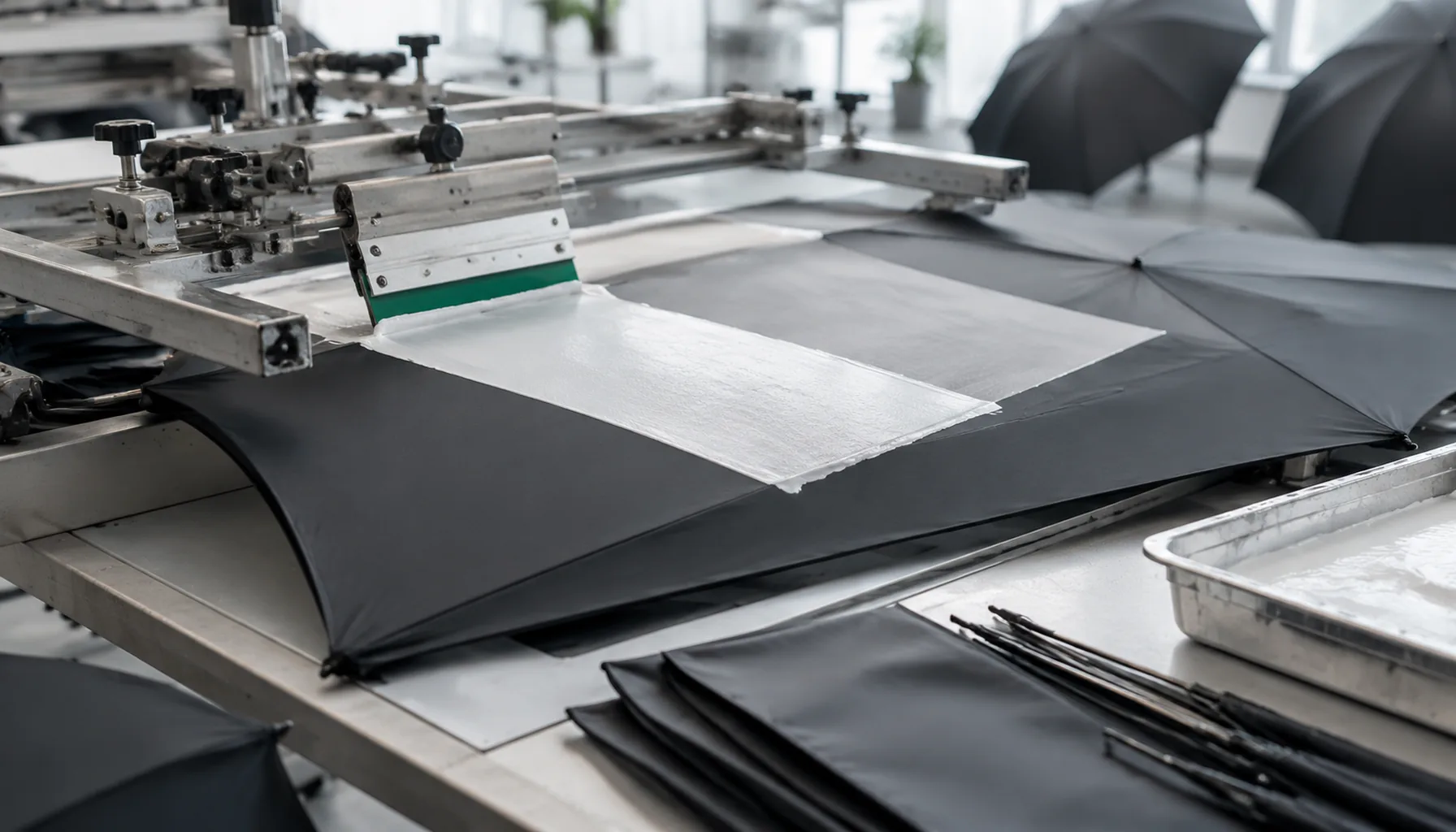
Dark umbrella canopies hide weak prints fast: navy dulls blues, black eats detail, and red can shift brand colors if the base layer is wrong. In white underbase umbrella printing, the real control happens before mass production—mesh count, flash cure, second color laydown, panel tension, and rubbing tests all decide whether a logo stays bright after folding, packing, and rain exposure.
When Dark Canopies Need a White Underbase
Dark pongee eats color because the fabric is not a neutral white base; black, navy, burgundy, and forest green 190T/210T polyester all shift ink tone before the customer ever opens the umbrella. A pale yellow logo printed directly on navy will usually turn gray-green, light blue on black can look smoky, and red on burgundy loses its edge. This is why white underbase umbrella printing exists: we first print an opaque white layer, flash-dry or cure it properly, then print the brand color on top. On umbrellas, the challenge is bigger than on a flat T-shirt because the canopy is cut into panels, sewn under tension, and later stretched over 8K or 10K ribs. If the underbase is too thick, it can crack along fold lines; if it is too thin, the dark canopy still bleeds through.
For dark canopy logo printing, I usually separate jobs into two groups: “good enough promotional” and “brand-controlled.” A one-color event giveaway on 190T black pongee may accept a slight tone drop if the buyer is chasing the lowest FOB unit cost and ordering 3,000 pieces. But retail brands, hotel groups, automotive dealers, golf tournaments, banks, and franchise chains often care more about logo color accuracy than saving a few cents per panel. If the Pantone red must stay red on a 23 inch auto-open umbrella or a 30 inch golf umbrella, direct printing is the wrong shortcut. Opaque umbrella logo ink with a white underbase gives the top color a stable surface, especially for white, yellow, orange, lime, sky blue, and metallic-look artwork.
The practical decision is made during sampling, not after mass production starts. Our standard practice at ZheBrella is to test the logo on the actual canopy fabric, not on a loose swatch from another dye lot, because navy from one mill and navy from another can absorb ink differently. For branded umbrella printing, we check opacity after curing, rub resistance, fold-line cracking, and visual match under D65 light before approving bulk. AQL 2.5 inspection will catch misregistration, pinholes, dirty white edges, and color drift, but it cannot rescue a bad print specification. If your logo has small reversed text, thin outlines under 0.3 mm, or tight multi-color registration, white underbase umbrella printing should be discussed before the quote is locked, because it affects screen count, setup cost, lead time, and realistic MOQ.
How Underbase Layers Change Print Results
The underbase is not a “primer” in the paint-shop sense; it is a printed white ink layer that blocks the dark canopy from contaminating the logo color above it. On black, navy, burgundy, or forest green 190T pongee, a red logo printed directly often turns brown and a yellow logo turns muddy. With white underbase umbrella printing, we first print an opaque white silhouette of the artwork, flash-dry or tunnel-dry it, then register the CMYK, Pantone, or spot-color layer on top. The result is much better logo color accuracy, especially for promotional marks where the buyer expects Pantone 186C red or 286C blue to look like the approved proof. The trade-off is thickness. Two ink films sit on the canopy, so the print has more hand feel than a single-color mark. On folding 21" panels this matters because heavy ink near rib fold lines can crack earlier; on 23" and 27" straight umbrellas it is usually less risky if the artwork avoids seams.
For dense white coverage, screen printing still gives the strongest opacity on woven polyester. A properly mixed opaque umbrella logo ink, usually plastisol-free water-based or solvent-based PU ink depending on destination compliance, can cover 190T and 210T pongee in one or two passes through a 100–120 mesh screen. 210T fabric has a tighter weave and smoother surface, so edge definition is cleaner and pinholes are fewer; 190T absorbs slightly more and may need a heavier flood stroke. Our standard practice at ZheBrella is to test rub fastness and adhesion after 24 hours because ink that looks dry after tunnel curing can still be soft inside. Underbase jobs also slow production: a normal one-color dark canopy logo printing order might run 1,500–2,500 panels per shift, while underbase plus top color can drop output by 30–45% due to registration checks, intermediate drying, and screen cleaning.
Heat transfer solves some screen-print limitations but creates different ones. For small multicolor logos, reflective details, gradients, or retail-grade branded umbrella printing, a transfer with a white backing layer gives very consistent color on dark 190T or 210T panels. The white is pre-built into the transfer film, so opacity is predictable and there is no wet-ink registration between underbase and top color on the canopy. However, the hand feel is usually more noticeable than screen ink, especially on large blocks over 80–100 cm², and poor press settings can leave a rectangular carrier impression on pongee. We normally use 145–155°C for 12–18 seconds with medium pressure, then check peel strength after cooling. Heat transfer is slower per panel but easier to control for complex logos; screen printing is better for large runs, simple spot colors, and flexible fabric feel when the artwork is not too dense.
Design Rules for Clean Edges and Registration
Clean white underbase umbrella printing starts with artwork that respects fabric movement, not just the logo file. On dark 190T or 210T pongee, I do not like positive strokes below 0.35 mm after scaling, and 0.5 mm is safer for retail work where the same mark repeats across 500 or 5,000 canopies. Reversed or knockout text needs more room because the dark canopy surrounds the letters and any ink gain will close the counters; keep knockout letter height above 6 mm for simple sans-serif fonts and 8 mm or more for serif or condensed type. If the buyer insists on a 3 mm legal line, we usually move it to a label, sleeve, hangtag, or single-color transfer instead of pretending it will print cleanly on a curved umbrella panel.
Trapping is not optional when white sits under red, yellow, light blue, or metallic-effect inks. For opaque umbrella logo ink on dark canopy logo printing, the white plate should usually choke 0.15 to 0.25 mm inside the top color so a slight registration shift does not leave a white halo. The exact trap depends on mesh count, ink viscosity, canopy fabric, and whether the job is screen printed panel-by-panel before sewing or printed after assembly with a jig. Heat transfer can hold tighter edges than wet screen print, but transfers still need bleed control because polyester pongee flexes over the ribs and the adhesive layer can show if the art has hairline gaps. Good branded umbrella printing separates the white plate, top color plates, and any varnish or reflective layer before sampling, not after mass production starts.
Avoid tiny multi-color details across rib seams because an umbrella is not a flat poster. On an 8K frame, the logo may cross fewer seam lines, but each panel still has bias stretch from cutting, sewing tension, and rib attachment. On 16K layouts, the narrower curved panels look elegant, but they increase the number of registration checks because the artwork is broken over more canopy sections and every seam can shift 1 to 2 mm if cutting or stitching is loose. Our standard practice at ZheBrella is to inspect logo color accuracy on a pre-production sample under D65-style light, then confirm placement against the rib layout before approving bulk. For white underbase umbrella printing, that means checking edge sharpness, underbase coverage, and color match after the canopy is opened, not only while the fabric lies flat on the printing table.
Sampling, MOQ, and Lead-Time Considerations
Sampling is where white underbase umbrella printing either proves itself or saves you from a container of muddy logos. For dark canopy logo printing on black, navy, forest green, or burgundy 190T/210T pongee, we normally start with a strike-off on the actual canopy fabric, not a loose paper proof. The printer lays down the white base first, flashes or dries it, then prints the Pantone color layer on top. That extra ink film changes hand-feel slightly and can shift edge sharpness on fine type under 1.5 mm, so the strike-off should include the smallest text, registration marks, and any gradients or metallic-effect colors. Pantone matching should be checked under D65 daylight or a light box, not yellow office lighting, because opaque umbrella logo ink can look acceptable indoors and still appear dull outdoors. Buyer approval photos should show close-up detail, full-panel scale, and a daylight comparison against the approved Pantone chip.
A pre-production sample is different from a strike-off and should not be skipped for retail or event programs where logo color accuracy matters. The strike-off confirms ink opacity and color; the pre-production sample confirms placement across the curved umbrella panel, seam allowance, rib interference, handle tag, sleeve printing, and carton marks. On a 23 inch auto-open straight umbrella with 8K fiberglass ribs, a logo printed too close to the seam may distort after sewing and tensioning, especially on double-canopy vented windproof constructions. For branded umbrella printing, our standard practice at ZheBrella is to photograph the finished sample opened, closed, sleeved, and under daylight before mass production starts. If the buyer needs courier samples, allow 3–5 days for printing setup, 2–4 days for sewing and assembly, and another 3–7 days for international express delivery depending on destination.
Underbase work can affect MOQ and schedule because the factory must reserve an extra screen, ink station, drying time, and QC checkpoint. A simple one-color logo on a dark canopy may have an MOQ of 300–500 pieces, but white underbase umbrella printing often pushes practical MOQ toward 500–1,000 pieces if the logo is large, multi-position, or requires tight Pantone control. Setup fees are also higher because each color may need its own screen plus a separate white base screen; buyers should confirm whether the quote includes strike-off, pre-production sample, and re-sampling if Pantone adjustment is needed. For lead time, add 2–5 days versus standard printing, more during March–June peak season. Under FOB Ningbo or Shanghai, production may run 25–35 days after sample approval; under DDP, build in another 20–35 days for sea freight, customs clearance, duty handling, and final-mile delivery.
Bulk Inspection Standards for Opaque Logos
Logo placement is inspected with a simple tolerance sheet: distance from panel seam, bottom hem, and rib line should normally stay within ±3 mm for retail orders and ±5 mm for basic promotional umbrellas, unless the artwork is oversized across multiple panels. A beautiful logo on a bad frame still fails the shipment, so inspection must include function checks: manual or auto-open action, auto-open-close reset, runner lock, spring force, tip attachment, and handle pull strength. Fiberglass ribs should flex without splitting at the joints, steel shafts should not wobble or show rust at the plating, and 8K/10K/16K rib counts must match the purchase order. For double-canopy windproof models, inspectors should open the vent, check panel overlap, and confirm the canopy does not bind when the umbrella is closed.
Frequently Asked Questions
Does white underbase printing make the logo feel thicker?
It can add a slightly heavier hand because the logo uses at least two ink layers. This is usually acceptable for promotional and retail umbrellas when opacity is the priority.
Can white underbase printing match Pantone colors exactly?
It improves color brightness on dark fabric, but final color still depends on fabric, ink system, and curing. Buyers should approve a strike-off or pre-production sample before bulk production.
When is a white underbase required for umbrella logo printing?
A white underbase is recommended for most light, bright, or Pantone-critical logos printed on dark canopy colors such as black, navy, burgundy, red, and forest green. Without it, the canopy fabric color can show through and make the logo appear dull or inaccurate.
Does white underbase printing increase cost or lead time?
Yes. Because it adds an extra ink layer and screen setup, white underbase printing usually increases the logo printing cost compared with single-layer printing. Sampling may add about 3–7 days, while bulk production timing depends on order quantity and factory schedule.
What QC tolerance should buyers allow for logo color on dark umbrellas?
For bulk orders, buyers should approve a pre-production sample and allow minor variation caused by fabric texture, canopy color, and ink curing. A common commercial tolerance is close Pantone matching under standard lighting, with small deviations acceptable if the logo remains opaque, legible, and consistent across panels.
Looking to Launch Your Custom Umbrella Line?
ZheBrella is a Zhejiang-based OEM/ODM umbrella manufacturer with 17 years of export experience. Free design, low MOQ from 100 pieces, windproof construction, full-color print.
Get Free Quote Now »People Also Search For
Related Articles
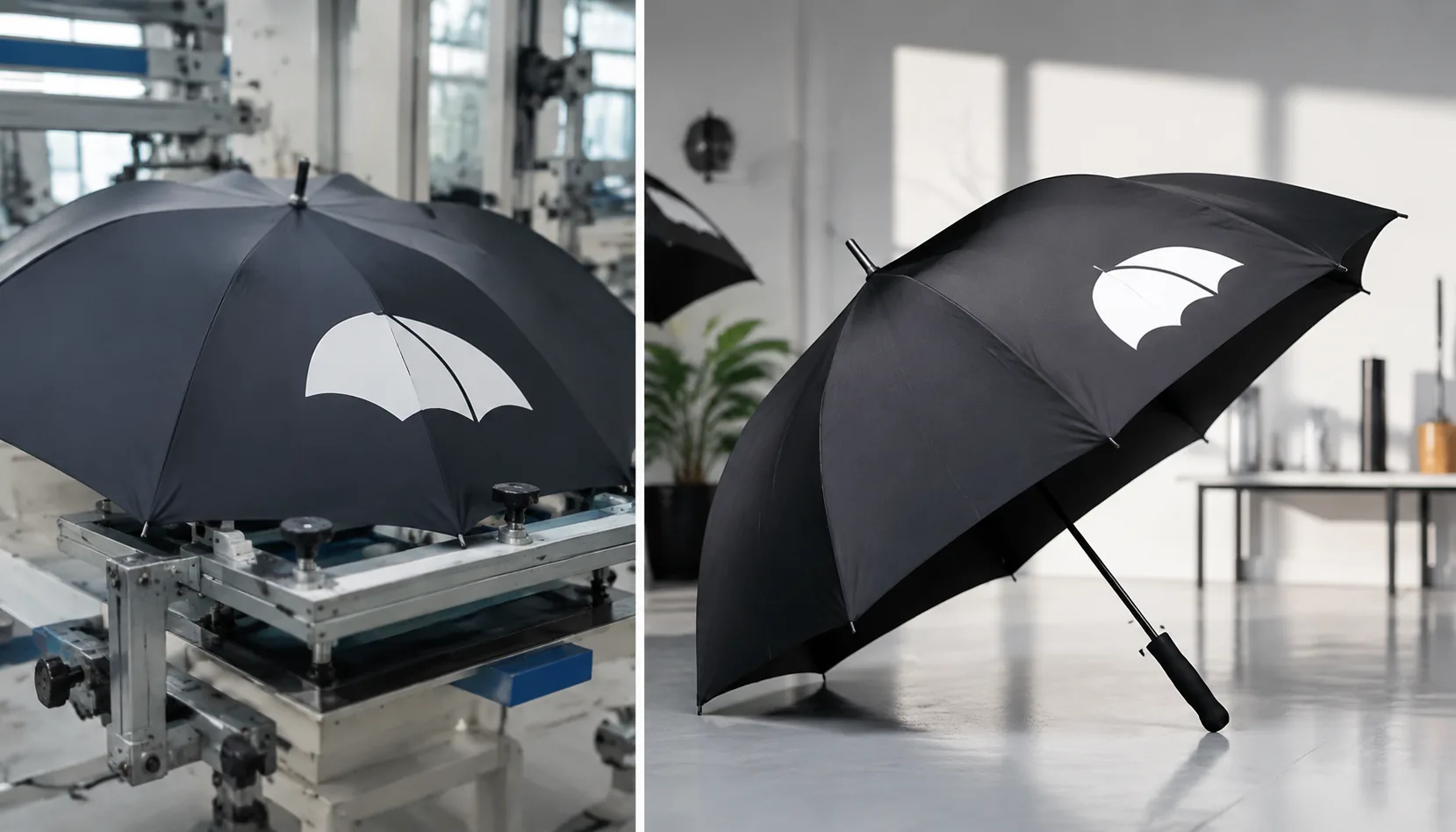
White Ink Underbase for Logos on Dark Umbrella Canopies
Learn when white ink underbase improves logo opacity on dark pongee canopies, how it affects cost, sampling, AQL checks,...
Read More »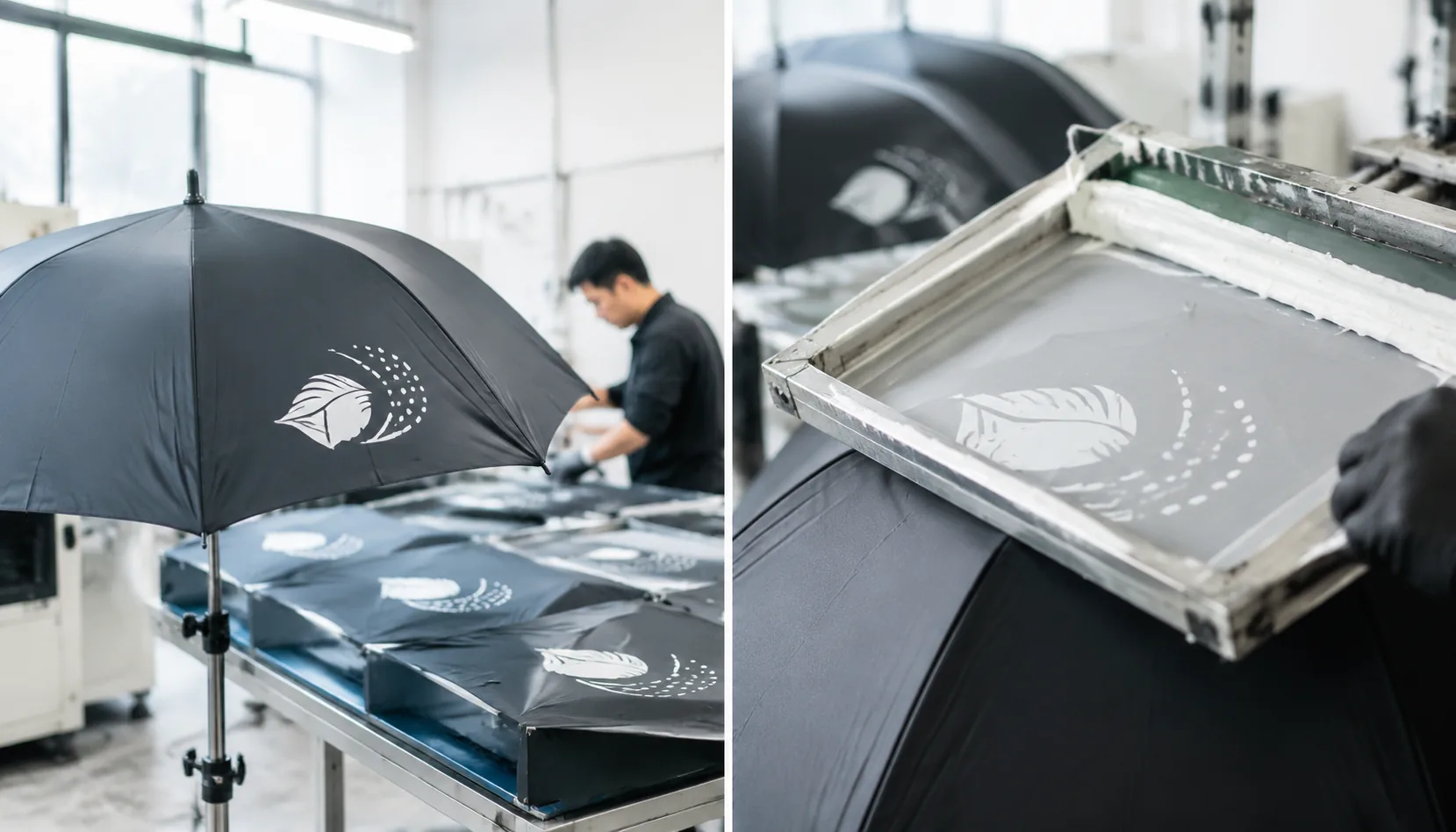
White Ink Underbase for Dark Umbrella Logo Printing
Learn when white underbase is needed on dark umbrellas to improve logo opacity, color accuracy, durability, and buyer ap...
Read More »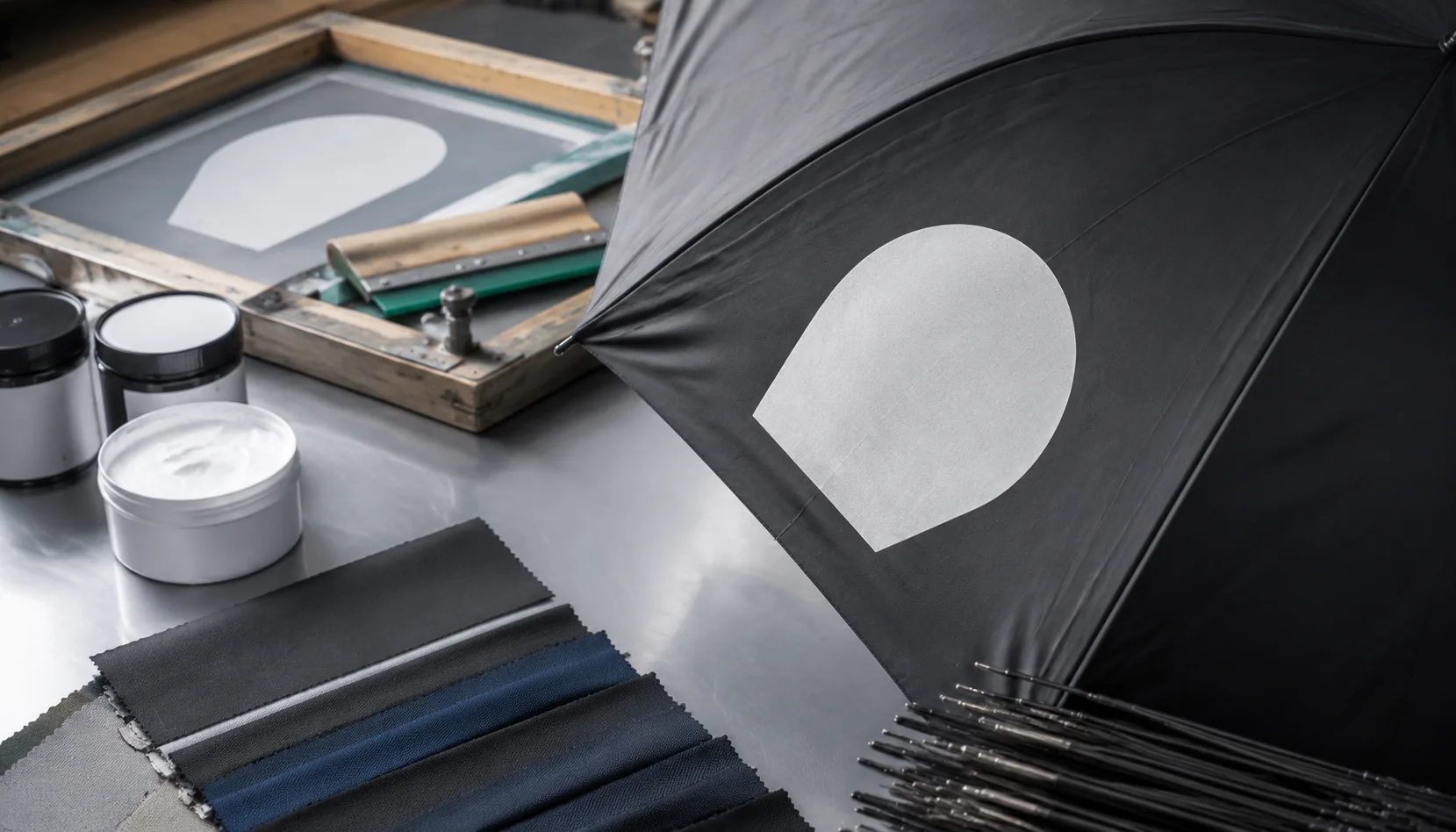
White Ink Underbase for Dark Umbrella Canopy Logos
Learn when white underbase improves logo opacity on dark umbrella canopies, with fabric, ink, sampling, MOQ, and QC tips...
Read More »