White Ink Underbase for Dark Umbrella Logo Printing
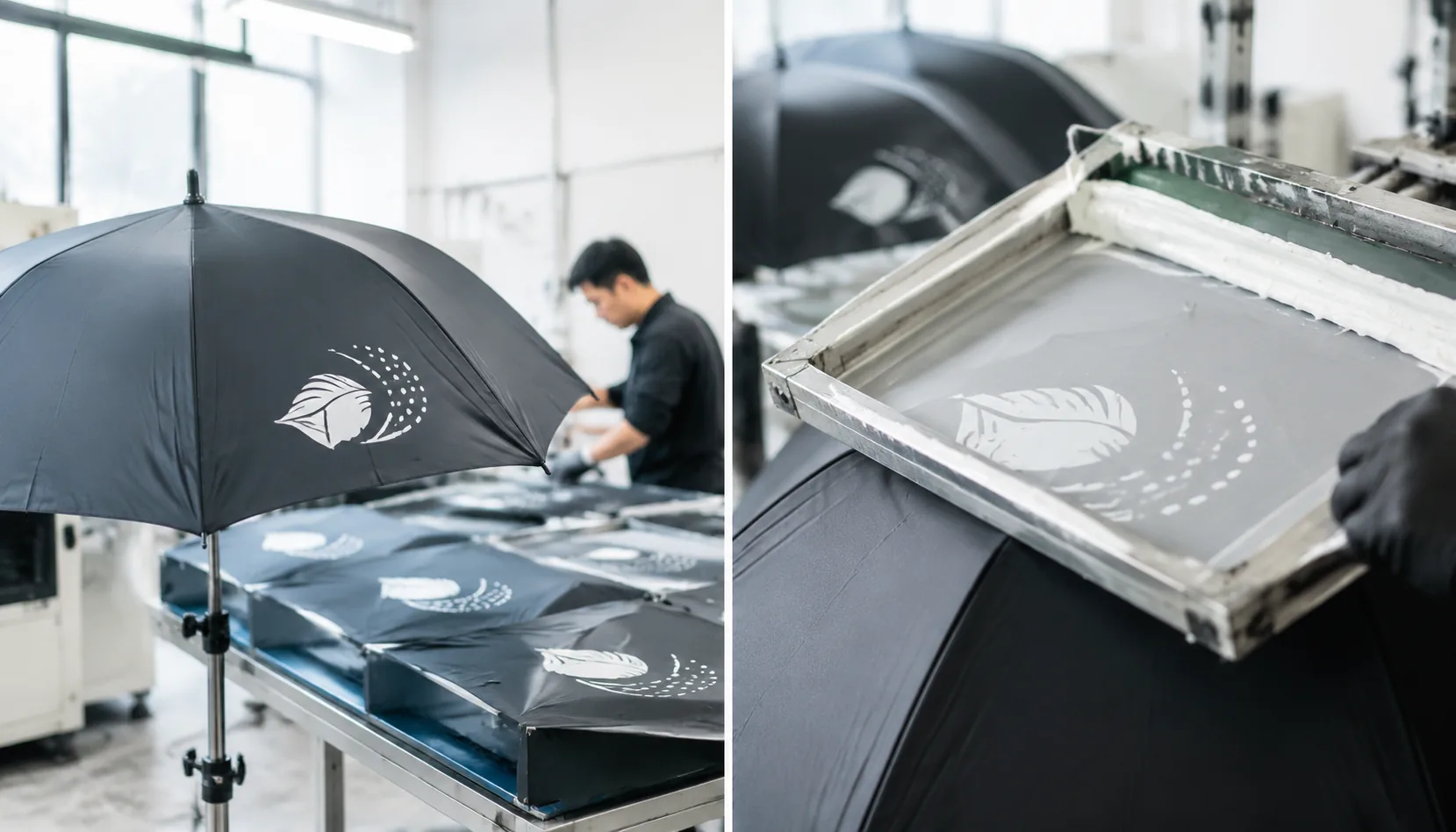
Dark umbrella panels can make even approved logo artwork look dull, shifted, or patchy once ink hits polyester pongee, especially on navy, black, bottle green, and burgundy fabrics. On our Songxia production floor, white underbase umbrella printing is one of the main controls we use to keep brand colors opaque, edges clean, and repeat orders consistent through sampling, bulk printing, heat setting, and final buyer inspection.
Why Dark Canopies Change Logo Appearance
Dark canopy logo printing fails most often because the fabric color becomes part of the ink system. Black, navy, forest green, and burgundy 190T/210T pongee do not behave like white paper; the yarn-dyed surface absorbs light and visually swallows translucent pigment. A red Pantone laid directly on black pongee can shift toward brown, yellow can look olive, and light blue can turn gray. Even when the ink film is technically even, the buyer sees a dull logo because the dark textile is reducing contrast underneath it. This is especially obvious on branded black umbrellas, where procurement teams approve artwork on a bright digital proof, then receive a sample that looks two shades weaker in daylight. The problem is not usually the Pantone formula itself; it is the missing reflective layer between the canopy and the printed color.
White underbase umbrella printing solves this by putting an opaque white ink layer down first, then printing the target Pantone over it after proper flash or air curing. That white layer blocks the canopy color and gives the top ink something closer to a neutral base, so an orange, royal blue, or lime green logo keeps its intended brightness. For screen printed umbrella logos, we normally treat the underbase as a separate screen with slightly tighter registration than the color layer, often choked back 0.2–0.4 mm so white does not halo around fine text. Without that control, an opaque umbrella logo can look heavy or misaligned, especially on 8K and 10K panels where seams and panel tension already affect print placement.
The fabric finish also matters. A water-repellent 210T pongee with Teflon treatment can resist ink wet-out more than standard 190T pongee, so mesh count, squeegee pressure, curing time, and ink viscosity must be adjusted before bulk production. Burgundy and forest green are particularly tricky because they do not look as dark as black indoors, but they still mute Pantone colors enough to disappoint buyers. A proper pre-production sample should be checked both folded and open, under warehouse light and outdoor daylight, because umbrella panels curve and reflect differently than a flat swatch. For white underbase umbrella printing, the pass/fail question is simple: can the end user recognize the approved brand color from two to three meters away, or does the canopy color still contaminate the logo?
When to Use White Underbase by Print Method
Digital printing gives the best result for gradients, photographic logos, shadows, and artwork with more than 6 colors, but white ink management decides whether the print looks premium or muddy. On dark polyester, UV digital or DTF-style processes need a controlled white layer under the CMYK image; otherwise gradients disappear into the canopy and skin tones become gray. This is where white underbase umbrella printing becomes a file-prep issue as much as a production issue: the RIP must choke the white slightly so it does not show as a halo around letters or fine icons. For small text below 6 pt, I prefer heat transfer or carefully registered screen printing, depending on quantity, because digital ink spread and fabric texture can soften edges. Our standard practice at ZheBrella is to proof one dark panel before bulk production, then check opacity, adhesion, and registration during AQL 2.5 inspection rather than arguing about color after 2,000 finished umbrellas are packed.
Cost, MOQ, and Production Trade-Offs
White underbase umbrella printing costs more because it is not just “one more color” on the quote sheet; it changes the whole print sequence. For dark canopy logo printing on black, navy, forest green, or burgundy 190T/210T pongee, the white layer needs its own screen, its own squeegee pass, and controlled flash or tunnel curing before the top colors go down. If the underbase is too wet, the second color picks it up and edges blur; if it is under-cured, adhesion fails during AQL rubbing and folding checks. On a simple 1-color white logo, screen printed umbrella logos may run efficiently at 500 pieces, but a 3-color opaque umbrella logo over white often needs more setup time than the printing itself. That is why a factory should separate screen charges, ink charges, and running cost instead of hiding everything in one vague unit price.
MOQ is driven by setup loss as much as material purchasing. A 23 inch auto-open umbrella with 8K steel ribs and black pongee may be available from stock shells at 300–500 pieces, but branded black umbrellas with a large panel logo, tight Pantone matching, and white underbase usually make better cost sense at 1,000 pieces or more. Small chest-size style marks on one panel waste less ink and setup time than a 20 cm event logo printed on four panels, because every panel placement needs jig control and operator alignment. Logo color count matters twice: first for the white base, then for each visible color printed above it. Our standard practice at ZheBrella is to quote artwork by print position, print size, number of screens, and whether the buyer accepts shared production with stock umbrella bodies or needs a full custom build.
The trade-off is durability and opacity versus speed and budget. Heat transfer can be attractive for short runs or photo-style artwork, but on folded umbrella panels it can feel heavier and may crease at the ribs if the film is too thick. Sublimation is clean on white polyester but does not solve dark canopy logo printing because sublimation inks are translucent and cannot print white. For retail-grade screen work, a white underbase gives the best opaque umbrella logo on dark fabric, but buyers should allow extra lead time: sampling often takes 5–7 days after artwork approval, and bulk production can add 3–5 days compared with a single-layer print. For FOB Ningbo or Shanghai orders, the print decision also affects inspection timing because adhesion, color registration, and wet/dry rub tests need to be checked before final packing, not after cartons are sealed.
Durability Testing and AQL Inspection Points
Durability failures on dark canopy logo printing usually start with adhesion, not ink color. For screen printed umbrella logos on 190T or 210T pongee, we run a cross-hatch tape pull after full curing, then repeat after 24 hours because some white ink systems feel dry before the binder has properly locked into the fabric coating. A good opaque umbrella logo should not lift at the edges, powder under a fingernail, or show gray fabric through the white layer after rubbing. For black or navy canopies with PU, Teflon, or UV coatings, ink matching matters more than buyers expect; the wrong catalyst can sit on top of the coating and peel after the first few wet folds. In production, white underbase umbrella printing needs a controlled flash cure before the top color, otherwise trapped solvent creates weak spots that later crack or bubble.
Rub resistance is checked both dry and wet because branded black umbrellas are handled with damp hands, packed while humid, and often rubbed against ribs during closing. We use a cotton cloth rub test, typically 20 to 50 cycles depending on order spec, looking for white transfer, edge feathering, and loss of opacity on corners of letters. Folding stress is more severe than flat fabric testing: the printed panel is folded along the normal umbrella crease line, pressed under canopy tension, opened and closed repeatedly, then inspected under angled light. Cracking risks are highest where the logo crosses fold lines, especially on compact 21 inch auto-open-close umbrellas where the canopy wraps tightly around the shaft. Thick white underbases can look excellent on the table but fail after 100 folding cycles if the ink film is too rigid.
AQL 2.5 inspection should define print defects before bulk production starts, not after cartons are packed. For white underbase umbrella printing, our standard practice is to check opacity, registration, pinholes, color shift, and contamination against an approved pre-production sample under consistent light, usually D65 or a buyer-specified light box condition. Major defects include visible dark show-through in the logo area, misregistration over 1 mm on tight artwork, pinholes in solid white zones, ghosting around small text, and top-color shift caused by an uneven underbase. Minor defects may include tiny edge roughness outside the main viewing area, but only if it is not visible at normal arm’s length. Inspectors should open the umbrella fully, inspect each printed panel under tension, then close and reopen it to catch cracking or ink transfer hidden by the first flat inspection.
Specifying Underbase Clearly in Purchase Orders
A purchase order for dark canopy logo printing should not say only “print logo as artwork.” It needs to lock the physical fabric first: 190T or 210T pongee, polyester with Teflon water-repellent finish, RPET pongee, or POE/PVC/EVA if the style is transparent or fashion-led. Ink behaves differently on each surface, especially after waterproof coating, so the PO should state whether printing is before or after coating and whether the panel is cut-piece printed or printed on assembled umbrellas. For branded black umbrellas, I also want the umbrella construction listed because print handling changes between a 21" folding auto-open-close and a 30" golf umbrella with fiberglass ribs. Define rib count, such as 8K, 10K, or 16K, plus panel count if the logo spans seams. That prevents a good graphic file from becoming a bad factory instruction.
For white underbase umbrella printing, specify the underbase as its own print layer, not as a vague “make logo bright” note. The PO should list Pantone colors for the visible logo, then state underbase coverage: full silhouette, text-only, icon-only, or trapped underbase with 0.2–0.5 mm choke to avoid white edges. If the buyer needs an opaque umbrella logo on black, navy, burgundy, or forest green pongee, the underbase usually needs one solid white pass and sometimes two passes for yellow, orange, light blue, or metallic-effect colors. Include exact print size in inches or millimeters, placement from panel edge or tip, and orientation, such as “centered on one panel, 160 mm wide, bottom edge 90 mm above hem.” Screen printed umbrella logos should also define mesh count, curing method, and whether hand-feel or opacity has priority.
Sample approval is where many disputes are prevented. The PO should require a pre-production sample or strike-off showing the real canopy fabric, real Pantone ink, and final underbase, with approval by photo only for simple logos and courier sample approval for retail or premium promotional orders. Our standard practice at ZheBrella is to keep the approved sample beside the line and inspect against AQL 2.5 for logo position, color, smearing, pinholes, and adhesion after wet rub. Commercial terms should be just as clear: MOQ by color and logo, FOB Ningbo or Shanghai, or DDP destination if duties and last-mile delivery are included. State target lead time in calendar days, such as 7–10 days for sampling and 25–35 days for mass production after sample approval and deposit, because white underbase umbrella printing adds screens, drying time, and inspection steps.
Frequently Asked Questions
Does every dark umbrella logo need a white underbase?
No. Solid white, silver, or intentionally muted tone-on-tone logos may not need it. Bright Pantone colors, fine details, and retail-grade brand marks usually benefit from a white underbase.
Will a white underbase make the logo feel thicker?
It can add a slight hand feel because it is an extra ink layer. Proper curing and the right ink system reduce stiffness and help the print survive repeated folding.
When is a white underbase required for dark umbrella logo printing?
A white underbase is typically needed when the canopy is black, navy, or otherwise dark and the logo uses light or bright colors. It improves opacity so the approved PMS color reads closer to the design instead of being muted by the fabric.
Does a white underbase affect production cost or lead time?
Yes, it usually adds one extra print pass, which can increase setup cost and slightly extend lead time. For OEM umbrella orders, that often means a small cost increase and about 1–3 additional production days depending on the print area and quantity.
What logo types work best on branded black umbrellas?
Simple vector logos with solid fills and limited colors work best, especially for screen printing. Fine gradients and very thin lines are harder to hold on dark canopies, so buyers usually approve bolder artwork for better opacity and durability.
Looking to Launch Your Custom Umbrella Line?
ZheBrella is a Zhejiang-based OEM/ODM umbrella manufacturer with 17 years of export experience. Free design, low MOQ from 100 pieces, windproof construction, full-color print.
Get Free Quote Now »People Also Search For
Related Articles
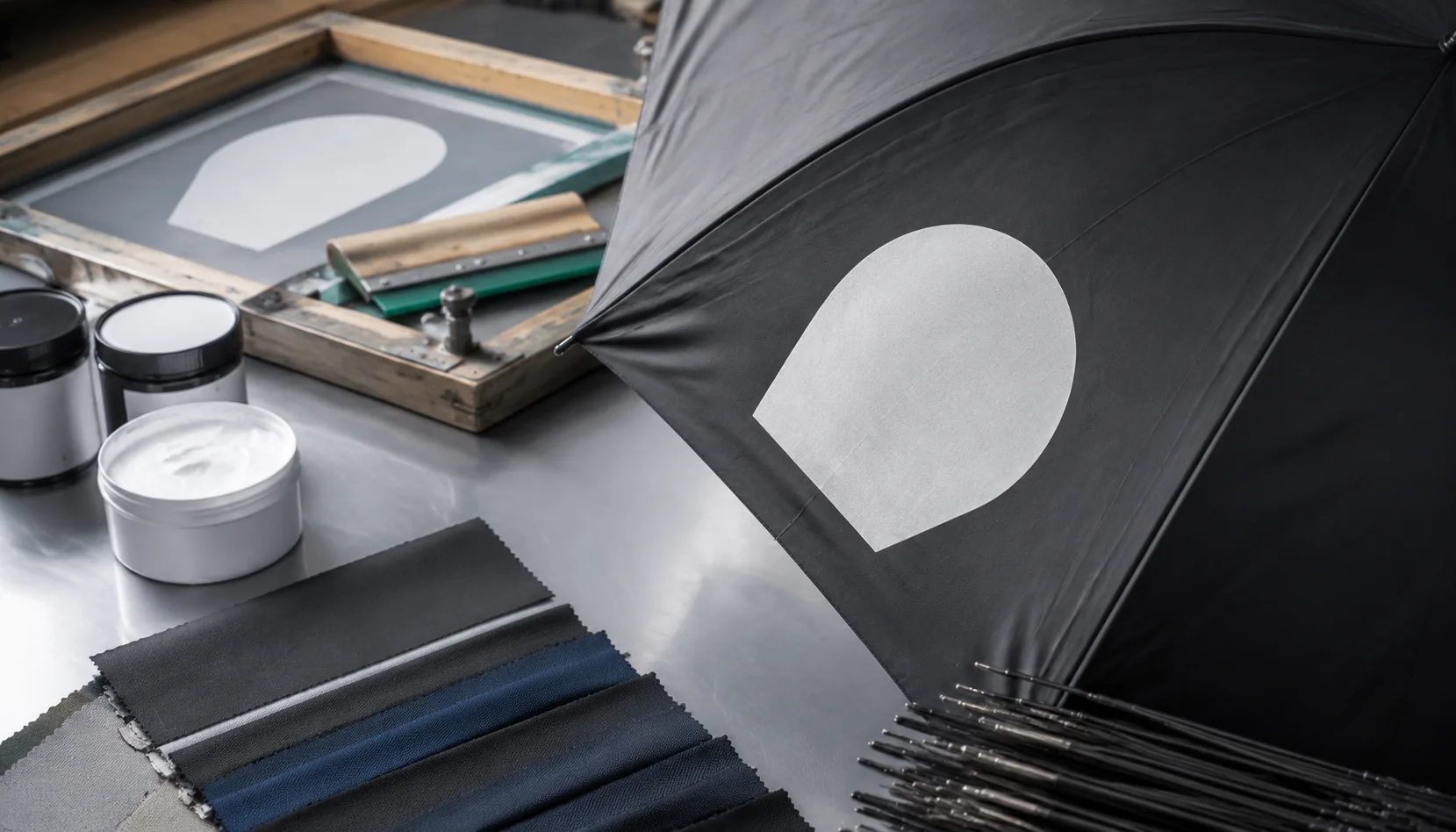
White Ink Underbase for Dark Umbrella Canopy Logos
Learn when white underbase improves logo opacity on dark umbrella canopies, with fabric, ink, sampling, MOQ, and QC tips...
Read More »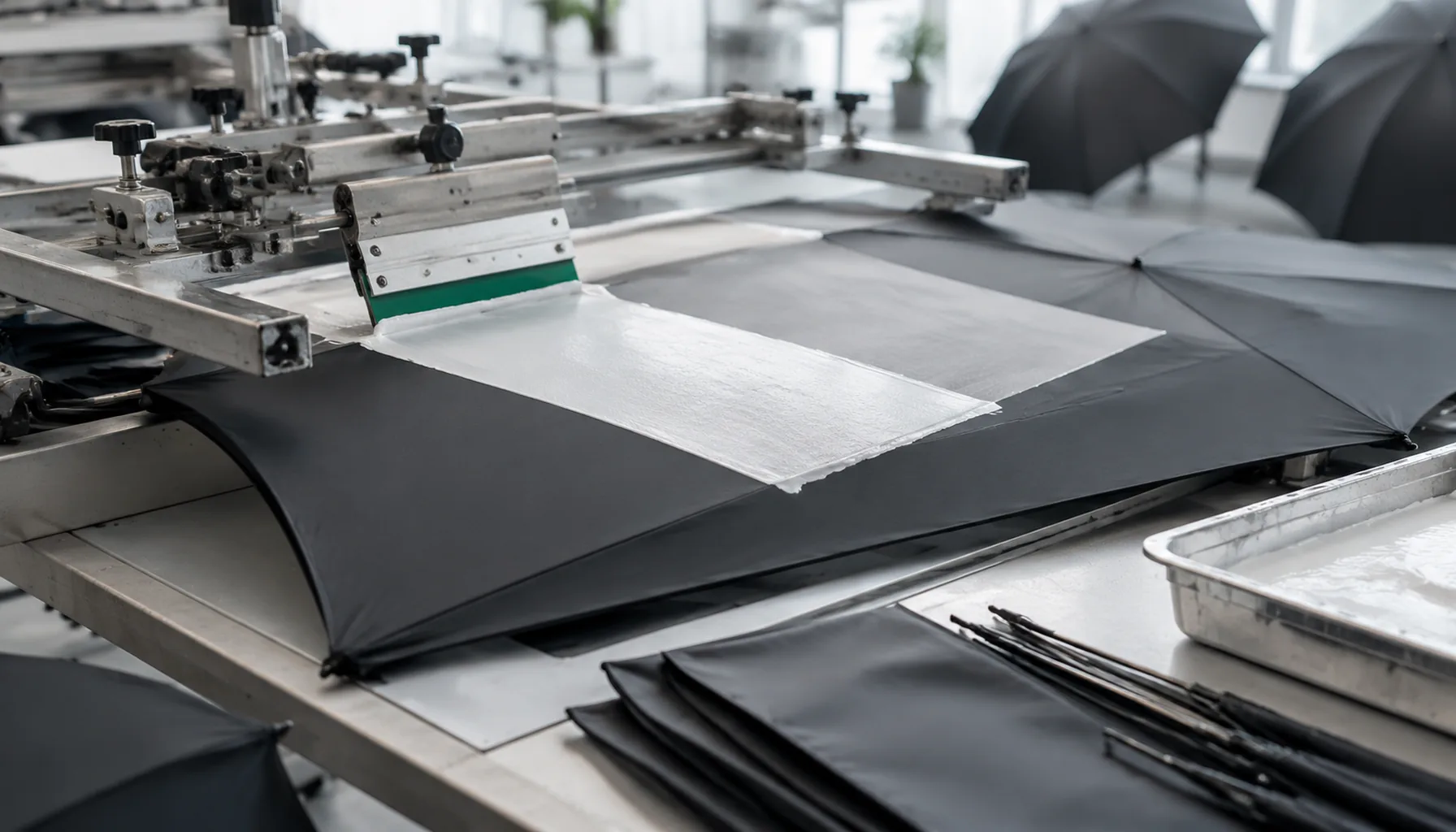
White Ink Underbase Printing for Dark Umbrella Canopies
Use white underbase printing to keep logos bright on navy, black, and red canopies, with clear guidance on ink layers, s...
Read More »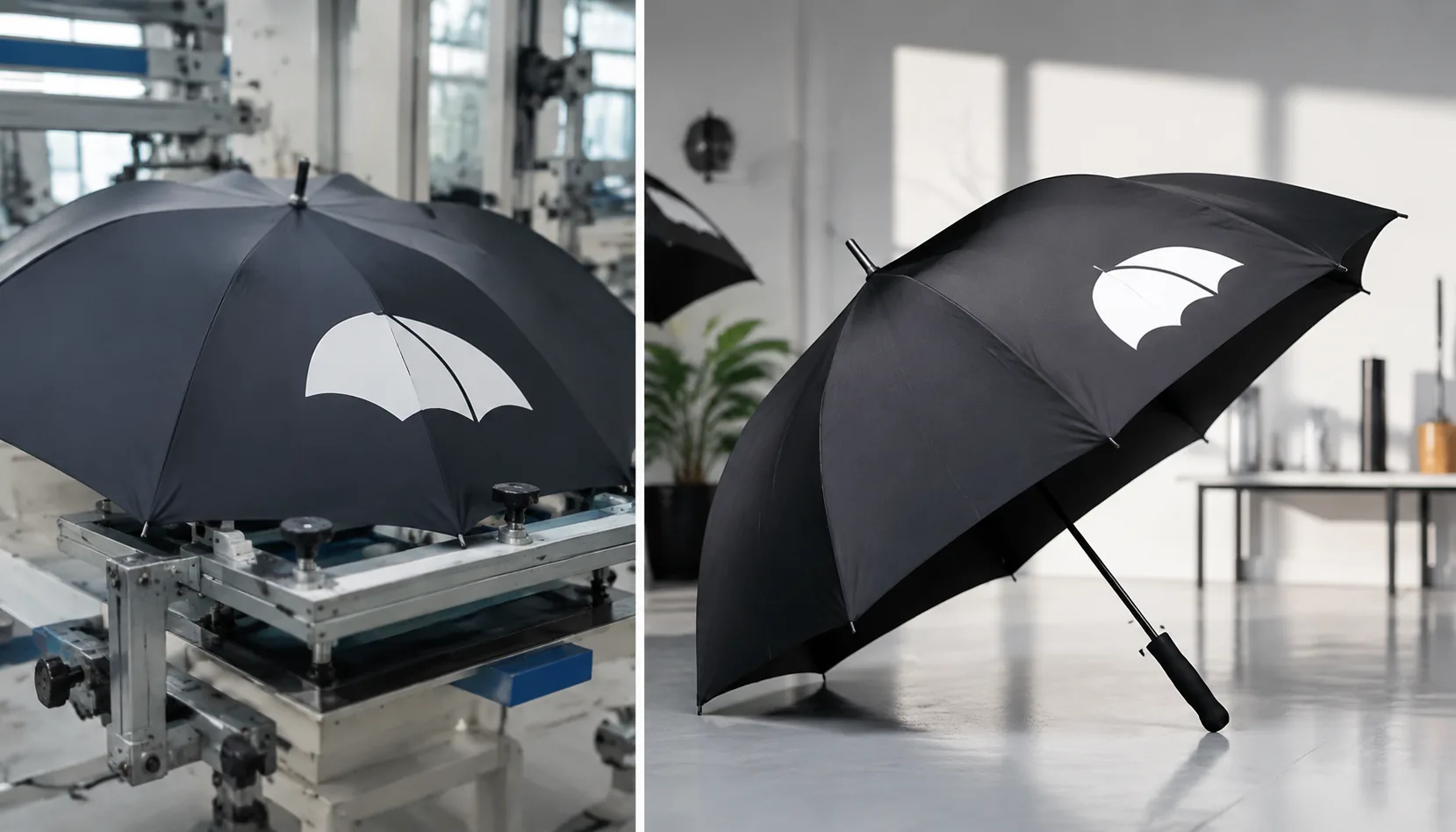
White Ink Underbase for Logos on Dark Umbrella Canopies
Learn when white ink underbase improves logo opacity on dark pongee canopies, how it affects cost, sampling, AQL checks,...
Read More »