Ink, Fabric, and Logo Sharpness on Branded Umbrellas
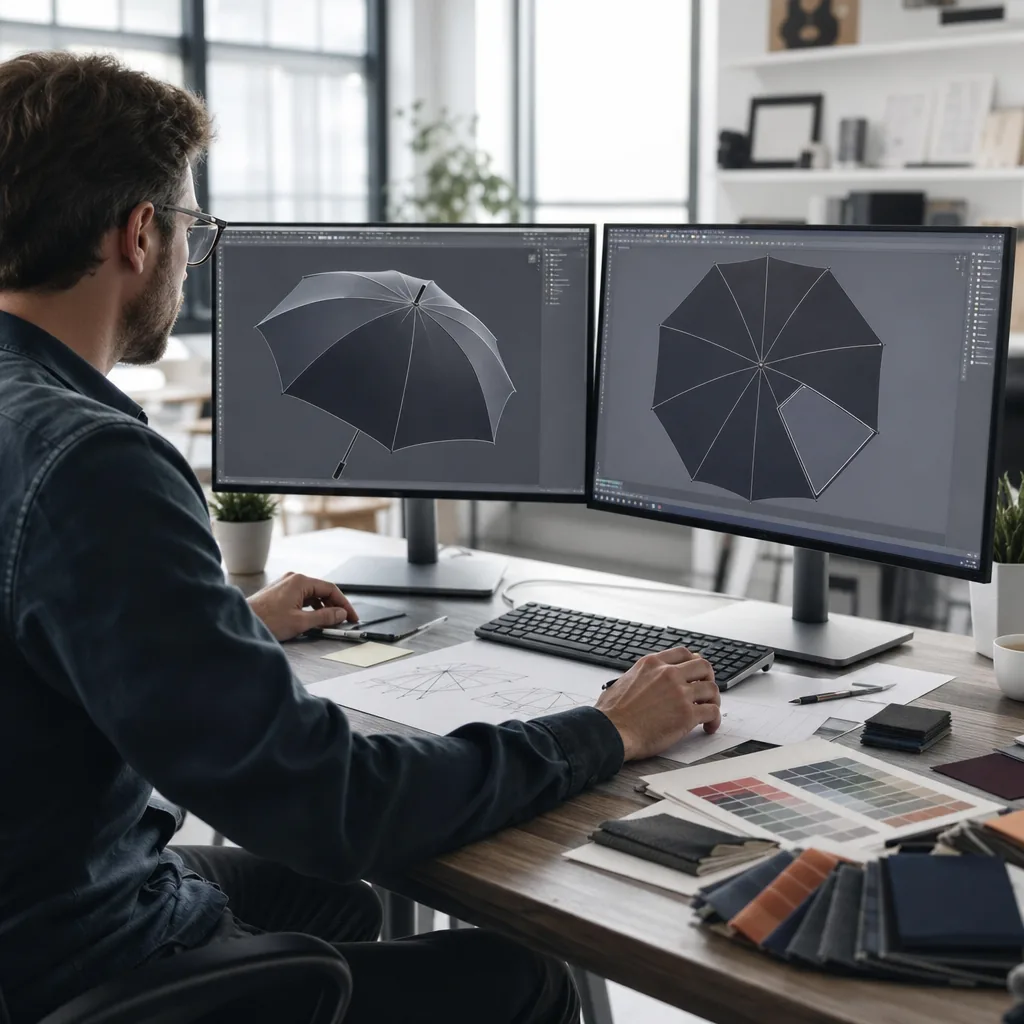
When buyers judge a branded umbrella, they are really judging how the logo survives real production variables: ink chemistry, fabric weave, panel tension, and stitching all affect whether a mark looks crisp or muddied. In our Songxia factory, we see the same artwork behave differently on polyester, pongee, and coated canopy builds, so managing umbrella print sharpness starts long before the press and ends only after the canopy is cut, sewn, and tested for repeatability.
How fabric weave changes print clarity
Pongee umbrella printing behaves differently on 190T and 210T because the weave itself controls how much ink sits on the surface before it starts to spread. A 190T cloth has slightly more open spacing between yarns, so fine lines can bleed a little more and small text loses edge definition faster. A 210T pongee is tighter, so it usually gives better umbrella print sharpness, stronger color density, and cleaner boundaries on logos with thin strokes or tight lettering. In factory terms, the tighter weave gives the screen or transfer film a more stable landing zone, which is why small marks and multi-color details register more reliably on the canopy.
Coated polyester changes the picture because the coating can block absorption and make the ink sit on top instead of biting into the fiber. That can help brightness, but it also makes ink type for umbrellas more important: the wrong ink will crack, smudge, or lift after folding and opening cycles. On a smooth coated surface, you need controlled viscosity and proper curing to protect logo durability on umbrellas; otherwise the print looks fine on day one and weakens at the fold lines after real use.
For production, tighter weave almost always helps print registration on canopy panels, especially when a logo has thin outlines, tiny type, or close color trapping. With pongee umbrella printing, the practical difference shows up most in small text and repeated motifs, where an open weave can make the edges look fuzzy even if the art file is clean. If the buyer wants crisp branding, 210T is usually the safer choice, while 190T is acceptable only when the design is larger, bolder, and less sensitive to edge loss.
Choose inks for the right end use
For branded umbrellas, the ink type for umbrellas matters as much as the fabric, because umbrella print sharpness starts with whether the ink sits on top of the weave or bonds into it. Pigment inks are the workhorse for promotional runs on polyester or pongee umbrella printing: they hold decent edge definition, dry fast, and are less likely to bleed on 190T or 210T pongee when the print is kept simple and the mesh count is right. Dye inks can look sharper on paper, but on canopy fabric they are more prone to migration and wash-out unless you are printing on a very receptive substrate, so I only use them when visual richness matters more than long-term wear.
Sublimation is the cleanest option for full-color graphics on light-colored polyester canopies, especially when you need tight print registration on canopy panels and a soft hand feel. It transfers into the fiber, so the image usually survives folding better than surface inks, but it still needs controlled heat and pressure; if the canopy has a heavy water-repellent finish, poor surface energy can cause uneven transfer or ghosting at panel seams. For UV-focused umbrellas, be careful: UPF 50+ coatings, fluorocarbon repellents, and some Teflon finishes can interfere with ink wetting and curing, so we test adhesion after coating, not before, because a print that looks perfect off the press can flake once the umbrella is flexed in real use.
For retail umbrellas where logo durability on umbrellas is the selling point, specialty inks such as UV-cure, epoxy, and certain elastomer-modified systems make sense because they resist abrasion from opening and closing cycles better than basic screen inks. UV-cure can give the crispest outline on dark panels and is often the best route when umbrella print sharpness has to stay intact after repeated folding, but the process window is narrow and over-cured ink can crack on stiff coatings. My rule is simple: use pigment or UV-cure for promotional and mid-market retail, sublimation for detailed graphics on compatible polyester, and do adhesion testing after any UPF 50+ or water-repellent treatment, because finish chemistry changes both curing and final bond strength more than most buyers expect.
Match print method to logo complexity
For simple logos, screen printing is still the most reliable way to protect umbrella print sharpness because the ink film is heavier and the edges stay cleaner on flat color blocks. On pongee umbrella printing, especially 190T and 210T polyester, screen ink bites into the weave better than people expect, but it is strongest when the artwork uses one to three spot colors, bold strokes, and no delicate gradients. If the design relies on a clean corporate mark, a phone number, or a large event name, screen printing gives better logo durability on umbrellas than most low-cost alternatives, provided the fabric is properly tensioned before curing.
Digital printing makes sense when the artwork has fades, shadows, photo-like detail, or more colors than a press operator can realistically register by hand. The catch is that umbrella print sharpness drops fast if the file has hairline rules, tiny reversed text, or weak contrast, because the canopy curve and fabric texture both soften the result. For best ink type for umbrellas decisions, digital works well on lighter pongee and coated polyester, but buyers should not expect the same edge definition as screen work on very small type; once letters get below about 4 to 5 mm high, readability becomes a production problem, not a design problem.
Transfer printing is the practical choice for short runs, sample development, and artwork that changes too often to justify screen setup. It handles multi-color logos quickly, but print registration on canopy is only as good as the placement jig and the operator’s heat pressure, so very fine outlines can shift or blur at the edges. In practice, transfer is acceptable for promotional orders and small MOQ jobs, but for fine lines, thin serif fonts, and strict brand marks, I would still push the buyer back to screen or digital depending on the color count and the required logo durability on umbrellas.
Protect print quality during production
On 8K and 16K umbrellas, umbrella print sharpness starts with the frame, not the press. A loose 8K steel frame with uneven rib spring will let panels drift after cutting, while a tighter 16K fiberglass frame holds the canopy flatter and gives better print registration on canopy lines and panel-to-panel repeats. For pongee umbrella printing, 190T material moves more than 210T when it is heat-set and sewn, so panel tension has to be balanced against the stitch path; if the canopy is over-stretched, logos square up on the table but shift once the umbrella opens fully. The practical fix is to print against the actual opened geometry, not a flat CAD panel, and to confirm the frame lock position before setting the artwork.
The ink type for umbrellas matters as much as the layout. On coated pongee, a fast-flash plastisol or tuned heat-transfer system can hold edges cleanly, but poor viscosity control causes feathering, ghosting, and overspray at small type sizes. For outdoor promotional work, logo durability on umbrellas depends on cure temperature, wash resistance, and flex resistance after repeated opening cycles; a crisp first pass is useless if the print cracks at the ferrule or along a seam after a week of use. We also check for pinholes under backlight, seam distortion where the hem pulls the image, and panel shrinkage after drying, because those defects show up first on dark ink over light fabric and on fine text around canopy seams.
Our standard practice is AQL 2.5 inspection on finished canopy lots, with sampling taken across first-off, mid-run, and packed cartons so we catch process drift, not just obvious rejects. The QC team checks print registration on canopy edges, repeated logos across adjacent panels, and any ghost image from misaligned multi-color passes; overspray is measured by viewing the print under angled light, and pinholes are counted against the approved reference sheet. If the umbrella opens with rib twist or panel puckering, the lot is held because the defect will read as poor umbrella print sharpness even when the ink itself is fine. That is why frame alignment, panel tension, and print cure are treated as one control system, not three separate steps.
Specify the order so results repeat
The order has to start with the fabric spec, because umbrella print sharpness is built on the canopy, not the artwork file. For pongee umbrella printing, I tell buyers to lock the base cloth first: 190T or 210T pongee, PU or silver coating if needed, and whether the canopy is 21-inch, 23-inch, or 27-inch. A tighter weave gives cleaner edges on small text and thin logos, while a loose or oily coating can make the same screen look soft. If the umbrella is PVC, POE, or EVA, the ink system changes again, so the purchase order should name the exact substrate, coating, and panel count before anyone talks about decoration.
Next, specify the ink type for umbrellas, Pantone target, and print registration on canopy as one package. Screen print, heat transfer, and sublimation do not behave the same on curved panels, and the wrong match gives drift, haloing, or uneven edge density. For logo durability on umbrellas, I prefer buyers to ask for adhesion and rub resistance criteria in writing, then approve a physical pre-production sample against a signed Pantone reference, not a PDF on a monitor. ZheBrella’s standard practice is to freeze the artwork after sample signoff, because once the canopy panels are cut and sewn, rework is expensive and usually lowers consistency across the run.
Then lock commercial timing: sample approval date, lead time in days, MOQ, and the delivery term. A normal run may need 15 to 25 days after sample approval, but complex multicolor printing, double-canopy vented frames, or tight color matching can push that longer. MOQ should be tied to the print method and panel count, because short runs raise setup loss and increase variation between units. FOB keeps reprint and replacement coordination simpler if the buyer controls freight, while DDP shifts more responsibility to the supplier and usually means the buyer must define replacement rules, carton labeling, and damage claims before production starts.
Frequently Asked Questions
Which fabric gives the sharpest logo printing on umbrellas?
Tight-weave pongee, especially 190T or 210T, usually gives the cleanest edge detail for logos and small text. Lower-quality or looser weaves can let ink spread and soften fine elements.
Why does a logo look crisp on a proof but softer on the umbrella?
The flat proof does not show how the fabric stretches over curved panels, seams, and ribs. Ask for a sewn sample or open-canopy approval so you can judge the final sharpness in real conditions.
Which ink type gives the sharpest logo on pongee umbrellas?
For most 190T and 210T pongee umbrellas, high-quality screen printing ink gives the sharpest solid logos and best edge control. Digital printing is better for gradients or photo-style artwork, but the factory should test ink absorption and color spread before bulk production.
How much print registration tolerance is normal on umbrella panels?
For panel-to-panel logo alignment, a tolerance of about 1–3 mm is common depending on canopy size, fabric stretch, and sewing method. If the artwork crosses seams, buyers should request a pre-production sample because small sewing shifts can affect final registration.
What tests should buyers request for logo durability on branded umbrellas?
Common checks include dry rub, wet rub, water spray, folding abrasion, and adhesion testing after the canopy is fully cured. For retail or corporate programs, buyers often request 24–48 hours of curing before testing and approval before mass production.
Looking to Launch Your Custom Umbrella Line?
ZheBrella is a Zhejiang-based OEM/ODM umbrella manufacturer with 17 years of export experience. Free design, low MOQ from 100 pieces, windproof construction, full-color print.
Get Free Quote Now »People Also Search For
Related Articles
White Ink Underbase for Logos on Dark Umbrella Canopies
Learn when white ink underbase improves logo opacity on dark pongee canopies, how it affects cost, sampling, AQL checks,...
Read More »Colorfast Logo Printing for Branded Umbrella Canopies
Reduce logo fading, bleeding, and transfer issues by matching ink, fabric, coating, and QC tests before branded umbrella...
Read More »
Print Durability Testing for Branded Umbrella Programs
Compare rub, adhesion, rain, UV, and folding tests for umbrella prints, with practical specs for 190T/210T pongee and AQ...
Read More »