Colorfast Logo Printing for Branded Umbrella Canopies
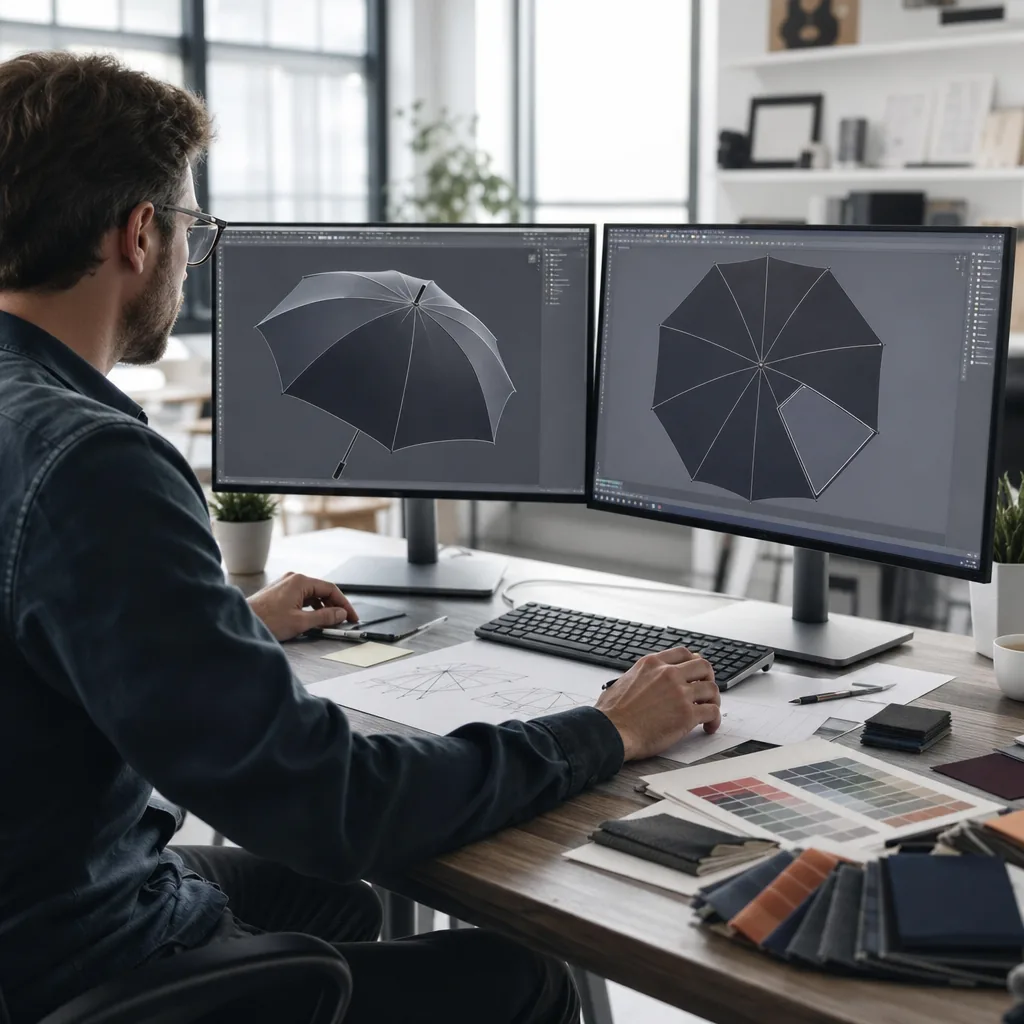
A logo that looks sharp on a strike-off can still fade, bleed into wet polyester, or transfer onto the fold if the ink system, canopy coating, and curing window are not matched before production. In our Songxia factory, colorfast umbrella logo printing starts with fabric and coating checks, then moves through ink selection, drying control, rub testing, water exposure, and folded-canopy inspection so buyers do not discover failures after cartons arrive.
Identify Common Colorfastness Failures
Start colorfast umbrella logo printing checks where the canopy fails first: crown seams, repeated fold lines, and outer panels exposed to direct sun. UV fading usually traces to low-grade disperse dye, weak pigment binder, or an ink system that does not match 190T or 210T pongee. Red, orange, and royal blue logos may pass an approval swatch yet shift after 24 to 48 hours in a UV chamber, especially without UPF 50+ treatment or when an uneven water-repellent coating changes ink penetration. Polyester pongee is the safer base for screen print and heat-transfer logos than low-cost nylon because dye fixation and surface behavior are more stable. POE, PVC, and EVA canopies need separate adhesion chemistry; using woven-polyester ink on these films raises peeling, fading, and cloudy-edge risk. Approve fabric, coating, ink, and curing settings as one print system, because separating them by purchasing line item hides the real failure point.
Ink cracking on fold lines is a production-control issue, not an artwork issue. Umbrellas crease in the same channels during every open-close cycle, so heavy ink deposits, stiff transfer films, or overcured layers can fracture after 200 to 500 cycles, especially on compact 21 inch auto-open-close frames packed tightly around 8K or 10K ribs. Undercuring creates the opposite defect: the logo stays tacky, collects dust, or blocks against the next panel under carton compression. OEM umbrella logo print approval should include bend testing after heat setting, not just a flat-panel visual check. Double-canopy vented windproof models need extra scrutiny because the upper and lower panels rub during opening, closing, and wind movement; weak adhesion shows faster there than on a single canopy. Umbrella print quality control should record ink type, press temperature, dwell time, pressure, and post-cure handling time so the approved sample can be repeated in bulk.
Color migration and wet-rub transfer usually appear after rain exposure or after a DDP shipment sits in a hot container. Migration means dark canopy dye moves into a white or light logo; common causes include poor fabric dye fixation, silicone or Teflon water-repellent finishes that disrupt bonding, or heat-press settings that push dye into the transfer layer. Wet-rub transfer is different: ink releases onto a hand, sleeve, or paper towel after soaking, pointing to weak binder chemistry or incomplete curing. For fade resistant umbrella branding, ZheBrella uses branded canopy ink testing that includes dry rub, wet rub, tape pull, fold abrasion, and sample wind-tunnel checks above 50 mph when the logo crosses high-stress panels. Run these tests before AQL 2.5 final inspection, because sealed cartons confirm packing quality, not print durability. Catching migration or rub-off at pre-production costs one sample panel; catching it after event delivery risks replacement freight, missed launch dates, and a rejected branded canopy program.
Match Ink System to Canopy Fabric
Start with the fabric, because the canopy surface determines adhesion, color hold, and failure risk. For colorfast umbrella logo printing on 190T or 210T pongee, screen printing is usually the lowest-risk option when artwork uses solid fills, bold marks, and a limited number of spot colors. Both are tightly woven polyester, but 210T has a smoother face, so edges print cleaner and dark solids look more even than on 190T. Plain polyester usually lowers unit cost, but print variation goes up: uneven surface treatment can increase dot spread, mute dark tones, and create panel-to-panel color shift. Buyers should rank priorities before approving an OEM umbrella logo print method—Pantone accuracy, rub resistance, or photo detail—because no single process leads on all three. On standard dyed pongee, properly heat-cured screen ink holds up well; on canopies with heavier water-repellent finishes, wet-out is weaker and adhesion failures usually appear first at fold lines and rib contact points after repeated open-close cycles.
Black-out coated and UPF 50+ canopies need separate testing because the ink is often bonding to a coating layer, not directly to the textile. Black or silver rubberized backings reduce ink bite and can shift the final shade; the same navy will read differently on black-coated fabric than on white-backed pongee. Heat transfer is often the better fit for coated canopies when the logo includes gradients, small text, or tight registration, but durability depends on film quality and a narrow press window. Excess heat can gloss the coating or leave platen marks; insufficient heat can cause edge lifting at rib stress points. Digital pigment printing works best for samples, short runs, and multi-color graphics, but it usually trails a well-cured screen print in fade resistant umbrella branding under wet folding and outdoor UV exposure. For 500- to 5,000-piece programs, 190T or 210T pongee with screen ink is typically the safest balance of cost, lead-time stability, and durability. Umbrella print quality control should include tape adhesion, crocking, accelerated UV aging, 24-hour transfer peel checks, 200-fold cycle testing, and final lot inspection to AQL 2.5 before packing.
Factor in Umbrella Construction Stress
Frame mechanics often damage ink before UV exposure does. On a 23-inch auto-open umbrella, the spring snaps the canopy tight in less than one second, loading the crown, cap seam, runner area, and first fold lines on every opening. Auto-open-close compact frames are harder on print films because the canopy collapses into shorter, tighter pleats. A large OEM umbrella logo print that crosses two fold valleys will rub against adjacent 190T or 210T pongee each time the user closes the umbrella. For colorfast umbrella logo printing, keep solid logo blocks 20-30 mm away from major fold ridges, runner contact zones, tip pockets, Velcro strap positions, and exposed metal hardware, especially when a heavy white underbase is required. This reduces edge lift, dull abrasion marks, and cracking at the ink shoulder.
Double-canopy windproof umbrellas add shear stress, not just folding stress. The upper and lower canopies move independently when air passes through the vent, so a logo crossing the vent seam may pass flat-panel inspection but crack, distort, or misregister after wind testing. On 8K and 10K frames, wider panels can help a retail logo sit flatter when open, but they also create deeper closed creases. On 16K golf umbrellas, narrower panels stabilize the open print area, while the higher rib count increases back-side contact lines. Fade resistant umbrella branding should therefore be checked for closed-storage compression and open-frame tension, not only sunlight resistance.
Rib material changes the failure pattern. Steel ribs are stiff and concentrate pressure at fixed contact points, so thick screen prints and heat-transfer films often develop straight hairline cracks parallel to the rib. Fiberglass ribs flex more evenly and can support 50+ mph wind testing, but diagonal canopy stretch can expose weak adhesion on PU, PVC, POE, or EVA surfaces. Umbrella print quality control should take place after frame assembly, not only on flat printed panels before sewing. At ZheBrella, branded canopy ink testing includes 20 open-close cycles, wet rubbing, dry rubbing, folded strap compression, and final release inspection under AQL 2.5. Watch for glossy ink turning dull at fold peaks, transfer film lifting at panel seams, and dark ink showing micro-cracks over fiberglass rib arcs.
Run Pre-Production Colorfastness Checks
For colorfast umbrella logo printing, approve the print on the actual canopy material that will ship, not on a paper drawdown. 190T pongee, 210T pongee, and POE absorb and release ink differently, so a logo that looks clean on a lab card can fail after sewing, packing, or repeated opening. Before bulk cutting, print fully cured panels and run dry-rub and wet-rub checks on that exact substrate. On polyester canopies, set the benchmark at a minimum of 20 dry-rub cycles and 10 wet-rub cycles, with no obvious transfer to a white test cloth. Start review on dark navy, red, and black grounds, where crocking and dye migration usually appear first. For OEM umbrella logo print made by heat transfer or sublimation, inspect line edges, small type, and halftones after cure; soft edges usually indicate incorrect temperature or dwell time, not bad artwork. Correct those settings before the factory commits canopy fabric and frame inventory, because that is where print errors become a cost and lead-time problem.
Flat strike-offs are not enough. Fold the finished sample umbrella, secure the tie band, leave it compressed, then open and close it 30-50 times to check cracking on rib lines, crown stress points, and the tie-band contact area. Heavy screen-print ink films often pass rub tests but fail here. Add a cross-hatch and tape adhesion check, especially on PU-, UV-, or Teflon-finished canopies where surface treatments can weaken ink anchoring. For golf umbrellas, beach retail, outdoor promotions, or campaigns with long shelf life, include light exposure testing so fade resistant umbrella branding is verified before bulk sewing. Approve color only after full cure and stabilization, typically 24 hours, then compare the print to the Pantone reference under controlled lighting and recheck the sewn panel, since seam tension can shift perceived density. Record the fabric lot, ink batch, curing temperature, dwell time, and pass/fail results for branded canopy ink testing. Use that file as the baseline for umbrella print quality control, with final acceptance under AQL 2.5 from random samples pulled across different cartons and production times.
Write Durability Requirements Into the Order
Put durability requirements in the PO before pricing, because fabric, coating, frame, and logo coverage drive both unit cost and failure risk. Colorfast umbrella logo printing on 190T pongee should not be quoted against the same ink system as 210T pongee with Teflon water repellency or UPF 50+ coating. Specify canopy fabric, coating, panel color, print method, logo size, logo position, and panel count. A 23-inch auto-open straight umbrella with an 8K steel frame and one 12 cm screen-printed mark has a different risk profile than a 30-inch golf umbrella with 16K fiberglass ribs, double-canopy venting, and four large heat-transfer logos on coated panels. Dark navy, red, and black canopies also need tighter ink control than white or light gray because underbase, curing temperature, and opacity affect dry rub, wet rub, water exposure, and final color appearance.
Define the OEM umbrella logo print as screen print, heat transfer, sublimation, or digital print, then require pre-production approval on one finished umbrella before bulk cutting. A flat fabric swatch does not show how rib tension, seam position, or canopy curvature can distort round logos, fine type, or artwork placed near a panel edge. State MOQ by model and canopy color, not only total order volume; 1,000 pieces across five colors creates different setup, ink matching, and production control work than 1,000 pieces in one color. For fade resistant umbrella branding used in retail, outdoor events, or repeat promotional programs, require branded canopy ink testing on the printed panel: dry rub, wet rub, tape pull after curing, and 24-48 hours of water soak observation. These items turn umbrella print quality control into pass/fail criteria before mass production starts.
Connect durability specs to commercial terms so the supplier prices the real job, not a simplified version. FOB Ningbo or Shanghai gives the buyer more control over freight timing; DDP to the U.S. or Europe needs extra buffer for customs, trucking, and carton strength because umbrellas ship as long cargo. A normal custom sample takes 5-7 days after artwork confirmation. Bulk production is commonly 25-35 days for standard manual or auto-open models, and 35-45 days for auto-open-close, vented golf, or mixed-SKU orders. Write AQL 2.5 into the inspection plan and include print registration, ink bleeding, color difference, adhesion, and panel contamination. At ZheBrella, colorfast umbrella logo printing is quoted against these order conditions upfront because weak ink, wrong curing, or an incompatible coating cannot be fixed by final inspection.
Frequently Asked Questions
Why does a logo look correct on the sample but fade in bulk use?
The most common causes are under-cured ink, coating incompatibility, or a fabric change between sample and bulk production. The approved sample should lock fabric, coating, ink system, and Pantone target.
Do UPF 50+ umbrellas need special logo printing tests?
Yes. UV coatings and black-out layers can affect ink adhesion and color appearance, so adhesion, rub, and folding tests should be done on the actual UPF 50+ canopy fabric.
Which logo printing method is best for fade-resistant umbrella canopies?
For most OEM umbrella orders, screen printing with properly matched solvent-based or water-based ink gives strong colorfastness on polyester or pongee canopies. Heat transfer can work for complex logos, but it should be tested for cracking, peeling, and coating compatibility before bulk production.
What QC tests should be done before approving mass production?
A factory should run dry rub, wet rub, tape adhesion, water spray, and light exposure tests on printed canopy panels. For branded umbrellas, buyers often approve a pre-production sample after 24-48 hours of curing and basic rub testing to confirm no bleeding or transfer.
Can canopy coating affect logo ink durability?
Yes. Silver coating, black coating, PU coating, and high water-repellent finishes can reduce ink adhesion if the ink system is not matched to the fabric. Buyers should confirm fabric, coating, ink type, and logo position before sampling, especially for dark canopies or large logo areas.
Looking to Launch Your Custom Umbrella Line?
ZheBrella is a Zhejiang-based OEM/ODM umbrella manufacturer with 17 years of export experience. Free design, low MOQ from 100 pieces, windproof construction, full-color print.
Get Free Quote Now »People Also Search For
Related Articles
Repeat Pattern Printing for Branded Umbrella Canopies
Plan repeat-pattern umbrellas with correct scale, panel sequencing, 190T/210T fabric choices, sampling steps, and QC che...
Read More »
Colorfast Umbrella Printing Specs for Outdoor Brand Use
Specify fade-resistant umbrella prints with fabric, ink, coating, and AQL checks suited for outdoor campaigns, retail, a...
Read More »
Colorfast Logo Printing Tests for Branded Rain Umbrellas
Define rub, rain, UV, and adhesion checks so printed umbrella logos survive wet use, sun exposure, packing friction, and...
Read More »