Repeat Pattern Printing for Branded Umbrella Canopies
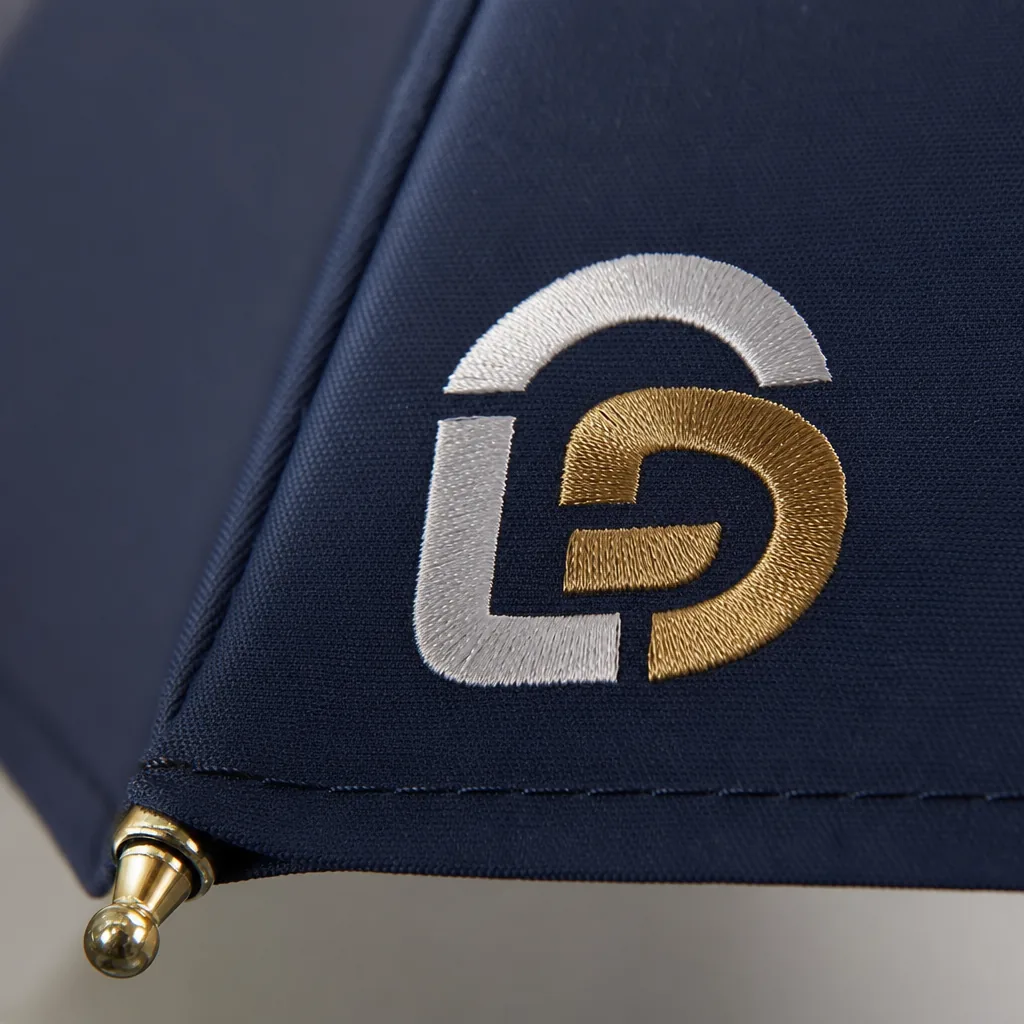
A repeat logo that looks clean on a flat artwork file can drift, distort, or break at the seams once it is cut into umbrella panels. In repeat pattern umbrella printing, the real work is controlling scale, fabric behavior, panel sequencing, and registration from strike-off through final canopy inspection. On our Songxia factory floor, most problems are prevented before mass production by matching the print method, 190T or 210T fabric, and QC checkpoints to the brand’s retail standard.
Why Repeat Patterns Work for Umbrella Branding
Repeat pattern umbrella printing works because an umbrella is a moving, curved billboard, not a flat poster. A single large center logo often looks distorted once the canopy is stretched over 8K or 10K ribs, and part of it disappears when viewed from the side. Smaller repeated logos, icons, mascots, or brand motifs stay readable across multiple panels and viewing angles. On a 23" or 27" canopy, a 25–60 mm repeat is usually enough for recognition without turning the umbrella into a giveaway-looking item. For retail and lifestyle brands, this is the difference between merchandise people actually carry and a canopy that feels like event signage.
Branded umbrella patterns are especially useful when the buyer wants brand presence without shouting. Hotels can use a subtle monogram repeat on 190T or 210T pongee for lobby loaner umbrellas, while campus stores often combine mascots, initials, and school colors into logo repeat umbrellas for alumni and student sales. Promotional-product distributors use the same method for banks, beverage brands, and trade shows because the artwork can carry identity from every angle, even when the umbrella is closed in a sleeve. For OEM umbrella branding, I usually push clients toward panel-safe repeats instead of huge edge-to-edge artwork if the order involves mixed manual, auto-open, and auto-open-close frames.
The production advantage is also real: a custom canopy print with repeating elements gives more tolerance during cutting and sewing than one giant placement logo crossing several seams. Each panel still has to be aligned, especially on full sublimation or heat-transfer jobs, but a controlled repeat hides minor sewing variation better than a large circle or wordmark split over rib lines. Our standard practice at ZheBrella is to check the repeat scale on a paper panel template before bulk printing, then confirm canopy appearance after stretching on the actual 21", 23", 27", or 30" frame. That step prevents the common mistake where branded umbrella patterns look fine on a flat AI file but become crowded, tilted, or unreadable once assembled.
Choosing Pattern Scale, Direction, and Panel Flow
Pattern scale should be chosen before artwork is separated into umbrella panels, because a canopy is not a flat poster; it is a cone made from wedges. For repeat pattern umbrella printing, I usually separate designs into three working scales. Small repeats, such as 10–25 mm dots, mini icons, or tight monograms, are the safest for 21" and 23" folding umbrellas because seam mismatch is less visible after sewing. Medium repeats around 40–80 mm work well on 23" and 27" stick umbrellas, especially for retail branded umbrella patterns where the customer should recognize the motif from 2–3 meters away. Oversized repeats above 120 mm need more planning because one flower, mascot, or logo may be cut by a seam or disappear under a rib line. On 190T pongee or 210T polyester, sublimation holds fine detail better than screen printing, but the pattern still has to survive cutting tolerance, sewing allowance, and canopy tension after assembly.
An 8K canopy gives you eight large triangular panels, so each panel shows more of the artwork but also makes every seam interruption more obvious. A 16K canopy, often used on stronger golf or premium windproof umbrellas, has narrower panels and more rib lines, so small and medium repeats usually look smoother, while large logos can feel chopped up if the layout is not adjusted. Rib placement matters because ribs create raised lines that visually divide the custom canopy print even when the ink is perfect. For logo repeat umbrellas, I avoid placing critical text or circular emblems directly on seam allowances; a 7–10 mm safe zone from each cut edge prevents distorted logos after overlock stitching and topstitching. Our standard practice at ZheBrella is to print a paper panel mockup at full scale before sampling, then mark rib positions so the buyer sees where the eye will naturally break the pattern.
Panel-to-panel alignment is possible, but it is not always the best choice. If the design is geometric, such as stripes, chevrons, plaid, or a repeating border, the artwork should be engineered so the motif flows across adjacent panels at the canopy edge and looks intentional when viewed from above. This requires tighter cutting control and slower sewing, so it can affect MOQ, sampling time, and cost. If the design uses scattered icons, tropical leaves, stars, or abstract shapes, intentional randomization is often cleaner because minor sewing movement will not read as a defect. For OEM umbrella branding, I recommend one clear decision in the tech pack: either matched flow with panel numbers and print orientation, or randomized flow with approved rotation rules. Without that instruction, the sewing line may rotate panels for fabric yield, and the finished umbrella can look inconsistent even when it passes AQL 2.5 inspection for construction.
Fabric and Print Method Selection
Fabric choice sets the ceiling for repeat pattern umbrella printing before any artwork goes to the RIP. For most branded umbrella patterns, 190T pongee is the practical baseline: it has enough yarn density for clean logo edges, folds well on 21" and 23" compact umbrellas, and keeps unit cost under control for promotional runs. 210T pongee gives a tighter hand and slightly smoother print surface, which matters when the repeat includes thin outlines, small serif text, gradients, or tight geometric spacing. On 27" and 30" golf umbrellas, I usually push buyers toward 210T because the larger panels expose distortion more clearly. If the fabric is too loose, the repeat may look acceptable flat on the cutting table but become fuzzy after sewing tension, rib attachment, and canopy stretching.
For full-color custom canopy print work, dye-sublimation is usually the best choice on white polyester pongee when the artwork includes photographic elements, multiple Pantone-like tones, or edge-to-edge repeats across all 8 panels. Digital printing can also handle complex OEM umbrella branding, but the factory must control panel orientation, shrinkage allowance, and color drift between batches. In production, we print before cutting for large repeats when alignment across seams is important, then die-cut panels with registration marks. Screen printing still wins for simple one- or two-color logo repeat umbrellas, especially on 190T pongee in medium to high quantities. It lays down stronger spot color, costs less after the screens are made, and is more stable for bold motifs than digital ink on darker fabric.
Coating decisions should be made before print approval, not added as an afterthought. A standard water-repellent finish is enough for most city umbrellas, but a Teflon-type coating improves beading and helps the canopy pass spray testing after repeated opening and closing. For UPF 50+ designs, black-out or silver UV coatings can block light well, but they may change fabric hand, panel stiffness, and sewing behavior; heavy coatings on 210T pongee can make compact umbrellas harder to close neatly. Our standard practice at ZheBrella is to test printed fabric after coating for rubbing, adhesion, water repellency, and color shift before confirming bulk production. A good pre-production sample should be checked both flat and mounted on the frame, because pattern sharpness and UV performance are judged on the finished umbrella, not on a loose fabric swatch.
Sampling, MOQ, and Production Lead Times
For repeat pattern umbrella printing, do not jump straight to a full umbrella sample. The first approval should be a strike-off on the actual fabric, or at least a printed panel sample cut from the same 190T or 210T pongee, POE, PVC, or EVA material planned for production. A repeat that looks clean on paper can drift badly once the artwork crosses 8 panels, especially when logos are small, diagonal, or expected to align near the rib seam. I normally ask buyers to approve three things before we sew a full canopy: color under D65 light, repeat scale in millimeters, and seam tolerance after cutting. For branded umbrella patterns, a 2–3 mm shift at each panel edge is normal; expecting wallpaper-level alignment across a curved 23-inch or 27-inch canopy is not realistic. At ZheBrella, our standard practice is to run strike-offs before full pre-production samples for logo repeat umbrellas because it saves both sides from paying for a beautiful but wrong umbrella.
MOQ depends heavily on the print method. Screen printing simple one-color repeats may start around 500–1,000 pieces if the artwork is not too dense, but each extra color adds screens, setup cost, and registration risk. Heat-transfer repeat work is usually sensible from 300–500 pieces, though unit cost is higher and large all-over coverage can affect hand feel. Digital sublimation on white polyester is the most flexible for a custom canopy print, often starting from 100–300 pieces, but it is not suitable for every fabric color or coating. For OEM umbrella branding on retail programs, 1,000–3,000 pieces is the cleaner band because fabric can be printed in roll form before cutting, giving better repeat consistency and lower waste. Pre-production samples usually take 7–10 days after artwork confirmation for digital or transfer work, and 10–14 days for screen or roll-print processes, assuming Pantone references and panel layout are already confirmed.
Lead time changes more than many buyers expect when repeat artwork is involved. A plain stock-color 23-inch auto-open umbrella may finish in 25–30 days after deposit, but repeat pattern umbrella printing usually adds 7–15 days because fabric printing, curing, color approval, cutting alignment, and extra inspection all sit before frame assembly. If the order uses a vented double canopy, 10K fiberglass ribs, UPF 50+ coating, or a Teflon water-repellent finish, the schedule should be locked only after the printed fabric passes rub, adhesion, and water-spray checks. FOB Ningbo or Shanghai timelines are normally easier to control: production plus 3–5 days for inland trucking, export docs, and port handling. DDP is less predictable because carton volume, customs channel, and destination warehouse appointments can add 10–25 days by sea or 5–10 days by air. For repeat-pattern orders, buyers should approve the final pre-production sample before bulk cutting, not after the fabric roll is printed.
Quality Control for Pattern Consistency
Pattern consistency has to be inspected after cutting, after sewing, and again after full assembly, because a canopy that looks correct on the printing table can shift once eight ribs pull it into a dome. For repeat pattern umbrella printing, our AQL 2.5 checklist starts with print registration at the panel level: the repeat pitch, logo spacing, and edge position must match the approved strike-off within the agreed tolerance, normally ±2 mm for small repeats and ±3 mm for large all-over graphics. On 190T or 210T pongee, sublimation can creep slightly during heat setting, while screen printing may show registration drift on multi-color branded umbrella patterns if the jig is not locked. We check the first 3 to 5 panels from every cutting stack before sewing, not just the top sheet, because fabric tension and knife drag can move lower layers. For logo repeat umbrellas, even a small diagonal error becomes obvious once the panels meet at the top notch.
Color control is handled with both visual and measured checks. The approved sample stays at the inspection table under D65 lighting, and we compare canopy panels for shade variation, ink density, and coating interaction, especially when Teflon water-repellent or UPF 50+ treatment is applied after printing. Dark navy, red, and black are the colors most likely to show batch differences, while white logos on dark canopies often reveal pinholes or under-curing. Seam distortion is another practical failure point: if the operator overfeeds one panel, the custom canopy print will bow across the seam even when the artwork itself is accurate. We inspect every seam junction at the crown, each panel-to-panel alignment line, and the rib pocket position. A good OEM umbrella branding job is not only about sharp ink; the repeat must remain visually balanced when the umbrella is open at full rib tension.
Final inspection is where many factories catch problems too late, so the open-umbrella check is mandatory. We open sampled units from the packed lot and inspect rib alignment, canopy tension, strap placement, stains, oil marks, loose threads, and whether handle or strap branding matches the canopy artwork version. A mismatch between a printed strap logo and the main repeat pattern is a real shipment risk, especially when several SKUs share the same 23-inch auto-open frame or 27-inch golf umbrella frame. At ZheBrella, the AQL 2.5 finished-goods inspection includes rotating the umbrella under light to see whether ribs pull the repeat off-center or distort circular logos into ovals. We also check that the closure strap lands in a clean visual area and does not cover a key logo unless the buyer approved it. These post-assembly checks matter because steel and fiberglass frames load the canopy differently, and tension can change how the pattern reads to the end user.
Frequently Asked Questions
Can a repeat pattern align perfectly across every umbrella seam?
Perfect seam-to-seam alignment is difficult because each panel is cut and sewn under tension. For best results, use patterns with forgiving repeats or design deliberate breaks at the seams.
Is repeat pattern printing better on 8K or 16K umbrellas?
8K umbrellas have larger panels and fewer seam breaks, which helps larger motifs read clearly. 16K frames create a more premium rounded canopy but require tighter control of pattern scale and placement.
What repeat size works best on a standard 8-panel umbrella canopy?
For most 21 to 23 inch, 8-panel umbrellas, buyers usually test a repeat block of 8 to 15 cm so the logo stays visible without distorting near the tip or edge. If the artwork includes text, keep key elements at least 10 to 15 mm away from seam lines to reduce readability issues.
How do buyers verify panel sequencing before bulk production?
Ask for a digital panel map plus one pre-production sample showing panel order, seam joins, and logo orientation when the umbrella is opened from the strap side. For OEM orders, this check is normally done before bulk cutting, which helps avoid a full-lot reprint.
Does 210T fabric always print better than 190T for repeat-pattern umbrellas?
Not always. 210T pongee generally gives a denser surface and can improve color consistency for fine repeats, but 190T can still perform well if the pattern is simple and the ink coverage is moderate. Buyers should compare strike-offs on both fabrics when matching retail color standards.
Looking to Launch Your Custom Umbrella Line?
ZheBrella is a Zhejiang-based OEM/ODM umbrella manufacturer with 17 years of export experience. Free design, low MOQ from 100 pieces, windproof construction, full-color print.
Get Free Quote Now »People Also Search For
Related Articles
Repeat Logo Pattern Printing for Branded Umbrellas
Use repeat logo patterns to create ownable umbrella canopies, with guidance on scale, panel alignment, 190T/210T pongee,...
Read More »
Colorfast Logo Printing for Branded Umbrella Canopies
Reduce logo fading, bleeding, and transfer issues by matching ink, fabric, coating, and QC tests before branded umbrella...
Read More »
Repeating Logo Patterns for Promotional Umbrella Canopies
Build repeating-logo umbrella canopies that stay legible, factory-feasible, and brand-safe across panel seams, rib count...
Read More »