Repeat Logo Pattern Printing for Branded Umbrellas
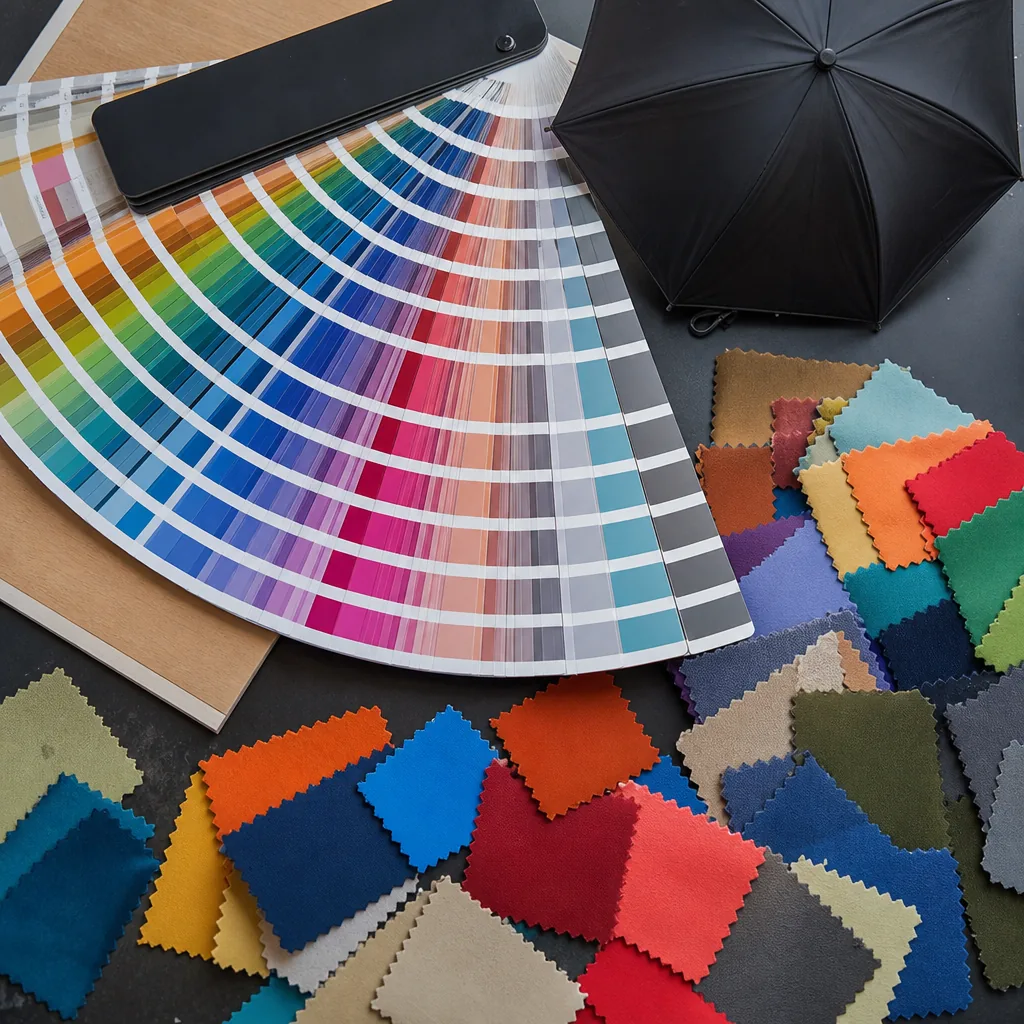
Buyers usually find out too late that a canopy pattern looking clean on screen can break at the panel seams, drift off scale, or lose edge definition once it hits 190T or 210T pongee. For repeat logo umbrella printing, the real work is controlling artwork repeat, panel registration, ink behavior, and sampling discipline so the finished umbrella reads as one brand surface instead of eight separate wedges.
How Repeat Patterns Differ from Single Logo Branding
Repeat logo umbrella printing shifts the product from promotion to merchandise. A single mark on one or two canopy panels is still the lowest-friction option on branded umbrellas because artwork setup is simpler and unit cost stays down, but buyers should expect it to read as advertising. A repeat layout changes that signal. When the logo runs across the full canopy on 8K, 10K, or 16K frames, the brand stays visible from multiple angles and the umbrella looks closer to retail accessories, fashion licensing, or hotel gift-shop stock than to a trade-show handout. That matters for programs where perceived value drives sell-through or gift acceptance. The effect is strongest on 21 inch and 23 inch folding styles using 190T or 210T pongee, since the tighter weave holds sharper repeat edges than low-density polyester. Small repeats, step-and-repeat monograms, diagonal wordmarks, and tonal branded canopy patterns also hide panel seams better than oversized artwork, so the finished product looks engineered as umbrella pattern branding rather than artwork dropped onto a canopy.
Execution matters as much as artwork. Dense allover logo umbrellas usually work best with sublimation on white pongee panels before sewing because it delivers full-bleed coverage, finer type, and more consistent repeat alignment across the canopy. Screen printing still fits 1-color repeats on darker fabric, but small logos expose panel-to-panel registration drift quickly, which raises rejection risk on image-sensitive orders. Clear POE or EVA canopies can support private label umbrella prints as well, although buyers need tighter controls on ink adhesion, fold marking, and cold-weather brittleness than with fabric canopies. The best use cases are programs that need a retail or fashion-brand finish: private-label collections, hotel retail, premium corporate gifts, and event merchandise meant to be photographed or sold at margin. On stock frames, MOQ is commonly 300 to 500 pieces; adding custom handles, woven labels, or hangtags usually pushes lead time to 35 to 50 days. For resale orders, lock in AQL 2.5, carton marks, and FOB or DDP terms early, because presentation defects usually hurt perceived value before functional defects do.
Choosing Logo Scale, Spacing, and Pattern Direction
Logo scale decides whether repeat logo umbrella printing reads as premium or gets lost once the canopy opens. Most failed first proofs are sized on a flat screen, then collapse visually across a curved 21-inch or 23-inch folding umbrella. Small monogram repeats work best when the mark is simple, stroke weight is heavy enough to hold on 190T or 210T pongee, and spacing is widened to compensate for canopy tension. Viewing distance should set the repeat size: check an opened sample from 6 to 10 feet, which is how pedestrians will see it on a street, campus, or event site. On an 8K frame, each panel narrows toward the tip, so logos that look evenly spaced in a flat tile often read compressed near the top and stretched at the outer edge. On a 16K fashion umbrella, seams interrupt the repeat twice as often, so dense layouts turn noisy faster. For umbrella pattern branding, approve scale from a full-canopy rendering or sewn sample, not a cropped repeat tile, because panel seams and canopy curvature change the pattern more than most buyers expect.
Medium diagonal repeats are usually the lowest-risk option for allover logo umbrellas because they cross panel joins more naturally than rigid horizontal or vertical grids. A diagonal step repeat also hides small seam shifts and fabric-tension variation, which matters on auto-open and auto-open-close frames where the canopy snaps tight and exposes uneven spacing. On 190T or 210T pongee, medium repeats with about 3- to 5-inch spacing usually give two-color private label umbrella prints enough brand visibility without crowding the background. Large motif layouts need more discipline, not just larger art. On 27-inch golf umbrellas or 30-inch vented double-canopy frames, oversized logos and icons can work, but only when key elements are kept clear of seam allowance, hemming, top-notch positions, runner stress points, and the closure-strap fold zone. Map the full 8K or 16K canopy before approval, rotate art panel by panel, and confirm the design reads from below, from the side, and in motion. That prepress step adds time, but it reduces approval risk on branded canopy patterns that look correct flat and wrong after assembly.
Panel Layout and Seam Alignment Considerations
Umbrella canopies are built from separate triangular panels, not printed as one continuous circle. In normal production, those panels are cut as 8K, 10K, or 16K layouts, then sewn over ribs, stretchers, and tip tension points, so seam alignment is a manufacturing variable, not just an artwork issue. For repeat logo umbrella printing, buyers should lock seam expectations before sampling: exact match across every seam increases fabric waste, slows cutting and sewing, and raises reject risk, especially on 21-inch and 23-inch folding umbrellas where each wedge is narrow. On 27-inch and 30-inch straight or golf umbrellas, standard production can usually hold seam registration at about +/-3 to 5 mm. Tighter tolerances are possible, but they usually push lead time from roughly 35 days toward 45 days and add cost because more panels fail after assembly. For most umbrella pattern branding programs, that tradeoff is unnecessary if the repeat is engineered to the actual wedge shape instead of dropped onto flat yardage artwork.
The most reliable layouts are panel-based. A mirrored motif centered inside each wedge usually looks cleaner than a horizontal band forced across 8 seams, because the canopy opens as tapered sections rather than a flat sheet. That matters even more for allover logo umbrellas in 190T or 210T pongee, where polyester has slight give during cutting and sewing; by comparison, POE, PVC, or EVA clear canopies show mismatch faster under light. Standard prepress practice is to build the file with seam allowance, crown distortion, and edge curvature already compensated, then approve one physical sample before bulk production. Keep critical logos, words, circles, and boxed marks off rib lines and away from the hem, where binding tape and tip reinforcement distort shape. On compact styles, place key motifs at least 12 to 18 mm from the seam and about 20 mm above the edge. For premium private label umbrella prints, one hero panel with simpler secondary repeats usually delivers a stronger result than chasing perfect matching on every seam. Under AQL 2.5, final inspection should judge visual balance on an opened canopy from about 1 to 1.5 meters, which reflects real viewing conditions for branded canopy patterns.
Fabric, Print Method, and Color Control
Fabric drives print definition before ink selection does. For repeat logo umbrella printing, 190T pongee is the commercial baseline on 21 inch and 23 inch folding umbrellas because it balances cost, fold volume, and dependable spot-color screen adhesion. When umbrella pattern branding uses small marks, tight spacing, or cleaner edge requirements, 210T pongee usually earns the higher fabric cost: the tighter weave presents a flatter print face and reduces edge bleed at yarn intersections. Polyester twill is a step up for private label umbrella prints, especially on 27 inch and 30 inch golf frames, because the surface gives branded canopy patterns more depth and a heavier hand. The tradeoff is functional, not cosmetic: the diagonal twill grain can soften thin strokes and micro text, so buyers should enlarge the repeat or remove very fine details. UPF 50+ fabrics need separate review. A silver coating or black-under UV layer can mute face color, reduce brightness, stiffen hand feel, and lower apparent sharpness on dense allover logo umbrellas versus uncoated 190T or 210T pongee.
Print method should match both artwork and MOQ. Screen printing is usually the lowest-risk choice for allover logo umbrellas with one to three solid Pantone colors and repeat layouts across 8K or 10K canopies; after screen charges are absorbed, unit cost typically improves on orders above 1,000 pieces, and opacity on dark grounds is stronger than most digital options. Digital printing is the better fit when branded canopy patterns include four or more colors, gradients, halftones, or photographic fills, particularly on white 190T or 210T pongee using heat-transfer or direct digital production. The risk shifts from ink setup to alignment: panel nesting, seam allowance, and stitching must be controlled so the repeat does not jump across canopy seams. Color approval should be explicit. Approve both logo and background against Pantone references, and record the fabric, coating, and print method on the signed standard, because the same Pantone can shift between 210T screen print, digital transfer, and coated UPF 50+ fabric. For export programs, AQL 2.5 inspection should cover repeat alignment, ghosting, pinholes, and panel shade variation, especially when FOB lead time is only 25 to 35 days.
Sampling, MOQ, Lead Time, and Inspection Points
Catch errors before bulk cutting. For repeat logo umbrella printing, use two approvals: first, a strike-off on the actual canopy fabric; second, a full pre-production umbrella on the final frame. A digital mockup cannot show how a repeat shifts when 190T or 210T pongee is tensioned, stitched, and wrapped over an 8K or 10K frame. The strike-off should show one full pattern repeat, Pantone color match, logo spacing, print direction, and seam interaction before printed yardage is released. Then approve one complete umbrella in the ordered construction: a 21 inch auto-open-close folding style, a 23 inch straight manual, or a 27 inch vented double-canopy model. That full sample exposes the real umbrella pattern branding risks: logos drifting into seam allowances, alternating panels flipping artwork upside down, and image loss near the tips where each gore narrows. For allover logo umbrellas, this two-step approval process is usually the lowest-cost way to avoid reprint, recutting, and delayed shipment.
MOQ and lead time increase once a project moves from spot decoration to private label umbrella prints on custom-printed fabric. A one-position logo on stock-color pongee may start at 300 to 500 pieces, but branded canopy patterns and other engineered repeats more often require 500 to 1,000 pieces per design and colorway because mills need stable print runs and the cutting room needs consistent yield across the repeat. Pattern setup also adds time. A simple silkscreen repeat on pongee typically adds 3 to 5 days after artwork approval; heat-transfer or sublimation layouts usually add 5 to 7 days for file separation, test output, and position checks. After sample approval, bulk production for FOB orders generally runs 25 to 35 days; DDP takes longer once transit and customs are included. Inspection should follow AQL 2.5 with explicit checkpoints for print registration, repeat continuity across adjacent panels, color consistency under the same light source, visible fabric defects such as slubs, pinholes, stains, and coating streaks, and sewing alignment at the seams. Inspect both flat cut panels and finished umbrellas, because some print and alignment failures only appear once the canopy is fully tensioned on the ribs.
Frequently Asked Questions
Can repeat logo patterns align perfectly across umbrella seams?
Sometimes on simple layouts, but exact seam-to-seam matching is difficult because panels are cut, stretched, and sewn. Buyers should define acceptable tolerance during sample approval.
Is digital printing better for repeat logo umbrella patterns?
Digital printing is usually better for multi-color or photographic repeats. Screen printing can be more cost-effective for one- or two-color patterns at higher volumes.
How much repeat mismatch is acceptable at umbrella panel seams?
For mass production, most buyers set a seam tolerance of about 2-4 mm depending on umbrella size and logo scale. If the artwork has tight geometric repeats or small text, request a pre-production sample and define the seam tolerance in the QC spec before bulk printing.
Should I choose 190T or 210T pongee for repeat logo canopy printing?
190T pongee is commonly used for promotional programs where cost control matters, while 210T pongee gives a denser surface that usually shows sharper edges and more stable color coverage. For retail-brand orders with fine repeats, 210T is typically the safer choice even if unit cost is slightly higher.
What file setup reduces print errors on allover logo umbrellas?
Factories usually want vector AI or editable PDF artwork with the repeat tile, pantone references, and one full panel layout showing logo direction. Add bleed and mark the safe area near cut lines and tip sections, because a pattern that looks balanced on flat fabric can shift visually once the canopy is sewn.
Looking to Launch Your Custom Umbrella Line?
ZheBrella is a Zhejiang-based OEM/ODM umbrella manufacturer with 17 years of export experience. Free design, low MOQ from 100 pieces, windproof construction, full-color print.
Get Free Quote Now »People Also Search For
Related Articles
Repeat Pattern Umbrella Printing for Retail Collections
Plan repeat-pattern umbrella canopies for retail lines with panel layout, fabric choice, color control, sampling, MOQ, a...
Read More »
Repeat Pattern Printing for Branded Umbrella Canopies
Plan repeat-pattern umbrellas with correct scale, panel sequencing, 190T/210T fabric choices, sampling steps, and QC che...
Read More »All-Over Repeat Patterns for Private-Label Umbrellas
Build private-label umbrella patterns that repeat cleanly across panels with the right fabric, rib count, artwork scale,...
Read More »