Choosing the Right Logo Decoration Method for Branded Umbrellas
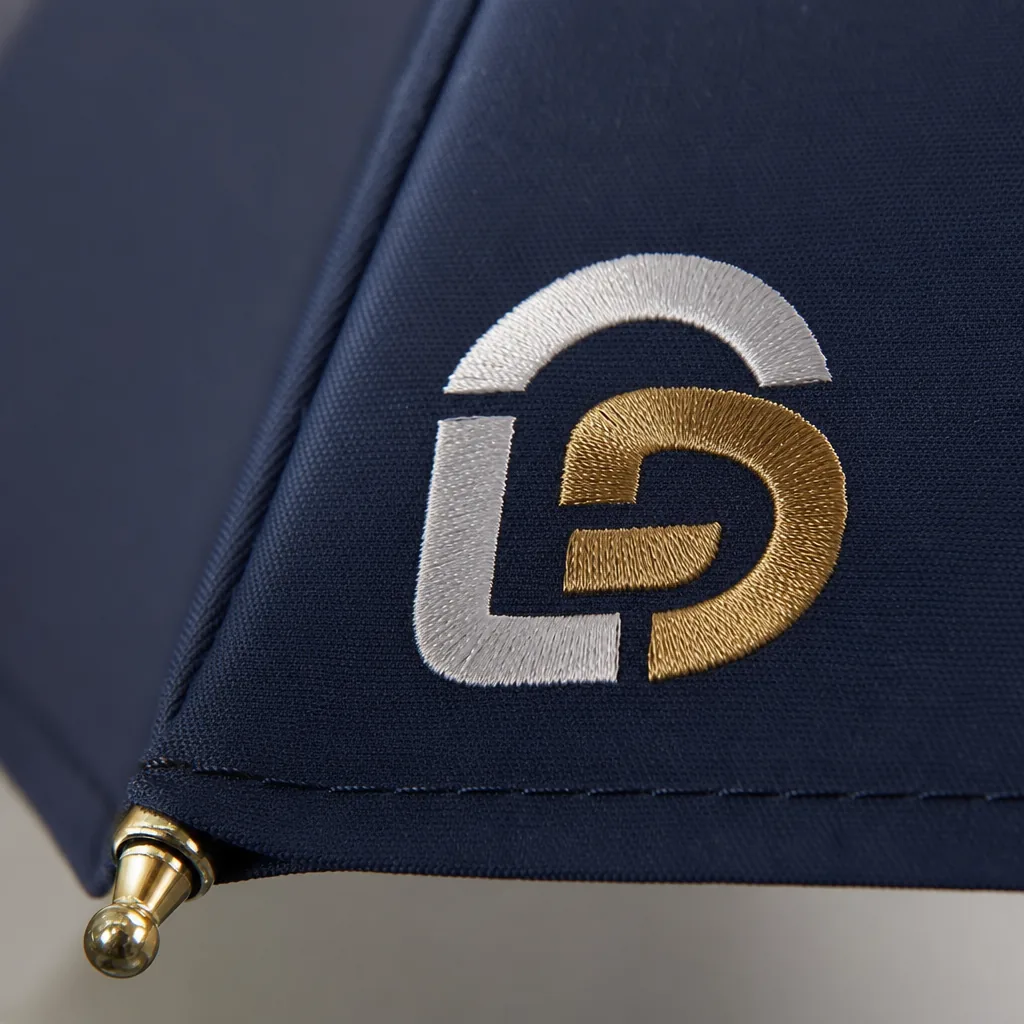
For branded umbrellas, the wrong decoration method can turn a good product into a complaint about fading ink, slow setup, or pricing that misses the target. Choosing between silk screen, heat transfer, digital print, and woven labels comes down to how the umbrella will be used, how much detail the logo needs, and whether the order volume justifies the setup cost. From the factory floor, we see logo printing on umbrellas succeed when buyers match the method to the canopy fabric, color, and required durability, not just the artwork.
Logo decoration methods and where each fits
Screen printing is still the default for logo printing on umbrellas when the artwork is simple and the order volume is stable. It gives the cleanest Pantone matching, the lowest unit cost, and the best opacity for solid logos, one- or two-color text, and clean vector shapes. On 190T pongee, it prints well if the fabric is tensioned correctly, but 210T pongee is better because the tighter weave holds sharper edges and reduces ink bleed. On coated polyester canopies, screen printing is usually fine as long as the coating is compatible and the cure temperature is controlled. It is not the right method for gradients, photo images, or very fine detail, and it becomes risky near seams, vents, or rib tips where the panel flexes hard in wind.
Heat transfer fits when the artwork is more complex than a screen can handle, or when the buyer wants smaller runs without paying for multiple screens. It handles gradients, shadows, and mixed-color branding better than screen printing, and it is often the practical choice for branded umbrellas with detailed logos or multicolor event graphics. On 210T pongee and coated polyester, transfer films generally hold better because the surface is smoother and more stable under heat. On 190T fabric, it can still work, but the lower-density weave is less forgiving and you see more texture under the graphic. For clear POE canopies, transfer is usually the only realistic route if you want opaque branding without making the panel look muddy. ZheBrella usually recommends testing heat, pressure, and peel behavior on the exact canopy lot before production starts.
Digital print is the right answer when the art needs full-color shading, small text, or variable artwork that would be expensive to separate into screens. It is especially useful on coated polyester panels where the buyer wants a more photographic look, but it should be used with realistic expectations: digital ink sits differently on each substrate, so the same file will not look identical on 190T pongee, 210T pongee, and clear POE. Clear POE usually needs a white underlayer or reverse-print approach, otherwise the colors lose body. Reflective and UV inks solve different problems. Reflective ink is for visibility at night and makes sense on golf, sports, or safety umbrellas. UV inks are for outdoor durability and sunlight resistance, especially on umbrellas that will sit in display conditions for long periods. If the order needs a long-lasting logo with stable Pantone matching, screen printing wins; if it needs detail or short-run flexibility, digital print or heat transfer is the better fit.
Durability, color accuracy, and feel
For logo printing on umbrellas, the first decision is whether the mark needs to survive repeated wet-dry cycles and sleeve abrasion. Screen printing with the right ink stack gives the hardest edge and the best wash resistance on pongee 190T or 210T, especially for one- to three-color solid logos on branded umbrellas. A properly cured plastisol or solvent system stays more matte and less tacky, while cheap overprint methods can feel glossy, crack at the fold lines, and start scuffing after a few months of use. Heat transfer sits in the middle: it can look clean at first, but the film edge is what fails first if the canopy gets folded tight or packed wet. Digital print is useful when artwork has many colors, but the hand feel is usually softer and the surface often reads slightly shinier, which matters on premium umbrellas where buyers notice the finish immediately.
Pantone matching behaves differently depending on the ink system and the fabric color underneath. On white or light canopies, screen printing can hit a tight Pantone target if the mesh count, ink density, and curing are controlled; on black, navy, or other dark fabrics, the same ink can shift duller or warmer because the base textile absorbs light and forces heavier ink laydown. Heat transfer and digital print usually have a wider color gamut, but they are less predictable for exact Pantone matching because the carrier film, adhesive, and print engine each introduce their own color drift. For branded umbrellas, that is why spot colors and clean logos are safer than subtle gradients. A simple vector mark with defined edges prints cleaner, holds its shape better at 21-inch or 23-inch panel curvature, and avoids banding or moiré that shows up fast on curved canopy segments.
Solid logos almost always outperform gradients on umbrellas because the fabric is not a flat poster surface. The canopy bends, the stitches interrupt the image, and the logo gets seen from oblique angles, so crisp blocks of color keep their identity better than soft fades. In practice, screen printing gives the sharpest boundary and the most stable matte appearance, while digital print can handle gradients but often sacrifices edge definition and tactile consistency. If the buyer wants a premium hand feel, the right answer is usually a restrained spot-color layout with good Pantone matching rather than a full-color picture. That is the same logic we use at ZheBrella when sampling: choose the method based on how the umbrella will age, not just how it looks in the mockup. A logo that still reads cleanly after abrasion, folding, and rain is the one that actually performs in the field.
Cost drivers buyers should compare
The first cost driver is setup, not ink. Screen printing usually has the lowest per-piece cost once the screens are made, but it carries film output, screen-making, and registration setup charges that only make sense when the order size is large enough. Heat transfer usually lands in the middle: lower tooling than screen printing, better for small and mixed-color runs, but the transfer sheets still add labor and material cost. Digital print removes most color-change setup, which is why buyers use it for artwork with gradients or full-bleed graphics, but the unit price is usually higher because the printer is laying down more ink and moving slower. For logo printing on umbrellas, the cheapest quote is often not the cheapest landed cost if the method is wrong for the art or the order size.
Color count is where buyers get surprised. With screen printing, each extra spot color normally means another screen, another setup step, and more chance of misregistration on curved panels, so a two-color logo can cost materially more than a one-color version. Pantone matching is straightforward with spot-color screen printing if the logo is flat and the canopy fabric is consistent, but matching becomes less predictable on textured pongee or coated POE. Heat transfer and digital print handle complex logos better, but the cost model changes from screen fees to file prep, transfer material, or print coverage. For branded umbrellas, buyers should compare not just the decoration quote but also whether the method can hold tight Pantone matching across 1,000 pieces without drift.
MOQ is tied to how the decoration is produced. Screen printing usually demands the highest minimum because the factory needs enough units to amortize setup, while heat transfer can support smaller orders and mixed artwork with lower risk. Digital print can be the most flexible for short runs, but the factory may still set an MOQ based on labor sorting, panel layout, and inspection time. Frame choice does not change the print method: auto-open frames and 8K or 16K constructions use the same decoration options, but they can slow handling because the canopy needs extra care during opening, alignment, and drying. That matters on the line, especially when the job has multiple print locations or requires strict placement tolerance on each panel.
Production controls and inspection points
For logo printing on umbrellas, the control point is proof approval before anything is cut or printed. We require a signed artwork proof that locks down logo size, color values, panel layout, and the exact decoration method, whether that is screen printing, heat transfer, or digital print. If the customer is asking for Pantone matching, the proof should show the target Pantone code and the acceptable delta, because a logo that looks correct on a monitor can drift badly on coated pongee or PVC. After proof approval, a strike-off or preproduction sample is the only reliable check that the artwork survives the curved panel and the real fabric stretch. On branded umbrellas, the panel is never a flat sheet, so placement has to be verified on the actual canopy geometry, not just a PDF.
Placement tolerance needs to be treated as a production spec, not a vague estimate. Our standard practice is to control logo position within a few millimeters from the approved centerline or edge reference, and to confirm the repeat position across every panel before bulk run starts. That matters most for screen printing, where a clean solid logo can still fail if the print lands too close to a seam or gets distorted by tension at the ribs. Heat transfer and digital print are more forgiving on detail, but they still need a strike-off to confirm adhesion, edge sharpness, and whether the ink or transfer film cracks when the canopy opens. For logo printing on umbrellas, the proof should also define what is allowed near the vent, the tie, and the tip so the factory is not guessing during mass production.
Inspection should follow AQL 2.5 for print defects, not just for general sewing quality. At that level, we look for color mismatch, blurred edges, pinholes, misregistration, missing ink, and any print shift that breaks the approved placement tolerance. Seams must be checked because a logo can look fine on a flat table and then split visually once the panel is stitched and tensioned, especially on 8K or 10K frames where panel width is narrow. Spine alignment also matters: if the runner, ribs, or tips are off-center, the artwork will appear crooked even when the print itself is technically correct. A double-canopy structure changes the visible print area because the outer vented layer blocks part of the view and can compress the logo into a smaller readable zone, so the approved artwork has to be scaled for the actual exposed area, not the nominal panel size.
Ordering terms for branded programs
For branded umbrellas, the first thing buyers should lock down is the commercial term, because FOB and DDP are not interchangeable even when the unit price looks close. FOB is cleaner for experienced importers: you control the freight, customs, and destination handling, so the factory quote stays focused on production and export clearance. DDP is useful for smaller teams or first-time buyers because the landed cost is bundled, but the margin for error moves into the logistics chain, where carton counts, duty rates, and last-mile access fees can change the final number. Typical lead times for standard logo printing on umbrellas run about 15 to 25 days after sample approval for in-stock materials, and 30 to 45 days if the canopy color, handle, or packing needs to be built around a retail spec. Screen printing is usually the fastest route for simple one- or two-color artwork, while heat transfer and digital print take longer when the art has gradients or tighter registration.
Samples are not optional when the decoration method affects color accuracy or placement. Buyers should request a pre-production sample before bulk production whenever the artwork uses Pantone matching, when the logo sits across seams or vents, or when the umbrella is intended for retail shelves where presentation matters. With screen printing, a strike-off is enough for simple logos, but heat transfer and digital print should be checked on the actual canopy fabric because ink density changes on pongee 190T, 210T, POE, and coated PVC surfaces. For promotional umbrellas with broad distribution, a photo sample and size confirmation may be enough if the logo is large and the event date is fixed. For retail programs, especially multi-SKU branded umbrellas with hangtags, sleeves, and barcode labels, a signed sample is the right control point before any bulk commit.
Volume should drive the order structure. Promo programs usually tolerate 300 to 1,000 pieces per color and favor fast-turn methods like screen printing or heat transfer, because the buyer wants speed and repeatable branding more than perfect tonal control. Event orders often push smaller quantities but harder deadlines, so the practical decision is to simplify decoration and avoid complex Pantone matching unless the client has already approved a sample. Retail programs are different: they usually justify larger MOQs because the decoration, packaging, and carton labeling must stay consistent across months of replenishment, and digital print becomes attractive when the artwork changes frequently or includes photographic detail. The main mistake is treating all branded umbrellas like the same order class; the correct terms depend on whether the priority is unit cost, speed, or shelf-ready consistency.
Frequently Asked Questions
Which logo method is best for small MOQ umbrella orders?
Screen printing is usually the lowest-cost option for simple one- to two-color logos, but MOQ and setup vary by factory. If the artwork is highly detailed or needs color gradients, digital print can be better even at smaller volumes.
Can a factory keep logo colors consistent across different umbrella fabrics?
Yes, but consistency is easier on stable substrates like 190T or 210T pongee than on textured or translucent materials. Ask for a Pantone target, pre-production sample, and a clear approval standard before bulk production.
Which decoration method is usually best for small logos on folding umbrellas?
For logos under about 40 mm wide, digital print or heat transfer usually gives the cleanest edges and the most readable text. Screen printing can work too, but very fine lines may fill in depending on the fabric texture.
How many Pantone colors can a screen-printed umbrella logo handle cost-effectively?
Most buyers keep screen printing to 1-3 spot colors for the best cost-to-quality balance. If you need 4 or more colors, setup costs rise and digital print may be more practical.
What MOQ is typical when choosing between printing methods for branded umbrellas?
Screen printing is usually the lowest-cost option at 300-500 pcs per design because the setup is spread across volume. Digital print is often better for 100-300 pcs or multiple artwork variations because it avoids screen charges.
Looking to Launch Your Custom Umbrella Line?
ZheBrella is a Zhejiang-based OEM/ODM umbrella manufacturer with 17 years of export experience. Free design, low MOQ from 100 pieces, windproof construction, full-color print.
Get Free Quote Now »People Also Search For
Related Articles
Choosing the Right Logo Decoration for Umbrella Branding
Compare logo decoration methods for branded umbrellas, with material limits, color counts, durability, and lead times fo...
Read More »
Screen Print, Digital Print, or Heat Transfer for Umbrella Branding
Compare umbrella logo printing methods by cost, MOQ, color range, and fabric compatibility so buyers can choose the righ...
Read More »
Screen Printing, Digital Printing, or Transfer for Umbrella Logos
Compare logo print methods for umbrellas by MOQ, color count, durability, and lead time so buyers choose the right brand...
Read More »