Custom Umbrella Handle and Strap Branding Options for OEM
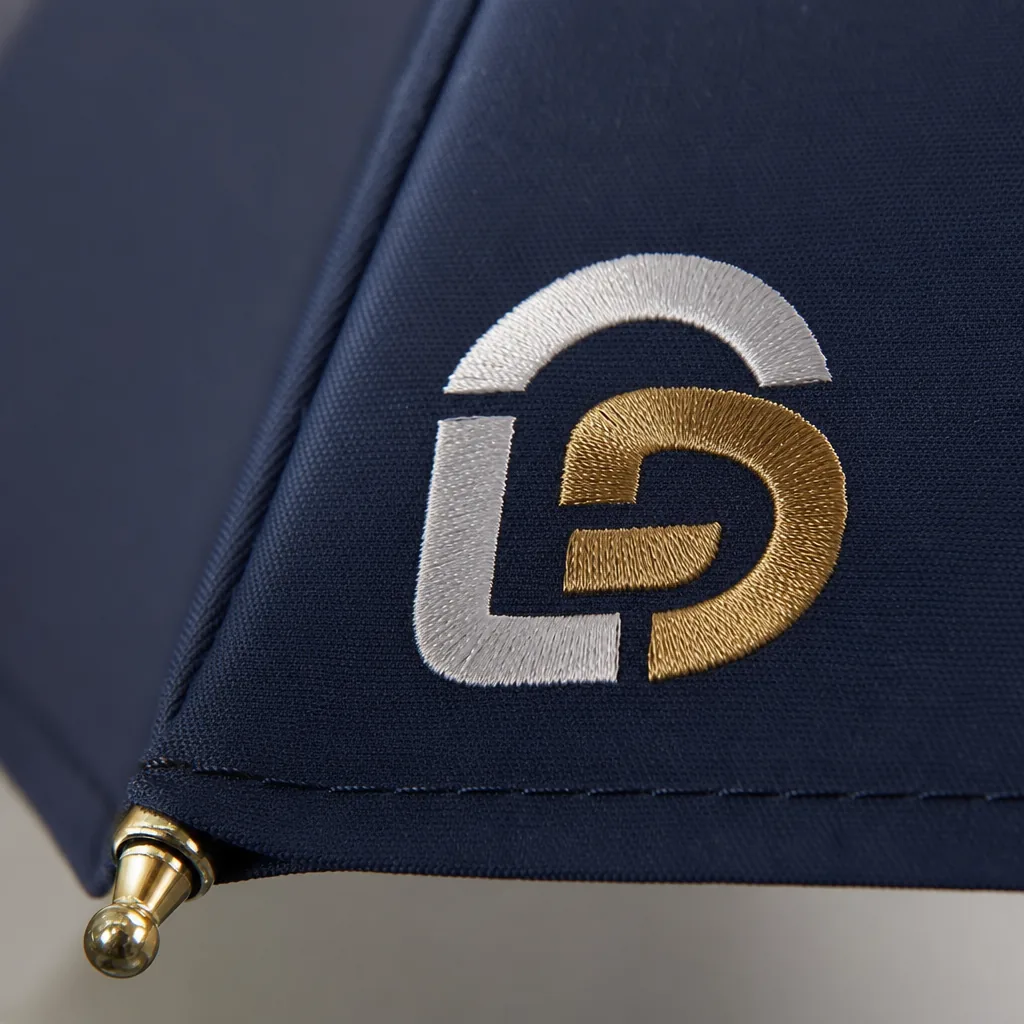
When an OEM umbrella program looks right on paper but the handle logo scuffs, the strap print shifts, or the tooling MOQ lands too late, buyers end up paying for revisions instead of launch volume. On our Songxia production lines, umbrella handle branding options and strap decoration have to be judged against resin shrinkage, pad-print area, mold cost, sewing tolerance, and assembly speed long before samples are approved.
Which Small Branding Areas Matter Most
Handles and closure straps often generate more repeat exposure than an extra canopy panel because they stay visible when the umbrella is closed. On a folded 21 inch or 23 inch umbrella, the handle and strap are what users see on a train seat, under a desk, or in a hotel lobby; the canopy logo only works when the umbrella is open. That is why umbrella handle branding options have a direct effect on perceived quality. A 1-color pad print on an ABS curved handle, a debossed silicone grip wrap, or a molded logo handle in PP or wood looks specified into the product, not added at the end. This matters on manual, auto-open, and auto-open-close folding umbrellas, where the handle is the first contact point and usually the last branded part the user sees. Buyers also read durability here. Clean logo edges, consistent paint or soft-touch finish, and tight fit between handle and shaft are more noticeable in hand than whether the canopy has one printed panel or two.
The closure strap is small, but it is one of the best-value branding areas on an OEM order. On a 21 inch 3-fold umbrella, the usable decoration area is typically about 70 x 15 mm to 85 x 20 mm. On a 27 inch or 30 inch golf umbrella, the tie wrap usually allows about 90 x 20 mm to 110 x 25 mm. That space can take a wrist strap logo print, woven label, rubber patch, or short slogan by screen print or heat transfer. In folded use, the strap often faces outward more consistently than a canopy panel, especially when 190T or 210T pongee wraps into a neat cylinder. On transparent POE or EVA canopies, strap branding can outperform canopy artwork because ribs, seams, and overlapping material compete with the print. For promotional umbrella details, this is usually the lowest-cost upgrade after the main canopy logo.
Tie wraps, hang loops, and handle medallions also reduce print risk compared with adding more canopy positions. Each extra canopy logo adds screen setup cost and tighter registration requirements, and that risk rises on vented double-canopy windproof styles and on 10K or 16K frames where more seams interrupt artwork. Small branding zones avoid that geometry problem while still adding OEM umbrella branding in places the user sees at close range. They also demand stricter inspection. Under AQL 2.5, an off-center pad print, fuzzy edge, or skewed strap is easier to spot than a slight shift on a 27 inch canopy panel. For buyers balancing unit cost, lead time, and perceived quality, these areas often outperform extra canopy logos because they keep the brand visible during actual carry and storage, which is when most umbrellas spend most of their life.
Handle Branding Methods and Material Limits
Choose the branding method after you lock the handle material, because logo quality changes sharply between ABS or PP plastic, EVA foam, and wood. On plastic crook or straight handles, pad print is usually the lowest-cost route for mass promo orders. It handles 1-color or 2-color logos well, especially on curved surfaces, once the jig is tuned and artwork is simplified. Keep the print area around 45 to 55 mm and use Pantone-matched solid inks; fine serifs, gradients, and wraparound graphics are where reject risk rises. Among umbrella handle branding options, a molded logo handle gives the strongest OEM umbrella branding because the mark is part of the handle, not added after molding. The tradeoff is tooling: any raised or recessed logo usually requires new or modified injection tooling, adds about 12 to 18 days to sampling, and makes MOQ less flexible. That economics works better at 3,000 to 5,000 pieces, especially if the same handle will run across multiple seasons. For a 500-piece event order, pad print remains the safer choice on cost, lead time, and approval risk.
EVA and wood need different decision rules. EVA grips compress, so pad print can work on high-density EVA, but adhesion is less reliable than on hard plastic under sweat, sunscreen, and repeated abrasion. Debossing is usually the better fit because the logo is pressed into the foam and cannot chip, but strokes under about 1.2 mm often fill in, so small text is a common failure point. Laser marking is rarely preferred on EVA because the burn edge can vary from batch to batch. For promotional umbrella details, a wrist strap logo print often carries the brand more clearly than forcing extra copy onto a soft grip; polyester strap screen print or a woven label stays readable in use. Wood handles sit in the retail, gifting, and heritage segment, not price-driven giveaways. Laser marking on beech, maple, or bamboo gives a permanent mark with no ink migration, but grain and moisture affect the final shade, so Pantone matching is not realistic. Debossing can work on flatter wood profiles if heat and pressure are controlled to avoid edge cracking. For retail lines, laser or engraved marks look more credible and wear better. For high-volume FOB or DDP promo programs, plastic pad print paired with wrist strap logo print is still the most efficient package and usually holds AQL 2.5 more consistently during rub and handling checks.
Strap Printing, Sewing, and Fabric Choices
Closure straps are a high-failure branding point, so treat them like a controlled print component, not a trim item. For OEM umbrella branding, the three practical methods are direct screen print on the strap face, custom woven logo tape, or a sewn-in damask or satin label at the strap edge. Screen print is usually the lowest-cost option at scale, but it stays readable only when the artwork matches the strap width. On a standard 25-30 mm closure strap, keep minimum text height at 3 mm for bold sans serif type and 4 mm for lighter strokes; below that, counters often close after curing. For wrist strap logo print on short carry loops, rotation in use makes orientation harder to control, so buyers should allow print-position tolerance of +/-1.5 mm plus normal sewing variation. If the logo must read straight when the umbrella is folded, approve orientation against the actual closing direction before sealing samples. Among umbrella handle branding options, straps are where small pre-production errors become visible fastest, so alignment standards need to be written into the approval sheet.
Woven straps solve some screen-print inconsistency, especially for repeating logos, borders, and small geometric patterns, but they introduce a different risk: color match across mixed materials. If the program pairs a woven strap with a molded logo handle, check the Pantone match under one agreed light source because yarn-dyed tape, molded parts, and canopy fabric reflect color differently. Fabric choice matters too. A self-fabric strap made from 190T pongee can show more color shift at the fold line and after heat setting because the weave is more open; 210T pongee usually gives better visual consistency between canopy and strap, especially on navy, black, and saturated red, because the denser weave dyes and coats more evenly. Keep visible logo registration on self-fabric straps within +/-2 mm of the centerline, and reject skew that stops the hook-and-loop from landing square.
Sewn branded labels are the cleanest choice when the closure strap is too narrow for legible direct print or when the buyer needs finer promotional umbrella details, such as a web address or small trademark symbol. A folded end label can hold sharper type than screen print, but the stitch margin has to be engineered in sampling; if the label is wider than the finished strap, operators will hand-trim and the logo will drift. For most runs, MOQ for printed or self-fabric straps stays aligned with the umbrella order, typically 500-1,000 pieces per color. Custom woven tape or custom labels usually add 5-10 days to sampling and bulk lead time, which matters if the order is shipping FOB on a fixed date or moving DDP into a promotion. Inspect straps to the same AQL 2.5 standard as the canopy, with explicit checks for rub resistance, hook-and-loop pull strength, seam bite, strap centering, and whether the strap wraps the folded umbrella without twisting the panels. That is where buyers control cost, lead time, and rework risk.
MOQ, Tooling, and Lead-Time Planning
MOQ shifts fast when you move from decoration to true part customization. For umbrella handle branding options, a wrist strap logo print on stock black polyester webbing is usually workable at 500 to 1,000 pcs if you keep the existing strap width, stock handle color, and a factory-run 21", 23", or 27" frame in manual or auto-open construction. A molded logo handle is a different cost structure: ABS, PP, or TPR parts need new tooling, so 3,000 pcs is the practical entry point, while 5,000 pcs or more is typically where tooling amortization starts to make commercial sense. Buyers should also budget by component, not only by finished umbrella. In one OEM umbrella branding program, canopy printing on 190T pongee, injection-molded handles, and woven strap labels can run through separate production cells, which changes unit cost, replenishment MOQ, and line scheduling. That separation matters most on straight-handle golf umbrellas and compact auto-open-close styles, where handle geometry, wrist strap logo print requirements, and canopy decoration follow different setup logic and create different delay risks.
Approvals should be staged early, because the slowest approval usually controls shipment. Start with artwork layout for canopy, strap, and handle logo position, then confirm a digital mockup, then a pre-production sample using the actual 190T or 210T pongee, selected frame, and nearest stock handle shape. If the program includes a molded logo handle, add a tooling sample after first PPS approval. Standard print programs typically need 3 to 5 days for sample preparation and 25 to 35 days for bulk production after sign-off. Custom injection molding usually adds 12 to 18 days for tool cutting, texture matching, and first-shot correction; when the logo is raised or recessed on a curved grip, plan for at least one revision cycle. Under FOB, approval flow is usually shorter because the buyer or agent signs off earlier and assumes downstream timing once canopy cutting, rib assembly, and AQL 2.5 inspection are released. Under DDP, expect added checkpoints for carton marks, compliance labeling, import paperwork, and final pack-out. Freeze promotional umbrella details before bulk materials are booked; under DDP, a late change to custom straps, molded parts, or mixed packing can add 5 to 7 days for carton rework and document revision even after production is finished.
Quality Control Standards for Branded Components
Most failures in umbrella handle branding options start before mass production, so the real control point is pre-production. Require a signed golden sample that locks five items: Pantone reference, logo size in millimeters, logo orientation relative to the runner button, strap length tolerance, and the exact branding method. That method should be named clearly on the approval sheet: silk-screen on a PU wrist strap, pad print on ABS, laser marking on metal, or a molded logo handle in PP, ABS, or rubberized TPR. For small branded parts, visual approval is not enough. Add a rub test and alcohol wipe test on the approved sample before line release, because a wrist strap logo print can look correct at the bench and still fail after carton abrasion or humid transit. Ask for first-article photos that show left-right placement, emboss depth, and edge cleanup around recessed logos. Color also needs its own checkpoint. On black, navy, and dark green handles, mismatch between the handle body and top cap is common unless the resin batch or pellet color code is frozen before production. That is a preventable source of OEM umbrella branding claims.
At final inspection, treat branded parts as functional components and inspect them under AQL 2.5, not as decorative extras. Inspectors should sample packed umbrellas and verify logo placement against the approved specification, typically within +/-2 mm on handle prints and +/-3 mm on strap prints because woven straps move more during sewing. Recheck rub resistance on finished goods with 20 to 30 dry-cotton cycles, and inspect printed straps for ghosting or ink transfer onto the sleeve. Assembly quality is equally important: handle shells should not rotate on the shaft, auto-open or auto-open-close buttons must clear the handle cover without scraping, and strap bartacks should hold steady tension with no skipped stitches. These defects appear more often on 21-inch and 23-inch folding umbrellas than on 27-inch or 30-inch golf umbrellas because the handle area is tighter. Buyers can reduce defects before shipment by approving three items separately: artwork, the branded component, and the full assembled umbrella. Freeze the component supplier, resin color code, ink formula, and sewing position, then recheck after the first 300 to 500 pieces instead of waiting for the full order. For FOB or DDP shipments with multiple logo colors in one PO, require carton-level segregation so traceability stays intact.
Frequently Asked Questions
Is a molded logo handle practical for mid-volume orders?
Usually only if the order can absorb tooling cost and higher MOQ. For many mid-volume programs, pad printing on a standard plastic handle gives faster sampling and lower setup cost.
Can strap branding match canopy branding exactly?
Not always. Strap material, weave, and print method can shift color appearance, so buyers should approve a physical sample when matching canopy colors on 190T or 210T pongee.
When should a buyer choose molded handle branding instead of strap printing?
Use molded or debossed handle branding when the umbrella program is long-term and volume is stable, because new handle tooling usually adds 20-35 days and a mold charge. Strap printing is faster for seasonal promotions because it typically avoids new mold development and works better at lower MOQs.
What artwork limits apply to wrist strap logo printing?
Most wrist straps fit best with 1-color or 2-color artwork and simple logos, since the printable area is narrow and folded construction can interrupt fine details. As a practical guide, keep line thickness above 0.3 mm and avoid small reversed text under 5 pt.
How do MOQ and lead time usually differ between strap branding and custom handle logos?
Logo printing on closure straps or wrist straps can often start around 500-1,000 pieces depending on fabric and print method, with production in about 25-35 days after sample approval. Custom molded handle logos usually require higher MOQs, often 1,000-3,000 pieces, plus tooling confirmation before mass production.
Looking to Launch Your Custom Umbrella Line?
ZheBrella is a Zhejiang-based OEM/ODM umbrella manufacturer with 17 years of export experience. Free design, low MOQ from 100 pieces, windproof construction, full-color print.
Get Free Quote Now »People Also Search For
Related Articles
Embossed Handle Logos on Umbrellas: OEM Options and Limits
Compare embossed, debossed, and molded handle logo options by material, MOQ, tooling, and lead time to choose a workable...
Read More »Embossed, Debossed, and Molded Logo Options for Umbrellas
Compare embossed, debossed, and molded logo options on handles, buttons, and tips, with MOQ, tooling, lead time, and bra...
Read More »
Branded Umbrella Handle Logo Options for OEM Programs
Compare debossed, molded, and cap-logo handle branding for umbrellas, with MOQ, tooling, lead time, and durability facto...
Read More »