Custom Umbrella Programs for Luxury Fashion Brands
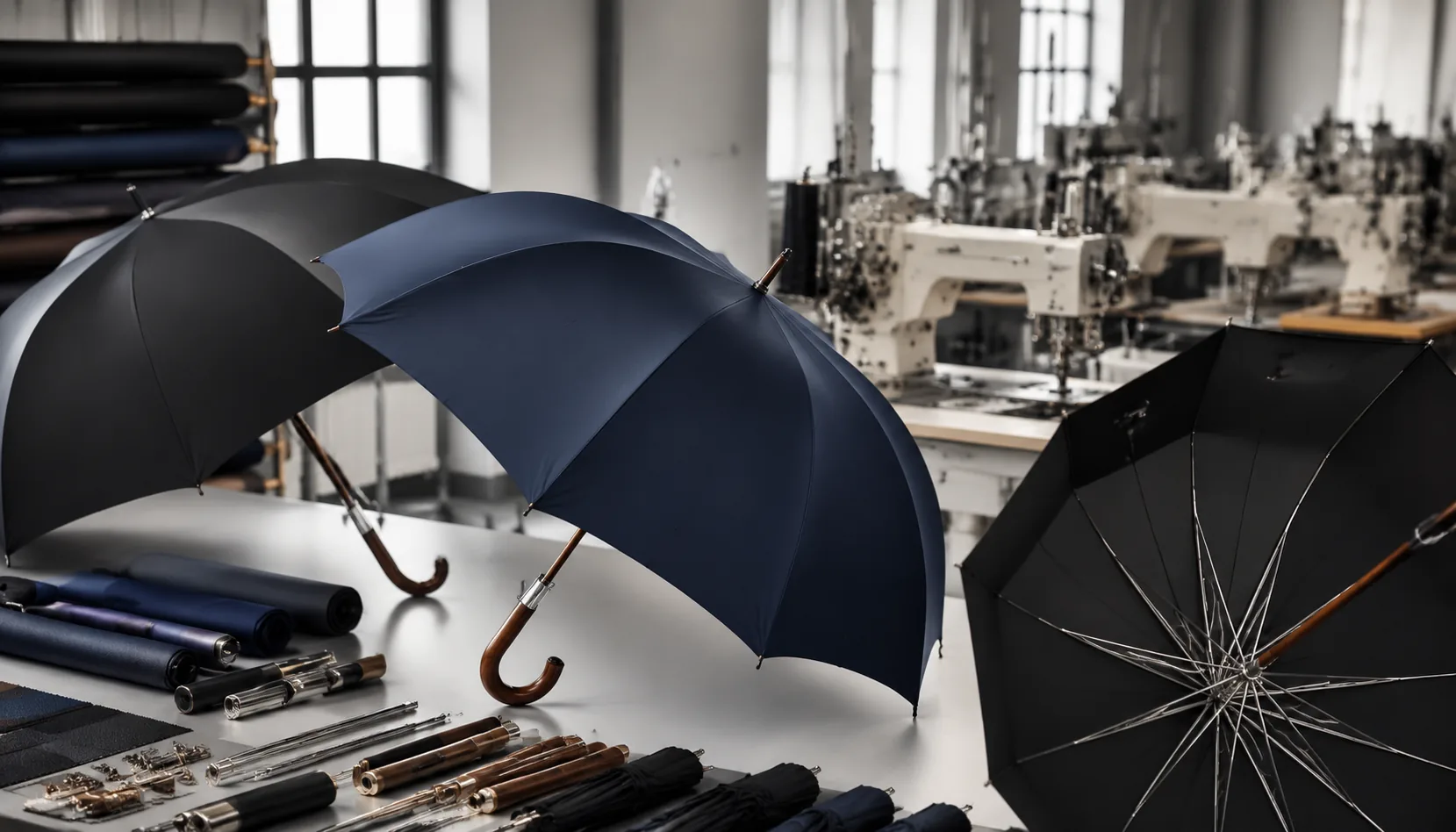
For a fashion house, an umbrella program fails when the handle finish, canopy handfeel, frame tension, or packaging looks one level below the collection it carries. On our Songxia factory floor, luxury fashion umbrellas are built by locking fabric selection, rib and shaft specs, logo placement, gift-box protection, and AQL inspection into one production plan before bulk cutting begins. That discipline keeps sampling decisions, FOB or DDP costs, and final shipment quality aligned.
Where Umbrellas Fit in Fashion Assortments
Umbrellas sit best in a fashion assortment when they are treated as accessories, not emergency rain goods. For luxury fashion umbrellas, the commercial logic is closer to scarves, caps, leather small goods, and seasonal bags: visible brand surface, moderate unit cost, strong giftability, and practical use that keeps the logo on the street. A 23" auto-open straight umbrella with 190T or 210T pongee canopy works for flagship retail and department-store corners, while a 21" auto-open-close folding model fits e-commerce, travel capsules, and handbag-adjacent merchandising. For runway or capsule drops, I would rather see 8K or 10K fiberglass ribs with a clean matte handle than a heavy 16K frame unless the creative direction specifically wants an oversized silhouette. Designer branded umbrellas also work well as licensed merchandise because artwork can be refreshed each season without changing the core frame tooling.
Quantity planning should start with sell-through channels, not factory MOQ. For store allocation, buyers often calculate opening stock at 6 to 24 pieces per door depending on foot traffic, climate, and whether umbrellas are displayed near accessories or hidden at cash wrap. A 30-store regional launch might need 600 to 1,200 units if the umbrella is a seasonal accessory, but a global VIP gift program can jump to 3,000 to 10,000 units because every box must ship on the same calendar. Online drops are easier to control: set the drop size against email audience and historical conversion, then hold 10% to 15% reserve for replacements, press samples, influencer seeding, and regional transfers. For premium umbrella sourcing, I always ask whether the item is meant to sell at retail, support a campaign, or satisfy a license agreement, because each path changes the tolerance for MOQ, packaging cost, and lead time.
Rainfall seasonality matters more than many fashion teams expect. Japan, Korea, the UK, Northern Europe, and the U.S. Pacific Northwest can support fashion accessory umbrellas across multiple months, while Mediterranean markets may need tighter spring and autumn drops. Lead time should be counted backward from the first wet selling window: 7 to 10 days for strike-off artwork, 15 to 25 days for frame and canopy sampling, and usually 35 to 55 days for bulk high end umbrella production after approval, longer if custom handles or plated metal parts are involved. If a brand wants a May launch in London or Tokyo, final artwork and color standards should be locked before Lunar New Year disruptions in China. Luxury fashion umbrellas also need regional forecasting by use case: compact folders for commuters and travel retail, 27" or 30" straight umbrellas for VIP gifting, and double-canopy vented models for markets where wind complaints damage brand perception faster than rain complaints.
Premium Materials and Frame Decisions
Material choice should start with the retail position, not the catalog photo. For luxury fashion umbrellas, 210T pongee is usually the safest canopy because it has a tighter hand feel than basic 190T, takes screen printing and heat-transfer logos cleanly, and dries faster when paired with a Teflon-type water-repellent finish. Coated polyester can work for sharper color blocking or lower-cost seasonal capsules, but heavy PU coating may make the canopy feel plasticky and can show needle marks around the seams. Recycled PET pongee is now realistic for designer branded umbrellas, especially when the brand wants GRS documentation, but buyers should approve lab dips carefully because recycled yarn lots can shift slightly between dye batches. For UV stories, specify UPF 50+ coating early, because it changes the fabric hand and sometimes the inside color tone.
Frame decisions control how premium the umbrella feels after six months of use. Fiberglass ribs are the right choice when the product needs wind flexibility, especially for 23 inch or 27 inch auto-open models and double-canopy vented windproof builds rated around 50+ mph in controlled testing. Steel ribs still make sense for structure, a crisp open shape, and better cost control, but they add weight and can bend permanently if the user fights gusts at the wrong angle. An 8K frame gives a clean classic profile for fashion accessory umbrellas where the silhouette should stay slim and elegant. A 16K frame costs more and takes longer to assemble, but it gives visibly better canopy tension, a rounder dome, and a more tailored look that suits high end umbrella production.
Handles and shaft finishes are where many premium umbrella sourcing projects succeed or fail. Real wood handles look excellent but vary in grain and moisture behavior; for consistent retail sets, a wood-look ABS or rubber-coated curved handle can be more stable and pass color matching more reliably. Matte black electroplated steel shafts, brushed gunmetal aluminum, and champagne finishes all read more premium than raw chrome, but plating thickness and salt-spray resistance must be specified before sampling. Our standard practice at ZheBrella is to check handle adhesion, shaft straightness, runner smoothness, and open-close force before AQL 2.5 final inspection, because a luxury customer notices a sticky runner faster than a 1 mm print shift. For luxury fashion umbrellas, I would rather upgrade the frame and handle first, then add special packaging, not the other way around.
Design Execution for Brand-Led Products
Premium umbrella sourcing for brand-led programs should include the soft goods and packaging in the same approval loop as the canopy, because the sleeve, woven label, hangtag, and gift box often carry more brand value than the frame itself. Sleeves can use matching all-over print, contrast piping, snap closures, or a woven logo label sewn into the side seam; the label artwork needs minimum stroke widths because fine serif type can fill in during weaving. Gift boxes should be specified by board thickness, surface finish, and insert style, not just dimensions: a 350 gsm art paper sleeve over corrugated E-flute protects better than a thin folding carton for DDP shipments. For high end umbrella production, I like to freeze the full bill of materials after strike-off approval: canopy fabric, coating such as Teflon or UPF 50+, rib count, handle finish, sleeve fabric, label position, and carton packing. That prevents the common late-stage problem where the approved sample looks luxurious, but the bulk order loses detail through uncontrolled substitutions.
Sampling, MOQ, and Collection Timelines
Fashion launch calendars punish vague sampling plans, so I separate development into three gates: prototype, pre-production sample, and sealed production standard. A prototype for designer branded umbrellas usually takes 7–12 days if we use existing 21", 23", or 27" frames, stock handles, and 190T/210T pongee colors. Add 10–18 days when the brand wants a custom curved acetate handle, metal logo cap, special runner color, or a POE/PVC transparent canopy with tight shade matching. At this stage I check frame balance, rib count choice—8K for compact retail price points, 10K or 16K for more premium feel—and logo placement by screen print, heat transfer, woven label, or sublimation. For luxury fashion umbrellas, the prototype should prove hand feel and silhouette first; exact carton marks, hangtags, and care labels can wait until the pre-production sample.
The pre-production sample is the sample that should match bulk production in every visible and functional detail: canopy fabric lot, Teflon or UV UPF 50+ coating, shaft finish, tip color, sleeve, gift box, barcode label, and master carton layout. I normally allow 5–9 days after artwork, Pantone numbers, and packaging die-lines are frozen, but custom molds can stretch that by 20–35 days because handle tooling, ferrule molds, or molded logo badges need CNC work, polishing, and trial injection before assembly. Premium packaging also changes the timeline; rigid boxes, magnetic closures, embossed paper, and satin pouches are not umbrella-line items, they run through separate vendors with their own MOQ and color tolerances. Our standard practice at ZheBrella is to approve the pre-production sample as the inspection reference, then attach it to the factory order so cutting, sewing, printing, and final AQL 2.5 checks use the same benchmark.
MOQ depends less on the word “custom” and more on what is being customized. Existing-frame fashion accessory umbrellas can often start around 300–500 pieces per color for manual or auto-open straight umbrellas, while auto-open-close folding models usually make better sense from 500–1,000 pieces because mechanism procurement is less flexible. Low-volume colorways are the expensive trap in premium umbrella sourcing: dyeing 210T pongee to four seasonal shades at 200 pieces each may cost more and take longer than one 1,000-piece color run. For high end umbrella production tied to a runway drop, I recommend locking the final sample 55–75 days before the warehouse delivery date: 20–30 days for bulk materials and printing, 12–20 days for cutting/sewing/assembly, 2–3 days for inline and final inspection, then freight by FOB or DDP depending on the launch market. Rush orders are possible, but not when custom molds, windproof double-canopy tests, or luxury packaging are still moving targets.
Quality Expectations for Premium Retail
Premium retail inspection starts before the umbrella is opened: the buyer will feel the canopy, read the logo edge, and judge the sleeve stitching within the first 10 seconds. For luxury fashion umbrellas, I specify 190T or 210T pongee with a dry, even hand feel, no greasy silicone residue, no hard coating streaks, and shade tolerance controlled under a signed lab dip or production swatch. On printed panels, screen print and heat-transfer logos should hold within ±1.5 mm registration across seams; sublimation artwork needs clean color transitions with no ghosting at rib tips or panel peaks. If the design uses alternating panels, the cut direction matters because pongee sheen can make two correct colors look mismatched under boutique lighting. Our standard practice at ZheBrella is to approve a sealed pre-production sample, then compare bulk umbrellas against it under D65 light before packing.
Frame and mechanism checks are where many designer branded umbrellas fail if the supplier treats them like disposable promotional pieces. On a 23 inch stick umbrella, the shaft must stand straight, the 8K or 10K ribs must sit evenly around the crown, and the canopy tension should be balanced so one panel does not sag while the opposite side pulls tight. For compact fashion accessory umbrellas, we test runner smoothness through repeated open-close cycles, checking that the runner locks positively without scraping, sticking, or leaving black metal dust on the shaft. Auto-open and auto-open-close models need consistent spring force: strong enough to deploy fully, but not so aggressive that the canopy snaps against the stop and distorts the tips. For premium umbrella sourcing, I also check rib symmetry after 24 hours opened on a rack, because weak steel ribs or poorly seated fiberglass ribs often reveal twist only after tension settles.
Final inspection should combine formal AQL with stricter cosmetic judgment, because premium retail customers complain about visible flaws long before a defect reaches functional failure. For export lots, AQL 2.5 is a practical standard for major defects such as broken ribs, failed auto-open mechanisms, loose tips, cracked handles, wrong logo placement, or runner lock failure. Cosmetic issues on high end umbrella production need tighter internal review: scratches on plated handles, glue overflow at ferrules, wrinkled woven labels, uneven sleeve drawstrings, crushed gift boxes, barcode misplacement, and dust trapped inside clear POE or PVC packaging should be rejected more aggressively than the AQL table alone requires. Packaging finish is part of the product for luxury fashion umbrellas, so cartons need correct inner counts, silica gel where required, clean polybags, straight hangtags, and color-consistent retail boxes. A beautiful canopy loses value fast if the sleeve seam is twisted or the presentation box arrives with rubbed corners.
Frequently Asked Questions
Can fashion brands develop umbrellas as a true accessory line?
Yes. Brands can customize canopy artwork, frame color, handle material, sleeve, hangtag, and retail packaging, making the umbrella consistent with handbags, scarves, or seasonal outerwear.
What specs signal a premium umbrella to retail customers?
Common upgrades include 210T pongee, fiberglass ribs, a 16K frame, refined handle finishes, and a well-fitted sleeve or box. Smooth auto-open action and accurate print registration are also critical.
What canopy fabrics work best for luxury fashion umbrella programs?
For luxury programs, buyers usually choose pongee, recycled polyester, or satin-finish fabrics depending on the brand position. Common specs are 190T to 210T for standard premium lines, while higher-end collections may use denser weaves with better hand feel and print clarity.
What inspection standards are typical for premium umbrella sourcing?
A common B2B setup is AQL-based inspection with focus on panel alignment, canopy tension, frame operation, print registration, and packaging accuracy. For branded retail orders, buyers often request 100% visual checks on logo placement plus pre-shipment random inspection before FOB or DDP release.
How do FOB and DDP options differ for umbrella imports?
FOB means the buyer controls freight and destination clearance after export handoff, while DDP includes delivery to the buyer’s named location with duties and taxes handled in the quote. DDP is often easier for brands testing new SKUs, but FOB usually gives more control over landed cost for larger programs.
Looking to Launch Your Custom Umbrella Line?
ZheBrella is a Zhejiang-based OEM/ODM umbrella manufacturer with 17 years of export experience. Free design, low MOQ from 100 pieces, windproof construction, full-color print.
Get Free Quote Now »People Also Search For
Related Articles
Custom Umbrellas for Luxury Retail and Fashion Brands
Build premium umbrella lines for fashion retail with fabric, frame, packaging, and QC specs that support brand perceptio...
Read More »
Custom Umbrellas for Luxury Fashion and Beauty Launches
Source premium umbrellas for fashion and beauty launches with fabric, hardware, print, QC, and delivery specs that prote...
Read More »
Umbrella Sourcing for Luxury Fashion and Beauty Launches
Build premium umbrella programs for fashion and beauty launches with materials, branding, QC, packaging, and timelines a...
Read More »