Custom Umbrellas for Luxury Retail and Fashion Brands
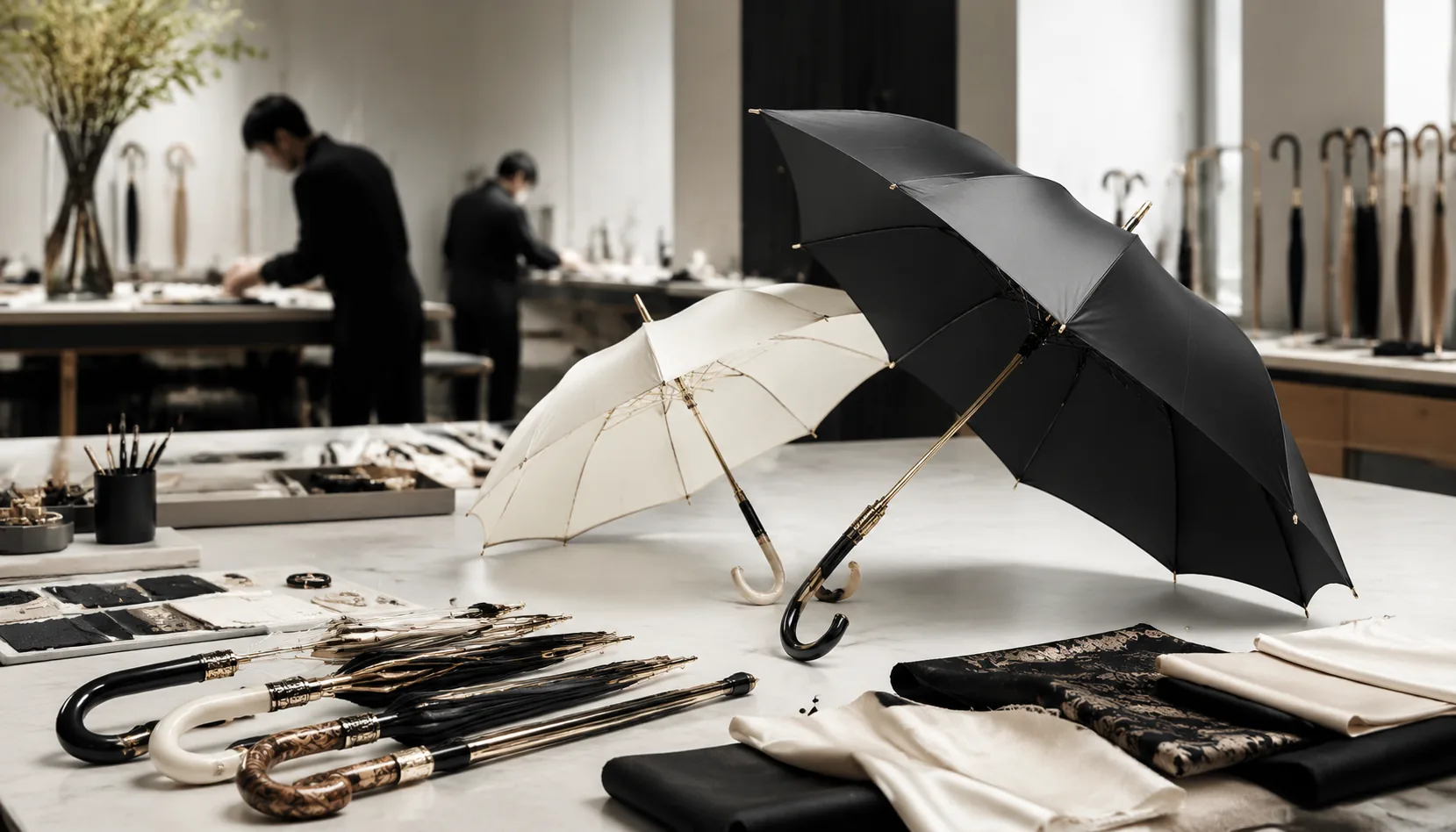
For fashion buyers, an umbrella is not just a rain item; it has to feel consistent with the handbag, outerwear, and store environment beside it. On our Songxia factory floor, luxury retail custom umbrellas succeed when fabric hand-feel, rib tension, handle finish, carton protection, and AQL checks are specified before sampling, not corrected after bulk production. The hard part is turning brand perception into repeatable production details that still hit delivery windows and retail margins.
Where Umbrellas Fit a Fashion Retail Assortment
Umbrellas fit a fashion assortment best when they are treated like sized accessories, not emergency hardware. A 21" compact auto-open-close belongs near bags, scarves, and travel goods because it has a low shelf footprint and works as a checkout add-on at $18-$45 retail depending on handle, sleeve, and print detail. A 23" stick umbrella with a curved PU leather or lacquered wood handle reads more like a style object and usually sits better in seasonal windows, capsule drops, or rainy-season merchandising. For luxury retail custom umbrellas, the mistake I see most often is overloading one SKU with too many functions; a compact commuter umbrella, a polished city stick, and a larger 27" walking umbrella serve different customers and should be costed separately from the start.
For fashion brand umbrella sourcing, typical first orders run 1,000-3,000 units per style for boutique retail tests, 3,000-5,000 units for department-store programs, and 5,000-10,000 units when the umbrella is tied to a national campaign or loyalty gift. The cleanest private-label builds use 210T pongee umbrellas with fiberglass ribs, a straight 8K or 10K frame, color-matched binding, and one disciplined logo position on the canopy, sleeve, snap strap, or handle plaque. Premium branded umbrellas can justify higher landed cost when the buyer specifies UPF 50+ coating, Teflon water repellency, a double-canopy vented construction, or wind-tunnel performance around 50+ mph, but those upgrades should match the retail story rather than just inflate the spec sheet.
Retail umbrella private label programs also need packaging planned early because the carton math affects margin more than many buyers expect. A slim compact sleeve ships efficiently, while a gift-boxed 23" stick umbrella can increase CBM enough to change FOB versus DDP decisions. Our standard practice at ZheBrella is to quote AQL 2.5 inspection with fabric shade control, opening-cycle checks, seam tension review, and barcode/carton labeling confirmed before mass production. For seasonal launches, I advise locking artwork and lab dips 45-60 days before the floor date; repeat styles can often run in 30-40 days after frame and fabric approvals, but custom handles, metal badges, or sublimation canopy panels add sampling time that retail calendars rarely forgive.
Premium Materials Buyers Should Specify
For luxury retail custom umbrellas, 210T pongee is usually the safest default because it gives a tighter hand feel, better drape, and cleaner print edge than 190T without pushing the canopy into outdoor-gear territory. I specify 210T pongee umbrellas for department-store capsules, designer gift-with-purchase programs, and resort boutiques where the umbrella will be handled before purchase; buyers notice the smoother surface and quieter fold. High-density polyester is better when the target price is tighter or the design needs broad solid colors more than fine artwork, but it can feel flatter and less refined if the yarn count and coating are not controlled. For fashion brand umbrella sourcing, ask for colorfastness testing on dark navy, black, burgundy, and forest green, because these shades show crocking and coating streaks first under retail lighting.
UV-coated fabric and UPF 50+ panels make sense when the umbrella is part of a resort, cruise, golf, or summer fashion collection rather than a pure rain item. A silver or black UV coating under the canopy can block heat well, but it changes the interior look; for premium branded umbrellas, I prefer a color-matched or matte black inner layer unless the design direction intentionally wants a technical sunshade appearance. UPF 50+ can be achieved on polyester or pongee with the right density and coating, but buyers should request lab documentation, not just a hangtag claim. On printed canopies, sublimation works well for full-panel artwork, while screen printing gives denser logo color on solid panels; coating selection must be confirmed before printing because some water-repellent and UV finishes reduce ink adhesion.
Frame choice is where retail umbrella private label projects often overpay or underbuild. Fiberglass ribs cost more than steel, but they flex back after gusts and are the right call for 23 inch and 27 inch fashion umbrellas expected to survive daily city use; an 8K fiberglass frame with a reinforced runner is more valuable than a decorative handle on a product that may face 40 to 50 mph wind. Steel ribs still have a place: they create a slimmer folded profile, sharper opening line, and lower FOB price, especially on compact 21 inch auto-open models. For luxury retail custom umbrellas, I avoid mixing a premium canopy with a weak zinc-plated frame; our standard practice at ZheBrella is salt-spray checking metal parts, cycle-testing open mechanisms, and inspecting finished goods to AQL 2.5 before export cartons are sealed.
Frame and Handle Details That Signal Quality
Rib count is one of the fastest ways a buyer can separate gift-shop umbrellas from luxury retail custom umbrellas, but more ribs are not automatically better. An 8K frame on a 23" or 27" stick umbrella gives a cleaner silhouette, lower weight, and fewer sewing points to inspect; for most premium branded umbrellas, I prefer 8K fiberglass ribs with a steel or aluminum shaft because the canopy panels stay broad and smooth for logo placement. A 16K frame looks more architectural and photographs well for fashion campaigns, but it adds labor, rib tips, runner stress, and more chances for panel tension mismatch. If the canopy is 210T pongee with Teflon water repellent, a 16K layout must be cut very accurately or the umbrella will show scalloping along the edge. For fashion brand umbrella sourcing, I usually recommend 8K for minimalist collections and 16K only when the rib pattern is part of the design language.
Opening mechanism changes both the user experience and the failure points. Auto-open is convenient for retail umbrella private label programs because it feels immediate at the store counter, but the spring, runner, and notch must be tested hard; our standard practice is 300 open-close cycles before bulk approval and AQL 2.5 inspection on production lots. Manual-open frames feel quieter and more deliberate, which suits luxury menswear, resort, and heritage brands, especially when paired with a wooden crook handle. Beech, maple, and faux bamboo handles can be stained, lacquered, or laser-engraved, but the finish must survive humidity and carton compression during 30-45 day sea freight. Rubberized grips are better for golf and commuter umbrellas, especially 27" and 30" sizes, but cheap TPR feels sticky after heat aging. Color-matched shafts look simple on a tech pack, yet powder coating must be checked against Pantone tolerance because black, champagne, gunmetal, and ivory shift visibly under retail lighting.
Double-canopy windproof construction is useful, but it is not free. A vented 8K fiberglass frame can survive 50+ mph wind-tunnel testing when the ribs, stretchers, and top cap are balanced, but the second canopy layer adds fabric consumption, sewing time, and bulk at the ferrule. On 210T pongee umbrellas, that can raise FOB cost by roughly 8-15% depending on size and printing method; with heat-transfer logos or all-over sublimation, registration between upper and lower canopies also needs tighter control. Packaging changes too: a slim single-canopy 23" stick umbrella may fit a narrow sleeve and 24-36 pieces per export carton, while a double-canopy 27" model often needs a wider sleeve, larger hangtag clearance, and fewer pieces per carton. For luxury retail custom umbrellas, the best result is usually not the heaviest build, but the frame-and-handle combination that opens smoothly, photographs cleanly, passes inspection, and still lands within the brand’s DDP margin target.
Private-Label Packaging and Retail Compliance
Private-label compliance starts at the small parts buyers often approve too late: woven canopy labels, printed sleeves, hangtags, barcode stickers, care labels, and master carton markings. For luxury retail custom umbrellas, I prefer locking the packaging BOM before frame production starts, because a 23" auto-open umbrella with a PU leather crook handle needs a different sleeve length and hangtag position than a 21" compact auto-open-close style. Woven labels are usually 20–35 mm wide with center-fold or end-fold construction, stitched into the seam near the lower canopy panel or on the sleeve edge. Printed sleeves can be 190T or 210T pongee, matching the canopy, or a heavier gift sleeve with logo transfer. Hangtags should specify model name, rib count such as 8K or 10K, canopy fabric, opening mechanism, country of origin, importer details, and any UPF 50+ or water-repellent claim that has test support.
Barcode stickers need to be treated as production data, not decoration. Retail umbrella private label programs usually require UPC/EAN labels on the hangtag, inner polybag, and sometimes the master carton, with scannable grade checked before mass packing. Care labels should state drying open after use, avoiding high heat, and cleaning with a damp cloth; if the canopy uses Teflon coating, UV coating, POE, PVC, or EVA panels, the wording should match the material. Master carton markings normally include SKU, colorway, quantity, gross/net weight, carton dimensions, PO number, destination DC, and made-in-China origin mark. For premium branded umbrellas going into department stores, we also add carton side labels on two adjacent faces so warehouse receivers do not need to rotate every carton on the pallet.
Artwork approval should run in three steps: digital layout, material strike-off, then a pre-production sample built with the correct frame, canopy, sleeve, hangtag, barcode, and carton label. Our standard practice at ZheBrella is to freeze Pantone, logo size, label placement, and carton data after the PP sample is signed, because late barcode or hangtag changes can add 3–7 days and create mixed-SKU packing risk. MOQ by colorway is usually higher than plain stock production: 500–1,000 pcs per color for 210T pongee umbrellas with custom sleeves, and more if dyed-to-match fabric or metal logo plates are used. FOB keeps the buyer responsible for DC routing, pallet rules, and appointment booking; DDP requires us to price carton strength, palletization, labeling, duties, and last-mile delivery into the retail DC. That is why fashion brand umbrella sourcing should confirm compliance manuals before quoting, not after production is finished.
Inspection Standards for Premium Sell-Through
For luxury retail custom umbrellas, inspection has to start before sewing, not at final packing. We check 210T pongee umbrellas by fabric roll and by cut panel, using a light box or D65 daylight booth to control shade drift between panels; a half-tone mismatch that passes on a promotional umbrella will look cheap on a $60 retail floor. Printed logos are checked for registration, ink edge sharpness, and color tolerance against the approved Pantone chip, especially on dark navy, black, ivory, and seasonal fashion colors. On cut panels, the grain direction must stay consistent so the canopy does not twist after sewing. Seam allowance is normally held around 6–8 mm, with even stitch density and no puckering at the crown, because that is where buyers notice poor workmanship first.
Final frame inspection should be stricter than normal fashion brand umbrella sourcing because luxury customers open the product in-store before buying. We check canopy tension on every sample pull: no loose valleys between ribs, no overstretched tips, and no visible asymmetry when the umbrella is fully open. For 8K and 10K frames, rib spacing must be even; for larger 27" or 30" golf styles, fiberglass ribs and double-canopy venting should be tested for stable recovery after flexing. Handles need a separate cosmetic standard: plated metal must show no pinholes or cloudy lacquer, wood handles need smooth sanding and consistent stain, and leather-wrapped grips should not have glue bleed at the seam. Tips and ferrules are checked for burrs, sharp edges, and secure riveting because tip safety is a critical defect, not a minor appearance issue.
For premium branded umbrellas and retail umbrella private label programs, our standard practice at ZheBrella is AQL 2.5 for major defects, with tighter critical checks at 0 or 0.65 depending on the buyer’s risk tolerance. Open-close cycling is mandatory: manual, auto-open, and auto-open-close mechanisms should be tested at least 20–30 cycles during inline inspection and again at final random inspection, with no button sticking, runner slip, spring weakness, or shaft wobble. We also test water repellency after Teflon or equivalent finishing, verify UPF 50+ labeling when UV coating is claimed, and confirm carton drop strength before FOB or DDP shipment. Luxury retail custom umbrellas fail sell-through when small flaws accumulate, so inspection records should include photos of shade bands, handle finish, tip riveting, barcode placement, hangtag position, and individual polybag condition.
Frequently Asked Questions
Is 210T pongee worth the upgrade for fashion umbrellas?
Yes, 210T pongee gives a smoother hand feel and denser appearance than 190T, which helps premium retail positioning. It also supports cleaner printing for detailed patterns and brand colors.
What MOQ should fashion brands expect per colorway?
Many factories start around 500-1,000 units per colorway for standard models, with higher MOQs for custom handles, shafts, or all-over printed fabric. Confirm MOQ separately for fabric dyeing and hardware customization.
What specifications make an umbrella suitable for luxury retail?
Luxury retail umbrellas typically use 210T pongee or higher-density polyester, fiberglass or steel-fiberglass frames, reinforced ribs, color-matched handles, and custom woven labels. Buyers should also specify AQL inspection levels, wind-resistance targets, and packaging such as rigid gift boxes or branded sleeves.
What MOQ should fashion brands expect for private label umbrellas?
For most private label retail umbrellas, MOQ usually starts around 500–1,000 pieces per style depending on fabric, frame, handle, and print method. Custom molds, special handles, or luxury packaging may require higher minimums or separate tooling fees.
How long does production take for a premium branded umbrella order?
Sampling usually takes 7–15 days after artwork and materials are confirmed. Bulk production commonly takes 30–45 days, with additional time needed for custom packaging, lab testing, or peak-season capacity.
Looking to Launch Your Custom Umbrella Line?
ZheBrella is a Zhejiang-based OEM/ODM umbrella manufacturer with 17 years of export experience. Free design, low MOQ from 100 pieces, windproof construction, full-color print.
Get Free Quote Now »People Also Search For
Related Articles
Umbrella Sourcing for Luxury Fashion and Beauty Launches
Build premium umbrella programs for fashion and beauty launches with materials, branding, QC, packaging, and timelines a...
Read More »
Custom Umbrella Programs for Luxury Fashion Brands
Build luxury fashion umbrella ranges with premium canopy fabrics, frame choices, packaging, inspection standards, and FO...
Read More »
Umbrella Sourcing for Outdoor Retail and Gear Brands
Build outdoor retail umbrella ranges with UPF 50+ fabric, fiberglass frames, 210T pongee, tested packaging, and order te...
Read More »