Inside-Canopy Umbrella Branding for Retail and Events
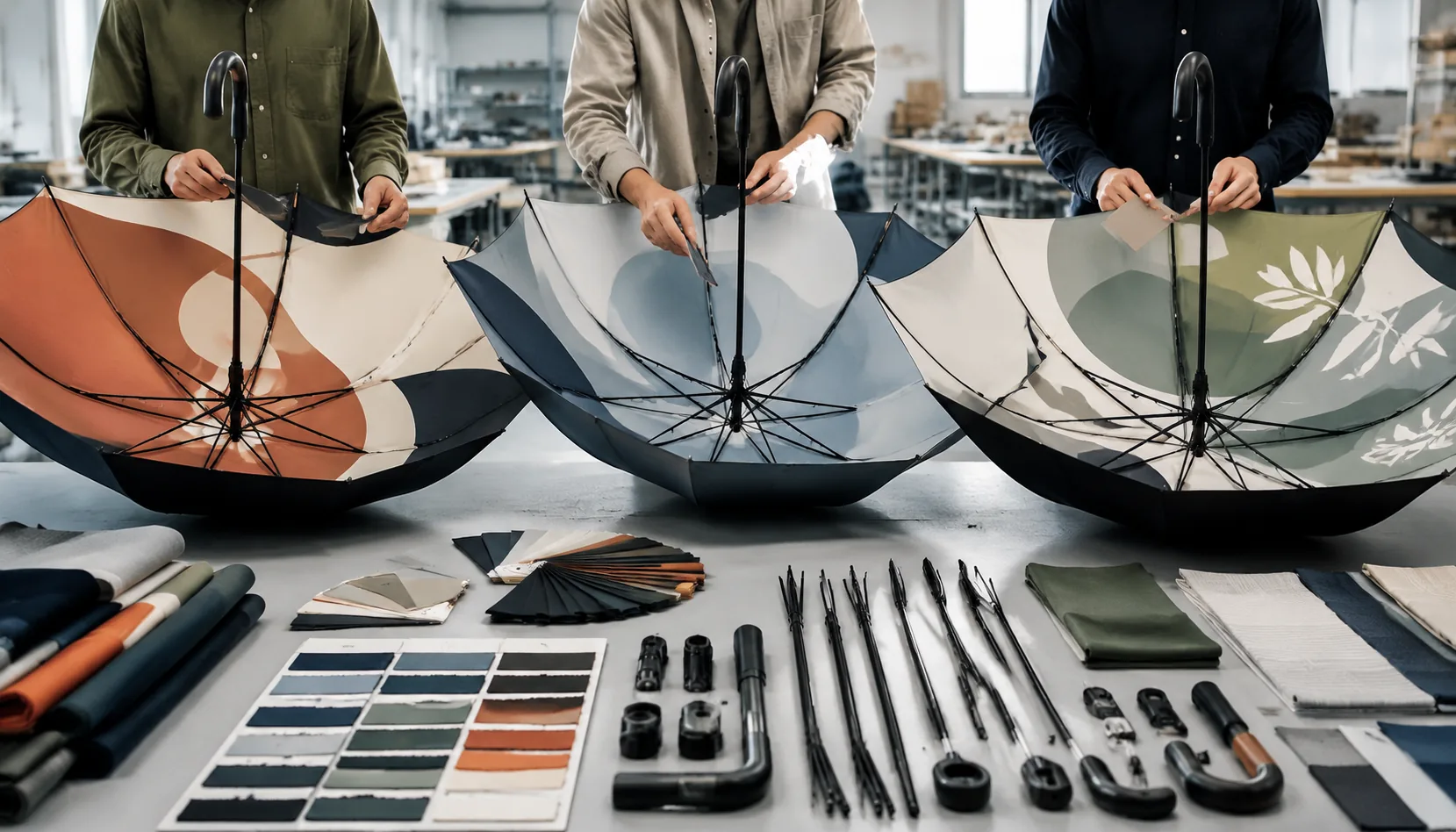
Buyers often approve a clean mockup, then discover the open umbrella looks patchy under mall lighting or the logo breaks across ribs at the event site. On our Songxia production floor, inside canopy umbrella branding starts with fabric denier, coating color, ink opacity, panel cutting, and rib position before any screen is burned. The right checks keep the underside readable, aligned, and consistent through retail cartons or event handouts.
Why Interior Branding Changes the User View
Inside-canopy umbrella branding works best when the person under the umbrella is part of the display, not just the carrier. On a retail shelf, a plain black outer canopy may fit the assortment, but the opened umbrella can reveal a color story, campaign artwork, or repeating logo pattern that feels more premium in the hand. For hospitality, we see it used on 23" and 27" stick umbrellas for hotel entrances, golf carts, wineries, and resort walkways because guests look upward into the canopy while waiting, walking, or posing. That is a different viewing angle from a standard outer-panel logo, which is mostly read by people across the street, from a balcony, or in drone-style event photos.
The practical advantage is control of the close-range photo moment. Umbrella interior printing puts the message behind the face, so a guest holding the umbrella naturally frames the brand in selfies, step-and-repeat photos, wedding exits, and VIP arrival shots. For branded event umbrellas, I prefer inside printing when the artwork includes a pattern, slogan, sponsor wall, or full-color image that would look too loud on the outside. On 190T or 210T pongee, we normally treat interior art as a separate print decision from the exterior: screen printing is clean for 1- to 3-color logos, heat transfer handles sharper gradients, and sublimation is better when every custom printed umbrella panel needs edge-to-edge graphics.
There are production limits buyers should respect. Interior artwork must not interfere with frame clearance, especially on auto-open and auto-open-close models where ribs, stretchers, and runner movement can rub the fabric during repeated cycling. A 10K fiberglass frame gives a smoother dome for panel alignment than cheap steel ribs, but vented double-canopy windproof umbrellas need careful registration because the inner and outer layers move differently in wind. For retail umbrella branding, inside art also has to survive normal handling: we test print adhesion, color migration, and wet rub before approving bulk, then inspect under AQL 2.5. If the goal is outdoor visibility from far away, use exterior panels. If the goal is a memorable user-view experience, inside canopy umbrella branding is the stronger tool.
Fabric and Coating Limits for Inside Printing
For inside canopy umbrella branding, fabric choice decides how sharp the logo looks and how many headaches you get after folding tests. 190T pongee is the common promotional grade: lighter, cheaper, and acceptable for 21" and 23" auto-open umbrellas, but the weave is more open, so heavy umbrella interior printing can show slight pinholes when held against light. 210T pongee has a denser hand, better color hold, and cleaner edges on custom printed umbrella panels, especially for fine type under 2 mm stroke width. The tradeoff is that 210T with coating becomes stiffer, so on compact auto-open-close frames the printed inner panels must pass crease and rub testing before approval. For retail umbrella branding, I usually recommend 210T for inside logos or full-panel graphics, while 190T is better kept to simple one-color marks unless the buyer accepts a softer print edge.
Silver coating is the most sensitive surface for inside printing because it is usually an aluminum-pigment layer laminated or coated onto the back of pongee for UV and heat reflection. Ink can sit on top instead of biting into the fabric, so adhesion depends heavily on primer, curing temperature, and whether the design uses screen print, heat transfer, or sublimation. Sublimation is generally poor on coated interiors because the dye cannot migrate correctly through the barrier layer; screen print or low-temperature transfer is safer, but both need tape-pull, wet-rub, and fold-line tests. Black coating gives better opacity for UPF 50+ and blackout effects, but light-colored logos need a white underbase or two-pass printing, which increases thickness and risk of cracking near rib tips. For branded event umbrellas with deadlines, do not skip a 1-2 panel swatch when silver or black coated interiors are involved.
UPF 50+ is not one single material; it can come from dense 210T pongee, silver coating, black coating, UV absorber treatment, or a combination. That matters because every added layer changes heat tolerance and surface energy. A canopy that passes UV testing before decoration may lose performance if aggressive solvent ink softens the coating or if heat-transfer pressure scars the coated film. Our standard practice at ZheBrella is to request a 30 x 30 cm test swatch for any inside canopy umbrella branding using large ink coverage, metallic ink, white underbase, or artwork crossing stitched seams. After printing, the swatch should be checked after 24 hours for adhesion, then folded around ribs and rubbed 20-30 cycles with a damp white cloth. If the result shows flaking, ghosting, tackiness, or coating lift, the artwork should be simplified, moved to uncoated 210T pongee, or converted to outside-panel printing before bulk cutting starts.
Logo Size, Panel Position, and Rib Interference
Rib count decides the real logo area before artwork ever reaches the print room. On a standard 8K umbrella, each canopy panel is wide enough for a centered inside mark, but the safe zone is still smaller than buyers expect because the fabric curves from crown to tip and pulls toward two stitched seams. For a 23 inch stick umbrella in 190T or 210T pongee, I usually keep a main inside logo at least 25–35 mm away from each seam and 60–80 mm above the rib tip pocket. Go closer and the print may look acceptable on the flat cutting table, then kink once the frame is opened. With inside canopy umbrella branding, the best-looking placement is often the middle third of the panel, not the largest possible logo.
A 16K frame changes the calculation because the panels are narrower and the ribs sit closer together, so a logo that works on an 8K panel often needs to be reduced, repeated, or split into a pattern. This is especially important for umbrella interior printing on double-canopy vented windproof models, where the upper and lower canopies move differently under wind load. On 16K layouts, I prefer small emblems, short text, tone-on-tone graphics, or radial artwork that follows the panel shape. Long horizontal logos fight the geometry and usually distort near the seam line. If the client insists on large retail umbrella branding inside the canopy, a clean 8K or 10K layout normally gives better visual value than forcing oversized graphics into 16 narrow wedges.
The biggest production mistake is approving artwork on a perfect circle template without marking seam allowances, rib channels, runner clearance, and tip reinforcements. Custom printed umbrella panels are cut as curved triangular pieces, then joined with 8, 10, or 16 stitched seams; every stitch line creates tension, and every rib end creates a hard point where ink, heat-transfer film, or sublimation detail can bend. For branded event umbrellas, our standard practice at ZheBrella is to place the logo on the actual panel dieline, add a no-print buffer around seams, and open a frame sample before bulk printing. For screen print, thick ink near seams can crack after repeated open-close cycles. For heat transfer, film edges should avoid the rib tip area because abrasion shows quickly during AQL 2.5 inspection and after real event handling.
Printing Methods for Interior Canopy Graphics
Screen printing is still the cleanest choice for inside canopy umbrella branding when the artwork is bold: logos, slogans, simple patterns, and 1–4 spot colors. On 190T or 210T pongee, I do not like approving interior screen print lines below 0.35 mm, because ink gain on coated fabric can close small gaps, especially around serif text and QR codes. Color tolerance is usually controlled to Pantone C/U references, but buyers should allow about Delta E 3–5 after curing because the fabric base, PU coating, and inner light reflection all shift perception. If the canopy is dark navy, black, bottle green, or burgundy, a white underbase is normally required before the color layer; without it, yellow becomes mustard and red becomes brown. For retail umbrella branding, screen printing works best when each custom printed umbrella panel repeats a controlled graphic rather than one continuous full-canopy image across seams.
Digital printing handles photographic skies, city maps, gradients, and high-color branded event umbrellas better than screen printing, but it is less forgiving on the umbrella interior than on a flat banner. For sublimation on polyester pongee, fine lines around 0.2 mm can print, though I still recommend 0.3 mm minimum for production because ribs, seam allowances, and panel curvature reduce readability once assembled. Digital color tolerance is usually wider than buyers expect: CMYK artwork on fabric can vary Delta E 5–8 between lab dip, pre-production sample, and bulk lot unless the factory locks the same fabric roll, ICC profile, ink set, and heat press parameters. White ink is the weak point; sublimation cannot print white, so white areas must come from the base fabric. If the inside canopy needs bright graphics on a dark outer canopy, we usually construct with a lighter inner layer or use transfer film instead of direct sublimation.
Heat transfer is useful for umbrella interior printing when the buyer wants sharp logos, metallic effects, small quantities, or artwork that needs a white backing on darker fabric. A good PU or PET transfer can hold 0.25–0.3 mm lines, but the edge must be tested after wet rub, dry rub, folding, and 24-hour recovery because thick transfer layers can crack along rib contact points. The practical issue is not only adhesion; it is folding bulk. A full interior moon, skyline, or all-over brand graphic printed as large transfers can stiffen the panels, make a 21" or 23" auto-open umbrella close unevenly, and create pressure marks near the tips after carton compression. For inside canopy umbrella branding, ZheBrella’s standard practice is to run a folding test on pre-production samples after 200 open-close cycles, then inspect by AQL 2.5 so the artwork looks good both open at an event and folded on a retail shelf.
Sampling, QC, and Bulk Order Planning
Inside canopy umbrella branding should be sampled as a construction job, not just a print job. I ask for one digital layout approval, then one physical pre-production sample using the final canopy fabric, frame, ink system, and handle color. For umbrella interior printing on 190T or 210T pongee, the inside artwork must be checked after the canopy is sewn, because rib shadows, seam allowances, and panel curvature can shift the visual center by 3–8 mm. On custom printed umbrella panels, we mark the top notch, rib positions, and seam direction before cutting so the logo does not disappear under a stitch line. For dark outer canopies with light inner graphics, a white underbase or heat-transfer film may be needed, but that adds stiffness; on compact 21" auto-open-close umbrellas, too much film can make folding bulky.
QC should include dry and wet rub tests, folding checks, and frame cycling before bulk approval. A basic rub test is 20 dry passes and 10 wet passes with white cotton cloth; for heavy-use branded event umbrellas, I prefer 50 dry passes because guests stack wet umbrellas together after an outdoor show. Folding inspection matters more than buyers expect: inner prints sit against ribs and tips, so we open and close samples at least 25 cycles to check cracking, ink pickup, and transfer marks. During final inspection under AQL 2.5, critical points include print registration across 8K or 10K panels, ink adhesion near seams, broken stitches, exposed rib tips, runner locking, shaft straightness, and canopy tension. Our standard practice at ZheBrella is to inspect both open diameter and folded length, because event cartons often need to match venue storage or hotel delivery limits.
Bulk planning depends on the print method and deadline. MOQ for retail umbrella branding is usually 500 pieces per colorway for stock frames, but inside full-panel artwork often works better at 1,000 pieces because screen setup, film alignment, and cutting loss are higher. Normal lead time is 25–35 days after sample approval; add 5–10 days for complex inner printing, double-canopy vented construction, or multiple SKUs. For a fixed event date, count backward from delivery, not from production: ocean FOB Ningbo/Shanghai may need 30–40 days on the water plus customs and trucking, while DDP air can land in 7–12 days but changes the unit economics sharply. I recommend approving the pre-production sample at least 45 days before a domestic China ship date, and 75–90 days before an overseas event if cartons, hangtags, retail barcodes, or venue-specific delivery labels are required.
Frequently Asked Questions
Can inside-canopy printing be used on UPF 50+ umbrellas?
Yes, but the coating must be tested first. Silver or black UV coatings can reduce ink adhesion, so a print swatch and folding test should be approved before bulk production.
Does interior printing increase the umbrella MOQ?
Often yes, especially for digital or transfer printing on coated fabric. MOQ depends on fabric stock, print method, and whether the order uses standard 190T pongee or a custom 210T canopy.
What artwork file should we provide for inside-canopy umbrella branding?
Provide vector artwork in AI, EPS, or PDF format with Pantone colors and the desired panel position marked. For multi-panel interior artwork, a factory panel template is recommended so the logo avoids ribs, seams, and the top notch.
Is opaque ink required for umbrella interior printing?
Opaque or high-cover ink is recommended for dark polyester pongee or coated fabrics because standard ink can look dull from the inside. For retail orders, request a strike-off sample to confirm color density before bulk production.
What quality checks are important for inside printed umbrella panels?
AQL inspection should check logo position against ribs, ink bleeding, color consistency, panel alignment, and visibility when the umbrella is fully open. Common tolerances are about ±5 mm for print placement, but retail programs may require tighter approval standards.
Looking to Launch Your Custom Umbrella Line?
ZheBrella is a Zhejiang-based OEM/ODM umbrella manufacturer with 17 years of export experience. Free design, low MOQ from 100 pieces, windproof construction, full-color print.
Get Free Quote Now »People Also Search For
Related Articles
Inside-Canopy Umbrella Printing for Branded Campaigns
Plan inside-canopy umbrella printing for campaigns with readable layouts, fabric selection, rib-count limits, sample app...
Read More »
Inside-Canopy Branding for Premium Umbrella Orders
Use inside-canopy printing to create premium brand moments while controlling bleed, fabric choice, UPF lining, samples, ...
Read More »
Inside-Canopy Umbrella Printing for Brand Storytelling
Use inside-canopy printing to add campaign artwork, messages, or maps without weakening exterior brand consistency on 19...
Read More »