Inside-Canopy Umbrella Printing for Branded Campaigns
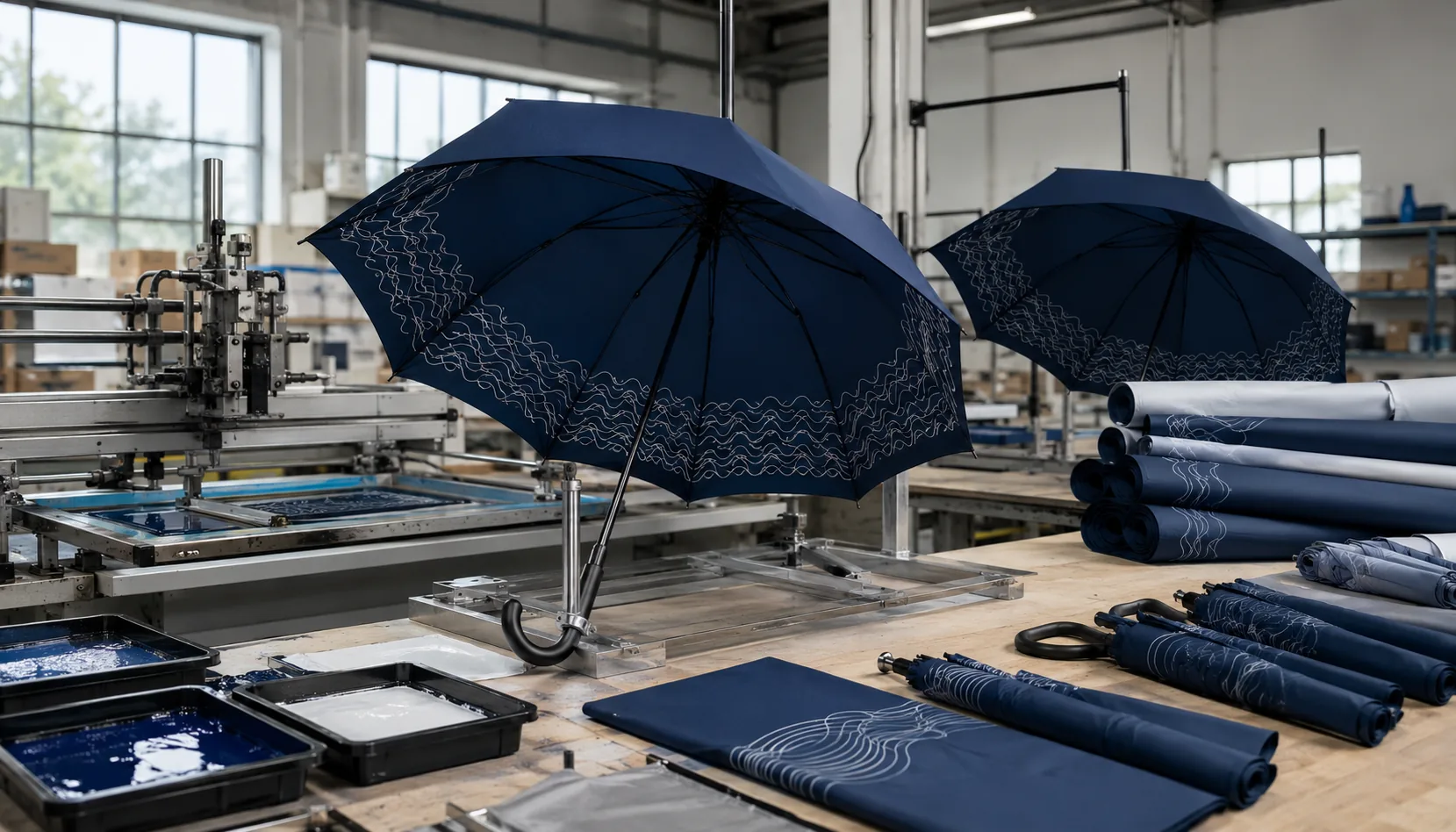
Many branded umbrellas look strong in a mockup but fail when the artwork sits under ribs, stretches across wet fabric, or disappears in low light. With inside canopy umbrella printing, the real work is matching the campaign layout to panel size, fabric coating, rib count, and the way operators register each panel before sewing. On our Songxia factory floor, sample approval and bulk QC are where readability, color consistency, and delivery risk are won or lost.
Campaign Goals for Interior Printing
Interior graphics work best when the campaign needs attention after the umbrella is already open, not just a quick logo flash on the sidewalk. With inside canopy umbrella printing, the user sees the message at arm’s length for several minutes: a brand story, city map, event schedule, QR code, hashtag, or product claim. For retail launches and conferences, we often print 8 separate custom printed umbrella panels so each rib bay carries one message step, such as agenda times from 9:00 a.m. to 5:00 p.m. or a walking route from hotel to venue. On 23" and 27" stick umbrellas, the interior field is large enough for readable 18–24 pt text if the artwork avoids rib seams and keeps key copy at least 35 mm from stitch lines.
Interior umbrella branding is different from exterior logo placement because the audience changes. Exterior printing is for street visibility: a 1-color logo on 190T pongee, usually placed on 1, 2, or 4 outer panels so people across the road can recognize the sponsor. Interior message printing is more private and controlled; it speaks to the carrier and nearby group under the canopy. That makes it useful for museum maps, campus tours, golf events, charity walks, and VIP gifting where the umbrella message printing should feel like a guide rather than a billboard. I usually recommend darker interior ink on light silver, white, or beige lining, or reversed white ink on navy and black, because low contrast looks fine on PDF proofs but fails in rainy daylight.
For branded campaign umbrellas, the construction has to match the communication goal. A double-canopy vented windproof model gives the cleanest split: outer panels carry the public logo, inner panels carry the story, with 8K or 10K fiberglass ribs to survive 50+ mph gust tests better than basic steel ribs. If the artwork is full-color, heat transfer or sublimation is cleaner than screen printing, especially for maps and social media prompts with gradients; for bold slogans, screen printing is cheaper and durable at MOQ 500–1,000 pieces. Our standard practice at ZheBrella is to check interior artwork on a sewn pre-production sample before bulk cutting, because panel curvature can bend straight lines and make QR codes unreliable unless they are kept at least 30 x 30 mm with quiet space.
Umbrella Structures That Support Interior Artwork
Golf and straight umbrellas give the cleanest interior viewing distance because the user’s eye sits farther from the canopy, usually 18 to 28 inches depending on shaft length and handle position. A 27 inch or 30 inch golf umbrella also has wider triangular panels, so logos, QR codes, slogans, or wayfinding arrows do not feel chopped up by seam lines. For inside canopy umbrella printing, I prefer 8K or 10K golf frames when the artwork needs large readable blocks; fewer ribs mean fewer interruptions. A 16K frame looks premium and rounder from outside, but inside it creates narrow panel wedges that punish long copy. Straight 23 inch umbrellas sit in the middle: enough depth for interior umbrella branding, but smaller panels than golf sizes. Folding 21 inch umbrellas are practical for giveaways, yet the viewer is too close to the canopy, so artwork should be bold, centered, and low-detail.
Bubble umbrellas are a special case because the dome shape pulls the print around the head, giving very strong close-range visibility but distorting straight lines. On POE or PVC bubble models, interior artwork works best as repeated icons, border graphics, or short umbrella message printing rather than a big rectangular campaign visual. The panel shape is taller and more curved than pongee panels, so prepress must compensate for arc distortion before screen printing or heat transfer. Folding umbrellas, especially 3-fold auto-open-close models, have short rib sections and tight canopy tension changes; heavy ink coverage on inner panels can crack faster if the fabric rubs against ribs during closing. For branded campaign umbrellas, I would use 190T or 210T pongee on straight or golf frames when the campaign needs color accuracy, and POE only when transparency is part of the concept.
Frame stability matters more for inner artwork than buyers expect, because a twisting canopy makes printed alignment look cheap even when the ink is perfect. Fiberglass ribs and stretchers hold shape better in gusts than low-cost steel ribs, and they reduce panel flutter during outdoor events; a properly built 8K fiberglass golf umbrella can survive 50+ mph wind-tunnel testing with a vented canopy. But double-canopy windproof construction creates limits for custom printed umbrella panels on the inside layer. The upper vent layer overlaps the lower canopy, so hidden areas near the crown and vent gap should not carry critical text or logos. If both layers are printed, registration becomes harder and AQL 2.5 inspection must check shadowing, ink show-through, and seam alignment. Our standard practice at ZheBrella is to keep key interior graphics inside the visible lower panel field, at least 20 mm away from rib seams and vent overlap zones.
Fabric and Color Choices for Readability
Readability starts with the canopy cloth, not the artwork file. For inside canopy umbrella printing, 190T pongee is the common promotional baseline because it is smooth enough for sharp screen printing and heat transfer, while still hitting practical MOQ and price targets for branded campaign umbrellas. 210T pongee costs more, but the tighter weave gives cleaner edges on small type, thin logo strokes, and QR-style graphics; I prefer it when the buyer wants interior umbrella branding that people will actually read at arm’s length. Polyester taffeta can work for budget orders, but it shows more weave texture and is less forgiving on fine text. For custom printed umbrella panels, keep the artwork inside one panel whenever possible: a standard 23" 8K umbrella gives less printable real estate than buyers expect once you leave safe distance from the rib stitching, tips, and crown reinforcement.
Light inner canopy colors improve legibility, but they also expose every registration mistake and ink-density shortcut. White, silver-gray, beige, and pale blue interiors are the easiest for black, navy, forest green, or dark red umbrella message printing; the contrast holds even under overcast daylight. Dark interiors such as black, navy, charcoal, or burgundy need opaque white underbase before most color inks, otherwise the print looks dull and the brand color shifts. On double-canopy vented windproof models, I also check whether the interior layer shadows through from the outer canopy, especially on 190T pongee. A black exterior with a white interior can look premium, but if the inner fabric is too thin or the coating is uneven, large solid graphics may show patchy density under bright light. That is why strike-off samples matter more than digital mockups for this category.
Coatings change the ink system. A standard waterproof PU or Teflon-treated pongee may reject some water-based screen inks unless the fabric is corona-treated or the ink is matched with the correct catalyst; poor matching causes edge cracking after folding tests. UPF 50+ coatings, especially silver or black-out layers, usually push us toward heat transfer, sublimation on prepared white fabric, or carefully tested plastisol-style systems depending on the design and hand-feel target. For text, I do not recommend anything below 18–22 pt for short copy or 28–36 pt for campaign slogans viewed while walking. Keep line weights above 0.4 mm for 210T and closer to 0.6 mm for 190T, avoid reversed-out thin type, and never run important words across rib seams. Each seam creates a raised line, needle holes, and fabric tension that distort letters after assembly.
Artwork Setup and Production Controls
Inside canopy umbrella printing has to be built panel by panel, not treated like a flat poster. A standard 23" or 27" stick umbrella usually has 8K panels, while golf umbrellas may use 8K or 16K layouts; every wedge needs its own artwork file with rib direction, top notch, and seam edge clearly marked. For interior umbrella branding, I normally ask for AI, PDF, or CDR vector files at 1:1 scale, with text converted to outlines and Pantone references listed separately from CMYK values. Keep critical logos and campaign copy at least 20-25 mm away from sewn seams and the cap area, because the canopy is pulled into a cone after sewing. Bleed should be 10-15 mm beyond each cut edge, and center alignment must be checked from the shaft line, not from the raw fabric edge, which can shift slightly after heat cutting.
Seam tolerance is where many branded campaign umbrellas fail if artwork is approved only on a screen mockup. On 190T or 210T pongee, our cutting and sewing tolerance is typically +/-2 mm per panel, but visual drift can look larger when a circle, QR code, or sentence crosses ribs. I do not recommend running fine type continuously across multiple custom printed umbrella panels unless the buyer accepts a 3-5 mm cumulative mismatch at the seams. Better production control is to split the message by panel, use radial graphics, or place the strongest brand mark on alternate panels. For dark interior prints on light canopy fabric, we also check shadow-through from the outside, especially when the outer canopy has UV coating, Teflon water repellent, or a second color print layer.
The printing method should follow quantity, color count, and artwork behavior under folding. Screen printing is still the most stable choice for 500+ pieces with 1-4 spot colors, especially white or metallic ink on navy, black, or red pongee. Digital printing works better for short runs, gradients, event artwork, and full-panel umbrella message printing, but color density must be tested because the inside surface reflects light differently under a 21", 23", or 30" canopy. Heat transfer is useful for photographic logos or small MOQ campaigns, though I avoid very large transfer films near fold lines because they can feel stiff and may crack after repeated closing. ZheBrella’s standard practice is to approve a printed strike-off before bulk cutting, then inspect registration, color, adhesion, and folding marks under AQL 2.5 before packing.
Sampling, Inspection, and Delivery Schedule
Prototype review should happen with the umbrella opened at real user angles, not flat on a table. For inside canopy umbrella printing, the buyer usually looks up from 12–24 inches below the runner, so a logo that seems centered on a CAD layout can feel too high once the ribs create panel tension. I check reading angle across 8K and 10K frames, especially on 23" and 27" golf umbrellas where the inner panel curve is deeper. Ink odor also matters because the print sits close to the face; solvent screen ink needs proper curing and airing, while heat-transfer film must not leave adhesive smell after packing. Rub resistance should be tested dry and with light moisture using a white cotton cloth, because interior umbrella branding often touches hair, collars, or hands during closing.
Auto-open performance must be approved on the actual production frame, not a similar sample from the showroom. Extra ink layers, transfer film, or full-panel sublimation can slightly stiffen 190T or 210T pongee, and that affects how the canopy releases when the button is pressed. On compact auto-open-close models, I watch for panel drag near the top notch and for print cracking around fold lines after 20–30 open-close cycles. Custom printed umbrella panels should also be checked under daylight and warm indoor lighting, because campaign colors can shift inside the canopy shadow. Our standard practice at ZheBrella is to send pre-production samples with the final rib count, fabric coating, handle, sleeve, and packing method so the approval reflects the bulk goods.
Inspection should be written into the purchase order before mass production starts. For branded campaign umbrellas, AQL 2.5 is a practical level for major defects: misregistered print, wrong Pantone target, ink smearing, broken auto-open mechanism, bent steel ribs, loose tips, or canopy leakage at seams. MOQ depends on the method: screen printing can start around 300–500 pcs per design, heat transfer usually 500 pcs, and sublimation is more efficient from 1,000 pcs because panel printing and cutting must be controlled together. Bulk lead time is commonly 25–35 days after sample approval for standard frames, 35–50 days for custom handles, special POE/PVC/EVA canopies, or multi-panel umbrella message printing. For launch-date campaigns, plan FOB Ningbo/Shanghai timing separately from DDP delivery, with sea freight, customs clearance, and final-mile buffers confirmed before the event date is printed on the umbrella.
Frequently Asked Questions
Can the inside and outside of an umbrella both be printed?
Yes, but artwork must be planned so inks, coatings, and seam positions do not interfere. Dual-side printing usually needs a physical sample and may increase lead time.
Is interior printing readable on compact folding umbrellas?
It can be, but compact models have smaller panels and sharper folds. Short messages, bold fonts, and limited color blocks work better than detailed maps or dense copy.
How many canopy panels can usually be printed on a standard promotional umbrella?
Most standard 8-rib umbrellas can print on 4 to 8 inside panels, depending on panel width, artwork placement, and whether the design needs to stay readable when the umbrella is open. Very small text often works better on fewer panels with larger type.
What fabric gives the best result for inside-canopy printing?
Polyester pongee is the most common choice because it holds color well and produces clean print edges. For higher-end campaigns, pongee with a tighter weave usually gives better ink consistency than lower-cost polyester.
What should a buyer approve before bulk production starts?
Buyers should confirm a digital mockup, panel layout, Pantone color targets if needed, and a physical or photo sample showing the umbrella opened fully. For campaign orders, factories often require sample sign-off before mass production to reduce rework and print misalignment.
Looking to Launch Your Custom Umbrella Line?
ZheBrella is a Zhejiang-based OEM/ODM umbrella manufacturer with 17 years of export experience. Free design, low MOQ from 100 pieces, windproof construction, full-color print.
Get Free Quote Now »People Also Search For
Related Articles
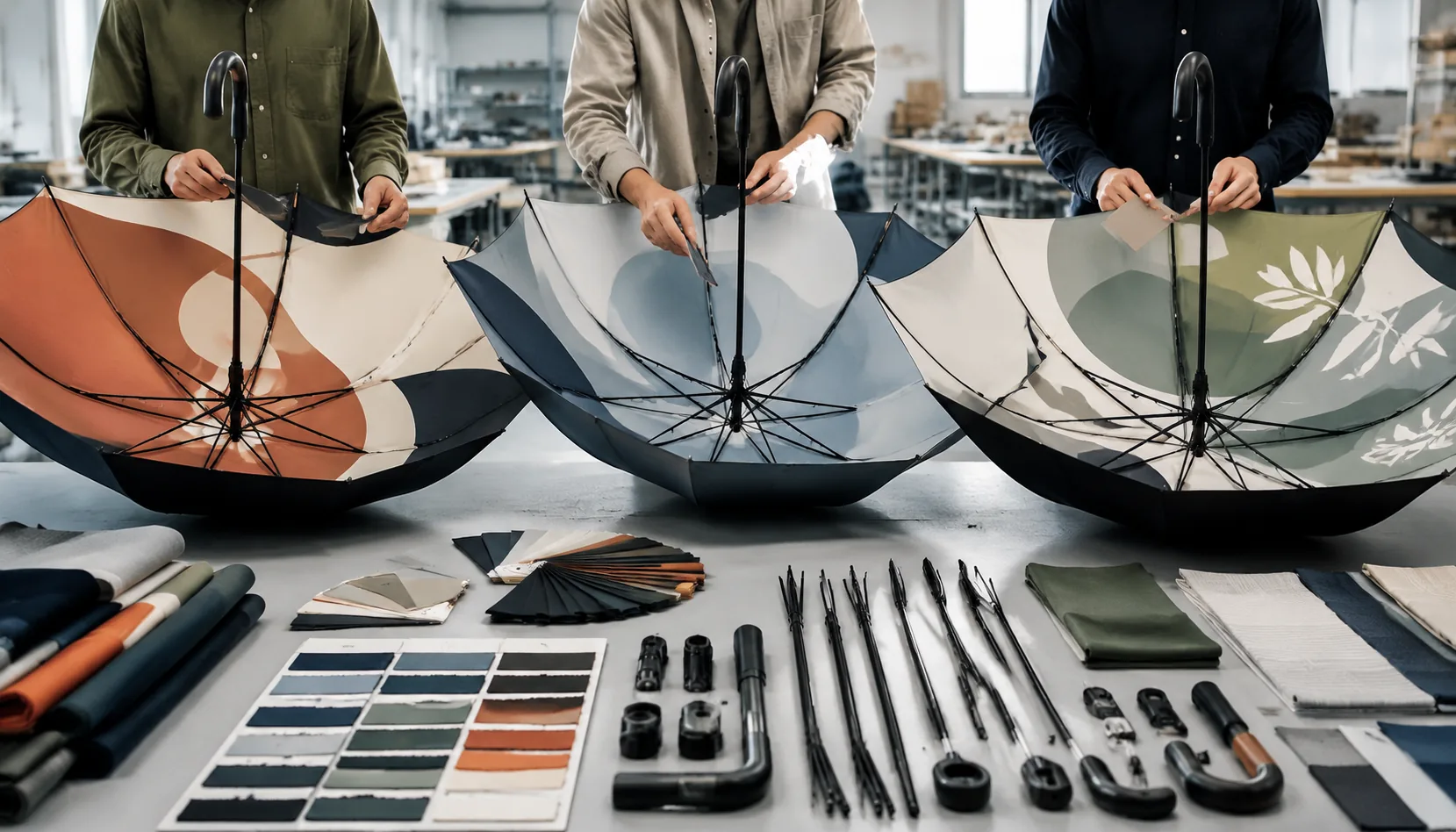
Inside-Canopy Umbrella Branding for Retail and Events
Plan inside-canopy logos with correct fabric, ink opacity, rib layout, and AQL checks so retail and event umbrellas look...
Read More »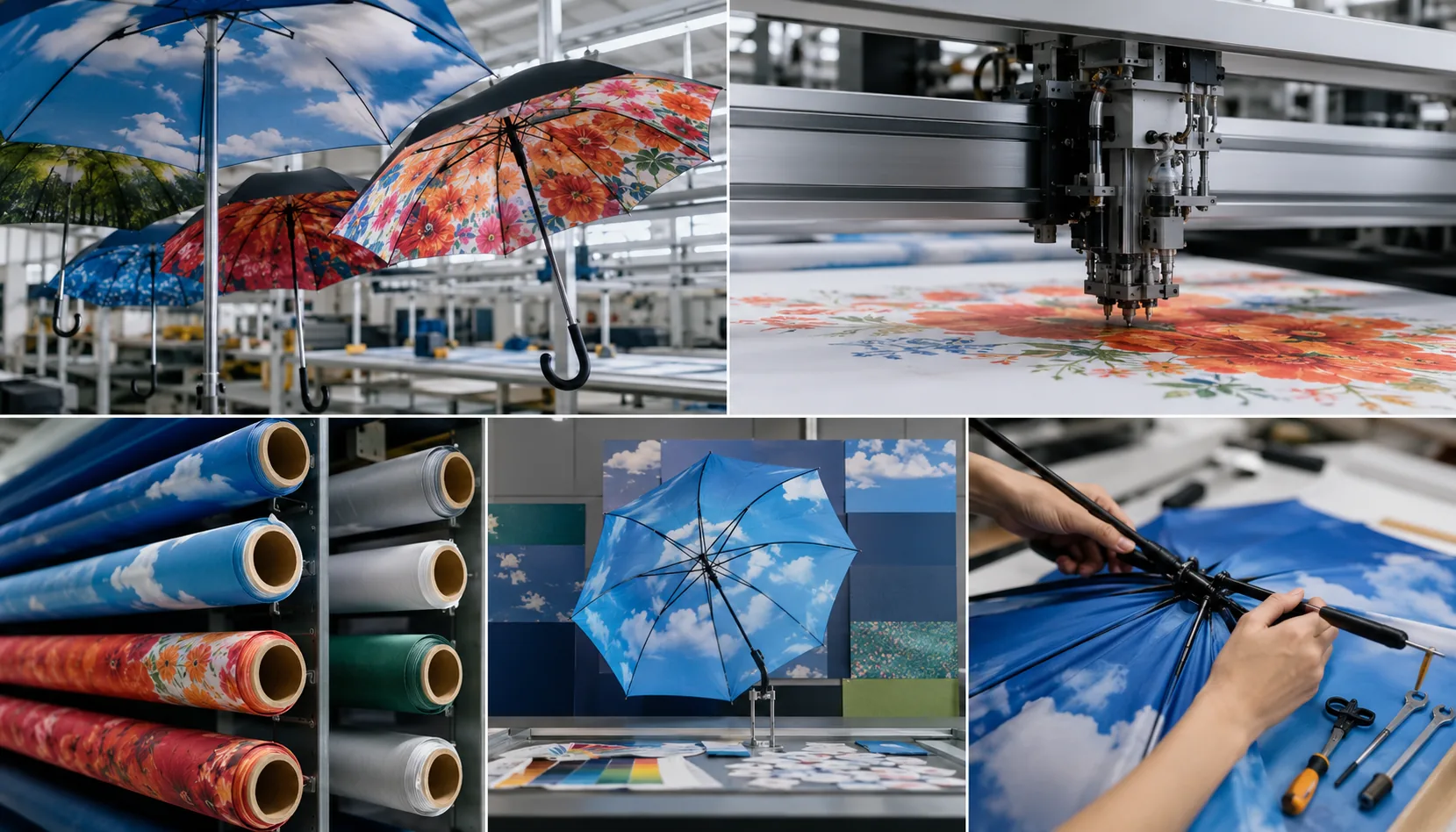
Inside-Canopy Umbrella Printing for Brand Storytelling
Use inside-canopy printing to add campaign artwork, messages, or maps without weakening exterior brand consistency on 19...
Read More »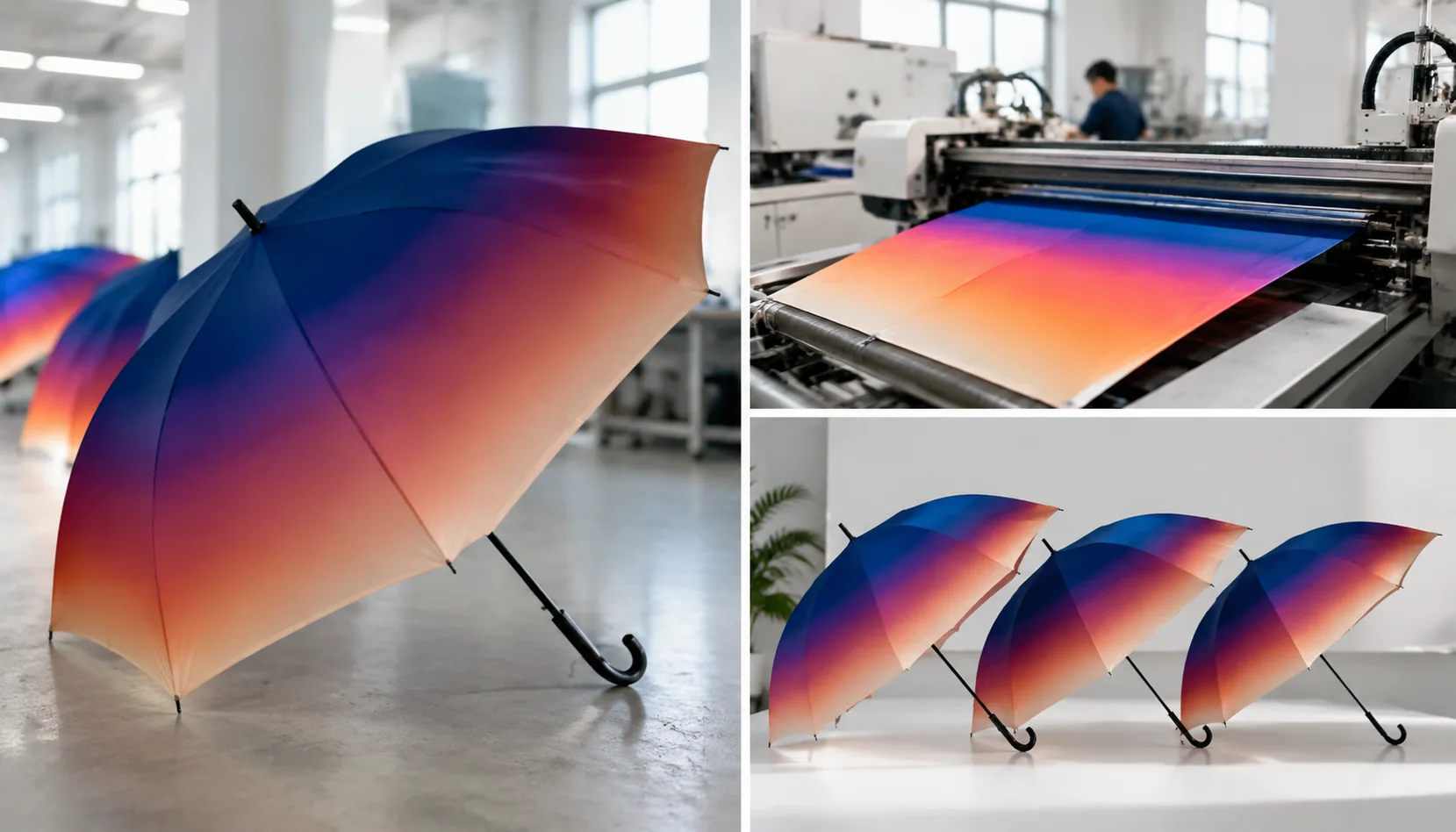
Gradient Umbrella Canopy Printing for Branded Campaigns
Use gradient umbrella printing for campaigns with clear artwork rules, fabric choices, color proofing, and production co...
Read More »