Inside-Canopy Branding for Premium Umbrella Orders
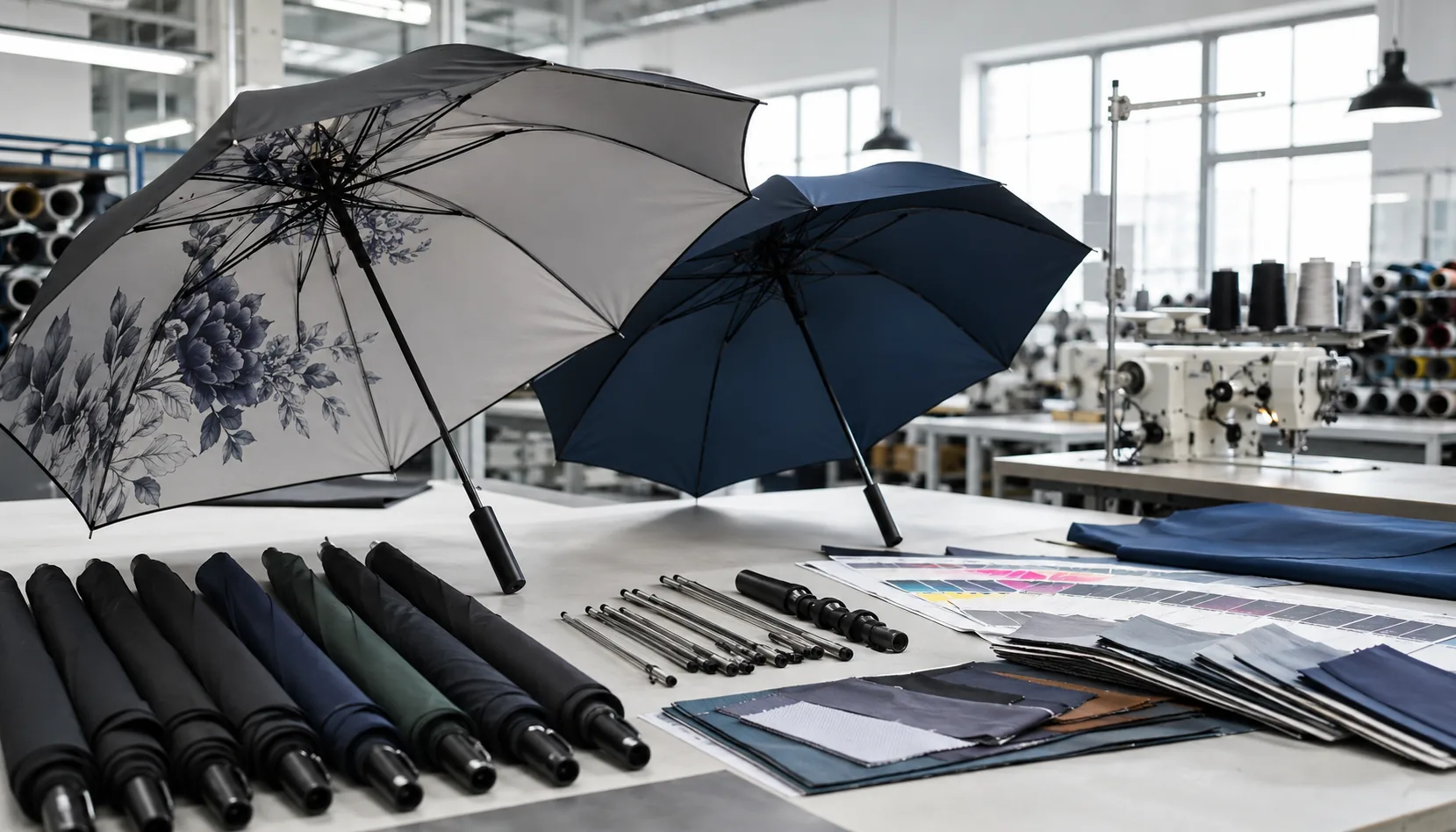
Premium buyers want the surprise of a logo or full graphic revealed under the canopy, but the factory challenge is keeping that effect sharp after cutting, sewing, coating, and final inspection. With inside canopy umbrella printing, the real decisions start before artwork approval: fabric hand feel, bleed allowance, UPF or silver lining compatibility, sample confirmation, MOQ planning, and how the print will look once ribs tension the panels.
Why Brands Print the Underside of the Canopy
From a merchandising point of view, the underside lets retail umbrella branding feel designed rather than applied. A museum can print the underside with a painting detail while leaving the outside a solid charcoal; a hotel can use a ceiling motif or city map; a fashion brand can place a seasonal lining print that matches bags, scarves, or trench coats. For executive programs, the reveal matters during arrival moments: stepping out of a car, walking a client across a wet driveway, or opening a gift in a conference room. Buyers should still specify performance first: fiberglass ribs over thin steel for better recovery, a double-canopy vented structure if wind is a concern, UPF 50+ or Teflon coating when needed, and AQL 2.5 inspection for print registration, seam alignment, and color consistency. Inside art is premium only when the umbrella still opens smoothly, closes cleanly, and survives real use.
Best Artwork Types for Inner-Canopy Printing
Campaign photography and message panels need stricter artwork control than most buyers expect. A portrait, product shot, or event photo can be strong for a custom umbrella lining, but faces and key objects should stay inside individual panels rather than landing on seam lines, rib tips, or the crown cap area. Sublimation handles gradients and photographic color best on light polyester pongee, while screen printing is better for solid slogan panels, QR codes, and limited-color campaign graphics. For message panels, keep body text above 8 pt after scaling, avoid thin reversed type, and leave a clear zone near each rib pocket because stitching can eat small details. Inside canopy umbrella printing is viewed at close range when the user opens the umbrella, so small copy can work, but only if contrast is high and the artwork is placed where the canopy curve does not distort it.
Fabric, Coating, and Color Decisions
Fabric choice decides whether inside canopy umbrella printing looks premium after 500 open-close cycles or starts showing needle puckering and dull ink. For most premium branded umbrellas, 190T pongee is the practical baseline: tight enough for clean screen or heat-transfer detail, light enough for 21" and 23" auto-open frames, and stable during panel sewing. I move to 210T pongee when the buyer wants deeper color, softer hand feel, or a more retail-grade 27"/30" golf umbrella with 8K or 10K fiberglass ribs. The denser yarn gives better opacity and less show-through from the outer canopy, but it also adds weight and slightly slows drying after rain. For photographic artwork or full-panel artwork on the underside, 210T usually gives fewer surprises than 190T, especially when the design has gradients, skin tones, or small sponsor logos.
A black outer canopy is the safest construction for umbrella underside printing because it hides frame shadows, dirt, and minor ink migration from the printed lining. If the buyer wants UV protection, silver coating reflects heat better and is common for UPF 50+ promotional golf umbrellas, but it can flatten inside colors if the print is applied over the coated face. Black UV coating gives a cleaner luxury look and stronger contrast for custom umbrella lining, especially with white, gold, or tone-on-tone artwork, but it absorbs more heat in direct sun. For summer events, beach retail, or outdoor staff uniforms, I usually specify UPF 50+ lining with a verified test report rather than a vague “UV fabric” claim. A true UPF 50+ layer must be checked after printing because heavy ink coverage, lamination, and sewing holes can change the final rating.
Coating order matters more than many buyers realize. Teflon water-repellent treatment, PU backing, silver UV, and black blackout coatings all change surface energy, so ink adhesion can fail if the factory prints on the wrong side or prints after a low-surface-energy finish is applied. Our standard practice at ZheBrella is to confirm the print sequence before bulk cutting: piece-dye or fabric stock selection, coating confirmation, trial print, adhesion tape test, then panel cutting and sewing. For retail umbrella branding, I ask for a strike-off under D65 light and a wet-rub check before approving mass production, because silver coating can make colors look colder while black backing can reduce brightness by one or two visual grades. If the artwork requires bright Pantone orange, red, or cyan, plan for a white underbase, slower curing, and 3-5 extra days before AQL 2.5 final inspection.
Frame Choices for Premium Positioning
Frame choice sets the price position before the buyer even sees the logo. For premium branded umbrellas with inside canopy umbrella printing, I usually separate the range into three builds: 23" straight umbrellas for retail and corporate gifting, 27" or 30" golf umbrellas for events and hospitality, and 21" compact auto-open or auto-open-close models for travel programs. Straight umbrellas give the cleanest balance of structure, handle options, and panel visibility; golf umbrellas deliver the strongest visual impact because the underside panels are wide enough for full-pattern artwork, city maps, constellation graphics, or brand storytelling; compact models are convenient but force tighter print registration because the folded canopy creases are more aggressive. A 190T pongee canopy is acceptable for many orders, but 210T pongee with a black outer layer and printed inner lining feels more premium and hides frame shadows better under showroom lighting.
Fiberglass ribs are the safer choice when the umbrella is being sold as a premium product rather than a disposable giveaway. Steel ribs keep cost down and feel rigid in the hand, but they can bend permanently after inversion, especially on 8K golf frames in coastal wind. Fiberglass ribs and stretchers recover better, reduce warranty claims, and pair well with double-canopy vented windproof construction. For a serious golf umbrella, I prefer 8K or 10K fiberglass ribs with a vented double canopy, tested to survive 50+ mph gusts when the runner, notch, and tips are properly matched. A 16K straight umbrella looks elegant and supports a rounder canopy profile for umbrella underside printing, but it adds labor and weight. Our standard practice at ZheBrella is to test rib flex, runner lock strength, and opening impact before approving any premium frame for bulk production.
Large panels sell retail umbrella branding better, but they also punish freight budgets. A 30" golf umbrella can make a custom umbrella lining look like an interior mural, while a 21" compact may only show the artwork clearly when photographed from below at close range. The tradeoff is carton volume: golf umbrellas often ship in long cartons around 90–100 cm, with fewer pieces per carton and higher dimensional weight for DDP air or courier delivery. Compact auto-open models pack more efficiently, but auto-open-close mechanisms add parts, failure points, and AQL 2.5 inspection time. For FOB Ningbo or Shanghai orders, the freight difference may be manageable in full cartons; for smaller MOQs shipped DDP, a large double-canopy golf umbrella can cost more to move than buyers expect. I advise confirming packed dimensions and gross weight before final artwork approval, not after the sample looks beautiful.
Approval Workflow and Quality Checks
Approval must start on paper before we touch fabric, because inside canopy umbrella printing leaves less room for correction than exterior logo work. For premium branded umbrellas, we first issue a digital mockup showing the artwork direction on each panel, rib positions, seam allowances, runner clearance, and whether the design crosses 8K, 10K, or 16K panel breaks. Buyers should approve Pantone targets, scale, orientation when opened, and how the artwork looks when folded. For umbrella underside printing, I also ask for confirmation of canopy fabric: 190T or 210T pongee, black coated pongee, or a custom umbrella lining laminated to the outer canopy. The underside print can shift visually under daylight, especially with dark outer colors or UPF 50+ coatings, so the mockup is only a layout control, not a final color proof.
The real approval point is the panel strike-off, followed by a full pre-production sample. A strike-off is normally 1 to 2 printed panels using the actual ink, transfer film, or sublimation profile, and it takes about 5 to 7 days after artwork confirmation. We check color variation against Pantone or LAB tolerance, edge sharpness, pinholes, coating reaction, and whether dense ink makes the panel curl before sewing. A pre-production sample usually takes another 7 to 12 days because it includes cutting, sewing, frame assembly, and opening tests on the chosen 21", 23", 27", or 30" umbrella. For retail umbrella branding, this sample must be reviewed open, closed, and half-open under ribs, because a perfect flat print can still look misaligned once the canopy is tensioned.
Bulk production should not begin until the signed sample is sealed and kept at the factory as the comparison standard. Our standard practice at ZheBrella is to run inline checks during panel cutting, sewing, and final assembly, then conduct final inspection under AQL 2.5 for major defects. For inside canopy umbrella printing, the inspection list must include print placement by panel, color drift between lots, pinholes visible against light, rib stains on the printed underside, seam puckering, loose tips, crooked ferrules, and manual, auto-open, or auto-open-close performance. We normally test repeated opening, closing, runner lock strength, and canopy balance, with extra attention on double-canopy vented windproof models because the inner print can rub against ribs. Typical production lead time is 25 to 35 days after sample approval, or 40 to 50 days for complex all-over underside artwork, custom lining, or DDP orders requiring consolidated packing and export scheduling.
Frequently Asked Questions
Can the outside and inside of an umbrella both be printed?
Yes, but the factory should confirm fabric opacity, coating compatibility, and print order. Dark outer fabric with a controlled inner print is usually safer than heavy full-color printing on both sides.
Is inside-canopy printing suitable for compact umbrellas?
Yes, but artwork should be simpler because compact umbrellas have tighter folds and smaller panels. Golf and stick umbrellas usually show inner graphics more cleanly.
What fabric is best for inside-canopy printing on premium umbrellas?
Tight-weave pongee or polyester is usually the safest choice because it holds detail better and reduces bleed-through. For premium retail orders, many buyers also specify a matte finish to keep interior graphics looking sharp under showroom lighting.
How do MOQ and sampling usually work for inside-canopy branding orders?
Sample sets are often produced first to confirm color accuracy and bleed control before bulk production. For factory orders, MOQ commonly starts around 500 to 1,000 pieces per design, depending on frame type, panel count, and print complexity.
Does adding UPF lining affect print quality or lead time?
Yes, it can, because the lining layer changes fabric behavior and may require extra testing for opacity and adhesion. Buyers usually allow an additional 7 to 14 days for sampling and approval when UPF performance and inside printing must both be verified.
Looking to Launch Your Custom Umbrella Line?
ZheBrella is a Zhejiang-based OEM/ODM umbrella manufacturer with 17 years of export experience. Free design, low MOQ from 100 pieces, windproof construction, full-color print.
Get Free Quote Now »People Also Search For
Related Articles
Inside-Canopy Umbrella Printing for Premium Brand Reveal
Plan underside umbrella graphics with fabric, rib, and QC choices that protect logo clarity while creating a premium rev...
Read More »
Inside-Canopy Umbrella Branding for Retail and Events
Plan inside-canopy logos with correct fabric, ink opacity, rib layout, and AQL checks so retail and event umbrellas look...
Read More »
Inside-Canopy Printing for Premium Branded Umbrellas
Plan inside-canopy umbrella printing with the right fabric, ink, frame, and QC specs so premium brand graphics look clea...
Read More »