Inside-Canopy Printing for Premium Branded Umbrellas
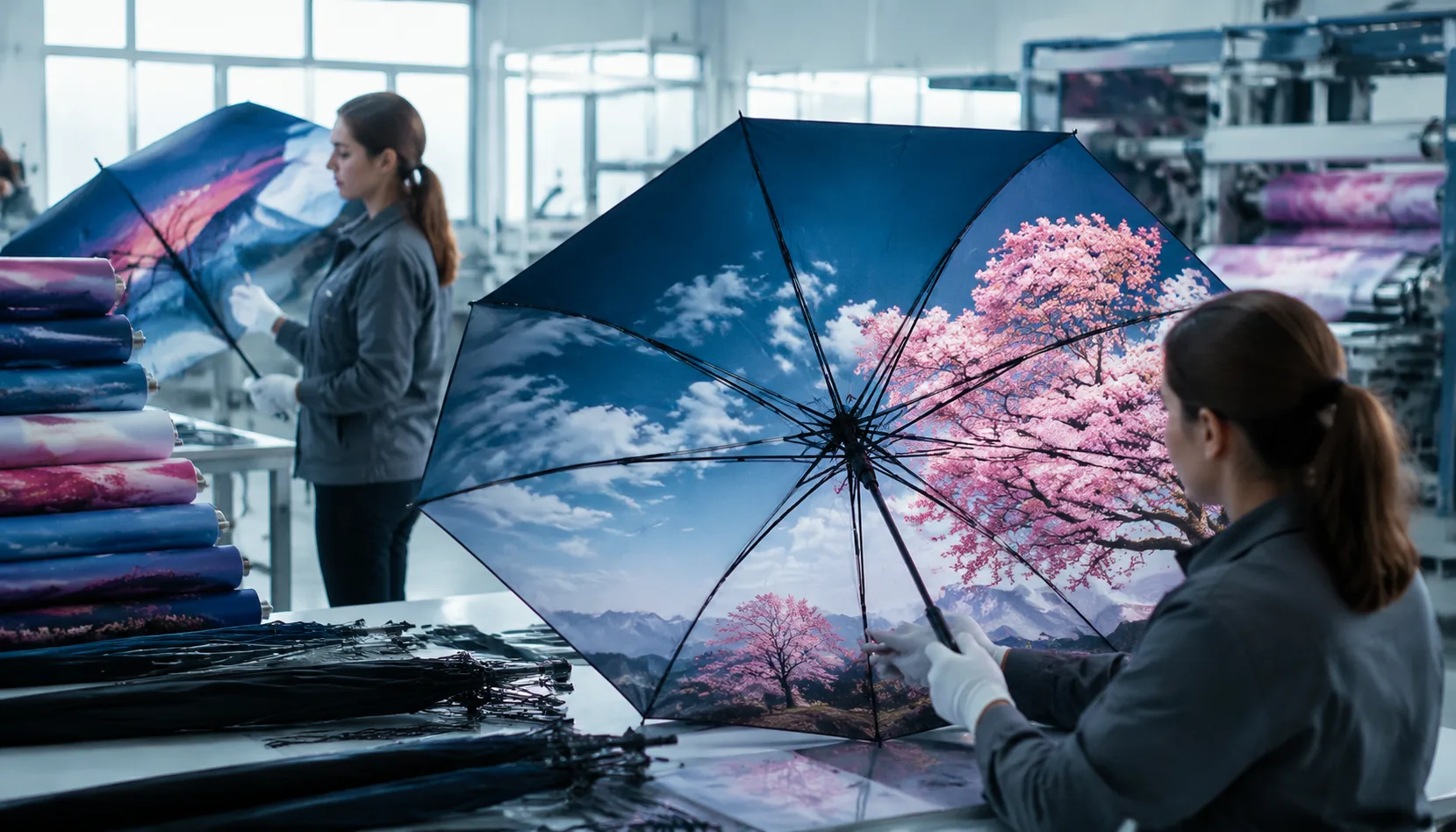
Premium buyers often approve a bold inner-canopy concept on screen, then discover the print reads muddy, wavy, or off-center once the umbrella is opened under real light. On our Songxia factory floor, inside canopy umbrella printing starts with fabric tension, ink opacity, rib shadow, and panel alignment—not just artwork size. Getting those specs right early is what keeps a luxury logo clean from the handle view to the retail display.
Why Print on the Inside of the Canopy
Inside canopy umbrella printing works because the owner sees the artwork every time the umbrella is used, not just when it is photographed from across the street. For luxury retail, five-star hotels, automotive launches, and VIP gifting, that private viewing angle matters. A 23" or 27" umbrella can keep the outside panels in a disciplined solid color, such as black 190T pongee, navy 210T pongee, or a matched Pantone brand shade, while the underside carries a city map, leather-grain pattern, campaign slogan, vehicle silhouette, or seasonal artwork. I prefer this construction for premium promotional umbrellas because it avoids the cheap billboard look. The product still reads clean from the outside, but the user gets a more personal brand moment under the canopy.
The technical choice is usually between direct screen printing, heat-transfer printing, and full sublimation on the custom underside canopy. Screen printing is efficient for one- to three-color logos or repeating marks on 8K or 10K panels, while heat transfer gives sharper gradients and photographic detail for launch graphics. Sublimation is best when the buyer wants full-panel artwork with no heavy hand feel, especially on white or light-color polyester pongee. For rain performance, we normally keep the water-repellent coating on the exterior face and print the interior face, then test opening tension, rub resistance, and color migration before packing. On double-canopy vented windproof models, the artwork must be positioned so vents and overlap seams do not cut through faces, QR codes, or key copy.
Branded umbrella interiors also solve a practical merchandising problem: many corporate umbrellas look identical when closed, but inside artwork makes the piece feel custom without shouting outdoors. Hotels use constellation ceilings, lobby artwork, or neighborhood maps. Automotive brands use grille textures, cockpit lines, or launch taglines. Retailers use monograms and seasonal patterns that match packaging, shopping bags, and window displays. For OEM umbrella printing, I usually recommend a steel shaft with fiberglass ribs for stable frame cost, or full fiberglass ribs on 27" and 30" golf umbrellas when the buyer needs wind resistance above 50 mph. The safest approval path is a digital layout, strike-off print, pre-production sample, then AQL 2.5 inspection against panel alignment, ink coverage, seam puckering, and handle finish before FOB Ningbo or Shanghai shipment.
Fabric and Ink Choices for Interior Graphics
For inside canopy umbrella printing, the fabric matters more than most buyers expect. 190T pongee is the safer baseline because the weave is tight enough to take fine detail without looking fuzzy, and it still sews well on curved panels. 210T pongee gives a denser hand feel and usually a cleaner print edge, especially when you want deeper blacks or more saturated brand colors on branded umbrella interiors. The tradeoff is that 210T can show press marks or tension lines more easily if the cutting and panel alignment are sloppy. Light bleed is also different: 190T will transmit more light through the canopy, which can soften the artwork but reduce contrast; 210T blocks a bit more and keeps the custom underside canopy looking sharper under bright daylight. For premium promotional umbrellas, I prefer 210T when the art has solid fills or small text, and 190T when the priority is a lighter, more economical build.
Print method choice should follow artwork complexity, not habit. Digital printing is the right tool for full-color gradients, photographic graphics, and detailed OEM umbrella printing because it can place multiple tones without building up ink thickness. On curved umbrella panels, though, digital needs tight color control and good pretreatment, or the edges will look washed out when the fabric flexes. Screen print is still the better choice for simple logos, spot colors, and repeat orders with strict Pantone targets because the ink deposit is heavier and more opaque. That matters on branded umbrella interiors, where a logo viewed from below must read cleanly at arm’s length, not just in a catalog photo. If the design uses one to three colors and a large open field, screen print usually gives the most stable result and the lowest reject rate in production.
UV layers and reflective coatings can change the visual result more than the ink formula itself. A silver UV coating or a black coating with UPF 50+ protection improves sun blocking, but it also changes how light passes through the canopy and can shift the underside color toward cooler, duller, or slightly grayer tones. That is the main reason color approvals for inside canopy umbrella printing should always be checked on the actual coated fabric, not on an uncoated swatch. Silver-backed cloth tends to brighten and flatten colors, while black UV layers can deepen contrast but hide subtle gradients and make some reds or oranges look darker than expected. If the goal is premium promotional umbrellas with accurate brand colors, the factory has to balance print method, coating color, and fabric weight together; otherwise the artwork may look correct under indoor light and wrong in direct sun.
Frame Structures That Support a Premium Look
Rib count decides how clean the artwork looks before the printer ever touches the fabric. An 8K frame gives eight larger panels, so each triangle of a 23" or 27" canopy is wider and easier for big logos, skyline graphics, or photo-style inside canopy umbrella printing. The downside is visible segmentation: a circular graphic must be split across eight seams, and poor alignment can make the underside look cheap. A 16K frame narrows each panel, which creates a more refined radial shape and better canopy tension, but it also means 16 separate artwork files, more registration points, and higher sewing discipline. For premium promotional umbrellas, I usually avoid tiny text crossing seams; even with laser-cut 190T or 210T pongee, seam allowance and fabric stretch can shift 2-3 mm during stitching.
Material choice matters more on branded umbrella interiors than many buyers expect, because users stare directly at the rib line when the umbrella is open. Steel ribs are acceptable for cost-driven manual-open 21" or 23" programs, but they can show rust at rivets and tips after salt air, wet storage, or repeated rain exposure. Fiberglass ribs cost more, yet they flex better in gusts, reduce corrosion risk, and pair well with auto-open or auto-open-close mechanisms where frame stress is higher. On higher-end OEM umbrella printing projects, we often combine fiberglass ribs with a black electroplated steel shaft or aluminum shaft, then run cycle testing and AQL 2.5 inspection for rib symmetry, rivet tightness, and canopy pull.
Double-canopy windproof construction is the safest way to add ventilation without damaging the custom underside canopy design. The outer canopy can lift and release pressure in 35-50+ mph gust testing, while the inner printed layer stays visually continuous from the user’s point of view. The trick is controlling vent overlap: if the upper layer is too short, rain blows in; if it is too long, the umbrella becomes bulky and the artwork near the crown gets shadowed. For premium programs, I prefer a 27" or 30" golf frame with 8K fiberglass ribs for large interior art, or 16K for luxury retail styling where the rib rhythm itself becomes part of the design. Coatings such as Teflon water repellent or UPF 50+ UV treatment should be confirmed before printing, because sublimation, heat transfer, and screen ink do not behave the same on coated pongee, POE, PVC, or EVA materials.
Artwork Setup, Sampling, and Buyer Approval
Artwork setup is where inside canopy umbrella printing either becomes a premium detail or turns into a crooked souvenir. I always ask buyers for the exact umbrella size and frame first: 21" folding, 23" straight, 27" golf, or 30" large golf all use different panel geometry, and an 8K frame does not share the same artwork template as a 10K or 16K frame. Each canopy panel needs its own trapezoid template with marked grain direction, rib line, seam allowance, and visible print area. For 190T or 210T pongee, we usually keep 10–12 mm seam allowance and a 15–20 mm logo safe zone away from rib stitching, tips, and top cap compression. On branded umbrella interiors, fine text should not cross seams unless the buyer accepts slight distortion. Large sky, city, or pattern artwork can wrap across panels, but logos and faces need to sit inside one panel whenever possible.
For a custom underside canopy, the approval file should show both the flat panel layout and a 3D open-umbrella mockup, because buyers often approve one and misunderstand the other. OEM umbrella printing for inside panels is usually done by heat transfer, sublimation on light polyester, or screen printing for simpler solid-color graphics; each method handles Pantone matching differently. Dark exterior fabric can also affect the perceived color inside, especially on single-layer pongee, so premium promotional umbrellas often use a double canopy or a white-backed transfer film when the artwork needs bright reds, clean skin tones, or photographic gradients. Our standard practice at ZheBrella is to mark rib positions, center cap radius, runner clearance, and panel order directly on the PDF proof, then require written sign-off before cutting fabric. This prevents the common mistake of placing the main logo where the rib seam breaks it.
A pre-production sample is not optional for premium work; it is the only honest way to approve color, alignment, and opening appearance before bulk cutting. Typical sampling takes 7–10 days after workable AI, PDF, or PSD files are received, longer if the buyer requests Pantone lab dips, UPF 50+ coating confirmation, Teflon water-repellent testing, or a double-canopy vented windproof frame trial. The sample should be opened, photographed from underneath, checked panel by panel, and compared against the signed artwork at normal viewing distance, not just on a cutting table. For inside canopy umbrella printing, I recommend buyers approve three things in writing: color tolerance, seam-to-seam alignment, and acceptable logo shift near ribs, usually within 3–5 mm. After artwork and sample approval, bulk production normally runs 30–45 days depending on MOQ, rib count, mechanism type, and whether shipment is FOB Ningbo/Shanghai or DDP to the buyer’s warehouse. Final inspection should use AQL 2.5 with added checks for underside print scratches and transfer peeling.
QC Points for Interior Printed Umbrellas
Interior printing fails differently from exterior logos, so AQL 2.5 inspection must look at the umbrella from the user’s eye position, not only flat on a table. For inside canopy umbrella printing, we check print registration against rib lines, panel seams, and the runner position after the umbrella is fully opened. A 2–3 mm shift may be acceptable on a small repeated pattern, but it looks cheap on a full custom underside canopy with a skyline, constellation, or retail brand graphic. Inspectors should open the 23" or 27" sample under white light and check whether artwork crosses the 8K or 10K rib layout cleanly. On premium promotional umbrellas, I also require a closed-canopy check because heavy interior ink can sometimes show pressure marks where ribs contact folded pongee 190T or 210T fabric.
Ink smearing, fabric stains, and rib marks are the three defects buyers underestimate until cartons arrive. Dark sublimation on light pongee can hide minor stains, but white or pastel branded umbrella interiors expose oil spots from sewing tables, dirty presser feet, and transfer-paper ghosting. For screen or heat-transfer OEM umbrella printing, we do a dry rub and light wet rub on the inner print zone before packing; if ink lifts onto tissue, the batch needs curing review, not just rework sorting. Rib marks are checked after the umbrella has stayed folded for at least 12 hours, because fresh samples often look clean before packing pressure sets in. On fiberglass ribs, marks are usually softer; on black steel ribs, sharp edges near tips and stretchers can emboss the coating if canopy tension is too high.
Mechanical QC matters because a beautiful interior print is useless if the umbrella opens poorly. Under AQL 2.5, our standard practice at ZheBrella is to test manual, auto-open, and auto-open-close mechanisms for smooth release, lock engagement, and safe closing force, then confirm canopy tension across all panels. A loose panel makes the interior artwork sag; an over-tight panel pulls seams, distorts circles, and increases tip stress during wind testing. For vented double-canopy models rated around 50+ mph, we inspect whether the inner printed layer interferes with airflow or catches on rib joints. Export buyers should tie these QC points to shipment terms: FOB Ningbo or FOB Shanghai works for importers controlling freight, while DDP is better for distributor programs that need landed-cost clarity, duty handling, and predictable delivery schedules before campaign launch.
Frequently Asked Questions
Can the inside and outside canopy be printed with different designs?
Yes, but it usually requires careful fabric selection and sampling to prevent show-through. For premium orders, a solid outside canopy with a printed underside is often cleaner than two heavy full-color prints.
What MOQ should buyers expect for inside-canopy printing?
MOQ depends on fabric, print method, and frame type, but many OEM programs start around 500–1,000 pieces per design. Complex digital artwork or custom dyed fabric may require higher MOQs.
What canopy fabric works best for inside printing on premium umbrellas?
For clean interior graphics, pongee polyester and high-density polyester are the most common choices because they accept fine detail and hold color well. Many premium programs specify 190T to 230T fabric with consistent weave to reduce distortion at panel seams.
How should artwork be prepared for inside-canopy printing?
Use vector files or high-resolution layered artwork with bleed and panel alignment marked for each gores. For multi-panel layouts, brands usually approve a printed strike-off or digital proof first to confirm registration before bulk production.
What quality checks matter most for OEM umbrella printing?
Key checks include color match tolerance, seam-to-seam registration, wash/rub resistance, and visual inspection under both open and closed positions. Buyers often require 100% inline inspection plus a final AQL check before shipment.
Looking to Launch Your Custom Umbrella Line?
ZheBrella is a Zhejiang-based OEM/ODM umbrella manufacturer with 17 years of export experience. Free design, low MOQ from 100 pieces, windproof construction, full-color print.
Get Free Quote Now »People Also Search For
Related Articles
Inside-Canopy Umbrella Printing for Premium Brand Reveal
Plan underside umbrella graphics with fabric, rib, and QC choices that protect logo clarity while creating a premium rev...
Read More »
Inside-Canopy Branding for Premium Umbrella Orders
Use inside-canopy printing to create premium brand moments while controlling bleed, fabric choice, UPF lining, samples, ...
Read More »
Inside-Canopy Umbrella Printing for Hidden Brand Moments
Design inside-canopy umbrella prints that surprise users while controlling fabric opacity, frame specs, sampling, MOQ, a...
Read More »