Debossed, Engraved, or Printed Handles for Umbrella Branding
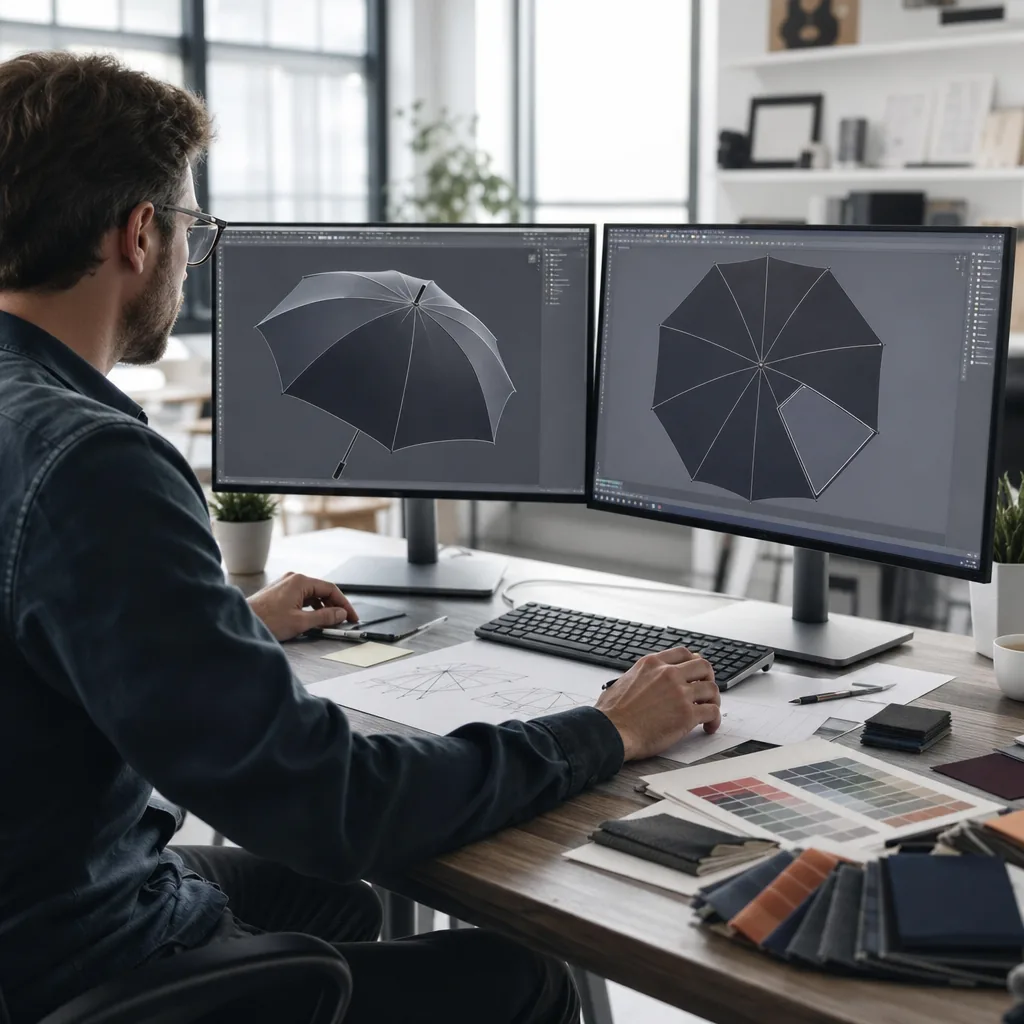
When buyers compare debossed, engraved, and printed logos on custom branded umbrella handles, the real issue is not appearance alone but how the mark behaves on ABS, wood, rubber-coated, or metal parts once production starts. On our Songxia factory floor, the choice usually comes down to mold cost, minimum order quantity, line speed, and how well the logo survives handling, humidity, and carton abrasion before the umbrellas ever reach retail.
When Handle Branding Makes Sense in a B2B Program
Custom branded umbrella handles make sense when the umbrella is handled at close range as often as it is seen from a distance. A canopy logo still does the long-range work, but in retail, hospitality, and gifting, the handle is what the user grips, checks, and stores. That matters most on 21" and 23" compact 3-fold auto-open-close umbrellas, where usable canopy area is reduced by panel seams, ribs, and safety tips. Adding a handle mark creates a second branding position without overloading the canopy print. For these compact models, a debossed umbrella handle logo is usually the lowest-risk option on rubberized ABS or PU-coated grips because the mark is recessed into the surface, not sitting as a thin top print that can scuff off during daily use. In resale programs, gift-with-purchase offers, and VIP kits, that small upgrade often does more for perceived value than adding another canopy color or a more complex panel layout.
Straight and golf umbrellas justify handle branding for a different reason: the grip stays visible when the canopy is closed and carried indoors. On a 27" straight umbrella or 30" golf frame with fiberglass ribs and a vented double canopy rated around 50+ mph, the handle remains on display in hotel lobbies, tournament tents, pro shops, and valet stands, even when the canopy is wrapped shut. That makes engraved umbrella handles a better fit for wood crook handles, bamboo-look grips, or metal end caps, where the decoration reads as permanent and premium. Printed handle branding still works on EVA or molded plastic grips for high-volume promotional orders when MOQ and unit cost are tight, but it carries higher wear risk if ink adhesion is weak; rings, stand hooks, and storage bins will show abrasion first. In hospitality, branded grips also help guests distinguish shared black POE, 190T pongee, or 210T pongee umbrellas at the entrance. If the goal is rain-day visibility only, canopy-only branding is enough. If the buyer needs better asset recognition, repeat brand contact, and a higher-value finish, handle branding usually justifies the extra cost.
Which Handle Materials Support Each Branding Method
Handle material determines how much detail your branding can hold, so choose the substrate before finalizing artwork. For custom branded umbrella handles, molded ABS or PP gives the sharpest and most repeatable results, sealed hardwood such as beech is next, and EVA foam is the most restrictive because the surface rebounds after compression. EVA can carry a debossed umbrella handle logo if the die uses bold strokes and about 0.5 to 0.8 mm depth, but thin serif text, tight counters, and strokes under about 2.0 mm usually soften back, especially after container heat exposure. Wood debosses more cleanly on flatter profiles and harder species; sanded beech holds edge definition better than textured handles or heavy varnish builds. Plastic handles rarely use debossing because pad printing and molded-in tooling control logo size and placement more consistently across production lots. Surface texture is the main clarity risk on all three materials: pebbled EVA, molded grain on ABS or PP, and thick wood coatings all break up small copy. If the logo includes fine lines or small text, polished ABS, smooth PP, or well-sanded beech is the safer choice.
Laser marking works well for engraved umbrella handles made from wood or laser-grade plastic, and it is a poor fit for EVA. Beech and maple typically engrave with even contrast and a cleaner premium look, while bamboo-style or heavily varnished wood can char at the edges unless laser speed and power are tuned to the coating thickness. On black laser-marking ABS, the logo can resolve in white or light gray and usually outlasts standard pad print under repeated hand contact, which is why many 21 inch and 23 inch folding umbrellas use it in higher-volume runs. EVA does not engrave cleanly; the beam melts and pits the foam, and coarse texture reduces legibility further on letters below roughly 4 pt equivalent. Pad printing remains the most flexible printed handle branding method across EVA, wood, ABS, and PP, but durability varies by substrate: on smooth plastic with correct surface treatment and curing, one-color prints can pass common tape and rub tests, while EVA prints wear faster on high-contact grip zones. Molded-in logos are the most durable umbrella OEM branding options because the mark is cut into the injection tool, but they usually make economic sense only at stable volumes of about 3,000 to 5,000 pieces per handle shape; for mixed FOB orders and 25 to 35 day lead times, pad print or laser is usually lower risk.
How Branding Holds Up in Real Use Conditions
Handle durability starts with the substrate, not the artwork. For custom branded umbrella handles, a debossed umbrella handle logo in ABS, PP, or wood usually outlasts printed handle branding because the mark sits below the main wear surface. That difference shows up fastest on 21" and 23" auto-open daily-carry umbrellas: the handle scrapes against tote linings, car door pockets, umbrella stands, zippers, and keys on every commute. Hand oils add a second wear factor by dulling surface print and exposing edge wear sooner on smooth plastic grips. Engraved umbrella handles, especially laser-engraved wood or engraved metal end caps, keep the logo readable even after the surrounding surface starts to polish from repeated use. For buyers, the practical rule is simple: match the branding method to the handle material first, then to the target price point. A pre-production sample can look clean at approval and still fail in market if the decoration method does not match the handle substrate and the umbrella is expected to survive a full season of daily use.
Moisture widens the performance gap. EVA and rubberized handles improve grip, but surface-applied logos are more likely to show gloss change, edge lift, or color loss after repeated wet-dry cycles. PU-coated wraps face added risk from sunscreen, sanitizer, and skin oils, so printed handle branding needs a defined adhesion and cure standard, plus a post-water rub test, instead of dry visual approval alone. Debossed plastic crook or straight handles are less sensitive to rain exposure, while engraving on wood or metal stays legible after damp storage and repeated opening cycles. Use case should set the spec. An 8K folding umbrella with steel ribs sees high grip frequency and pocket carry, so abrasion resistance matters more than display impact. A 27" or 30" double-canopy windproof event umbrella with fiberglass ribs faces rough carton packing, turf contact, and higher wind loads, so umbrella OEM branding options should favor debossed or engraved handles for premium programs. Printed handles still fit short-lead event orders where unit cost matters more than long-term wear.
MOQ, Tooling, and Sampling for Branded Handles
For custom branded umbrella handles, the cost driver is simple: are you changing decoration only, or the handle itself? Printed handle branding on an existing straight EVA grip or a standard ABS or PP crook usually needs artwork setup, a print jig, and logo position approval, not a new mold. That keeps MOQ in the 500 to 1,000 piece range, depending on handle shape and print area. A one-color pad print is typically the lowest-cost route because the base handle mold stays unchanged, but it carries more abrasion risk on high-contact promotional umbrellas than a recessed mark. A debossed umbrella handle logo moves into a higher tooling bracket. If the stock handle already has a flat badge area, a brass or steel embossing die may be enough. If the logo must be formed directly into the plastic or rubber surface, the factory will need a mold insert change or a new handle mold. At that point, MOQ usually rises to 3,000 to 5,000 pieces so tooling can be amortized without pushing unit cost out of range.
Engraved umbrella handles usually sit between pad print and full mold rework on both cost and setup time. On wood handles, laser or CNC engraving can work from 300 to 500 pieces because there is no injection mold to modify; the real constraints are handle consistency, lacquer thickness, and how much depth the surface can take without chipping. On zinc alloy, aluminum, or plated end caps, the main requirement is a holding fixture so the logo lands at a consistent clock position against the canopy panel and closing strap. For umbrella OEM branding options on molded handles, quote accuracy depends on three checks before sampling: whether the artwork fits the draft angle, whether ejector-pin positions interfere with the logo area, and whether the surrounding texture must change. Those checks determine whether the project needs only artwork setup, a fixture charge, or full mold rework.
Lead time problems usually come from approving samples in the wrong order. The clean sequence is to approve vector artwork and logo orientation first, then a pre-production handle sample, then the assembled umbrella with canopy, strap, and handle alignment confirmed. For printed handle branding, a photo sample may be acceptable before a physical sealed sample; for debossed or engraved marks, a physical sample is the safer checkpoint because depth, edge sharpness, and fill quality do not read reliably on screen. Standard timing is 3 to 5 days for artwork and jig setup, 7 to 10 days for printed-handle samples, 10 to 14 days when an engraving fixture or debossing die is needed, and 15 to 25 days when a mold insert must be cut. After sample approval, bulk production usually takes 25 to 35 days, followed by final inspection at AQL 2.5 before FOB shipment or DDP dispatch.
How to Specify Handle Branding for Production and QC
Start the spec by matching the branding method to the handle material, because that determines the detail the factory can hold and prevents rework after sampling. For custom branded umbrella handles in wood straight or crook styles, a debossed umbrella handle logo should use strokes no finer than 0.3-0.5 mm and target about 0.4 mm depth; finer detail often softens after sanding and varnish. On ABS, PP, or rubberized EVA, engraved umbrella handles can reproduce smaller features, but text should still be at least 8-12 mm high, with icon marks in the 18-35 mm range for consistent legibility across production. Printed handle branding is less forgiving on curved grips, so on a typical 23 inch or 27 inch auto-open umbrella, limit the print zone to about 35 x 12 mm on the flattest panel. If one program spans wood crooks, pistol grips, and compact folding handles, do not force one artwork file across all molds. Approve one logo lockup per handle family to reduce tooling changes, lower reject risk, and make the spec practical across umbrella OEM branding options.
Most branding failures come from unclear placement and weak QC criteria, not bad artwork. The PO and approved drawing should define one reference point—closing strap, push button, or canopy front seam—and state orientation clearly: logo centered on the handle flat, top of logo facing the canopy front panel, tolerance +/-10 degrees. Contrast also needs a written requirement. A blind deboss on a black rubberized handle can pass a sample review and still disappear under warehouse lighting; if retail visibility matters, specify white or silver pad print, or laser engraving with paint fill when the material allows it. For inspection, separate cosmetic defects from assembly defects and check against an approved limit sample under AQL 2.5. Wrong logo, wrong orientation, or unreadable custom branded umbrella handles should be major defects; slight edge softness or depth variation can be minor if the mark stays legible at 50 cm. For mixed-SKU branded shipments, carton labels should list PO number, SKU, handle branding method, canopy color, quantity, and destination mark, with inner bundle labels when multiple logos share one master carton. FOB is usually the better term when the buyer manages consolidation and relabeling; DDP fits better when small branded lots ship to one market and one party owns labeling, customs, and final delivery risk.
Frequently Asked Questions
Is debossed handle branding more durable than printed logos?
Usually yes. Debossed or engraved branding tends to outlast surface printing because the logo is recessed or cut into the material, while printed marks can wear faster under repeated handling.
Do branded handles require a higher MOQ than canopy printing?
Often they do, especially when a custom mold, engraved insert, or non-stock handle shape is involved. Simple pad printing on an existing handle may keep MOQs closer to standard umbrella programs.
Which handle materials support debossing, engraving, and printing most reliably?
Debossing is typically used on PU, EVA, and some molded plastic grips, while engraving is best for wood, metal, and plated handle inserts. Printing works on plastic, coated wood, and smooth synthetic surfaces, but curved or textured grips often need a smaller print area and adhesion testing before approval.
How much does handle branding affect MOQ and lead time compared with canopy printing?
Handle branding usually raises the MOQ because it requires a separate mold, fixture, or marking setup; a common starting point is 500-1,000 pieces per handle style, versus lower MOQs for standard canopy printing. Lead time is often extended by 5-10 days for sample development and production setup, especially for engraved metal parts or custom deboss tooling.
What is the most practical option for a distributor program with multiple logo versions?
Printed handle branding is usually the most flexible when you need several logo versions on the same umbrella platform, because artwork changes do not always require new tooling. If you expect repeat orders above 3,000-5,000 units per design, debossed or engraved treatments can become more cost-effective and more durable over the long term.
Looking to Launch Your Custom Umbrella Line?
ZheBrella is a Zhejiang-based OEM/ODM umbrella manufacturer with 17 years of export experience. Free design, low MOQ from 100 pieces, windproof construction, full-color print.
Get Free Quote Now »People Also Search For
Related Articles
Debossed, Engraved, or Printed: Branding Umbrella Handles
Compare debossed, engraved, and printed handle branding by material, MOQ, tooling, and lead time so buyers can match log...
Read More »
Debossed, Engraved, or Printed Logos on Umbrella Handles
Compare debossing, engraving, and pad printing on umbrella handles by material, MOQ, cost, and durability for stronger b...
Read More »Debossed, Molded, or Printed Umbrella Handles for Brand IDs
Compare debossed, molded, and printed handle branding for umbrellas, with MOQ, tooling, lead time, and durability tradeo...
Read More »