Debossed, Engraved, and Molded Branding on Umbrella Parts
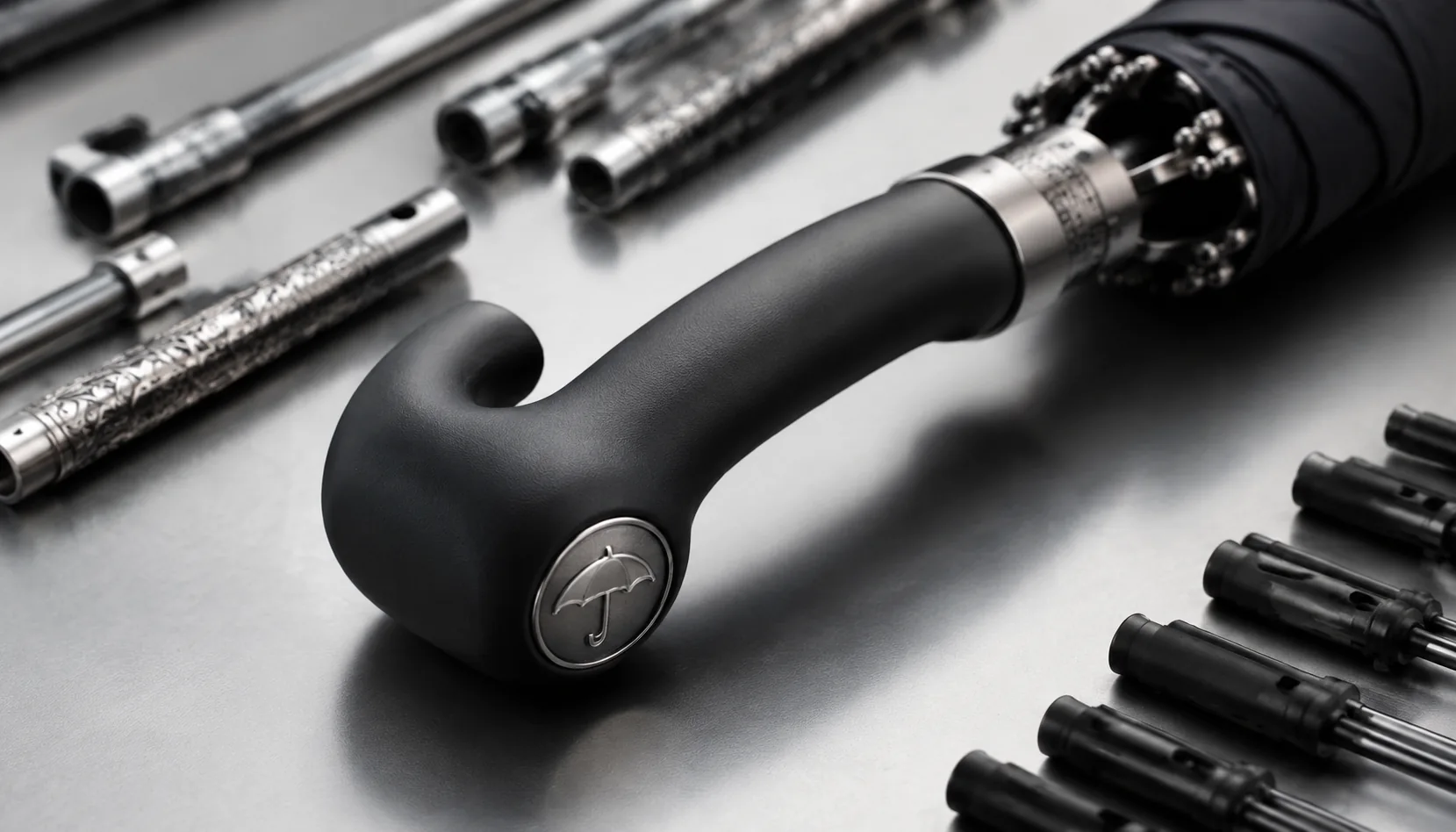
Brand buyers comparing a debossed umbrella handle logo with engraved and molded branding usually run into the same problem: the mark looks simple on paper, but tooling, material choice, and production volume decide whether it will hold up in real use. On the factory floor, the right option depends on the part itself, the substrate, and how much detail can be carried without slowing output or creating scrap.
Which Umbrella Parts Can Carry Permanent Branding
Plastic handles are the strongest candidate for permanent branding because they give you enough wall thickness and a stable land for clean detail. A debossed umbrella handle logo works best on straight cane handles, hook handles, and molded ABS or PP grips, where the logo band has at least 8-10 mm of usable height and enough surrounding material to hold the cavity without distortion. Below that, letters start to bridge during molding and small strokes blur after polishing. Wood handles call for engraved umbrella branding instead of debossing: laser engraving or rotary engraving gives a clearer result on natural grain, while stain and clear coat can soften very fine lines. For buyers, this is where custom umbrella handle tooling matters most, because the handle is the first part people touch and the one most likely to justify the added mold cost.
Ferrules, tip caps, buttons, and sleeve zipper pullers can also carry molded logo umbrella parts, but the readable area shrinks fast. On ferrules and tip caps, keep the mark to initials, a simple icon, or a short raised symbol on nylon, ABS, or plated metal; once the face drops below about 12 mm across, full words usually stop reading cleanly. Buttons on push-close or auto-open frames can take a shallow molded mark, but the strokes need to stay bold because fine serif text fills in quickly. Zipper pullers on sleeves can accept a tiny molded or laser-marked logo, but they work as secondary branding only, since they flex, rub, and wear faster than the handle. The same rule applies to umbrella logo on ferrule and tip: use these parts for reinforcement, not for your primary identity.
The practical cutoff is simple. Use thicker parts for a full brand name and reserve small parts for symbols, initials, or a short mark; if the artwork needs two words, a tagline, or thin linework, move it to canopy print or sleeve print instead of forcing it into a cavity that is too small. The debossed umbrella handle logo is usually the most durable option for primary branding, while engraved umbrella branding on wood and molded marks on ferrules or buttons work better as support details. Draft angle, wall thickness, and post-polish wear set the real limit, not the CAD file, so part selection directly affects tooling risk, scrap risk, and rework across different handle shapes and frame styles.
Compare Debossed, Engraved, and Molded Results by Material
A debossed umbrella handle logo works best on soft-touch plastics, EVA, and rubberized overmolds because the mark is formed by compression, not cutting. On matte ABS or TPR, it usually stays legible for the first few months of daily carry, then softens as hand oils and friction polish the edges. On wood, debossing is typically shallower and less uniform because grain direction and moisture content affect the press result, so the part gets tactile depth but not the crisp visual definition many retail buyers want. On coated zinc or aluminum metal-touch parts, debossing can hold up only when wall thickness is enough to retain the shape; thin decorative shells lose detail faster. By contrast, engraved umbrella branding gives a cleaner edge on wood, plated metal, and painted trim because the line is cut into the surface, not pressed in. It is still a poor match for glossy plastics if the part is handled often, since the recess can collect dirt and lose contrast over time.
Molded logo umbrella parts are the most durable option when the branding is built into the tool instead of added after molding. With custom umbrella handle tooling, the logo becomes part of the cavity, so it will not fade the way printing can and it holds up better than shallow surface detail. That makes it the lower-risk choice for 8K and 10K auto-open umbrellas, where the button and thumb area see repeated pressure, bag contact, and desk-drawer abrasion. Manual umbrellas usually wear more slowly at the handle because the user touches the grip less during opening, but the ferrule and tip still take impact from floor contact, pavement knocks, and stacking during transport. In practice, auto-open models need deeper, more readable branding on the handle, while manual models can rely more on simple formed detail at the ferrule and tip without losing legibility as quickly.
For buyers comparing finish options, the decision comes down to visibility over time versus tooling cost. A debossed or engraved umbrella branding choice can work on plastic, EVA, wood, or metal-touch parts, but the result depends on part thickness, surface texture, and how often the umbrella is handled. If the logo must stay visible on a high-touch grip, molded detail or a deeper debossed pattern is usually safer than a shallow engraved line. If the mark sits on a low-contact ferrule or tip, fine engraving is more acceptable because wear is slower there. For a debossed umbrella handle logo on an auto-open style, expect faster edge wear than on a manual model; for manual umbrellas, the handle is less exposed, but the ferrule and tip still need enough depth to survive daily abrasion and transit damage.
Tooling, MOQ, and Lead Times Buyers Need Up Front
Tooling is the first cost to price, not decoration. A debossed umbrella handle logo usually requires a new handle cavity or a steel insert, while molded logo umbrella parts for ferrules and tips may only need an insert change if the base geometry already exists. That is why pricing moves so much by component: a handle tool often lands in the low hundreds to a few thousand dollars, while small umbrella logo on ferrule and tip work is usually lower because the molded area is smaller. Engraved umbrella branding on metal parts often avoids a full plastic mold change, but it still adds setup cost, artwork proofing, and line-width approval before production starts. Buyers should compare that spend against the full order life cycle, not just the first PO, because the same mold charge looks very different on a 500-piece event run than on a 20,000-piece retail program.
Sample timing follows the tooling scope. An insert change typically takes 7 to 15 days after artwork confirmation; a new mold or new texture finish usually needs 20 to 30 days for sampling and approval. Send 2D artwork, exact dimensions in millimeters, and the target resin or alloy up front, because thin lines that look fine on screen can disappear in injection or die-casting. A pre-production sample in the actual material is the right checkpoint, since a drawing cannot show how the debossed umbrella handle logo reads in hand or how sharp the edge feels after molding. For repeat retail programs, that sample step protects margin and consistency; for one-off event orders, buyers usually trade that control for speed and lower setup cost.
MOQ should match the branding method and the sales plan. Permanent component branding makes sense when the same style will repeat across retail seasons, distributor replenishment, or multi-SKU gift sets, because the mold charge gets spread over volume. A practical threshold is 3,000 to 5,000 units for a handle insert, and 5,000 to 10,000 units when the cost is shared across several colors or sizes. For one-off event orders of 300 to 1,000 pieces, canopy printing or sleeve branding is usually the lower-risk route unless the buyer needs a molded part for handheld visibility. After approval, first production is usually 25 to 45 days. FOB is the cleaner choice for repeat programs; DDP is better when the buyer wants the landed cost fixed up front.
How Structural Specs Affect Component Branding Choices
Frame class should drive branding method before artwork does. A 21" or 23" compact umbrella, especially an auto-open-close model, leaves limited real estate on the handle, so a debossed umbrella handle logo needs shallow relief, clear draft angles, and a resin or TPR grip that releases cleanly from the mold. A 27" or 30" golf umbrella gives more surface area on the handle and ferrule, which makes engraved umbrella branding easier to read, but the larger profile also changes carry weight and balance. Keep the mark inside the grip zone and avoid deep cuts that create sharp edges or increase molding scrap. On single-canopy commuter SKUs, the handle usually carries the brand most efficiently; on premium golf SKUs, the ferrule and tip can carry an umbrella logo on ferrule and tip without crowding the grip.
Fiberglass vs steel ribs affect more than durability. Fiberglass is lighter and is common in travel and premium builds, so molded logo umbrella parts on the handle or tip usually fit the product better than heavy metal inserts that can throw off balance. Steel ribs and shafts tolerate firmer hardware, but branding on ferrules and tips should stay low-profile and corrosion-resistant, especially on plated parts that face repeated wet-dry cycles. Double-canopy windproof umbrellas add another constraint: the vented crown flexes under load, so branding belongs on stable zones such as the handle, ferrule, or cap, not on panels or moving edges. If the spec calls for a lighter fiberglass frame, place the brand where it reinforces that positioning; if it is a steel frame built for cost control, keep the treatment simpler and more robust.
Tooling cost is where buyers usually miss the budget. Custom umbrella handle tooling for debossing or molding only makes sense when volume can absorb cavity work, texture control, venting, and ejector marks; short runs are better served by laser engraving on a metal ferrule or tip. ABS, PP, and rubberized overmolds usually give the cleanest repeatability for a debossed umbrella handle logo, while plated parts need shallow engraving so coating build-up does not blur the mark. For programs with frequent spec changes, put the brand on interchangeable hardware instead of a part that needs new tooling every season. That reduces retooling risk, keeps lead time predictable, and makes MOQ planning easier when the same umbrella logo on ferrule and tip must work across multiple frame classes.
Set QC Standards for Branded Components Before Mass Production
Lock QC before mass production starts, and make the approval sample the controlling reference. For a debossed umbrella handle logo or engraved umbrella branding, freeze the physical master for logo depth, edge radius, text size, and legibility; a PDF is not enough for molded logo umbrella parts. Record the base material, whether TPR, EVA, ABS, or PP, then set a depth tolerance of about +/- 0.2 mm in the logo zone and check it on the actual part, not just the mold drawing. If the design includes an umbrella logo on ferrule and tip, add orientation, flash, plating coverage, and post-process checks for paint, chrome, or UV coating. Do not release custom umbrella handle tooling until mold finish, gate position, venting, and ejection marks match the approved sample, because those details change how the mark reads after trimming and cooling.
Surface finish and assembly inspection need the same discipline. A polished ABS handle can hide sink marks, while matte PP exposes weld lines, burn marks, and gate vestige, so the inspection sheet should call out gloss level, visible flow lines, and cleanliness around the logo. Compare the first production lot against the approved sample for logo depth consistency, sharp corners, and color transfer from spray coating or laser engraving. Then inspect fit, not just appearance: the handle, ferrule, and tip still need to seat correctly on the shaft, rib ends, and canopy stack so the part does not rotate off-axis or crack during press-fit. Run cosmetic and functional checks separately at AQL 2.5, since a clean surface does not guarantee a tight ferrule or an intact handle collar. Put the sample standard, inspection scope, and acceptance criteria in writing before PO release.
Build shipment terms into the QC plan because custom molded parts often move on a different schedule from the finished umbrellas. FOB works when you want control of freight and can absorb extra days for tooling approval, pre-shipment inspection, and replacement stock. DDP gives a clearer landed cost, but it needs earlier signoff so the supplier can manage packaging, export timing, and last-mile delivery risk. Separate sourcing for branded components can add 7-14 days if the mold still needs tuning or if the umbrella logo on ferrule and tip needs a rework pass. That timing matters when the finished umbrella is already tied to a canopy or frame shipment. State the approval sample, AQL 2.5 standard, assembly inspection scope, and shipment term in the PO so the debossed umbrella handle logo does not become a downstream delay.
Frequently Asked Questions
Are molded logo parts practical for short-run promotional umbrellas?
Usually not. Molded branding often needs tooling investment and higher component minimums, so it fits ongoing retail or corporate programs better than small one-time campaigns.
What lasts longer on umbrella parts: debossing or printed logos?
Debossed, engraved, and molded logos generally last longer because they are part of the component surface rather than applied ink. The tradeoff is longer development time and higher upfront cost.
What tooling is usually needed for molded logo umbrella parts?
Molded branding typically requires a custom mold insert or revised part tooling, and the upfront tooling cost depends on the part size and cavity complexity. For handle or ferrule parts, buyers often see MOQ requirements starting around 3,000 to 5,000 units per design, with tooling lead time around 10 to 20 days before production.
Which branding method holds up best on high-touch umbrella parts like handles and tips?
Engraved and molded logos usually outperform printed marks on wear resistance because the branding is recessed or formed into the part itself. For daily use and retail resale, molded logos on plastic handles and debossed marks on metal parts are typically more durable than surface coatings.
Can one umbrella order use different branding methods on different parts?
Yes, many OEM buyers combine methods, such as an engraved logo on the ferrule and a molded logo on the handle. This can increase setup complexity, but it is useful when you want strong brand visibility without changing the main canopy artwork.
Looking to Launch Your Custom Umbrella Line?
ZheBrella is a Zhejiang-based OEM/ODM umbrella manufacturer with 17 years of export experience. Free design, low MOQ from 100 pieces, windproof construction, full-color print.
Get Free Quote Now »People Also Search For
Related Articles
Embossed, Debossed, and Molded Logos on Umbrella Parts
Compare embossed, debossed, and molded logo options on umbrella handles, buttons, and tips with MOQ, tooling, lead time,...
Read More »
Debossed, Engraved, and Molded Umbrella Logo Details Compared
Compare debossed, engraved, and molded logo details on umbrella components, with guidance on tooling cost, MOQ, durabili...
Read More »Debossed, Molded, and Metal Logos on Umbrella Components
Choose debossed, molded, or metal logo details for umbrella handles and hardware. Compare appearance, tooling, MOQ, and ...
Read More »