Embossed, Debossed, and Molded Logos on Umbrella Parts
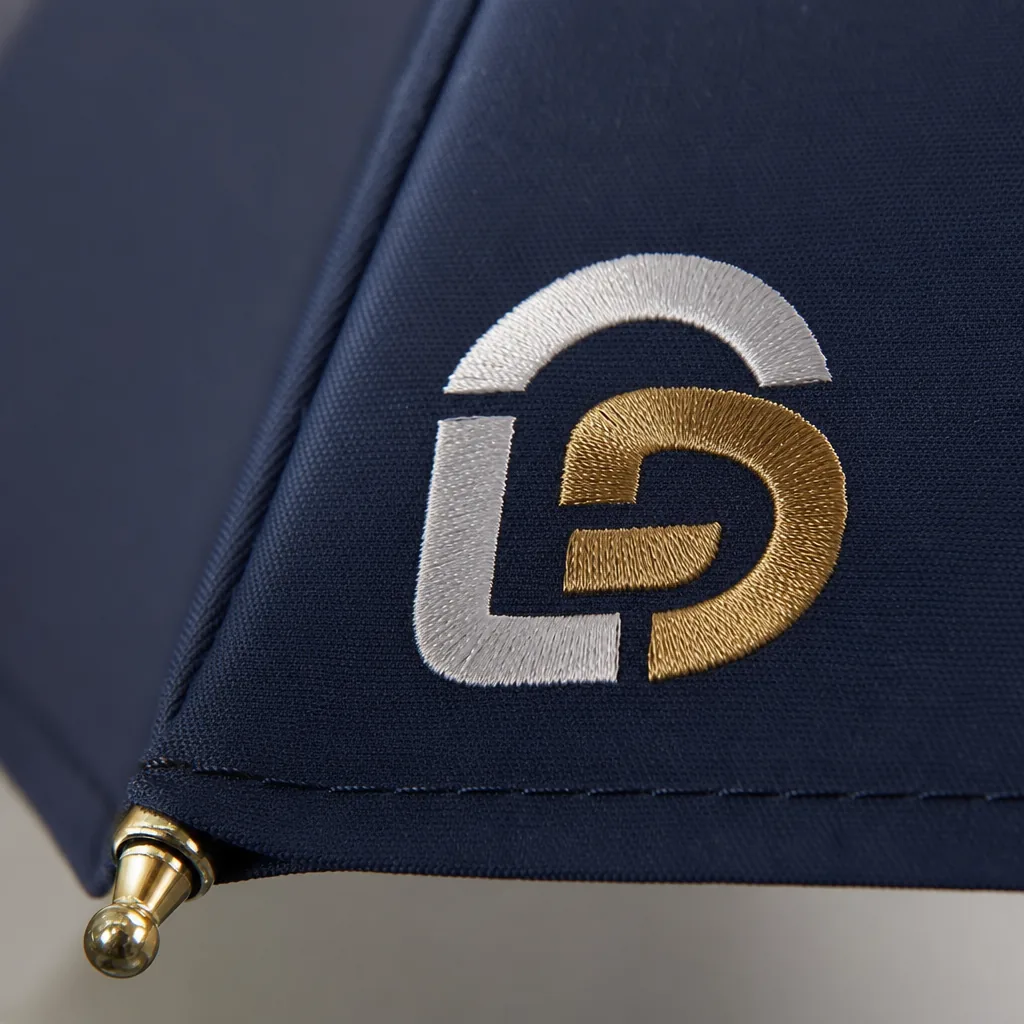
When buyers ask for logo treatment on umbrella handles, buttons, or tips, the real question is how to balance appearance, tooling cost, and production risk before mass production starts. On our Songxia lines, embossed, debossed, and molded marks each behave differently in ABS, PP, rubber, and plated parts, so the right custom umbrella handle logo choice depends on MOQ, cavity changes, lead time, and how clean the mark still looks after assembly and packing.
Where Non-Canopy Logo Decoration Works Best
The best non-canopy branding point is usually the handle cap, because it is the first part the user sees and one of the few hard components with enough surface for durable molded detail. A custom umbrella handle logo is most practical on flat or slightly domed caps in ABS or PP, either as an embossed umbrella logo, a debossed cavity, or a separate molded logo badge press-fit into the cap. On straight umbrellas, J-handle plastic and wood-look handles typically give the largest usable area, with end-cap diameters around 18-28 mm; that makes 27" and 30" golf umbrellas the easiest format for cleaner edge definition and more recognizable artwork. By contrast, 21" compact folding umbrellas leave much less room, so logos need thicker strokes and fewer small elements. For OEM umbrella branding at volume, molded-in decoration is usually lower risk than pad print because repeated hand contact and routine abrasion wear ink first, while molded detail keeps its shape longer.
Push buttons are the next-best option, but only on frames that actually expose a button face. Auto-open and auto-open-close umbrellas commonly use ABS or PC/ABS buttons that can be laser marked, molded with a raised icon, or fitted with a small metalized badge when assembly tolerances are tight enough to keep the badge flush. On 3-fold 21" and 23" umbrellas, the visible button is often only 10-12 mm wide, so debossed handle branding on the grip body usually reads better than forcing fine detail into a small circle. Manual straight umbrellas often have no visible button, so branding shifts to the handle cap, strap snap, ferrule collar, or tip trim. Strap snaps can carry a small raised or recessed mark in nylon, silicone, or injected plastic, but artwork should stay bold because snaps flex and take frequent abuse. Ferrules and tip-end details are used more often on straight umbrellas than folding styles, which need lighter end parts for packing. Metal ferrules can take a stamped ring mark; plastic ferrules can use a shallow molded logo badge effect. For either construction, approve 3D drawings and first-off samples before mass production, then inspect logo depth, edge sharpness, and color consistency to AQL 2.5 at MOQ stage under FOB or DDP terms.
Embossed vs Debossed vs Molded: How the Methods Differ
Start with the handle material, because it determines which logo process is practical. For a custom umbrella handle logo, embossing creates raised artwork, debossing presses the artwork below the surface, and molded branding adds a separate badge or insert. On ABS plastic handles, embossed and debossed marks are typically machined into the injection mold, so the logo becomes part of the handle body instead of a surface layer that can peel. EVA foam and TPR or other rubberized grips usually perform better with debossed handle branding: the recessed mark stays readable after repeated hand contact, hides light scuffing, and gives a cleaner tactile cue than pad or screen printing. Wood handles require a different route. A debossed mark on wood is usually made by hot stamping, pressure branding, or CNC routing, because a true raised emboss on turned wood is limited by grain direction, sanding loss, and the tighter dimensional tolerance needed around the logo area.
The buyer tradeoff is visual effect versus detail and cost. An embossed umbrella logo catches light on the raised edge and feels more dimensional, but it needs enough wall thickness and proper draft angle to release cleanly from ABS tooling, especially on crook handles and straight grips. Debossed marks usually hold sharper edge definition on EVA and TPR-coated parts because the logo sits below the wear surface and is less exposed to abrasion. Compared with printed logos, both molded-in methods last longer in daily use and cannot scratch off or peel, but they reproduce less fine detail: small text, thin serif strokes, gradients, and multicolor artwork still read better with pad printing, screen printing, or heat transfer. A molded logo badge is a separate option, typically in PVC, silicone, ABS, zinc alloy, or epoxy-domed plastic, fixed into the handle, top cap, or ferrule when the buyer wants sharper detail, layered color, or a retail-style emblem. It is common in OEM umbrella branding, but it adds tooling and assembly cost, and badge fit, adhesive bond, and edge flushness should be checked at AQL 2.5 because the insert is often the first failure point.
Tooling, MOQ, and Lead Time for Custom Parts
For a custom umbrella handle logo, the tooling decision sets the real budget and schedule before canopy production starts. The fastest, lowest-risk option is a logo insert cut into an existing ABS or PP handle mold. For a small embossed umbrella logo or debossed handle branding on a stock handle shape, buyers typically budget about $120-$300 for the insert. A full new mold for a handle, tip, top, or ferrule is a separate spend: about $1,200-$4,500 for a simple single-part handle, and $4,000-$8,000+ if the part adds multiple cavities, TPR overmolding, undercuts, or a separate molded logo badge. The risk is not only mold steel cost. Trial shots, surface texture matching, logo depth correction, and fit checks against 8 mm to 14 mm shaft diameters usually determine whether the first sample is usable. Lock the artwork, 2D drawing, and Pantone color before steel cutting. Late logo changes often mean a new insert, another sample round, and less flexibility on MOQ and delivery.
MOQ follows how reusable the part is. If the factory runs a standard handle family with only a logo insert change, MOQ is often 1,000-3,000 pcs, and can be lower when the umbrella stays close to a stock build such as 190T pongee on a 21 inch or 23 inch 8K auto-open frame. A fully custom injected handle or separate molded logo badge usually starts at 3,000-5,000 pcs, while 10,000 pcs is common when the part is exclusive to one OEM umbrella branding program and has no resale value. Confirm whether MOQ applies per color, per handle mold, or per full umbrella SKU; black PP is simpler to run than Pantone-matched parts that require separate material setup, color chips, and purge loss. Timing follows the same logic. Insert modification and a pre-production sample usually add 7-12 days; a new handle mold adds about 15-25 days; and parts with curved logo areas, soft-touch overmolding, paint-fill depth control, or repeated assembly-fit correction often need 25-35 days before bulk. After sample approval, standard production still takes another 30-45 days, with longer schedules when the order also includes custom printing, UPF 50+ coating, AQL 2.5 inspection, and FOB shipment preparation.
Matching Brand Standards Across Materials and Finishes
Brand matching gets harder when the logo moves from canopy print to hard parts. A custom umbrella handle logo on ABS, PP, TPR, zinc alloy, or electroplated steel will not match a single Pantone-style callout the way 190T or 210T pongee can, because each substrate changes how color is seen. Matte injection-molded handles diffuse light and make dark colors look flatter; high-gloss ABS reads deeper but exposes swirl, gate marks, and texture variation; plated steel or zinc alloy shifts the color standard entirely because the finish is reflective, not opaque. Painted ferrules, tips, and top caps usually come closer to a Pantone-like target than color-through molded parts, but buyers should set a visual approval range instead of demanding chip-perfect matching. On molded components, resin lot variation, mold temperature, and mold texture can all move the final color, especially on black, navy, red, and metallic-look parts. The practical control point is to approve substrate-specific targets by finish type: matte, gloss, plated, or painted.
Approval needs to follow both the material and the branding method. An embossed umbrella logo is shaped by draft angle, cavity depth, shrinkage, and mold texture, so thin strokes and fine serifs can soften after texturing. Debossed handle branding usually protects small marks better in daily use because the edges sit below the surface, but shallow cavities and large corner radii can reduce paint definition. A molded logo badge gives cleaner separation for detailed marks and is often the better choice when a plated emblem sits on a matte handle, though it adds assembly cost and an adhesion risk that needs pull-checking during sample review. For OEM umbrella branding, raised or recessed logo depth is commonly controlled in the 0.3 to 0.8 mm range depending on resin hardness and mold polish; below that, paint or texture can bury the mark, while above that, slim handle sections are more likely to show sink or edge distortion. To reduce repeat-order variation, approvals should always be dual: a signed artwork file for geometry, placement, and nominal color callouts, plus a retained physical sample on the actual substrate showing the approved matte level, gloss, plating tone, or paint appearance. That is the most reliable way to prevent disputes on repeat runs over gloss mismatch, plated badge tone drift, or molded-part color shift that still passes paper spec but fails side-by-side review.
QC Checkpoints Before Mass Production
Lock the logo standard before tooling release. For any custom umbrella handle logo, the highest-risk defect is depth variation between mold cavities, so QC should be tied to a signed master sample and measurable limits: embossed height within +/-0.15 mm, deboss depth within +/-0.10 mm, and clean letter edges with no visible rounding after cavity polishing. On ABS, PP, and rubber-coated handles, cavity polish and venting determine definition: over-polished steel softens corners, while poor venting causes short shots in thin strokes. Require inline inspection from first-off samples at the initial injection run, then at fixed intervals during production. Inspectors should measure depth with a caliper or profile gauge and compare each cavity to the approved sample under the same light angle. Any lot where the embossed umbrella logo looks shallow, uneven, or washed out should be stopped or segregated immediately instead of passing to assembly.
Separate cosmetic approval from functional QC, because debossed handle branding and molded logo badge parts often fail later in packing and transit. On plated caps, tip ends, and badge inserts, define burrs, flash, paint bleed, weak fill in recessed text, and edge chipping as reject points. After curing, run cross-hatch adhesion and alcohol-rub tests on pad-printed or hand-filled enamel logos; under-cured paint can pass a line check and still peel during shipment. Assembly inspection should confirm each badge or cap seats flush on the handle shell, ferrule cap, or push-button housing with no rocking, glue squeeze-out, or parting-line mismatch. On auto-open and auto-open-close frames, verify badge thickness does not reduce runner clearance, affect spring travel, or bind the button through repeated opening cycles. Final inspection should be to AQL 2.5 after packing, with random samples checked for logo position, cosmetic finish, inner-pack tightness, head-to-tail packing, protective bagging, and carton-drop risk so OEM umbrella branding arrives intact under FOB or DDP terms.
Frequently Asked Questions
Are molded logo parts practical for small promotional orders?
Usually only if the umbrella program will repeat. New molded parts often require tooling cost and higher MOQ, so they make more sense for ongoing retail or corporate standard programs than one-off event buys.
Can embossed or debossed logos replace canopy printing entirely?
They can for minimalist premium designs, but visibility is lower at distance. Many buyers pair a subtle handle logo with a small canopy print to balance brand presence and cost.
Which logo method works best on soft-touch or rubberized umbrella handles?
Debossed logos usually hold up best on soft-touch and rubberized handles because the recessed detail is less likely to wear smooth in repeated use. For very fine artwork, buyers often need a new mold insert and should expect a sample lead time of about 7 to 12 days after artwork approval.
Can one mold support multiple logo versions for different customers?
Usually only if the logo area is built as a replaceable insert. That reduces future change costs, but each logo insert still has its own tooling charge and adds a few days to mold preparation before sampling.
When does a molded logo badge make more sense than embossing directly into the handle?
A molded badge is usually the better choice when you need two-tone contrast, sharper logo visibility, or want to use the same handle body across several SKUs. It often makes sense on medium to high-volume orders, especially when MOQ starts around 1,000 to 3,000 pieces per design depending on the part and mold structure.
Looking to Launch Your Custom Umbrella Line?
ZheBrella is a Zhejiang-based OEM/ODM umbrella manufacturer with 17 years of export experience. Free design, low MOQ from 100 pieces, windproof construction, full-color print.
Get Free Quote Now »People Also Search For
Related Articles
Embossed Handle Logos on Umbrellas: OEM Options and Limits
Compare embossed, debossed, and molded handle logo options by material, MOQ, tooling, and lead time to choose a workable...
Read More »Debossed, Molded, and Metal Logos on Umbrella Components
Choose debossed, molded, or metal logo details for umbrella handles and hardware. Compare appearance, tooling, MOQ, and ...
Read More »
Debossed, Printed, or Molded Logos on Umbrella Handles
Evaluate handle logo options by material, tooling cost, MOQ, and durability to build branded umbrellas that look consist...
Read More »