Debossed, Molded, and Metal Logos on Umbrella Components
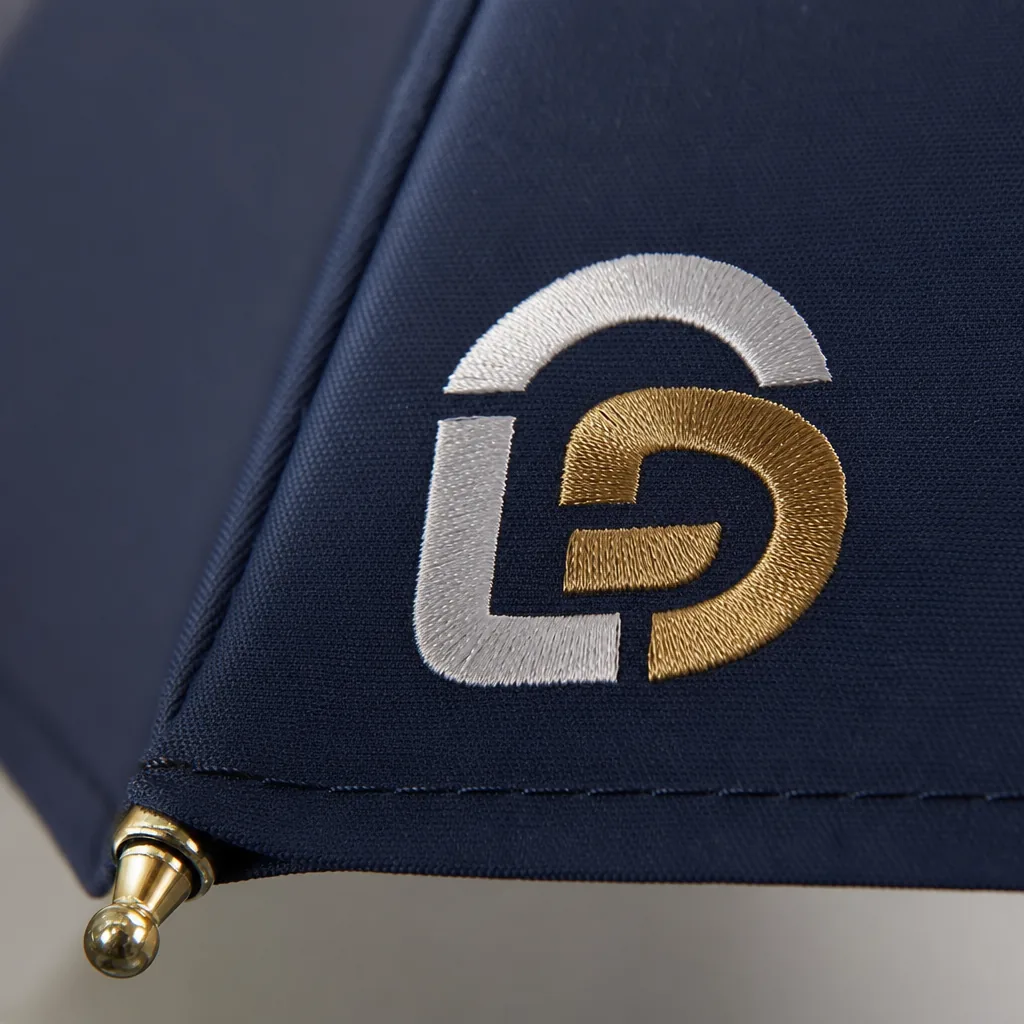
Logo details on handles and hardware look simple on a sample board, but in mass production they affect tooling cost, grip feel, plating yield, assembly speed, and rejection rates. For umbrella handle logo customization, the right choice between debossed, molded, and metal logos depends on the handle material, order volume, brand finish, and how the part will survive daily use. On our Songxia production floor, these decisions are made before mold cutting, not after the first failed batch.
Where Non-Printed Logos Can Be Added on an Umbrella
The safest non-printed logo zones are closed-position touchpoints: handle ends, push buttons, top caps, ferrules, sleeve zipper pulls, and flat badge areas molded into the grip. For umbrella handle logo customization, the handle end is usually the lowest-risk position because it stays visible in retail barrels and does not sit under the palm during use. A debossed logo umbrella handle works best on EVA foam, rubberized PP, PU-wrapped grips, and selected wooden handles, but artwork needs practical stroke width; fine serif letters and hairlines often disappear after texture graining, PU wrapping, or soft-touch coating. On 3-fold and 4-fold umbrellas, keep debossing shallow, typically 0.3–0.5 mm, so the grip does not feel rough in a coat pocket or handbag. On straight 23-inch sticks and 27-inch, 30-inch, or 68-inch arc golf umbrellas, larger handle diameters allow deeper debossing or an inserted badge with less impact on carry comfort.
Push buttons and runner buttons can carry branding, but they remain functional parts first. Auto-open and auto-open-close buttons need travel clearance, spring return, and comfortable thumb pressure; a raised logo must not reduce button travel or create a sharp edge. A molded logo umbrella parts design works best on larger oval buttons used on many 3-fold and 4-fold models. Small 12–15 mm buttons are poor candidates for full brand names because raised letters can cause flash, sink marks, weak plating coverage, or uneven ABS molding. On straight umbrellas, the push button is usually narrower and closer to the shaft, so a simple icon or single initial is safer than a wordmark. On golf umbrellas with EVA or TPR handles, the wider handle neck often supports a recessed side badge without weakening the auto-open trigger housing or rubbing the user’s hand.
Top caps, ferrules, zipper pulls, and molded badge zones are useful for branded umbrella hardware when the placement avoids ribs, shafts, and closure straps. A metal logo badge umbrella detail fits well on a side plate or handle end cap, commonly using aluminum, stainless steel, or zinc alloy held by adhesive plus a mechanical lip; adhesive alone can fail after container heat cycling and repeated wet-dry use. Ferrule logos suit straight and golf umbrellas, but edges must stay rounded and must not block tip insertion into floor stands. For compact folding umbrellas, the sleeve zipper pull is often the cleanest small-logo location because it avoids the opening mechanism entirely. At ZheBrella, we confirm badge thickness, edge radius, and exact placement during pre-production fitting, then run open-close cycling and carry-comfort checks before tooling approval, especially on 8K and 10K frames where runner clearance is tighter.
Debossed, Molded, and Metal Badge Options Compared
Debossing is the safest low-cost choice for EVA foam, rubberized straight grips, and soft-touch crook handles when the buyer needs durable umbrella handle logo customization without adding assembly risk. The effect is matte, recessed, and integrated into the grip, so it suits 23" auto-open promotional umbrellas and standard golf umbrellas where the logo must survive hand sweat, rain, and carton abrasion during ocean freight. It does not peel because there is no surface ink, foil, or adhesive layer. The limitation is resolution: bold letters, simple icons, and strokes above about 0.4 mm press cleanly; thin serif fonts, gradients, QR codes, and small legal copy should be moved to a hangtag, woven label, or canopy print. Tooling uses a heated brass or steel die, so setup cost is moderate, but unit cost falls quickly once production reaches several thousand handles.
Injection-molded logos work best on ABS handles, end caps, ferrules, tips, runner buttons, and other molded logo umbrella parts used across repeat programs. The logo can be raised or recessed in the plastic, giving a cleaner structural look than pad printing and better wear resistance because there is no ink layer to rub off. This method fits private-label SKUs that share the same branded umbrella hardware across 21" folding umbrellas, 27" stick umbrellas, or multiple canopy colors. It is not efficient for short-run promotions or artwork still under approval: once the steel mold is cut, changes require mold modification or replacement. Detail can exceed a debossed logo umbrella handle when the mold is polished well, but tight gaps, small counters, and very fine strokes may show plastic flow marks or inconsistent finishing.
A metal logo badge umbrella handle gives the most premium retail signal, especially on wood-look crook handles, PU-wrapped grips, zinc-alloy caps, or higher-spec 16K golf umbrellas with fiberglass ribs and 210T pongee canopies. Badges can be die-cast zinc alloy, stamped brass, aluminum, or stainless steel, with nickel, gunmetal, gold, black plating, enamel fill, or laser engraving. They reproduce sharp edges, small lettering, and multi-level relief better than debossing or standard injection molding, but they add material cost, assembly time, and inspection risk. Attachment is the failure point: pins, rivets, ultrasonic setting, or a properly specified adhesive are safer than low-grade glue, which can fail after container heat aging or repeated wet-dry cycles. ZheBrella pull-tests badges during pre-shipment inspection under AQL-based QC, commonly aligned to AQL 2.5 for major defects when the buyer spec allows.
Engineering Constraints Buyers Should Know Early
The first engineering limit in umbrella handle logo customization is feature survival, not artwork resolution. For a debossed logo umbrella handle in ABS or rubber-coated plastic, keep minimum strokes at 0.35–0.45 mm; on soft EVA, use 0.5 mm or wider because molded edges round off. Counters and internal gaps in A, O, R, and similar letters should stay above 0.4 mm, or they visually close after paint, oil spray, or soft-touch coating. A metal logo badge umbrella can carry finer detail when laser-etched on stainless steel, but stamped zinc alloy or aluminum needs bolder geometry: about 0.3 mm minimum raised detail and 0.8–1.0 mm clear spacing around the badge edge for adhesive, pins, or heat staking.
Curved handles distort logos before production defects even enter the picture. J-hooks, crook handles, and ergonomic grips with finger grooves stretch a flat PDF at the ends when wrapped around a 22–28 mm diameter surface. For molded logo umbrella parts, reduce logo width, flatten the branding zone in the handle CAD, or switch from a long wordmark to a shallow oval badge. Compact 3-fold handles create the tightest layout because the button, strap hole, end cap, shaft socket, and grip length leave only about 18–35 mm of usable branding width. Auto-open and auto-open-close handles add another constraint: the push button needs an unobstructed travel path, and placing a deboss, badge, or oversized button cap too close can require mold slides or inserts that raise tooling cost and weaken the button wall.
Lock the attachment method before sampling. Metal badges can use 3M adhesive, heat staking, small pins, or overmolding, but each option changes tooling, assembly time, and pull-test performance. On branded umbrella hardware for windproof frames, especially 23 inch and 27 inch umbrellas with fiberglass ribs and steel shafts, the handle sees higher torsion when the canopy inverts or snaps back during 35–50 mph gust testing. A thin badge across a curved stress zone can lift; a large button cap can interfere with the auto-open spring housing. ZheBrella reviews handle CAD, button diameter, shaft specification, and logo artwork together before quoting tooling, because a logo that works on a straight manual golf umbrella handle may fail on a short compact auto-open-close grip with crowded internal parts.
Tooling, Sampling, and Quality Control Requirements
Treat umbrella handle logo customization as hard tooling, not a standard print proof. Quote CNC engraving, injection-mold inserts, stamping dies, badge recess tooling, and any plating or paint setup separately from the umbrella unit price, with revision costs stated before PO release. A debossed logo umbrella handle, molded logo umbrella parts, or metal logo badge umbrella cannot be approved from a PDF, AI file, or Pantone callout alone; the buyer needs a physical pre-production sample to confirm logo depth, edge radius, badge fit, plating tone, gloss level, and hand feel. Sampling should cover tooling, first-shot or first-stamped parts, assembly on the actual 21", 23", 27", or 30" umbrella frame, and at least one mold or die correction if the mark is shallow, distorted, off-center, or loses readability after handle assembly.
Lock the QC standard before bulk production and inspect branded umbrella hardware under AQL 2.5. For badges, specify pull or pry tests to verify adhesive strength and mechanical locking; weak hot-melt glue, shallow recesses, and poor insert fit can fail under carton compression, humidity, or repeated opening cycles. Plated and painted parts require finish checks for color consistency, orange peel, pinholes, exposed base metal, fingerprints trapped under clear coat, and abrasion on high-touch edges. Final inspection should compare logo alignment to the approved sample and reject burrs on stamped badges, scratches on glossy handles, glue overflow, loose inserts, poor adhesion, and sharp edges that can catch fabric or skin. For molded logo parts, add checks for sink marks, short shots, flashing, uneven deboss depth, and logo readability after normal assembly pressure.
When Premium Component Branding Pays Off in B2B Programs
Premium component branding pays when the umbrella is reused, photographed, or resold; it rarely pays for a disposable event handout. Hospitality programs, VIP corporate gifts, licensed sports merchandise, and premium retail justify umbrella handle logo customization because the brand remains visible when the canopy is closed and stored at a concierge desk, boardroom, or retail shelf. A debossed logo umbrella handle works best on EVA, PU leather wrap, rubberized ABS, and wood handles when the buyer wants low-gloss, wear-resistant branding instead of bright canopy graphics. A metal logo badge umbrella suits luxury hotel loaner umbrellas, retail gift sets, and executive gifts, especially on 23" or 27" straight frames where the handle, runner, ferrule, tip cup, and end button are visible indoors. For budget conferences, spend the upgrade budget on the product spec: 190T or 210T pongee canopy printing, 8K fiberglass ribs over steel where wind risk matters, stronger shaft construction, or UPF 50+ / water-repellent coating.
The buying risk is not the logo idea; it is tooling approval. A screen-printed canopy logo can move quickly, while custom-molded or metal branded umbrella hardware typically adds 10–18 days for CAD review, sample making, mold adjustment, and buyer sign-off before bulk production. Zinc alloy or stainless-steel badges add stamping or die-casting, polishing, plating, adhesive testing, and salt-spray checks for coastal hotels or wet retail markets. Licensed merchandise needs tighter control than corporate gifting: final artwork, Pantone color, legal approval, component drawings, and attachment method should be frozen before the pre-production sample. Changing a canopy print can delay production; changing molded logo umbrella parts after the tool is cut can create scrap tooling, extra sampling cost, and missed ship dates. Treat the pre-production sample as the decision gate, not a formality.
Evaluate MOQ by component, not just by finished umbrella. A stock 21" auto-open folding umbrella may be workable at 500 pieces, but a custom-molded handle, runner badge, plated end button, or metal badge often needs 1,000–3,000 pieces to absorb mold cost, plating setup, and assembly fixtures. Under FOB Ningbo or Shanghai, the buyer controls freight and can consolidate cartons with other promotional items; under DDP, the supplier must price carton volume, duties, inland delivery, and delay risk if metal parts raise customs questions. Metal badges also add weight, which matters when air freight is used to hit an event deadline. These upgrades make sense for recurring corporate gifts, licensed programs, hotel retail, and premium retail lines where reorders spread tooling cost. For one-time low-budget promotions, keep components standard and specify AQL 2.5 inspection before shipment.
Frequently Asked Questions
Do metal logo badges increase the risk of failure on folding umbrellas?
They can if placement or attachment is not engineered for repeated handling. Buyers should confirm badge size, attachment method, and cycle testing on the actual folding handle before approving mass production.
Are debossed logos possible on all umbrella handles?
No. Debossing is most suitable on softer materials such as EVA or rubber-coated handle surfaces, while hard plastic handles often require molded detail, pad print, or an inserted badge instead.
What is the typical MOQ for debossed or molded logo umbrella handles?
For debossed or molded logos, MOQ is usually higher than standard printing because a dedicated mold or insert is required. Many factories start at about 1,000 to 3,000 pieces per handle style, depending on material and logo complexity.
Are metal logo badges suitable for folding umbrellas and golf umbrellas?
Yes, metal badges can be used on both folding umbrella handles and larger golf umbrella handles, but the badge size and curvature must match the handle shape. For compact handles, thin alloy plates or small round emblems are usually preferred to avoid added weight.
How long does tooling take for custom umbrella handle logos?
Tooling for debossed, molded, or metal logo details typically takes 7 to 15 days after artwork approval. Bulk production usually starts after a pre-production sample is confirmed, adding about 25 to 45 days depending on order quantity and component availability.
Looking to Launch Your Custom Umbrella Line?
ZheBrella is a Zhejiang-based OEM/ODM umbrella manufacturer with 17 years of export experience. Free design, low MOQ from 100 pieces, windproof construction, full-color print.
Get Free Quote Now »People Also Search For
Related Articles
Embossed, Debossed, and Molded Logos on Umbrella Parts
Compare embossed, debossed, and molded logo options on umbrella handles, buttons, and tips with MOQ, tooling, lead time,...
Read More »
Debossed, Engraved, and Molded Umbrella Logo Details Compared
Compare debossed, engraved, and molded logo details on umbrella components, with guidance on tooling cost, MOQ, durabili...
Read More »
Debossed, Molded, or Printed Umbrella Handles for Brand IDs
Compare debossed, molded, and printed handle branding for umbrellas, with MOQ, tooling, lead time, and durability tradeo...
Read More »