Debossed Logos on Umbrella Handles for Premium Branding
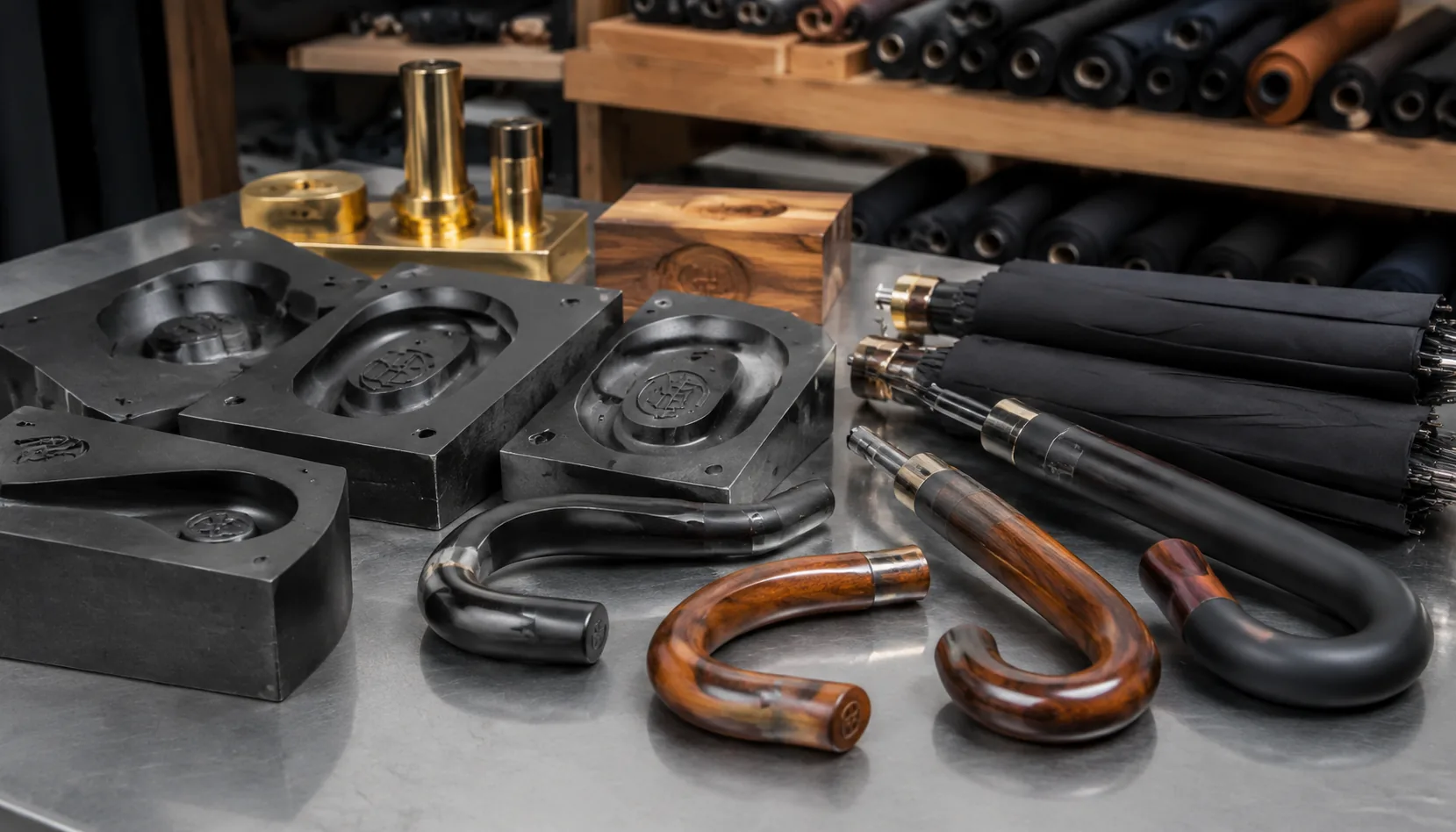
When buyers specify handle branding, they are usually balancing appearance, wear resistance, and production consistency. A debossed umbrella logo can solve that problem on wood, EVA, or plastic handles by giving the umbrella a premium tactile mark that survives daily use without adding fragile decoration. From the factory floor, the real challenge is matching the logo depth, mold tolerance, and material behavior so the mark stays clean at scale.
When handle branding fits premium programs
Retail private label buyers use handle decoration when the umbrella is meant to sit in hand, on a concierge desk, or in a gift box where the handle is the first thing the customer touches. Hotel amenity programs and executive gifts are the two cleanest use cases because the branding reads as premium without fighting the canopy artwork. A debossed umbrella logo on a wood or EVA handle is more discreet than canopy printing, and that restraint is exactly why it works for higher-end programs. In practice, handle branding for umbrellas makes sense when the brand wants a quieter look, a more permanent mark, or a version that still looks clean when the canopy is closed.
Typical placement zones are the outer shaft handle face, the side flat of a wooden grip, or a molded band area on a straight handle, depending on the geometry. For wood handle customization, the logo usually needs enough flat or gently curved surface to hold a clean debossed or embossed handle logo without tearing the grain or losing legibility; small details disappear fast on narrow profiles. Minimum order quantity is usually higher than basic canopy printing because the handle mold, laser jig, or engraving setup has to be locked in before production starts. OEM umbrella branding programs usually justify that cost when the same handle spec will repeat across multiple colors or SKUs.
The added value shows up when the umbrella is part of the product identity, not just a printed carrier for a campaign message. Premium retail lines, hospitality sets, and corporate gifts often use handle branding for umbrellas because the mark survives folding, packing, and long-term handling better than ink on fabric. On a 21-inch compact or a 23-inch stick umbrella, a debossed umbrella logo can make the item feel like a designed object instead of a commodity, especially if the canopy print is minimal or absent. If the buyer wants a loud full-surface graphic, canopy printing is cheaper; if the goal is perceived value and repeat use, the handle is where the branding earns its keep.
Debossing, embossing, and laser marking compared
Debossing gives the cleanest premium read when the handle material can actually hold a cavity: hard wood, dense EVA, and some coated plastics. A debossed umbrella logo has real tactile depth, so it catches light and feels intentional in the hand; that matters more than people think for handle branding for umbrellas because buyers touch the grip before they notice the canopy. Embossing is the opposite move: it raises the mark, which looks more decorative but is usually weaker under abrasion because high spots get polished down faster. Laser marking is the thinnest visual treatment, with no physical depth, so it works best when the goal is fine linework, variable data, or a subtle branded look rather than a heavy premium badge.
For substrate limits, wood handle customization is the easiest place to do true relief work. Straight-grain beech, maple, and similar hardwoods hold crisp edges if the cutter is sharp and the moisture is stable; soft or oily woods tend to fuzz or chip around the logo. EVA can take a debossed or embossed handle logo, but the depth has to stay shallow or the surface rebounds and softens the edge. Coated plastic is the most restrictive: if the coating is thin and the base resin is brittle, a deep press can crack the skin, so laser marking or a very light deboss is safer. In practice, OEM umbrella branding usually picks the method by grip shape first and by logo detail second.
Tooling and setup drive lead time more than the decoration itself. Debossing and embossing need a matched metal die or heated mold, plus a trial run to confirm depth, alignment, and release, so the first sample stage usually takes longer than laser marking. Laser setups are faster to start, but the mark contrast depends on the coating color, resin blend, and beam speed, so you still need sample approval before mass production. For repeat orders, the fastest path is a locked handle profile with existing tooling; for new shapes, expect extra days for mold machining, especially if the handle wall is thick or the logo wraps around a curved grip.
Material and finish choices that affect legibility
The first thing that changes a debossed umbrella logo is not the artwork; it is the handle material and finish. On a smooth ABS or PP handle, a shallow cut reads cleanly because the surface is uniform and light catches the recess consistently. Once you move to textured resin, matte rubber paint, or molded wood grain, the same artwork can lose edge definition fast because the tool mark disappears into the pattern. In handle branding for umbrellas, gloss also matters: high-gloss surfaces make shallow debossing look sharper at first, but fingerprints and wear can quickly flatten the contrast, while satin or matte finishes hold the visual boundary better for daily use.
For wood handle customization, grain direction and hardness are the real variables. Open-grain wood and soft coatings compress under the die more easily, which can give you a deeper-looking mark, but they also fuzz up at the edges if the pressure is wrong. Hard lacquered wood or dense painted handles usually need a stronger strike or a deeper relief to stay readable after use, especially on the curved sections near the ferrule or tip. That is why an embossed handle logo can look fine on a press sample and still underperform in production if the relief is too shallow or the radius is too tight for the tooling.
Our standard practice is to approve a physical sample before mass production, then lock the depth, placement, and surface treatment against that sample. On OEM umbrella branding jobs, we check the first articles under normal lighting and again after handling, because a debossed umbrella logo that looks sharp in the photo can vanish once the surface picks up scuffs or hand oils. For bulk inspection, AQL 2.5 is the practical floor for cosmetic consistency on handle marks; if the logo is critical to the order, we usually tighten the acceptance criteria on depth, alignment, and edge crush rather than relying only on visual appearance.
How to pair handle branding with canopy graphics
The cleanest way to treat a debossed umbrella logo is to make the handle do quiet work while the canopy carries the message at a distance. On a 23" or 27" stick umbrella, I usually keep the handle mark smaller than the canopy logo and use the same icon shape or wordmark proportions, so the product reads as one system instead of two unrelated placements. With 8K or 10K panels, a one-color canopy print is easier to coordinate because the eye does not have to process too many tones; that is especially true when the handle branding for umbrellas is a debossed impression on wood or a shallow embossed handle logo on EVA or PU. OEM umbrella branding works best when the handle treatment matches the canopy palette by intent, not by accident.
If the canopy uses a strong contrast trim, the handle should echo that contrast in a controlled way. A black logo on a silver-coated pongee canopy can be paired with a dark-stained wood handle customization, while a navy canopy with white piping looks more cohesive with a deeper deboss and a matte ferrule in the same metal finish. Matching ferrules matter more than buyers think: a brushed nickel ferrule beside a nickel cap and a monochrome canopy print looks finished; a bright gold ferrule under a cool gray canopy usually reads as a mismatch. For premium programs, I prefer one-color logos on the canopy and a restrained debossed umbrella logo on the handle, because that keeps recognition high without making the product feel busy.
The practical rule is to coordinate visibility by viewing distance. The canopy logo should be legible from 3 to 5 meters, while the handle mark should reward the hand at arm’s length, so both placements support recognition without competing. On larger 30" golf umbrellas, a slightly bigger canopy mark and a deeper handle impression can share the same brand cues; on compact folding models, the handle artwork should be even simpler, because the panel count and seam breaks already fragment the visual field. If the brand uses a specific accent color, repeat it in the canopy edge binding, tie strap, or ferrule ring rather than forcing a second logo treatment. That is the difference between thoughtful OEM umbrella branding and random decoration: one message, two touchpoints, no visual noise.
Ordering specs buyers should lock before production
For a debossed umbrella logo, the first thing to lock is the handle substrate, because the marking method behaves very differently on ABS, EVA, rubberized TPR, PU, and real wood. A debossed mark on a smooth polymer handle can stay crisp at the mold line, while wood handle customization needs tighter control over grain, moisture, and lacquer, or the impression will look uneven after finishing. Buyers should also specify whether they want a true deboss, an embossed handle logo, laser etching, pad print, or a metal insert; those are not interchangeable, and the tooling and scrap risk change fast once the handle diameter drops below 30 mm.
Artwork is the next failure point in OEM umbrella branding. Send vector files in AI, EPS, or editable PDF with exact Pantone references, logo depth, and placement dimensions measured from the top of the handle or the ferrule side if the handle shape is asymmetrical. Confirm pack-out at the same time: individual polybag, hangtag, barcode label, master carton count, and whether the branded handles need scratch protection during transport. If the buyer wants a premium presentation, pre-production samples are worth the extra 5 to 10 days because they expose alignment, fill, and surface-finish issues before the factory cuts production tooling.
Commercial terms should be written down before the first sample is approved: MOQ, target unit price, FOB or DDP responsibility, destination port or warehouse, and the lead time in calendar days, not vague weeks. For handle branding for umbrellas, a small variation in resin hardness or wood density can shift the impression depth enough to trigger rework, so the sample should be checked under the same lighting and carton configuration used for shipment. ZheBrella’s standard practice is to tie sample approval to a signed spec sheet with photo references, which reduces disputes on batch consistency and keeps the production run from drifting away from the agreed debossed umbrella logo.
Frequently Asked Questions
Which handle materials are easiest to brand cleanly?
Wood usually gives the most premium debossed or laser-marked result, while coated plastic can work well for laser or pad print. EVA is softer, so deep relief is usually less consistent and should be tested with a sample first.
Does handle branding increase production time?
Yes, it can add tooling, setup, or sampling time depending on the method. Buyers should expect extra lead time for first orders and confirm whether the factory can support the decoration method at the requested MOQ.
What handle materials work best for debossing or embossing on umbrellas?
Wood handles are the most common choice for debossing or embossing because they hold detail well and give a premium look. EVA and some plastic handles can also be branded, but the result depends on the material hardness and mold design.
What is the typical MOQ for custom handle branding on OEM umbrellas?
MOQ is usually tied to the umbrella model and handle tooling, but branded handle production often starts around 500 to 1,000 pieces per design. If a new mold or engraving tool is needed, the minimum may be higher.
Does debossed handle branding affect lead time?
Yes, it usually adds a small setup step for tooling or mold preparation. For most OEM projects, expect about 7 to 15 extra days if the handle requires new branding tooling.
Looking to Launch Your Custom Umbrella Line?
ZheBrella is a Zhejiang-based OEM/ODM umbrella manufacturer with 17 years of export experience. Free design, low MOQ from 100 pieces, windproof construction, full-color print.
Get Free Quote Now »People Also Search For
Related Articles
Debossed and Embossed Branding for Premium Umbrella Handles
Compare debossed and embossed handle branding for premium umbrellas, including tooling, MOQ, tactile finish, and cost im...
Read More »Embossed Handle Logos on Umbrellas: OEM Options and Limits
Compare embossed, debossed, and molded handle logo options by material, MOQ, tooling, and lead time to choose a workable...
Read More »Embossed, Debossed, and Molded Logos on Umbrella Parts
Compare embossed, debossed, and molded logo options on umbrella handles, buttons, and tips with MOQ, tooling, lead time,...
Read More »