Custom Umbrella Handle Tooling and Mold Cost Guide
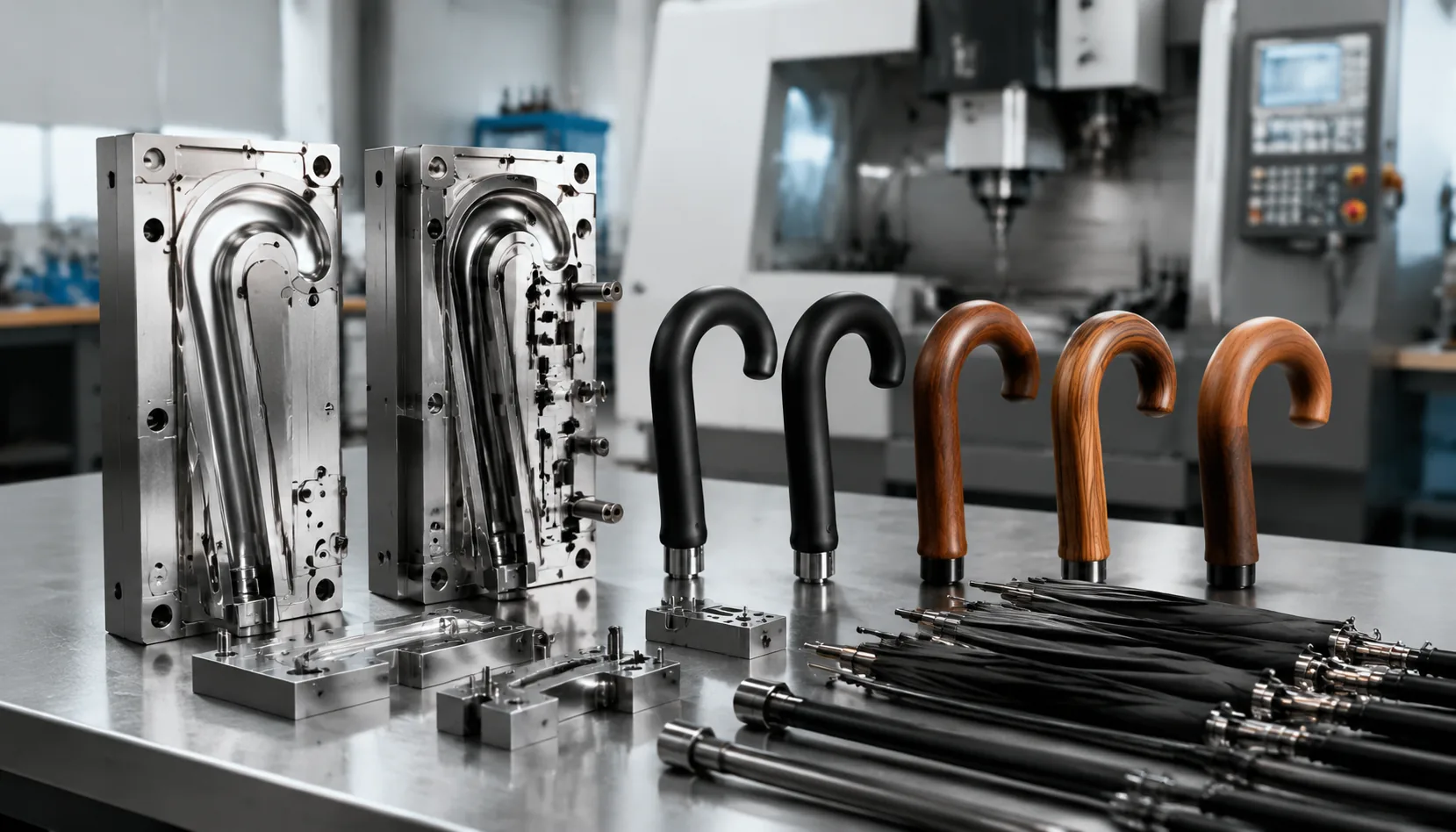
A branded handle can look simple on a rendering, but the real cost is decided by parting lines, shrinkage, insert fit, polishing level, and how many trial shots it takes before the grip feels right in hand. On our Songxia factory floor, custom umbrella handle tooling is where buyers most often underestimate lead time, MOQ pressure, and approval risk. Before you pay a mold fee, you need to know what the tool must prove in sampling and QC.
When Custom Handle Tooling Makes Sense
Custom umbrella handle tooling makes sense only when the handle changes the buyer’s sell-through, not just the drawing. For most promotional orders under 3,000 pieces, a stock ABS, PP, EVA, or rubberized straight handle is the correct choice; spend the budget on 190T/210T pongee, fiberglass ribs, better printing, or AQL 2.5 inspection instead. A logo insert, metal badge, or epoxy dome on an existing J-handle or straight handle usually covers corporate gifts, conferences, and retail private label runs from 500 to 5,000 pieces. If the buyer wants a nicer hand feel, soft-touch coating on a stock mold is cheaper than new tooling and works well on 21" and 23" folding umbrellas, 27" golf umbrellas, and auto-open models where the grip is visible but not the main product story.
Fully molded umbrella handles are worth considering when the handle shape must be proprietary: a mascot shape, bottle-shaped grip, ergonomic retail handle, color-matched brand form, or custom branded handles that need to be recognizable without reading the canopy print. The umbrella handle mold cost normally starts around USD 800–1,500 for a simple single-color ABS or PP handle mold, while a more complex two-shot TPR overmold, textured grip, or internal screw-post structure can reach USD 2,000–5,000 before sampling. Buyers should also budget 10–18 days for 3D drawing confirmation, 15–25 days for CNC tooling and EDM work, and another 7–10 days for T0/T1 samples, fit testing, and color correction before mass production starts.
A practical amortization rule is simple: below 5,000 pieces, avoid custom umbrella handle tooling unless the handle is the campaign centerpiece; from 5,000–10,000 pieces, a simple OEM umbrella handle design can make sense if the same mold will be reused; above 20,000–30,000 pieces, tooling cost becomes small enough per unit to justify custom geometry, especially for retail programs. For molded umbrella handles, we check balance with the full frame, not the handle alone: a heavy grip on a 10K steel-rib stick umbrella can feel stable, but the same handle on a 21" auto-open-close compact may make the product butt-heavy. Our standard practice at ZheBrella is to approve handle samples together with the frame, shaft, runner, and canopy so the final umbrella opens cleanly, passes drop testing, and still packs within the carton dimensions quoted for FOB or DDP pricing.
Common Handle Materials and Finishes
ABS is the workhorse for molded umbrella handles because it gives clean detail, stable color, and a solid hand feel without making a 21" or 23" folding umbrella feel tail-heavy. For promotional and retail orders, I usually recommend ABS when the buyer wants a precise logo plate, metallic spray finish, piano-black gloss, or soft-touch rubberized coating. PP is cheaper and tougher against cracking, but it feels lighter and less premium; it also shows sink marks more easily if the wall thickness around a curved J-handle is not controlled. When buyers compare umbrella handle mold cost, ABS and PP tooling can look similar at first, but ABS often saves trouble later because texture, color matching, and assembly tolerances are more predictable in mass production.
EVA is not a hard molded handle in the same way as ABS or PP; it is a foam grip, usually used on golf umbrellas, kids’ umbrellas, and outdoor styles where comfort matters more than sharp cosmetic lines. A 27" or 30" straight umbrella with 8K or 16K fiberglass ribs benefits from EVA because the soft grip reduces hand fatigue, especially in rain-and-wind use. Rubberized coating over ABS gives a similar comfort upgrade, but coating quality must be controlled: cheap oil-spray coatings get sticky after warehouse aging, especially in hot containers during FOB or DDP shipment. For custom umbrella handle tooling, we specify coating adhesion tests and abrasion checks before approving bulk production, because a handle can pass appearance inspection and still fail after three months on a retail shelf.
Wood-look plastic is a good compromise for fashion umbrellas: it keeps the weight and molding consistency of ABS while giving a maple, walnut, or bamboo-style appearance through water-transfer printing or grain texture in the mold. Real wood feels warmer and more premium, but it is better suited to straight umbrellas than compact folding frames because the added weight can make a 3-fold auto-open-close umbrella feel unbalanced. Real wood also introduces moisture movement, color variation, and extra polishing labor, so AQL 2.5 inspection must define acceptable grain differences clearly. For OEM umbrella handle design and custom branded handles, our standard practice at ZheBrella is to match the material to the frame first: compact umbrellas need lightweight molded umbrella handles, while straight executive or golf umbrellas can carry heavier wood, EVA, or larger ergonomic shapes without hurting usability.
Mold Development and Sampling Workflow
A handle project should start with a locked 3D drawing, not a photo and a loose sketch. For OEM umbrella handle design, we normally ask the buyer to confirm hand length, grip diameter, shaft hole size, runner clearance, button position, and whether the handle fits a 21" folding umbrella, 23" straight umbrella, or 27" golf umbrella. A plastic J-handle, rubberized crook, EVA foam grip, and ABS pistol grip all need different wall thickness and parting-line planning. If the handle carries a metal badge, injected logo, or recessed print panel, that must be built into the CAD before mold cutting. Good custom umbrella handle tooling avoids sharp internal corners, thin ribs under 1.2 mm, and logo areas placed where fingers rub during open-close testing. Once the 3D file is approved, we usually make an SLA or CNC prototype so the buyer can check hand feel before paying for steel.
Prototype confirmation is where many umbrella handle mold cost disputes are prevented. A resin sample can show the silhouette, logo scale, and ergonomics, but it cannot fully represent final ABS, PP, TPR, or rubber-coated texture. For molded umbrella handles, we check the prototype against the umbrella frame: shaft insertion depth, rivet hole alignment, pull strength, spring-button exposure, and whether the canopy tie strap or sleeve catches on the grip. If the buyer wants custom branded handles, we mark the logo position on a physical sample and confirm whether the logo will be raised, debossed, pad printed, laser engraved on a metal plate, or heat-transferred onto a flat panel. Our standard practice at ZheBrella is to photograph the handle from front, side, bottom, and assembled-on-frame views before mold release. This prevents the common problem where a beautiful handle looks correct alone but sits crooked after final assembly.
After sign-off, the factory cuts either a CNC aluminum sample tool for low-volume validation or a hardened steel injection mold for mass production. Simple straight ABS handles may need 10 to 15 days for tooling, while complex two-material TPR-over-ABS handles often take 20 to 30 days because shrinkage and gate location are harder to control. First-shot samples usually arrive 2 to 4 days after mold trial, then we check flash, sink marks, color matching, logo sharpness, shaft fit, torque strength, and drop resistance. If the handle is part of a full umbrella order, we also assemble samples on 8K or 10K frames and run open-close cycling before buyer approval. Typical custom umbrella handle tooling plus sampling lead time is 18 to 35 days, depending on cavity count, material, surface texture, and revision rounds. Mold modification is normal, but changing the basic grip shape after first shot can add another 7 to 12 days.
MOQ, Unit Cost, and Production Risks
Custom molds push MOQ higher because the factory has to amortize CNC machining, EDM work, polishing, texture treatment, and trial shots before the first sellable handle exists. For a simple straight EVA or PP hook handle, we may accept 1,000–2,000 pcs if the buyer pays the full umbrella handle mold cost separately. For a complex ABS, rubberized TPR, or two-color overmolded grip, 3,000–5,000 pcs is more realistic, and some mechanisms need 10,000 pcs to make the unit price sensible. Color minimums are separate from umbrella MOQ: one Pantone-matched handle color usually needs 500–1,000 pcs because resin purging wastes material and machine time. Molded umbrella handles with metallic paint, soft-touch coating, or wood-grain transfer add another process, so the price gap versus a stock black J-handle can be $0.20–$1.20 per umbrella depending on weight, finish, and rejection rate.
The hidden cost in custom umbrella handle tooling is not only the steel mold; it is the scrap created while the handle, shaft, runner, button, and end cap are brought into tolerance. A handle that looks good in a rendering can crack at the shaft socket if the wall thickness drops below about 2.2–2.5 mm, or it can twist under load on a 27" or 30" golf umbrella with fiberglass ribs. Trial production normally carries 3%–8% handle scrap until injection temperature, gate position, shrinkage, and insert fit are corrected. On production orders we still price in 1%–3% loss for molded umbrella handles, higher if the buyer wants high-gloss white, transparent resin, or tight logo alignment. Our standard practice at ZheBrella is to approve a T1 sample, then run a small pilot before cutting canopy fabric, because a bad handle can delay the whole 25–45 day lead time.
Auto-open buttons and wrist straps must be engineered into the OEM umbrella handle design from the beginning, not drilled in after molding. For manual umbrellas, the handle mainly needs a secure shaft bore, pin hole, and comfortable grip angle. For auto-open or auto-open-close frames, the button seat must align with the runner spring, latch travel, and shaft diameter; a 1 mm mismatch can cause weak release, false triggering, or button sticking after AQL 2.5 drop testing. Wrist straps also need a reinforced slot or metal eyelet boss, especially on compact 21" folding umbrellas where the strap carries the product during retail handling. Custom branded handles are worth the mold investment when the order will repeat, the logo shape is part of the brand identity, or the buyer wants retail differentiation. For one-off events, a stock handle with pad print, laser logo, or heat-transfer badge is usually lower risk and faster under FOB or DDP timelines.
Quality Checks for Molded Handles
Before shipment under FOB or DDP terms, the inspection has to match the buyer’s risk, not just the umbrella handle mold cost. We use AQL 2.5 for major defects and tighter internal screening for cracking, loose handles, blocked buttons, visible color mismatch, wrong logo position, and sharp burrs. OEM umbrella handle design projects should include drop checks from 80–100 cm, because brittle ABS handles can pass visual inspection but crack at the screw boss or shaft socket after carton vibration. Inspectors pull samples across all production lots, not only the top cartons, and separate defects by molding, decoration, and assembly cause. If handles are packed onto finished 21", 23", 27", or 30" umbrellas, we also check carton compression, polybag scuffing, and moisture exposure before releasing the shipment documents. That matters for DDP orders because a handle defect found after customs clearance is far more expensive than rejecting one molding lot in Songxia.
Frequently Asked Questions
Can a custom handle be used on both folding and straight umbrellas?
Sometimes, but shaft diameter, runner travel, and auto-open button position often differ. A handle should be engineered for the specific frame type before mold approval.
Who owns the umbrella handle mold after production?
Ownership depends on the purchase agreement. Buyers paying the full tooling fee should request written mold ownership terms, storage conditions, and rules for exclusive use.
What mold fee should buyers budget for a custom umbrella handle?
A basic plastic umbrella handle mold typically costs about $800–$2,500, while complex ergonomic, two-color, rubber-coated, or metal-insert designs can range from $3,000–$6,000 or more. The final fee depends on handle size, cavity count, surface texture, logo method, and expected production volume.
How long does custom umbrella handle tooling and sampling usually take?
After 3D artwork approval, tooling usually takes 20–35 days, followed by 5–10 days for first samples. Buyers should allow extra time for fit testing with the shaft, pull-force checks, color matching, and any mold adjustments before mass production.
What MOQ is practical for a new molded umbrella handle design?
For a new private mold, most factories prefer 3,000–5,000 umbrellas per handle style to spread the tooling cost efficiently. Lower quantities may be possible, but the unit cost is higher and the buyer normally still pays the full mold fee upfront.
Looking to Launch Your Custom Umbrella Line?
ZheBrella is a Zhejiang-based OEM/ODM umbrella manufacturer with 17 years of export experience. Free design, low MOQ from 100 pieces, windproof construction, full-color print.
Get Free Quote Now »People Also Search For
Related Articles
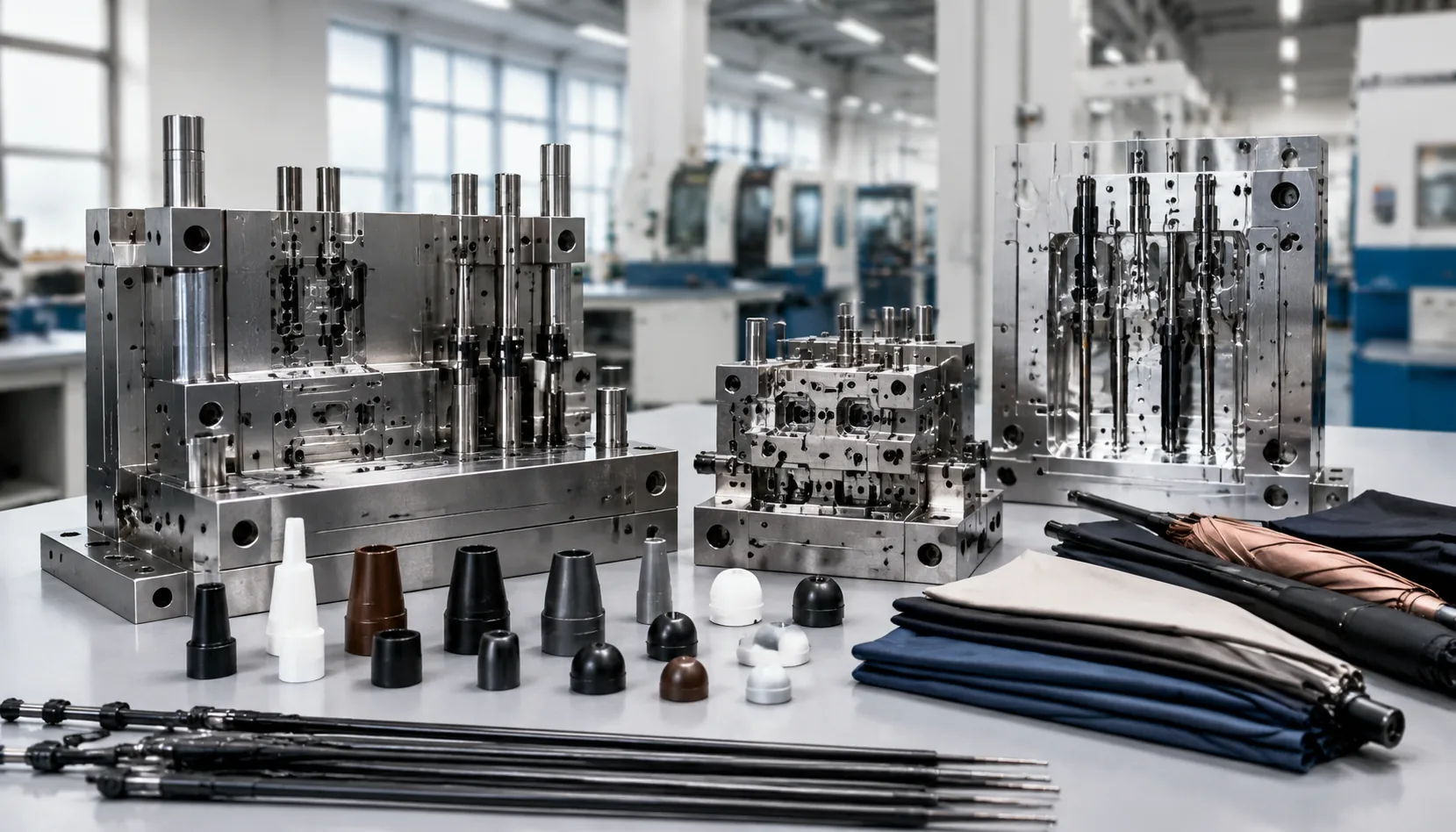
Umbrella Mold Tooling for Custom Tips, Runners, and Caps
Plan custom umbrella plastic parts with tooling costs, resin choices, color matching, MOQ, sample timing, and QC checks ...
Read More »
Umbrella Handle Materials for OEM Orders: Grip, Cost, and Durability
Compare ABS, EVA, TPR, and wood umbrella handles by grip, tooling cost, MOQ, and durability so buyers can match spec to ...
Read More »
Umbrella Handle Manufacturing: Materials, Molds, and Finishes
Compare molded, wood, and metal handles, plus overmolding, soft-touch grips, and finish choices that affect comfort, bra...
Read More »