Umbrella Handle Manufacturing: Materials, Molds, and Finishes
For buyers evaluating umbrella handle manufacturing, the real challenge is balancing hand feel, durability, branding, and unit cost without pushing MOQ beyond what the program can support. On the factory floor, the decision usually comes down to how the handle is formed, what substrate it uses, and which finish will survive daily grip, UV exposure, and packing. Small changes in mold design, overmolding, or coating can shift both user comfort and production yield.
Handle Materials and Where They Fit
In umbrella handle manufacturing, the material choice is not cosmetic; it determines tooling cost, hand feel, breakage rate, and how much post-processing you need before the handle is ready for packing. ABS is the workhorse for injection molding because it fills cleanly, takes color well, and gives a rigid, polished surface at a reasonable cost. PP is cheaper and lighter, but it feels less substantial in the hand and can flex more than buyers expect, so I only use it when the program is price-driven and the design is simple. For OEM umbrella parts, ABS and PP are the first two materials we quote because they let us control cycle time and mold life without pushing unit cost out of range.
TPR and EVA sit in a different lane. They are better when the buyer wants a soft-touch grip or a more comfortable palm feel on compact and golf umbrellas, especially for retail programs where the handle is part of the perceived quality. TPR gives better tack and a more premium touch, but it can mark more easily and usually costs more to mold and finish. EVA is lighter and softer, useful for a cushioned grip, but it is not the most durable choice if the handle will be handled roughly in transit or stored under heat. For high-volume promotional work, ABS with a simple matte handle finish is usually the safest balance; for premium retail umbrellas, I would move to TPR over PP every time if the budget allows.
Wood and aluminum are the opposite end of the spectrum. A wood handle adds warmth, weight, and a more traditional retail look, but it needs tighter control on sanding, sealing, and moisture content or you get cracking and uneven staining. Aluminum handles look clean and modern, and they hold up well structurally, but they can feel cold and slippery unless you add a coating or pair them with a grip insert. In umbrella handle manufacturing, the right answer is usually program-specific: high-volume promotional umbrellas should stay with injection-molded ABS or PP to protect margin, while premium retail umbrellas can justify wood, TPR, or aluminum because the customer is paying for feel as much as function. Our standard practice at ZheBrella is to match the material to the target retail price first, then choose the mold and finish from there, not the other way around.
Injection Molding and Overmolding Process
In umbrella handle manufacturing, mold design is where most quality problems are either prevented or locked in. The cavity has to account for wall thickness, rib transitions, and the way the part will cool, because a 1.5 mm difference can show up as sink marks, ovality, or a loose fit on the shaft tube. Gate location matters more than most buyers expect: if the gate sits in the wrong place, flow lines run across the visible face, the logo area distorts, or the underside pulls unevenly during cooling. For injection molding, we usually put the gate where it can be trimmed cleanly and where shrinkage pulls away from the cosmetic surfaces instead of toward them. With OEM umbrella parts, the mold also has to match the internal metal insert or push-button geometry so the handle does not crack during assembly or long-term use.
For a soft-touch grip or two-tone handle, the process is usually a hard inner substrate first, then overmolding with TPR, TPU, or a similar elastomer to build the tactile layer. The first shot has to be dimensionally stable, because the second shot depends on precise interference and surface keying for adhesion. If shrinkage is not controlled, the outer layer can rotate, delaminate, or leave a visible witness line where the materials meet. On a real production line, we check cooling time, mold temperature, and packing pressure together, because changing only one of them rarely fixes the problem. ZheBrella treats this as standard umbrella handle manufacturing practice for higher-volume programs, especially when the buyer wants a soft-touch grip that still survives repeated open-close cycles and bag abrasion.
Logo relief, matte finish, and a molded wrist strap loop all change the tooling, not just the decoration step. A raised logo needs deeper engraving in the mold steel and more careful draft so the text releases cleanly without dragging the edges. A matte handle finish is usually controlled by cavity texture rather than post-processing, because sanding or spray coating adds cost and creates inconsistency across batches. If the buyer wants a molded wrist strap loop, the mold needs a bridge feature or side action so the loop forms without weak flash lines at the base. For umbrella handle manufacturing, those details affect cycle time, reject rate, and final hand feel. When the handle is part of a larger OEM umbrella parts package, we also check color match, shrink tolerance, and assembly clearance before approving the handle finish for mass production.
Ergonomics, Balance, and User Comfort
In umbrella handle manufacturing, the first mistake is treating the handle as decoration. Diameter and palm shape decide whether a user trusts the umbrella in wind and rain. For most manual and auto-open models, a round or slightly oval grip around 28-34 mm at the widest point works well, with a narrower neck around 22-24 mm so the fingers can close without strain. A handle that is too thin forces a pinch grip; too thick and the wrist rotates outward, which becomes noticeable on 23" and 27" canopies. On the factory floor, we check how the hand lands during the first 5 seconds of use, because that is when people decide if the umbrella feels stable or awkward. A proper handle finish should also break the edge at the cap, button, and shaft junction so the user does not feel a hard transition under load.
Balance is the second part that people underestimate. A light canopy on a heavy shaft can still feel clumsy if the handle sits too low or if the center of gravity is far forward, especially on double-canopy vented windproof frames with fiberglass ribs and reinforced steel tips. Auto-open and auto-open-close umbrellas need a handle profile that lets the thumb find the release button without twisting the wrist, while manual umbrellas can tolerate a simpler J-hook or straight cane shape. For heavier constructions, I usually want a slightly longer grip area, about 95-115 mm of usable palm contact, so the hand can shift during gusts instead of locking in one position. In umbrella handle manufacturing, this is where the part either supports the frame or makes the whole product feel cheap.
Slip resistance is not a cosmetic choice; it is a safety issue when the canopy is wet and the user is carrying bags or riding in traffic. A soft-touch grip with shallow ribs, matte overmold texture, or a fine sand finish gives better control than a glossy surface, especially on injection molding parts made from ABS, PP, or TPR overmold combinations. For OEM umbrella parts, the handle finish has to match the expected use: a wood handle gives a warmer feel and better perceived value, but it must be sealed properly so sweat and water do not swell the grain or crack the lacquer. Our standard practice is to test with wet-glove handling and repeated open-close cycles, because a grip that feels fine in a dry showroom may fail in real weather. The right texture does more than improve comfort; it reduces hand fatigue and keeps the umbrella aligned with the shaft instead of letting it spin under load.
Decorative Finishes and Brand Customization
In umbrella handle manufacturing, finish selection matters as much as the base material because the handle is the first part buyers touch and the first part that gets scuffed in transit. For injection molding on ABS, PP, or TPR overmolds, a spray coating can improve color depth and hide gate marks, while a UV lacquer adds a harder outer film that holds gloss better after carton compression and rubbing against other OEM umbrella parts. On wood handle jobs, stain is not decoration only; it controls pore contrast, hides filler lines, and changes how the grain reads under retail lighting. Our standard practice is to test sample sets after carton drop and rub checks before approving a production finish, because what looks good on a bench can look tired after 300 pieces are packed tight and shipped.
Electroplating is the right choice when the buyer wants a metal look on a plastic handle, but it has to be matched to the environment. A bright chrome or nickel-like finish gives strong shelf appeal, yet scratch resistance depends on the base prep, the primer stack, and how well the layer cures; a cheap plate will show handling marks quickly. For coastal or humid markets, salt-spray performance is not a cosmetic detail, because poor plating will haze, pit, or lift at edges long before the canopy fabric wears out. If the design needs a soft-touch grip, the surface treatment must be planned around the elastomer texture so the coating does not turn sticky or glossy in hot storage. That is the part many umbrella handle manufacturing projects get wrong: they choose a finish from a photo, not from the shipping and use conditions.
Branding is usually done with pad print or laser marking, and the right method depends on the handle geometry and the finish stack. Pad print works well on curved injection-molded handles and allows color logos, but the ink needs proper curing or it will abrade where fingers and bags constantly rub. Laser marking is cleaner for metal-look parts, painted surfaces, and some wood handle styles because it does not add a layer that can chip off; the mark is part of the surface rather than sitting on top of it. For premium OEM umbrella parts, I prefer laser on dark coatings and pad print on bright, smooth finishes where the logo must stay visible from retail distance. The practical test is simple: if the carton gets shaken and the handles still look even, readable, and free of scuffs, the finish stack was specified correctly.
QC Checks, MOQ, and Tooling Implications
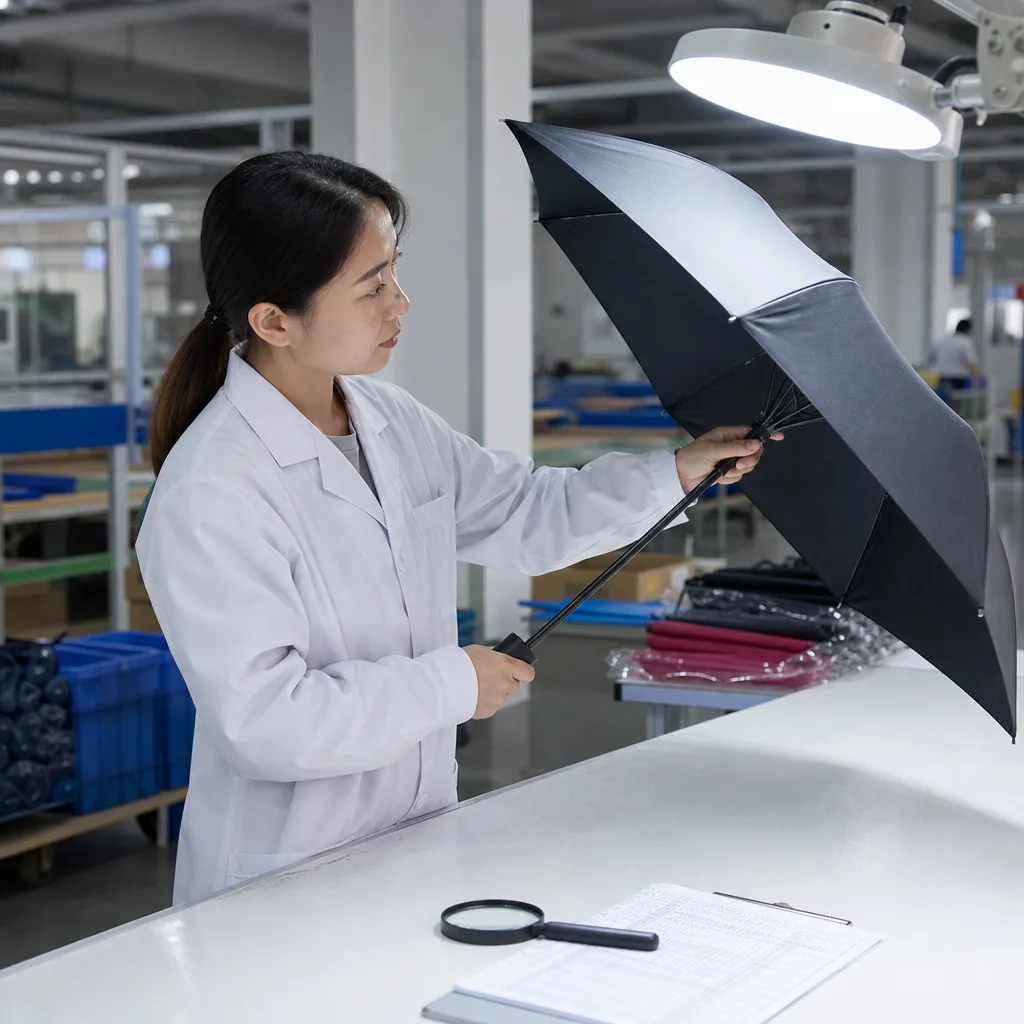
In umbrella handle manufacturing, the first approval gate is visual and tactile, not theoretical. We check color match against the signed standard under daylight and under shop lights, because molded ABS and PP will shift differently with pigment load and batch temperature. Then we look for flash at the parting line, sink marks around thick sections, and any knit lines that show up near the hook or neck. Odor matters more than many buyers expect, especially on soft-touch grip parts, TPR overmolds, and EVA sleeves; if the resin or release agent is off, the complaint comes back as a “bad smell” claim after packing. Grip firmness is another hard point: a soft-touch grip should compress slightly but not rotate on the core, and logo placement has to stay centered after trimming and assembly, not just in the mold cavity.
Custom molds change the economics fast. A standard injection molding handle with an existing cavity can usually move into sample production in about 7 to 10 days, but a new mold, especially with side-action inserts or hidden screw bosses, is more like 20 to 30 days before stable samples. Mixed-material builds push MOQ higher because the factory has to coordinate separate shots, inserts, or post-assembly steps; a wood handle with metal ferrule, or an overmolded soft-touch grip on a rigid core, adds both tooling complexity and scrap risk. For OEM umbrella parts, the unit price is driven less by raw material cost than by mold structure, cycle time, and how many manual steps are still needed after ejection.
The practical QC sequence is simple: first article approval, pilot run, then AQL 2.5 inspection on the mass order. On the floor, we check whether the handle locks correctly into the shaft, whether the insert hole holds tolerance after cooling, and whether the finish survives friction and alcohol wipe tests if the buyer wants a matte or rubberized handle finish. A wood handle needs separate checks for grain cracks, moisture content, and varnish uniformity; an injection-molded one needs gate marks, color drift, and dimensional repeatability from cavity to cavity. If the design includes a branded insert, laser mark, or metal badge, the logo position must be approved after full assembly, because a perfect loose part can still be wrong once the ferrule, cap, or connector is pressed in.
Frequently Asked Questions
Which handle material is best for a low-risk bulk order?
ABS or PP is usually the safest choice for tooling cost and consistency. If the order needs a softer feel, TPR overmolding works well, but it adds tooling complexity and usually increases MOQ.
Can a factory make the same handle shape in both wood and plastic?
Usually not with the same tooling method. Wood handles are turned or machined, while plastic handles are injection molded, so the structure, finish, and cost stack are different even if the exterior shape looks similar.
What MOQ is typical for custom umbrella handles with a new mold?
For injection-molded handles, factories often set MOQs around 500 to 1,000 pieces per style after tooling is approved. If the handle uses a new mold, tooling is usually quoted separately and sample delivery is often 7 to 10 days after mold completion.
How long does it take to develop a new umbrella handle finish?
A standard finish change, such as matte, gloss, or soft-touch coating, usually adds 5 to 15 days after sample approval. If you need special plating, painting, or wood staining, allow extra time for color matching and curing.
Which handle type is best for a private-label umbrella line?
For branded retail umbrellas, injection-molded handles with overmolded soft-touch grips are usually the most flexible because they support custom shapes, color matching, and logo placement. Wood handles work better for premium positioning, but they typically have tighter finish consistency requirements and higher material cost.
Looking to Launch Your Custom Umbrella Line?
ZheBrella is a Zhejiang-based OEM/ODM umbrella manufacturer with 17 years of export experience. Free design, low MOQ from 100 pieces, windproof construction, full-color print.
Get Free Quote Now »People Also Search For
Related Articles
Umbrella Handle Overmolding: Grip Design, Tooling, and Cost
Understand how overmolded umbrella handles are made, what tooling adds to cost, and how grip design affects durability a...
Read More »
Injection-Molded Umbrella Parts: Runners, Tips, and Caps
Understand how injection-molded runners, tips, caps, and buttons are specified, tooled, and checked to reduce defects in...
Read More »
Umbrella Handle Materials for OEM Orders: Grip, Cost, and Durability
Compare ABS, EVA, TPR, and wood umbrella handles by grip, tooling cost, MOQ, and durability so buyers can match spec to ...
Read More »