Injection-Molded Umbrella Parts: Runners, Tips, and Caps
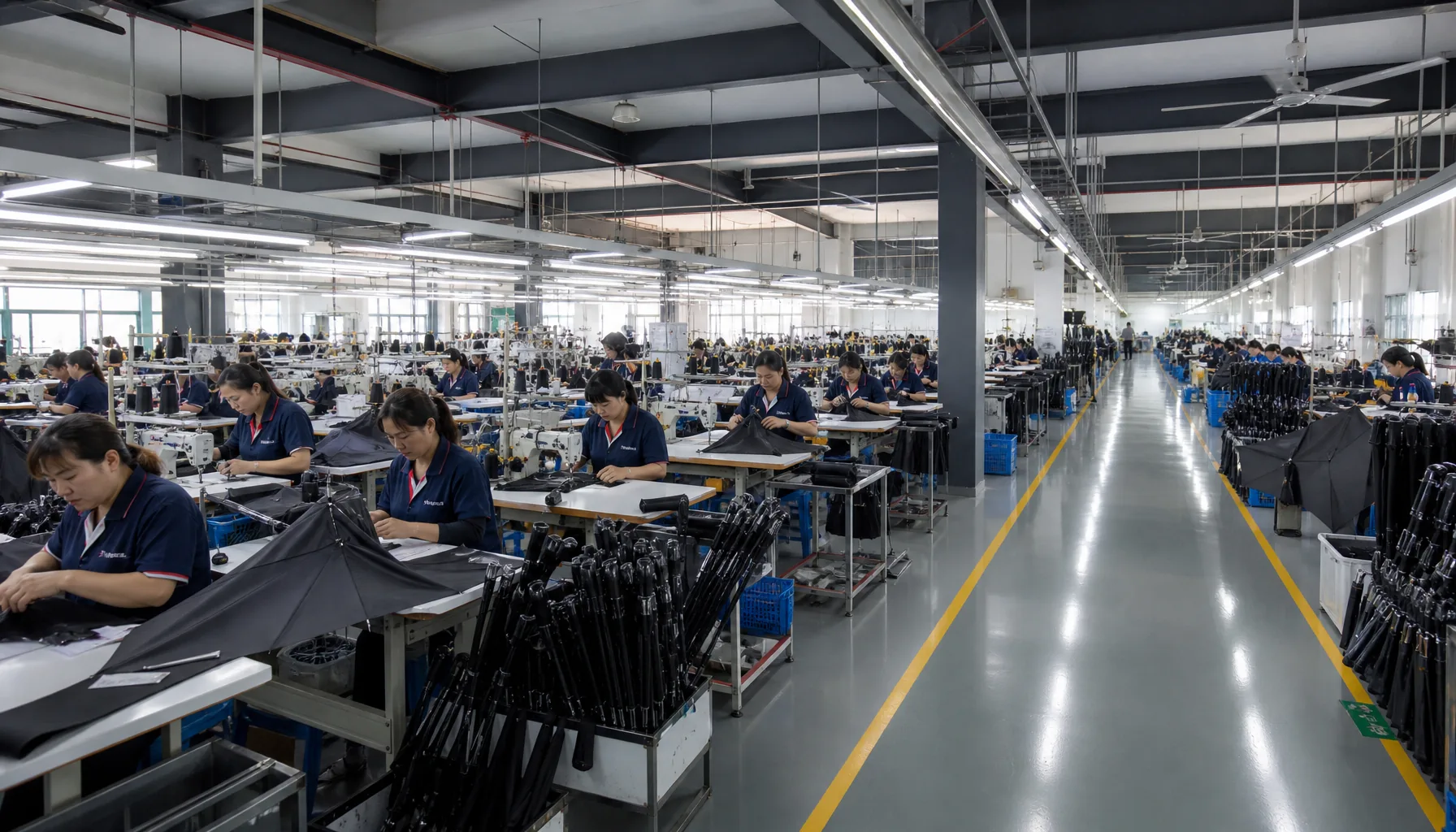
Small plastic components can decide whether an OEM umbrella order runs smoothly or turns into rework, loose tips, cracked caps, or buttons that jam after assembly. On our factory floor in Songxia, we treat injection molded umbrella parts like runners, tips, caps, and push buttons as engineered fit parts, not cheap accessories—checking material, tooling, shrinkage, gate marks, and assembly tolerance before mass production.
Which Umbrella Parts Are Injection Molded
The most common injection molded umbrella parts are the runner, top cap, ferrule, rib tips, handle insert, push button, end plug, and small bushings used around the shaft or stretchers. On a straight umbrella, the runner is the sliding hub that carries the stretchers; if its bore is too tight, the umbrella feels rough, and if it is too loose, the canopy shakes in wind. Runner geometry also changes by frame: an 8K steel promotional frame uses a simpler runner than a 10K or 16K fiberglass frame because the stretcher load and slot spacing are different. Umbrella tip molding is usually done in multi-cavity tools because each canopy needs 8, 10, or 16 tips, and small variation in the slot width can make sewing slower or cause tips to pop off during AQL opening tests. Caps and ferrules look minor, but they control water sealing at the top and affect how clean the finished umbrella looks after canopy mounting.
Material choice is where many cost-down projects go wrong. Low-cost promotional umbrellas often use PP for runners, tips, caps, and end plugs because it molds fast, keeps weight down, and is acceptable for manual 21-inch or 23-inch giveaways with steel ribs. For better retail models, I prefer nylon or POM for higher-wear parts, especially the runner and push button, because these materials handle repeated open-close cycles better and have less deformation in hot containers during ocean freight. ABS is common for decorative handle inserts and logo plates because it gives a cleaner surface for plating, painting, or pad printing, but it is not my first choice for stressed sliding parts. For POE or PVC transparent umbrellas, the plastic parts also need color stability because milky or yellowed caps are immediately visible to the buyer.
Auto-open and auto-open-close umbrellas require tighter control in umbrella runner manufacturing because the molded runner, button, notch, and spring-loaded parts must work as a system. A 3-fold 21-inch auto-open-close frame may have a plastic runner, internal pawl, button cap, handle insert, and shaft plug all molded to narrow tolerances; a small burr from the gate can cause misfire or make the button stick after 50 test cycles. For durable 27-inch or 30-inch golf umbrellas with double-canopy vented construction, OEM umbrella components are usually specified with reinforced nylon or POM in load-bearing areas, while PP remains acceptable for non-structural caps. Our standard practice at ZheBrella is to match umbrella plastic parts to the frame test target: basic promotional models may only need normal open-close inspection, while windproof retail umbrellas expected to survive 50+ mph wind-tunnel tests need stronger runners, deeper rib-tip engagement, and better material consistency from batch to batch.
Material Selection for Strength and Surface Finish
For injection molded umbrella parts, PP is the cheapest workhorse, but it is also the easiest to damage if you expect repeated drops, frozen storage, or rough handling in transit. It has decent flexibility and low density, which is useful for lightweight umbrella runner manufacturing, but its surface can look chalky unless the mold polish is good and the shrinkage is controlled. ABS gives a much better cosmetic finish, sharper edges, and higher impact resistance, so it is often preferred for visible OEM umbrella components like decorative caps or grip-style buttons. The tradeoff is that ABS can get brittle under long UV exposure unless you use a stabilized grade. POM is the strongest choice for sliding wear parts because it runs smoothly against metal or fiberglass and holds dimensions well, which matters for runners and moving clips. Nylon has good toughness and fatigue resistance, but it absorbs moisture, so dimensions and surface feel can change if storage conditions are poor.
TPR is not usually the structural answer, but it is the best material when the customer wants a soft-touch outer shell or a non-slip finger contact zone on umbrella plastic parts. It improves grip feel immediately, especially on handles, caps, and safety tips that users touch with wet hands, but pure TPR is too soft for load-bearing hinges or runner bodies. In umbrella tip molding, I usually treat material choice as a balance between stiffness, surface finish, and outdoor durability, not just price. For UV exposure, PP and ABS both need a UV package if the umbrellas will sit in sunlight for months, while nylon and POM need attention to color shift and long-term aging. Resort and beach programs, especially UPF 50+ sun umbrellas, should ask for UV-stable masterbatch or colorfast masterbatch so the parts do not fade before the canopy does. If the product is for marine or poolside use, I would avoid unmodified general-purpose resin and spec a stabilized grade from the start.
The right material also depends on whether the part is carrying load or only finishing the assembly. A runner body needs low friction and crack resistance, so POM or glass-reinforced nylon is usually safer than PP on higher-end automatic umbrellas, while a tip cap or crown can often use ABS if the geometry is thick enough. For mass-market injection molded umbrella parts, surface defects matter as much as strength: sink marks, weld lines, and flow marks show up fast on glossy black pieces, especially under retail lighting. That is why mold design, gate position, and drying discipline matter in umbrella runner manufacturing and tip molding. For export programs, I ask buyers to define UV exposure, salt air, and color targets early; otherwise the same mold can pass a sample but fail after one season at a resort. If the order is for premium outdoor sets, specify stabilized resin, tighter color tolerance, and a masterbatch that keeps its shade after repeated sun exposure instead of just looking good on day one.
Tooling, Cavities, and MOQ Considerations
Tooling cost is the first number buyers notice, but cavity count and cycle time are what decide the long-term unit price for injection molded umbrella parts. A simple runner or cap mold may be 4 cavities, 8 cavities, or 16 cavities depending on part size, gate design, and expected volume. If a runner takes 22 seconds per shot in a 16-cavity mold, the output is very different from a 4-cavity mold running a 35-second cycle, even if the resin is the same ABS, PP, or nylon. In umbrella runner manufacturing, the tolerance matters because the runner must slide smoothly on the shaft without wobble, jamming, or cracking around the notch. Cheap single-cavity tooling often looks attractive for a trial order, but it raises labor, machine time, and scrap percentage. For high-volume OEM umbrella components, we normally calculate MOQ from machine setup time, resin drying requirements, color-change waste, and the number of usable shots needed to amortize the mold cost.
Existing factory molds are usually the right choice when the buyer only needs standard umbrella plastic parts: black runners, clear POE tips, generic caps, plain push buttons, or standard J-handles for 21-inch, 23-inch, 27-inch, and 30-inch umbrellas. The advantage is speed and lower risk. Sampling can often be done in 3 to 7 days, and bulk production can move directly into canopy sewing and final assembly without waiting 25 to 45 days for new tooling. This is especially practical for promotional umbrellas where the branding is on the 190T or 210T pongee canopy by screen print, heat transfer, or sublimation, not on the molded parts. Existing molds also make sense for first orders under 3,000 to 5,000 pieces, because a custom mold can cost more than the price difference between a standard component and a custom one. The tradeoff is limited control over shape, texture, logo position, and Pantone consistency.
Custom molds become worthwhile when the molded part affects brand identity or function: a logo-embossed end cap, color-matched push button, ergonomic handle insert, special runner for an auto-open-close system, or reinforced tip for a 10K or 16K windproof frame. For umbrella tip molding, we check wall thickness carefully because a tip that is too thin splits during rib insertion, while a heavy tip slows cooling and causes sink marks. A custom mold also lets the buyer specify resin grade, surface finish, draft angle, logo depth, and whether the part must pass pull tests during AQL 2.5 inspection. At ZheBrella, we usually advise custom tooling only when repeat volume is clear, such as 10,000 to 30,000 pieces per order or a seasonal program running multiple colors. Otherwise, the better engineering decision is to use a proven mold, control color and fit tightly, and spend budget on frame strength, canopy coating, or packaging.
Dimensional Control and Fit With Metal Frames
The first failure point I look for in injection molded umbrella parts is not surface gloss; it is whether the runner slides on the shaft with the right controlled drag. Steel shafts are usually the most dimensionally stable, aluminum can vary more after anodizing, and fiberglass shafts need extra attention because pultruded profiles are not always perfectly round. For a 23" auto-open umbrella, we normally check runner inner diameter with pin gauges and verify actual shaft OD after coating, not just the drawing. A runner that is 0.10 mm too tight will jam after rainwater brings in dust; 0.15 mm too loose can rattle, tilt, and fail the button lock. On manual and auto-open frames, button clearance must be tested with the spring button fully depressed and released at least 20 cycles, because a runner that passes once on the bench may stick when the ribs are under canopy tension.
Umbrella runner manufacturing also has to match rib count and rib geometry, especially on 8K versus 16K frames. An 8K golf or straight umbrella gives each rib more load per slot, so the runner ears need enough wall thickness and clean radii to avoid cracking at the hinge pin hole. A 16K fashion or windproof model has tighter spacing, so even a small molding burr can interfere with adjacent stretchers during opening. For OEM umbrella components, we set go/no-go checks for runner travel from lower stop to top notch, including clearance around the runner button, spring, and notch. I do not approve a runner only by static fit; it must open under canopy load with 190T or 210T pongee attached, because sewing tension and cap height can change the geometry. Our standard practice at ZheBrella is to test molded runners on production metal frames, not just master samples.
Caps and tips need the same discipline. Umbrella tip molding looks simple, but the tip hole size determines whether the rib end seats securely or splits the plastic after flexing. Steel rib tips can tolerate a tighter press fit, while fiberglass rib ends need a slightly more forgiving bore and enough socket depth to avoid stress whitening. For umbrella plastic parts used on 27" and 30" frames, we check tip pull-out force, cap concentricity, and whether the top cap clamps the canopy without crushing the washer or allowing water entry around the shaft. Mold shrinkage must be controlled by resin batch, cavity location, and cooling time; otherwise one cavity produces caps that slip on aluminum shafts while another cracks during assembly. AQL 2.5 inspection should include inner diameter, hole depth, flash at the parting line, and a functional open-close test on both 8K and 16K frames before bulk packing.
Quality Checks Before Final Umbrella Assembly
The last place to discover weak injection molded umbrella parts is on the assembly line, when 20 workers are waiting for runners, tips, or caps that should have been sorted yesterday. For plastic runners, we check flash around the bore, parting line, and rib slots because even 0.2 mm of extra material can stop smooth sliding on a 8K or 10K shaft. Sink marks near the spring button window usually mean uneven cooling or insufficient packing pressure, and those parts often crack after repeated opening cycles. For umbrella tip molding, short shots at the tip end are a serious reject because the canopy seam cannot seat properly and the tip may split during stitching or heat pressing. Color variation is checked against the approved PP or POM color chip under D65 light, not by eye under a sewing-room lamp, especially for black, navy, and custom PMS colors used on OEM umbrella components.
Mechanical testing matters more than appearance once the parts look acceptable. We perform pull-off strength checks on tips and caps after they are fixed to fiberglass or steel ribs; for standard 23-inch umbrellas, a practical internal target is no separation under 35–45 N, while larger 27-inch and 30-inch golf umbrellas need a higher margin. Runners must slide without binding on painted steel, aluminum, or fiberglass shafts, and the notch engagement must hold after manual-open, auto-open, and auto-open-close cycling. A typical check is 500 open-close cycles for regular orders and 1,000 cycles for retail or windproof models with double-canopy venting. Cracking around runner collars, cap sockets, and rib-hinge contact points is recorded separately from cosmetic defects because it affects field failure. Our standard practice at ZheBrella is to keep molded-part trial samples with the approved frame set, not in a separate plastic parts box where nobody compares fit.
For bulk shipments, I recommend AQL 2.5 for major defects and AQL 4.0 for minor cosmetic defects, with critical defects at zero tolerance. Major defects include short shots, functional cracking, wrong material, poor runner travel, weak tip retention, or cap looseness that affects assembly. Minor defects include light gate marks, small non-sharp flash that does not interfere with sewing, and slight color shade variation within the signed tolerance. Inspection records should show cavity number, resin grade, color batch, molding date, sampling quantity, defect photos, and corrective action, because umbrella runner manufacturing problems are often cavity-specific. For FOB Ningbo or Shanghai and DDP bulk shipments, buyers should require a pre-shipment inspection file covering molded umbrella plastic parts before final cartons are sealed: AQL report, cycle-test sheet, pull-off test data, and signed golden sample comparison. This documentation prevents arguments later when cartons arrive mixed with otherwise acceptable canopies, ribs, and handles.
Frequently Asked Questions
When should a buyer pay for a custom mold for umbrella parts?
A custom mold is worth considering when the order is repeatable, the part affects brand identity, or existing molds cannot meet the required fit or finish. For one-time promotional orders, standard molds usually reduce tooling cost and lead time.
Which molded umbrella part causes the most functional problems?
The runner is one of the most critical molded parts because it controls opening travel and locking performance. Poor dimensional control can cause jamming, loose locking, or failure in auto-open and manual umbrellas.
What resin is usually specified for umbrella runners, tips, and caps in OEM production?
Most orders use PP or ABS for runners and caps, while tips may use PP, ABS, or nylon depending on impact and fit requirements. If the part must handle tighter snap-fit tolerances or cold-weather use, buyers often request virgin material with a defined melt flow index and color masterbatch ratio.
When should a buyer approve a separate mold for the umbrella tip versus combining multiple small parts in one tool?
A separate mold makes sense when the tip has a unique shape, plated finish, or tight shaft-fit tolerance that affects assembly yield. Combined multi-cavity tools work better for standard caps and buttons when annual volume is high enough to justify faster cycle output and lower unit cost.
What dimensional checks matter most before approving mass production of molded umbrella parts?
The critical checks are inner diameter or shaft-fit size, overall part length, wall thickness consistency, gate vestige, and color match against the approved standard. For mass orders, buyers typically ask for first article samples plus cavity-by-cavity measurements to catch fit issues before full production starts.
Looking to Launch Your Custom Umbrella Line?
ZheBrella is a Zhejiang-based OEM/ODM umbrella manufacturer with 17 years of export experience. Free design, low MOQ from 100 pieces, windproof construction, full-color print.
Get Free Quote Now »People Also Search For
Related Articles
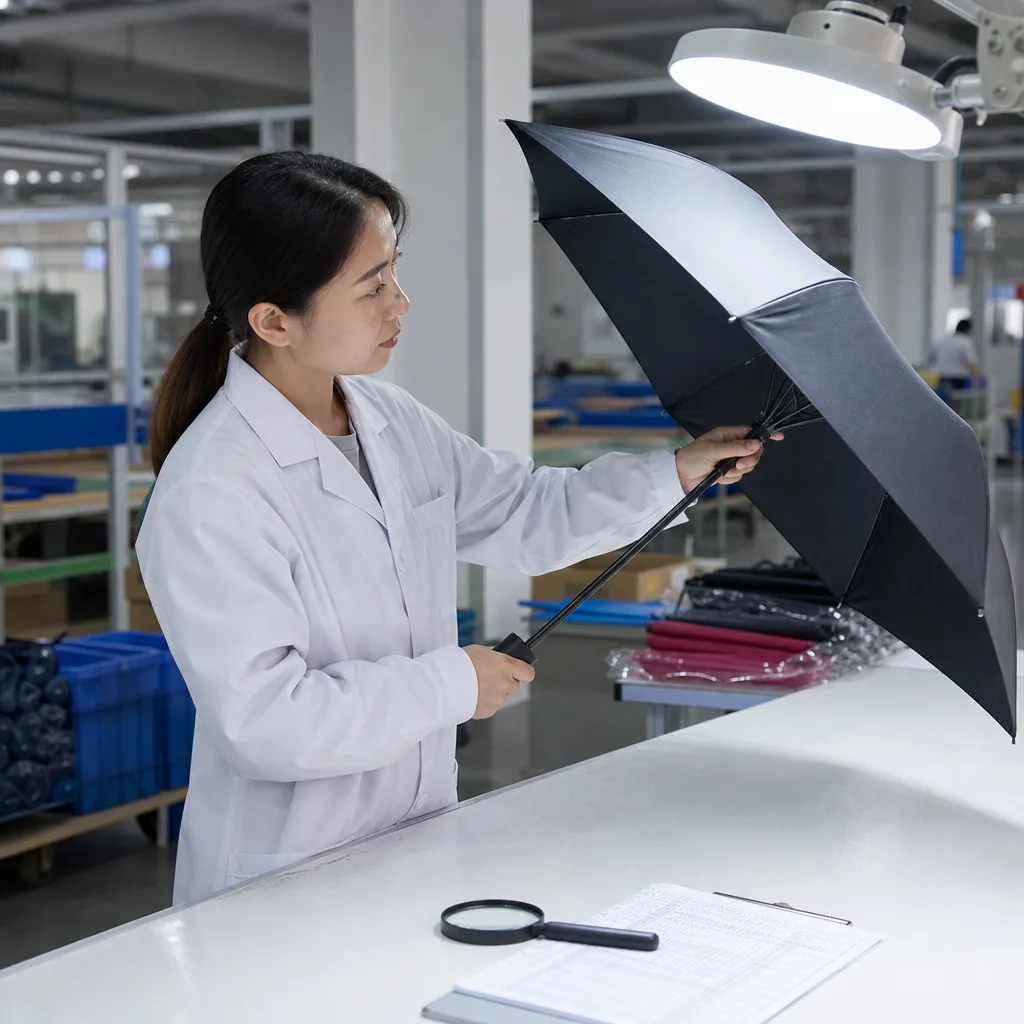
Injection-Molded Umbrella Parts: Tooling, Shrinkage, QC
Plan molded tips, runners, caps, and handles with correct resin choice, shrinkage allowance, tooling checks, and cosmeti...
Read More »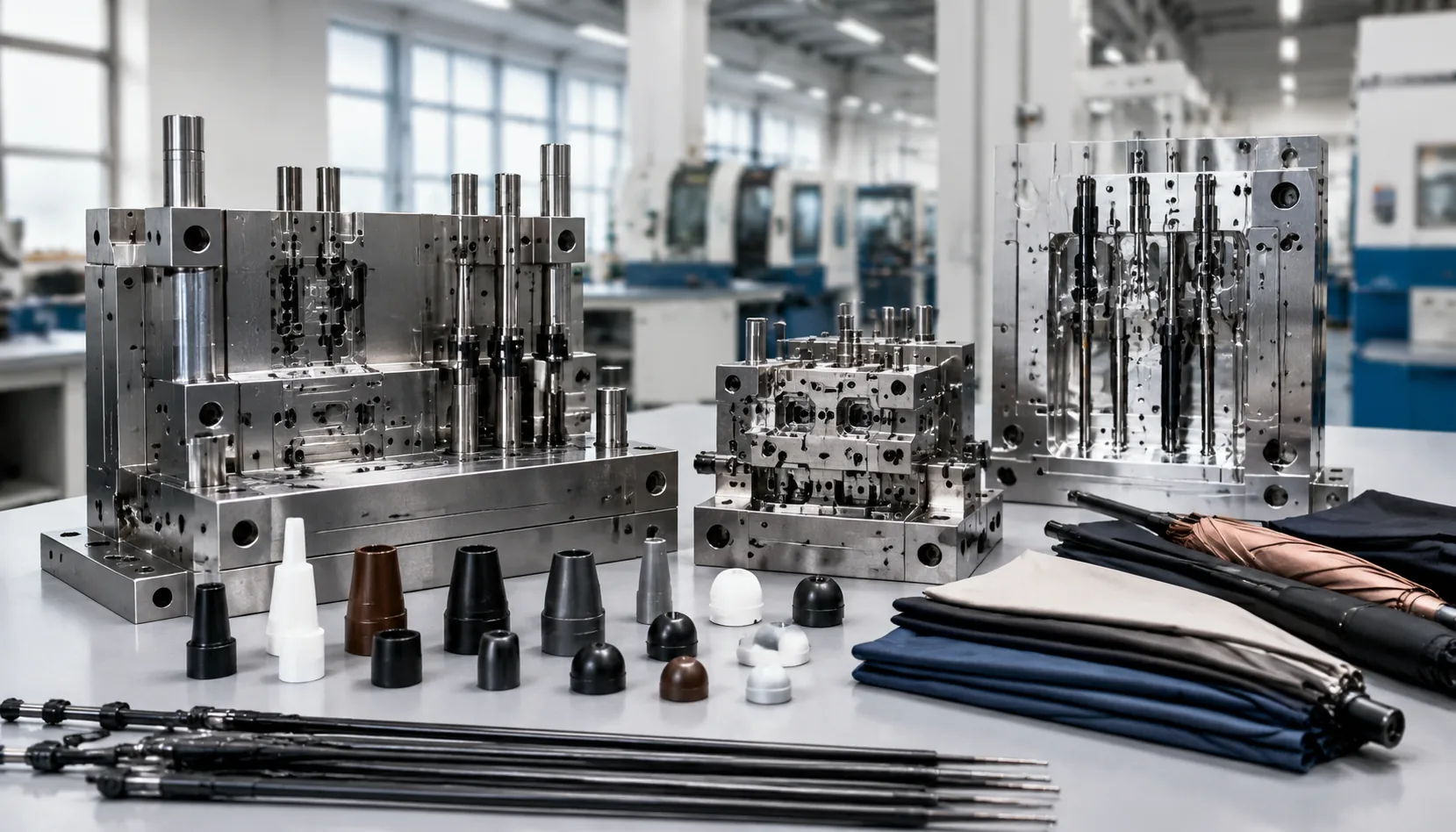
Umbrella Mold Tooling for Custom Tips, Runners, and Caps
Plan custom umbrella plastic parts with tooling costs, resin choices, color matching, MOQ, sample timing, and QC checks ...
Read More »
Umbrella Ferrule and Tip Assembly Tolerances for OEM Runs
Learn the fit, adhesion, and pull-test specs that prevent loose ferrules, cracked tips, and field failures in OEM umbrel...
Read More »