Umbrella Ferrule and Tip Assembly Tolerances for OEM Runs
On OEM umbrella programs, ferrule and tip failures usually trace back to small stack-up errors: tube OD drift, insert depth variation, glue spread, or cure conditions that looked acceptable at first article but open up during production. When buyers ask about umbrella tip assembly tolerances, they need more than a drawing callout; on the Songxia factory floor, we control fit, adhesive laydown, and pull-test windows together because a few tenths of a millimeter can decide whether tips stay locked through packing, transit, and end use.
Why Ferrule and Tip Tolerances Matter in Production
Ferrules, top caps, and rib-end tips are small parts, but they control three things buyers notice immediately: safety, appearance, and opening force. Tight umbrella tip assembly tolerances keep the ferrule concentric on the shaft, hold the top cap through repeated opening cycles, and place rib-end tips cleanly into the canopy corners without twisting panel geometry. On a 21-inch or 23-inch folding auto-open-close frame, even a few tenths of a millimeter of ferrule fit error can create visible crown wobble and extra friction when the runner locks. On a 27-inch or 30-inch golf umbrella with fiberglass ribs and a vented double canopy, the same misalignment shows up as uneven canopy tension and a crooked tip line visible from roughly three meters. Buyers may compare 190T and 210T pongee first, but poor control of umbrella tips and caps lowers perceived quality faster than a small print shift because the defect appears the moment the umbrella opens and remains visible through every use.
The main failure modes are predictable and preventable in OEM umbrella manufacturing. Loose glue joints usually trace back to an oversized ferrule ID, an undersized shaft OD, incomplete adhesive coverage, or cure time shortened before packing; after carton vibration in FOB shipment, the cap may spin or detach. Burrs on stamped metal ferrules and poorly trimmed plastic tips can cut 190T/210T pongee, POE, or EVA at stress points, often after 500 to 1,000 open-close cycles. Misalignment typically comes from uneven insertion depth, worn assembly jigs, or a rough shaft-end chamfer, causing snagging, distorted canopy peaks, and false "bent umbrella" claims when the real defect is off-center assembly. Cracked plastic is another common risk: low-grade PP tips tend to fail sooner in drop tests and cold-weather use, while ABS or nylon generally holds shape better. Assembly QC should be dimensional, not just visual: first-article approval, in-line assembly QC, and final AQL 2.5 inspection should verify shaft OD, ferrule ID, insertion depth, adhesive coverage, pull-off force, seam-to-tip alignment, cycle performance, and basic drop resistance. That discipline matters even more at a 3,000-piece MOQ, where a small tolerance stack-up becomes a shipment-wide claim risk under FOB or DDP terms.
Critical Dimensions and Material Pairings to Specify
The highest-risk variable in OEM umbrella manufacturing is the stack-up between shaft OD, wall thickness, and the ferrule or tip bore. An 8.0 mm shaft with a 0.45 mm wall leaves little internal clearance for a plug, rivet, or spring end; that is usually manageable on a 23 inch or 27 inch straight umbrella, but it becomes a failure point on 21 inch and 23 inch auto-open-close frames where spring hardware competes for the same space. For umbrella tip assembly tolerances, hold steel tube OD at ±0.05 mm and aluminum at ±0.08 mm, then match the ferrule fit to the material: a light press fit for stable metal-to-metal assemblies, or an adhesive-assisted slip fit where plastic shrinkage or surface variation is expected. If the bore is undersized, ABS umbrella tips and caps can crack during winter drop testing; if oversized, the ferrule can rotate, wobble, or leak after a few hundred open-close cycles. Fiberglass shafts need separate incoming inspection because pultrusion and resin flash often shift actual OD away from nominal, so line setup should be based on measured parts, not only the drawing.
Insertion depth is a structural spec and should be written into the BOM, not left to line judgment. On a straight umbrella with a 14 mm to 16 mm ferrule, call for at least 12 mm effective shaft insertion depth to maintain pull-off strength and keep the tip aligned under wind load. On compact auto-open styles, runner stroke, top-notch geometry, and the spring package reduce usable engagement, so tip bore tolerances should typically stay within +0.03 to +0.08 mm over the mating pin or shaft feature to keep the assembly on axis. Material pairing should be explicit: ABS fits basic manual 8K straight umbrellas where surface finish matters; PP is the safer choice for compact auto-open umbrellas because it handles repeated shock with less cracking; plated steel or aluminum fittings suit higher-end 30 inch golf umbrellas or fashion sticks, but only when contact with fiberglass is controlled to reduce abrasion and stress concentration. Assembly QC should verify umbrella tip assembly tolerances with go/no-go bore gauges, pull testing, and concentricity checks under AQL 2.5.
Assembly Methods: Press Fit, Adhesive, and Heat Setting
Press fit is the fastest option, but it only works when umbrella tip assembly tolerances are controlled at all three interfaces: shaft OD, ferrule ID, and molded tip bore. In OEM umbrella manufacturing, it is most dependable on standard black nylon or PP umbrella tips and caps for 8K or 10K steel or fiberglass frames, especially 21" and 23" compact umbrellas where lower end weight reduces leverage during opening and closing. Buyers should ask for the measured shaft tolerance, insertion depth, and a defined pull-force target in newtons; "fits tight" is not usable assembly QC. If ferrule fit drifts because tube OD changes or molded parts shrink unevenly, operators often over-press to compensate, which increases cracked caps, scratched plating, and rework. The advantage is speed: press fit usually gives the shortest production flow and scales most easily on standard colors. The drawback is low tolerance for variation, so preproduction approval should include lot-level QC records, not only a hand-built sample.
Adhesive assembly is slower but more forgiving, and it is often the safer choice for 27" and 30" umbrellas, clear POE or PVC canopies, and custom-colored fittings where cosmetic rejects cost more than extra labor. Buyers should ask three direct questions: which adhesive is used, how long it must fixture, and how long it needs to reach full cure before carton packing. A cyanoacrylate may set in seconds but still need about 24 hours to stabilize bond strength; epoxy usually takes longer but handles loose ferrule fit better because it fills gaps. The right control point is a minimum pull-force target after full cure, plus clear testing frequency by lot or by shift and whether heat-humidity aging is included after the umbrella sits closed in a master carton. Adhesive typically adds 1-2 days to lead time, which matters when Pantone-matched fittings already require a 3,000-5,000 piece MOQ under FOB or DDP planning.
Heat setting works when the ferrule or tip resin is formulated to soften and lock around the shaft, and it usually produces a cleaner appearance than visible glue squeeze-out. It is also the most process-sensitive method: temperature window, dwell time, and molded-part consistency directly affect yield. Transparent or soft materials, including PVC- or EVA-related components, are less forgiving, and low-grade molded parts can distort if heat input is uneven. For custom-colored end fittings, heat setting can improve appearance consistency, but setup time and first-article adjustment make it less practical for very small runs, so low-MOQ custom colors can be harder to approve. Buyers should ask which method can be reworked without marking the canopy or damaging shaft coating, because rework limits directly affect recovery rate, defect cost, and shipment timing. Strong factories tie method selection to measured data: pull-force checks, insertion-depth gauges, open-close cycle verification, and AQL 2.5 appearance inspection after the assembly has fully stabilized.
In-Line QC Tests That Catch Loose or Crooked Parts
Catch ferrule defects on the line, not at packing. In OEM umbrella manufacturing, the ferrule and top-tip stations should use go/no-go insertion depth gauges at the point of assembly so operators verify every unit instead of judging by feel. For a typical 21 inch or 23 inch straight umbrella with a steel shaft and molded PP or ABS umbrella tips and caps, a workable control limit is plus or minus 1.0 mm on insertion depth. On fiberglass shafts, the same check usually needs tighter control because even slight tilt becomes visible after the canopy is tensioned. Ferrule fit should be checked twice: first for full axial seating, then for rotational play after cooling or adhesive cure. Any ferrule that can twist by hand is a reject, because that movement usually gets worse after carton vibration, repeated auto-open impact, and normal handling. This is where umbrella tip assembly tolerances become actionable: the line team measures depth, seating, and rotation in real time before defects compound into rework at final dressing.
Pull testing is the next in-process control, and it needs a defined force standard recorded by lot. Assembly QC should sample each lot with a spring scale or digital force gauge to confirm the tip and ferrule bond holds above expected service loads before umbrellas move to canopy closing and packing. The threshold will vary with shaft material, wall thickness, and part geometry, but approval should always be against a documented number, not a subjective tug. Pair that with opening and closing cycle verification for manual, auto-open, and auto-open-close frames, since parts that look straight at rest can still loosen after 200 to 500 cycles when adhesive bead volume is inconsistent or the cap bottoms out unevenly. Visual alignment still matters, but set it against a flat fixture and fixed reference line across the shaft, tip, and crown. Reject any visible lean, gap line, flashing interference, or canopy distortion, with closer checks on 8K and 10K frames, vented double-canopy styles, and 27 inch or 30 inch golf umbrellas where canopy tension makes small angle errors easy to see. Run these checks in process, then hold final inspection at AQL 2.5 as the shipment gate, not the first time assembly QC finds the defect.
How Tolerance Control Affects Cost, Claims, and Shipments
Ferrules and top caps are tolerance-critical components, not decorative trim. In OEM umbrella manufacturing, a loose ferrule fit or an over-tight tip socket creates scrap on day one: cracked plastic caps during pressing, scratched plating on metal ferrules, split canopy corners when the tip eyelet over-pulls the fabric, and end-of-line rework that cuts line speed. On a standard 23-inch 8K auto-open umbrella with a steel shaft and fiberglass ribs, umbrella tip assembly tolerances around +/-0.15 mm on the mating diameter are typically stable across a normal run. Push that to +/-0.05 mm while buying parts from mixed suppliers, and cost rises unless tooling is matched across the set. Operators assemble more slowly, incoming sorting increases, and scrap can move from under 1.5% to 3% to 5%. Across 5,000 to 50,000 pieces, that means more labor hours, more rejected hardware, and more pressure on a 35-50 day lead time.
The bigger commercial risk is downstream claims. If umbrella tips and caps do not seat evenly, canopy tension shifts panel to panel and the defect shows up later as loose thread tails, pinholes around the tip patch, or caps that fall off after a few open-close cycles. On 21-inch manual promo umbrellas in 190T pongee, buyers may accept that as cosmetic; on 27-inch double-canopy golf umbrellas, poor stack-up at the rib end can reduce wind performance and trigger inversion complaints below the expected 50+ mph range. Procurement teams should approve a golden sample only after the ferrule, rib end, tip cap, adhesive, and canopy fabric are all fixed, then require pre-production approval before bulk assembly. Assembly QC should verify pull-off force, cap seating depth, plating appearance, and open-close cycling against the approved sample under AQL 2.5, because visual checks alone miss the failures that drive returns.
Tolerance control also affects shipment quality, especially on assembled 21-inch and 23-inch auto-open-close folding umbrellas. When ferrule fit varies and cartons are overpacked, protruding tips and caps can rub through polybags, dent adjacent handles, and create cosmetic claims that are later blamed on freight. The exposure is higher with plated ferrules, matte-painted caps, and transparent POE or EVA canopies that show every scuff. For FOB orders, buyers should lock inner-pack quantity, divider or tip-protector requirements, carton orientation, and export-carton drop resistance before production starts. For DDP, specify extra carrier-handling protection because parcel networks are harsher than palletized ocean freight. A practical rule is simple: if MOQ is above 3,000 pieces, lead time is 35-50 days, and the style uses custom-molded tip hardware, approve the golden sample before material booking and sign off on packing after the first assembled cartons, not when production is already 80% complete.
Frequently Asked Questions
What defect level should buyers treat as critical for ferrules and tips?
Loose or detached ferrules and exposed sharp edges should generally be treated as critical safety defects. Cosmetic color mismatch may be minor, but cracked or misaligned tips that affect opening should be major defects under the agreed inspection plan.
Do fiberglass-rib umbrellas need different tip specifications than steel-rib models?
Yes. Fiberglass ribs flex more, so rib-end tips need secure retention and materials that resist cracking under repeated bending. Steel-rib models may tolerate harder tips, but rust-prone hardware still needs proper sealing at the joint.
What pull-force range is typically used to approve ferrule retention in OEM umbrella runs?
Many OEM buyers use a ferrule pull-test threshold in the 8-15 kgf range, depending on umbrella size, shaft material, and ferrule design. For children's or lightweight compact models, the lower end may be acceptable, while straight golf umbrellas often require higher retention.
Should ferrule fit be controlled by adhesive only or by mechanical interference as well?
For stable mass production, buyers usually specify both: an interference fit on the shaft end plus adhesive bonding. Relying on glue alone increases the risk of rotation, tip loosening, or detachment after temperature cycling and carton compression during shipment.
How is tip assembly QC usually sampled during a production run?
A common approach is first-article approval, then hourly line checks with pull testing and visual inspection for cracks, glue overflow, and misalignment. On larger orders, importers often require AQL-based final inspection with separate sampling for ferrule retention and cosmetic defects.
Looking to Launch Your Custom Umbrella Line?
ZheBrella is a Zhejiang-based OEM/ODM umbrella manufacturer with 17 years of export experience. Free design, low MOQ from 100 pieces, windproof construction, full-color print.
Get Free Quote Now »People Also Search For
Related Articles
Umbrella Ferrule and Tip Assembly Tolerances for OEM Orders
Learn which ferrule and tip tolerances reduce wobble, cracking, and returns in OEM umbrellas, with practical QC points f...
Read More »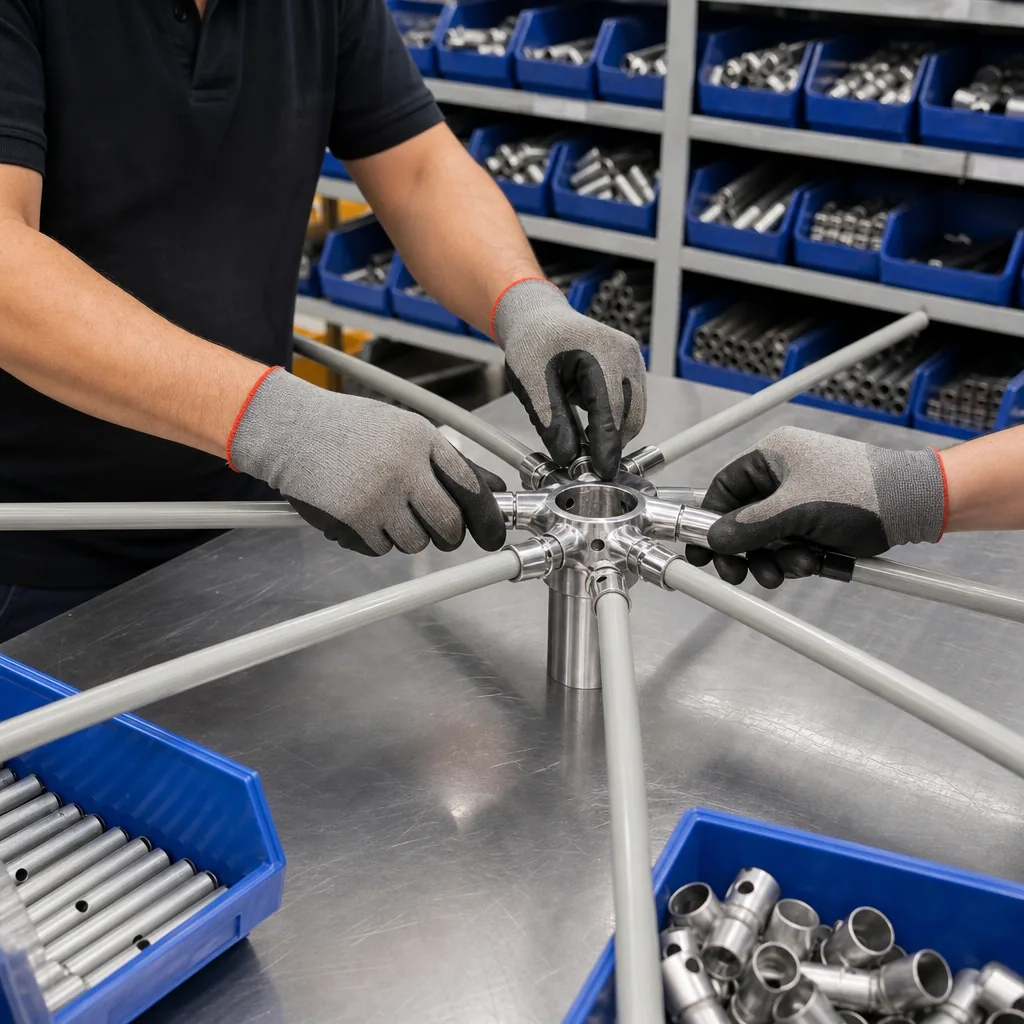
Umbrella Frame Assembly Tolerances for OEM Production
Define rib, shaft, runner, and canopy-fit tolerances for OEM umbrellas so bulk production opens smoothly, resists wind, ...
Read More »
Umbrella Frame Assembly Tolerances That Reduce Field Failures
Learn which umbrella frame tolerances matter most in production, from rivet play to runner alignment, to cut defects, cl...
Read More »