Umbrella Frame Assembly Tolerances for OEM Production
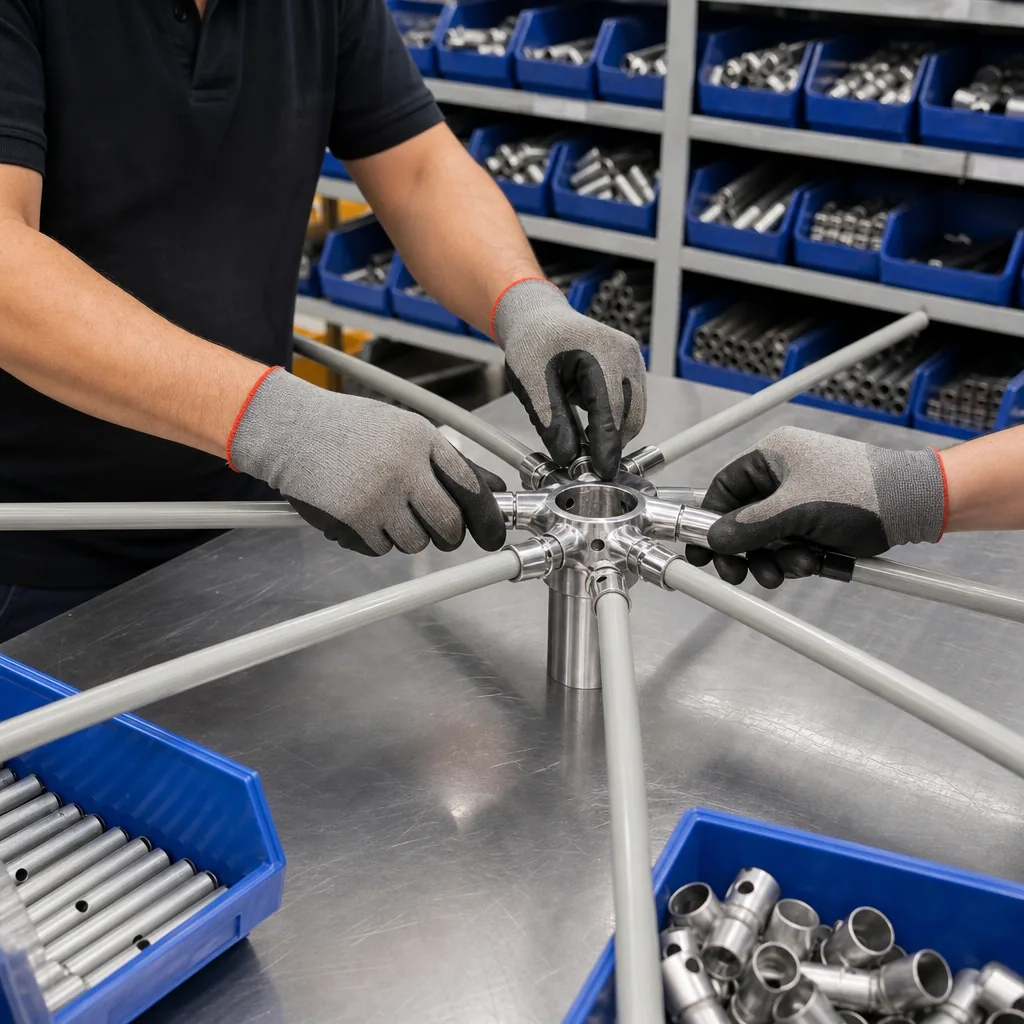
When an OEM umbrella order fails AQL for rough opening, loose ribs, or uneven canopy tension, the root cause is often not the fabric or design file but small tolerance drift across the frame line. On our Songxia factory floor, umbrella frame assembly tolerances are controlled at the shaft, runner, rib joint, and canopy-fit points because a 0.5 mm mismatch can become a sticking runner, twisted panel, or weak wind response in bulk production.
Why Frame Tolerances Decide Umbrella Performance
Umbrella frame assembly tolerances decide whether an umbrella opens with a clean snap or feels like it is fighting itself. A 1.0 mm error in notch position can change rib angle enough to overload the runner, especially on auto-open and auto-open-close frames where the spring force is fixed. Shaft straightness is just as critical: on a 23" stick umbrella, we normally hold center shaft runout within about 1.5 mm over the working length; beyond that, the runner drags, opening force rises, and the canopy pulls off-center. Rib length variation looks harmless on the bench, but when eight ribs are tied into one canopy, a 2 mm long rib can create a loose panel beside a tight panel. That uneven canopy tension is where flutter starts in wind. In OEM umbrella manufacturing, good fabric and printing cannot hide a bad frame geometry.
Rib and runner fit is one of the first places I look during umbrella frame QC because it exposes accumulated errors from stamping, riveting, plastic injection, and assembly. If the runner bore is too tight on a steel shaft, plating thickness or paint buildup can make the umbrella stick halfway open. If it is too loose, the canopy shakes under side load and the user feels a cheap wobble. For fiberglass ribs, the tolerance problem is different: the material flexes well, but inconsistent rib length or rivet hole position changes the bow shape, so a 10K windproof frame may not distribute load evenly. Double-canopy vented golf umbrellas are even less forgiving because the upper and lower canopies must breathe without pulling the ribs into a twisted set. Our standard practice at ZheBrella is to check runner travel, locking height, rib symmetry, and opening force before sewing approval, not after bulk assembly.
Compact, golf, and stick umbrellas fail in different ways when umbrella frame assembly tolerances are loose. A 21" three-fold compact has multiple shaft sections, small link bars, and tight clearances; a small bend or rivet offset can create high friction, slow closing, or auto-open-close rebound. A 27" or 30" golf umbrella has more leverage, so 8K or 16K rib spacing errors become canopy tension problems and reduce resistance in 50+ mph wind testing. Stick umbrellas are simpler, but long shaft straightness and notch alignment matter because the runner has a longer travel path and users expect a smooth manual or auto-open stroke. Many umbrella assembly defects blamed on fabric, such as puckering, loose tips, uneven valance, and off-center logos, actually start with frame tolerance drift. Once the frame is wrong, sewing operators compensate by pulling panels, and the defect becomes permanent.
Key Dimensions to Control Before Assembly
The first control point in umbrella frame assembly tolerances is rib length, because a 2 mm error that looks harmless on the bench becomes a twisted canopy after sewing. For standard 8K steel frames on 23" and 27" umbrellas, I usually allow rib length variance within ±1.0 mm between ribs in the same set, with total left-right symmetry checked after stretchers are riveted. On 16K frames, the window should be tighter, about ±0.5 to ±0.8 mm, because twice the rib count means small errors stack around the crown and create visible scalloping at the hem. Fiberglass ribs need a different mindset: they flex more than steel, so free-state length can vary slightly, but molded end inserts and drilled rivet positions must stay consistent. For fiberglass golf umbrellas, especially 30" double-canopy models, we check rib arc and recovery after bending, not just straight-line length, because poor recovery causes umbrella assembly defects during opening tests.
Shaft and runner dimensions decide whether the umbrella opens smoothly or feels cheap before the buyer even sees the canopy. For common 8 mm steel shafts, the shaft outside diameter should normally stay within ±0.05 mm, and the runner inner diameter should give enough clearance for sliding without wobble, often 0.10 to 0.20 mm depending on plating thickness and coating. A tight runner will pass one dry test and then fail after powder coating, nickel plating, or humidity exposure; a loose runner causes shaking, uneven stretcher angles, and poor rib and runner fit. In OEM umbrella manufacturing, I also measure notch slot width, spring button height, runner locking groove depth, and top cap thread engagement before assembly starts. Our standard practice at ZheBrella is to pull pre-assembly samples from each frame lot and test them with actual production runners, not only with gauge pins, because mixed tolerances from different subcontracted parts are a common source of umbrella frame QC failures.
Rivet hole position is where many factories lose control because punching tools wear slowly and operators do not notice until the canopy no longer sits square. On steel ribs, rivet hole center deviation should generally stay within ±0.3 mm for 8K frames and closer to ±0.2 mm for 16K frames; oversized holes may make assembly easier, but they introduce play that becomes noise, uneven opening force, and loose stretchers after 300 to 500 cycles. Fiberglass ribs with plastic joints need clean molded holes and consistent insert depth, because drifting joints change the effective rib length even when the rib itself measures correctly. Tip alignment is the final pre-assembly checkpoint: rib tips should land on the same circular plane, usually within ±1.5 mm on standard straight umbrellas and tighter on promotional models with full-panel printing, where misalignment makes logos look crooked. Before cutting 190T or 210T pongee panels, I want a trial frame opened under load, checked for crown centering, stretcher angle balance, and equal distance from tip to tip across opposite ribs.
Jigs, Gauges, and Line Checks Used in Production
The fastest way to lose umbrella frame assembly tolerances is to let operators “eyeball” rib spacing during crown and runner assembly. On a proper OEM umbrella manufacturing line, we use fixed radial jigs matched to the model: 8K, 10K, or 16K, with separate nests for 21", 23", 27", and 30" frames because rib length changes the arc and tip position. The jig holds the shaft vertical and locks each rib tip at the correct clock position while stretchers are pinned or wired. For straight umbrellas, I want the rib tips within about ±3 mm on a 23" frame; for compact 3-fold frames, the tolerance is tighter at the folding joints because small errors multiply when the canopy is sewn on. A line leader should check the first 10 pieces after any setup change, then at least 5 pieces every hour per workstation. If a rib sits high, the canopy will wrinkle; if spacing drifts, printing alignment on panels can visibly rotate.
Go/no-go gauges are the cheapest insurance against bad rib and runner fit. The runner bore, spring hole position, notch depth, and locking button clearance should be checked with hardened plug and slot gauges, not only calipers, because operators need a clear pass/fail decision in seconds. For steel shafts, we normally check runner sliding force by hand plus a simple pull gauge target; too tight causes sticky opening, too loose causes wobble and early wear. Fiberglass ribs need special attention at the connector, since plastic molds can flash or shrink and create uneven opening loads. Our standard practice at ZheBrella is to gauge the first 20 runners from each incoming bin, then sample 13 pieces per 500-piece lot under an AQL 2.5 umbrella frame QC plan, with 100% segregation if two functional failures appear. Common umbrella assembly defects caught here include runners that jam before full crown travel, loose stretchers, tilted top caps, and safety springs that do not lock consistently after 20 cycles.
Shaft straightness is checked before the frame reaches canopy mounting, because a bent 8 mm or 10 mm shaft cannot be corrected later without twisting the entire umbrella. A simple V-block and dial indicator is enough for production; for promo umbrellas I would reject visible runout above 1.5 mm over the main shaft length, and for golf umbrellas above 2.0 mm can already cause uneven panel tension. Each workstation should perform sample opening tests: open, shake, close, and reopen at least 3 to 5 pieces every 30 minutes, plus the first and last piece of each bundle. For auto-open and auto-open-close models, test the button response, spring return, runner lock, and closing force after 10 repeated cycles. These checks protect umbrella frame assembly tolerances better than final inspection alone, because the defect is caught while the operator, jig setting, and component batch are still identifiable.
Common Defects Caused by Poor Tolerance Control
The first defects buyers notice are loose ribs and hard opening, but the root cause usually starts earlier than final assembly. If rib drilling is off by even 0.3-0.5 mm, the rivet has to compensate, and that creates side play at the stretcher joint. On an 8K or 10K steel frame this shows up as wobble when the canopy is shaken; on fiberglass ribs it can become a stress point that cracks after repeated opening cycles. Hard opening is often blamed on the spring, but in OEM umbrella manufacturing I see it more often from poor rib and runner fit: stretcher tips sitting at different angles, runner slot width too tight, or a center shaft with inconsistent plating thickness. Good umbrella frame assembly tolerances keep those contact points predictable, so the runner travels smoothly without forcing the ribs into position.
Asymmetric canopy pull is another classic tolerance problem. If rib lengths vary by 2-3 mm across an 8-panel canopy, the fabric cannot distribute tension evenly, even when the sewing is correct. A short rib pulls the panel down and makes the logo look twisted; a long rib pushes the seam upward and creates a peaked panel. This is especially visible on 190T or 210T pongee with screen printing, because straight artwork exposes frame imbalance immediately. In umbrella frame QC, we separate fabric cutting errors from frame errors by testing the bare frame first, then mounting a sample canopy. If the frame opens unevenly before fabric attachment, the issue is usually inconsistent rib sourcing, wrong stretcher length, or sloppy drilling fixtures. If the bare frame is balanced but the finished umbrella pulls to one side, the likely causes are panel cutting, seam allowance drift, or tip pocket placement.
Runner jamming, broken rivets, and inverted panels are more serious because they cause returns, not just cosmetic complaints. Runner jamming often comes from burrs inside the runner, oversized rivet heads, or shaft slots punched with worn tooling. Broken rivets usually mean the rivet material is too soft, the setting pressure is too high, or the joint stack thickness was not controlled before riveting. Inverted panels on a windproof double-canopy frame can be caused by weak fiberglass ribs, but we also see it when rib angles vary too much and one panel catches wind before the others. Our standard practice at ZheBrella is to check high-risk joints during pilot run assembly, not only during final AQL 2.5 inspection, because umbrella assembly defects become expensive after canopy sewing, printing, and packing. The best prevention is tight incoming frame inspection, controlled drilling jigs, and sample testing through at least 300 open-close cycles before mass production.
How Buyers Should Specify Tolerances in the Tech Pack
Buyers should spell out the frame stack-up in the tech pack instead of writing “standard quality,” because that is how umbrella frame assembly tolerances get vague and disputes start later. State the frame material first: steel for low-cost promotional units, fiberglass for wind resistance, or mixed constructions with steel shaft and fiberglass ribs. Then lock the rib count and size, such as 8K, 10K, 16K, 21-inch, 23-inch, or 27-inch formats, because rib geometry changes the whole rib and runner fit. For OEM umbrella manufacturing, the canopy fabric matters too: 190T pongee, 210T pongee, or POE/PVC/EVA if the product is meant for rain cover or clear visibility. If the frame is built for an auto-open or auto-open-close mechanism, specify the button action, latch behavior, and acceptable opening force in Newtons, not just “easy open,” so the factory can test the spring rate consistently.
A good tech pack also defines what counts as an acceptable defect before production starts. In umbrella frame QC, buyers should list critical dimensions such as rib length tolerance, shaft straightness, runner travel, tip insertion depth, and the maximum play allowed at the joints. If the product uses fiberglass ribs, say whether the ferrules are bonded, crimped, or sleeved, because that changes failure modes and umbrella assembly defects like loose tips, uneven canopy tension, or runners that hang up halfway. I also recommend stating whether the umbrella is manual, auto-open, or auto-open-close, because each mechanism has a different force curve and different wear points. ZheBrella’s standard practice is to confirm these points in the pre-production sample, then freeze the sample as the control standard before bulk cutting and frame assembly.
Do not wait until shipment to discuss inspection. Put AQL 2.5 into the contract and define which defects are critical, major, and minor, especially for broken ribs, misaligned runners, weak spring return, and incomplete opening. In practice, buyers should require a pre-production sample approval with measured umbrella frame assembly tolerances, then compare bulk output against that signed sample during inline and final inspection. If the canopy is 190T or 210T pongee, ask for confirmation that stitch pitch, panel symmetry, and frame centering still meet spec when the canopy is fully tensioned, because a frame can pass parts inspection and still fail in real use. That is the point where umbrella assembly defects show up, so the tech pack should require photos, measurement records, and a clear rejection list before mass production starts.
Frequently Asked Questions
Should tolerance specs differ for fiberglass and steel umbrella ribs?
Yes. Fiberglass ribs flex more and need careful length matching to keep canopy tension even, while steel ribs need tighter control on straightness and anti-rust finish thickness. Mixed-material frames should be tested as a complete assembly.
Can frame tolerance problems be found only at final inspection?
Final AQL inspection can catch visible failures, but it is late and costly. The factory should check rib length, runner fit, rivet security, and opening smoothness during in-process assembly.
What tolerance range should buyers request for runner-to-shaft fit on a standard OEM folding umbrella?
For most steel or aluminum folding frames, buyers commonly request runner travel that is smooth with no binding and a clearance tight enough to avoid wobble, typically controlled within about 0.2-0.5 mm depending on shaft coating and frame size. The factory should confirm the target with sealed samples before mass production.
How many opening and closing cycles should be checked during pre-shipment inspection for assembly tolerance issues?
A practical B2B standard is 10-20 repeated open/close cycles per sampled unit during inspection, especially on top-of-carton and random carton samples. This helps expose rib interference, runner sticking, spring misfit, and canopy tension problems before shipment.
Can tight frame tolerances increase defect risk in bulk production?
Yes. If tolerances are specified too tightly for the material and tooling capability, defect rates can rise through binding runners, scratched shafts, or slow assembly speed. Most buyers balance performance and yield by setting functional tolerances tied to smooth opening, symmetry, and AQL pass rates rather than only dimensional limits.
Looking to Launch Your Custom Umbrella Line?
ZheBrella is a Zhejiang-based OEM/ODM umbrella manufacturer with 17 years of export experience. Free design, low MOQ from 100 pieces, windproof construction, full-color print.
Get Free Quote Now »People Also Search For
Related Articles
Umbrella Frame Assembly Jigs: Tolerances for OEM Consistency
Learn how frame jigs, rib angle tolerances, runner fit, and in-line checks reduce wobble, canopy strain, and rejects in ...
Read More »
Umbrella Frame Assembly Tolerances That Reduce Field Failures
Learn which umbrella frame tolerances matter most in production, from rivet play to runner alignment, to cut defects, cl...
Read More »
Umbrella Frame Assembly QC for OEM Production Runs
Plan frame assembly checks for OEM umbrellas, from rib alignment and runner fit to cycle tests, AQL sampling, lead-time ...
Read More »