Umbrella Frame Assembly Tolerances That Reduce Field Failures
When bulk umbrellas fail in the field, the root cause is often not the fabric or handle but small stack-ups in umbrella frame assembly tolerances that were missed on the line. In Songxia production, we watch rivet play, runner alignment, notch position, and rib symmetry because a few tenths of a millimeter can decide whether a frame opens smoothly, rocks under wind load, or comes back as a claim.
Why Tolerances Matter in Umbrella Manufacturing
Most failures buyers call “random” begin with stack-up error in the frame, not the canopy. In umbrella frame assembly tolerances, a center shaft OD drifting by 0.10-0.15 mm or a runner bore going slightly oval can raise opening force enough to scrape plating, slow the runner, or stop it mid-stroke. Add runner notch alignment that is off by even a fraction of a millimeter and the symptoms become consistent: sticky opening, uneven lock-up, and a canopy that sits skewed instead of square. Small errors compound fast across the frame. A top notch punched slightly high, a stretcher hole wandering 0.20 mm, and a rib shoulder stamped narrow can turn a standard 21-inch 8K frame into one that shows side-play at full open, drags on closing, and wobbles long before the 190T pongee canopy shows wear. For importers and OEM buyers, that means more warranty claims, more rework, and higher scrap risk even when incoming fabric, plating, and finish look acceptable.
Joint fit is the next control point. In rivet fit umbrella frame assemblies, a loose rivet shank lets rib and stretcher eyelets chatter until holes bell out and the user feels head-shake within weeks; a tight rivet binds the joint, especially after black electrophoresis or nickel plating adds thickness. This matters more on mixed-material designs that pair fiberglass ribs with steel stretchers or steel shafts, because steel keeps its geometry while fiberglass flexes and rebounds. If the dimensions are mismatched, the fiberglass takes the misalignment load and failures shift to cracked end sections, split connectors, or broken springs near the runner. Umbrella manufacturing tolerances matter on both manual and auto-open frames, but auto-open designs expose bad dimensions faster because spring force magnifies shaft straightness error, rib length mismatch, and locking offset. A manual 23-inch 10K frame may still pass a casual open-close check; the auto-open version with the same errors will open unevenly, strike one side first, and wear joints faster. That is why OEM umbrella quality depends on controlling shaft concentricity, stretcher symmetry, rib matching, and locking geometry before final assembly.
Critical Frame Dimensions Buyers Should Put on Drawings
Put the load-bearing dimensions on the drawing, not in a sealed sample, if you want fewer field failures. For a common 23-inch auto-open frame, specify shaft outer diameter, wall thickness, and straightness as measurable requirements—for example, a 14.0 mm shaft OD with 0.45-0.50 mm wall is far more useful than calling out only steel or aluminum tube. Those numbers directly affect column strength, opening feel, and wear between the shaft, top notch, and runner. Pair the shaft OD with a runner bore fit and a straightness limit, especially if the parts will be plated or painted, because coating buildup can turn a nominally smooth slide into drag or chatter. Rib length consistency belongs on the same print. On an 8K frame, a main rib that runs 1.5 mm long may be hidden by the canopy; on a 16K frame, the same error stacks around the circle and shows up as wrinkled panels, uneven crown tension, and tips that miss their landing points. That is the practical case for tighter umbrella frame assembly tolerances as rib count rises: 16K frames leave less room for accumulated error than 8K.
The next dimensions to lock down are notch spacing, runner ear spacing, and concentricity between the runner bore and notch features, because runner notch alignment is a common root cause of crooked opening. On 8K frames, wider panel pitch can absorb small angular variation; on 16K frames, narrower pitch makes the same spacing error visible at the tips and easier for end users to notice. Treat the runner as a bearing surface, not a simple stamped part: if the bore is loose, the frame chatters and wears; if it is tight, auto-open and auto-open-close actions can hang up. Rivet joints need the same discipline. A reliable rivet fit umbrella frame starts with defined hole size, rivet diameter, and controlled play at each pivot so ribs articulate without side shake that elongates holes, loosens stretchers, or damages plating. On steel and fiberglass hybrid frames, washer thickness where used and post-flare consistency matter more than cosmetics once wind loads move past 50 mph. For OEM umbrella quality, these umbrella manufacturing tolerances should be written into the print and verified with inline checks for opening force, closing force, symmetry, pivot looseness, and final AQL 2.5 inspection.
How Material Choice Changes Tolerance Windows
Material choice defines umbrella frame assembly tolerances long before canopy sewing starts. Steel ribs and stretchers usually allow the tightest control of straightness and hole position because stamped carbon steel has more predictable spring-back after forming; on a 21 in. or 23 in. compact frame, rib camber variation is typically lower than aluminum under the same tooling. The cost tradeoff is weight and corrosion risk, so plating consistency has to be controlled alongside forming accuracy. Aluminum cuts mass, but higher spring-back after bending makes hole location and runner notch alignment less stable, especially as wall thickness drops. If tooling does not compensate, the runner can drift out of sequence during open-close cycling. Fiberglass adds a different tolerance profile. Pultruded fiberglass ribs improve wind performance in 8K and 10K windproof frames rated above 50 mph, but cut length, end squareness, and flex return vary more than steel or aluminum. For that reason, umbrella manufacturing tolerances for fiberglass have to account for elastic movement under load, not just static incoming dimensions.
The highest field-failure risk sits at the joints, not in any single part, so mixed-material frames need subassembly reviews instead of relying on final inspection alone. A steel shaft with fiberglass ribs and metal stretchers can be durable, but only if rivet stack height, drilled hole diameter, and cap thickness match the flex behavior of each component. A rivet fit umbrella frame that is too tight can crack fiberglass eyes after repeated opening cycles; too loose, and the frame develops lateral play, canopy skew, and early notch wear. The same tolerance stacking affects aluminum runners on steel shafts, where a broad shaft OD window creates visible wobble, and the problem gets worse on auto-open and auto-open-close frames because spring force magnifies small clearance errors. Double-canopy constructions add another stack: upper and lower 190T or 210T pongee layers load the rib set differently during sewing, closing, and reopening. That is why umbrella frame assembly tolerances should be reviewed at the rib assembly, center-shaft assembly, runner travel force, latch sequence, and opening-symmetry stages. Final AQL 2.5 inspection supports OEM umbrella quality, but it does not reliably identify these root causes once the canopy is already mounted.
Factory Controls for Assembly Accuracy and Repeatability
Control umbrella frame assembly tolerances at receiving, before labor and canopy fabric are consumed. A capable factory checks every incoming batch against the approved drawing for shaft OD and ID, rib and stretcher hole position, notch slot width, spring length, and runner bore concentricity, then records the results by lot. Use go/no-go gauges for top-notch slot width, runner channel width, ferrule insertion depth, and end-cap fit, backed by caliper records where dimensions matter most: rib length held near ±0.5 mm and punched hole location near ±0.3 mm on critical joints. These are not minor details; drift here causes sticky opening, loose crowns, uneven canopy tension, and early rib breakage after shipment. Specs also need to match the frame type. A 21-inch or 23-inch 8K folding frame with an aluminum shaft, fiberglass ribs, and auto-open-close springs needs tighter control of spring length, wall thickness, and sliding-fit parts than a 27-inch golf frame with heavier steel stretchers, where leverage and mass shift the failure mode.
Repeatability depends on fixtures, gauges, and release criteria, not operator feel. Runner notch alignment should be set in a dedicated jig that fixes shaft position, top-notch orientation, and rib indexing before riveting; otherwise one rib rides high, the frame tracks off-center, and load distribution across the canopy becomes uneven. For rivet fit umbrella frame control, use a matched pin-and-hole standard so each joint swings freely without excess drag or side play. Start every machine and shift with first-article approval covering crown height, rib spread angle, runner travel force, and closing position, then maintain control with in-line torque checks on handle and cap assembly plus pull tests on wrist-strap anchors and ferrule joints. Functional opening checks should be part of lot release: 100% at startup, then sampled by lot size for manual, auto-open, or auto-open-close action, latch engagement, rebound, and rib symmetry, including 10K and 16K frames. Final inspection at AQL 2.5 should confirm that these upstream controls held for operation, appearance, print registration, and packing, not serve as the factory's main filter through end-of-line sorting. That link between process control and final audit is what keeps umbrella manufacturing tolerances stable and supports dependable OEM umbrella quality.
What Procurement Teams Should Request Before Mass Production
Before mass production, require the signed tech pack to lock the frame revision before PO release, not after deposit. The minimum package is a key-dimension drawing plus a part-by-part tolerance table for the full frame stack: shaft OD and wall thickness, shaft straightness, top notch and runner notch widths, rib and stretcher lengths, spring wire diameter, handle insertion depth, and canopy-to-frame matching points that control closing symmetry. For a 21 in. or 23 in. folding style, practical callouts can include shaft straightness within 0.5 mm over section length, rib length tolerance of +/-0.8 mm, and notch slot width of +/-0.15 mm. If those values stay at "factory standard," you are effectively accepting uncontrolled umbrella frame assembly tolerances, variable opening feel, and higher assembly variation across the lot. Put the tolerance table inside the signed tech pack and link it to the approved frame revision so purchasing, line QC, and final inspection all check the same build against the same umbrella manufacturing tolerances.
Require a signed golden sample, and add a sealed pre-production sample when the canopy print or panel layout can affect frame balance. The approval pack should also include a CTQ list and written defect definitions. For OEM umbrella quality, name the CTQs explicitly: runner notch alignment, opening and closing force, lock engagement, rib symmetry, tip tension, and rivet rotation resistance. For rivet fit umbrella frame control, define defects in measurable terms: loose rivet with lateral play above the agreed limit, runner sticking during the auto-open cycle, visible left-right rib offset, or frame inversion below the agreed wind rating, such as 50 mph on fiberglass-rib windproof styles. AQL 2.5 only works when QC and the line supervisor use identical pass-fail limits. Commercially, MOQ changes process control: about 3,000 pcs on a custom 8K auto-open-close frame can justify dedicated jigs, go/no-go gauges, and a first-article setup run, while 500-1,000 pcs usually means semi-standard parts and looser process capability. Approve samples 7-10 days before line scheduling; a late change to rib length or runner clearance can add 5-12 days, risking missed vessel cutoffs on FOB orders or delivery-slot disruption on DDP programs. Tight control of umbrella frame assembly tolerances reduces field failures and lowers lead-time risk at the same time.
Frequently Asked Questions
Which umbrella frame dimensions are usually most likely to cause assembly defects?
Runner inner diameter, shaft outer diameter, notch placement, and rivet-hole alignment are common failure points. If these stack up poorly, the umbrella may open stiffly, sit off-center, or develop joint breakage in use.
Do 16K umbrellas need tighter assembly control than 8K umbrellas?
Yes. With 16 ribs, small alignment errors repeat more times around the frame, so canopy symmetry and opening smoothness are more sensitive to tolerance drift. Factories should use stricter fixture checks during frame assembly.
What tolerance issue most often causes umbrellas to stick during opening and closing?
Runner-to-notch misalignment is one of the most common causes. In production, buyers typically ask suppliers to confirm smooth runner travel across multiple open-close cycles and hold notch alignment within the factory's approved assembly spec before mass production.
How should a buyer evaluate rivet fit on a sample umbrella frame?
Check for both excessive looseness and binding at the rib and stretcher joints. A practical inline QC method is to compare several approved golden samples side by side and reject frames showing visible wobble, uneven articulation, or metal deformation around the rivet head.
Can tighter frame tolerances increase unit cost or lead time?
Yes, especially if the frame requires added jigs, slower assembly speed, or more frequent in-line inspection. For OEM orders, tighter tolerance control often adds a few days to pre-production validation and may raise unit cost if defect-risk parts need upgraded tooling or stricter sorting.
Looking to Launch Your Custom Umbrella Line?
ZheBrella is a Zhejiang-based OEM/ODM umbrella manufacturer with 17 years of export experience. Free design, low MOQ from 100 pieces, windproof construction, full-color print.
Get Free Quote Now »People Also Search For
Related Articles
Umbrella Frame Assembly Line: Rivets, Jigs, and Tolerance Control
Learn how umbrella frames are assembled with rivets, jigs, and tolerance checks so bulk OEM orders open smoothly and pas...
Read More »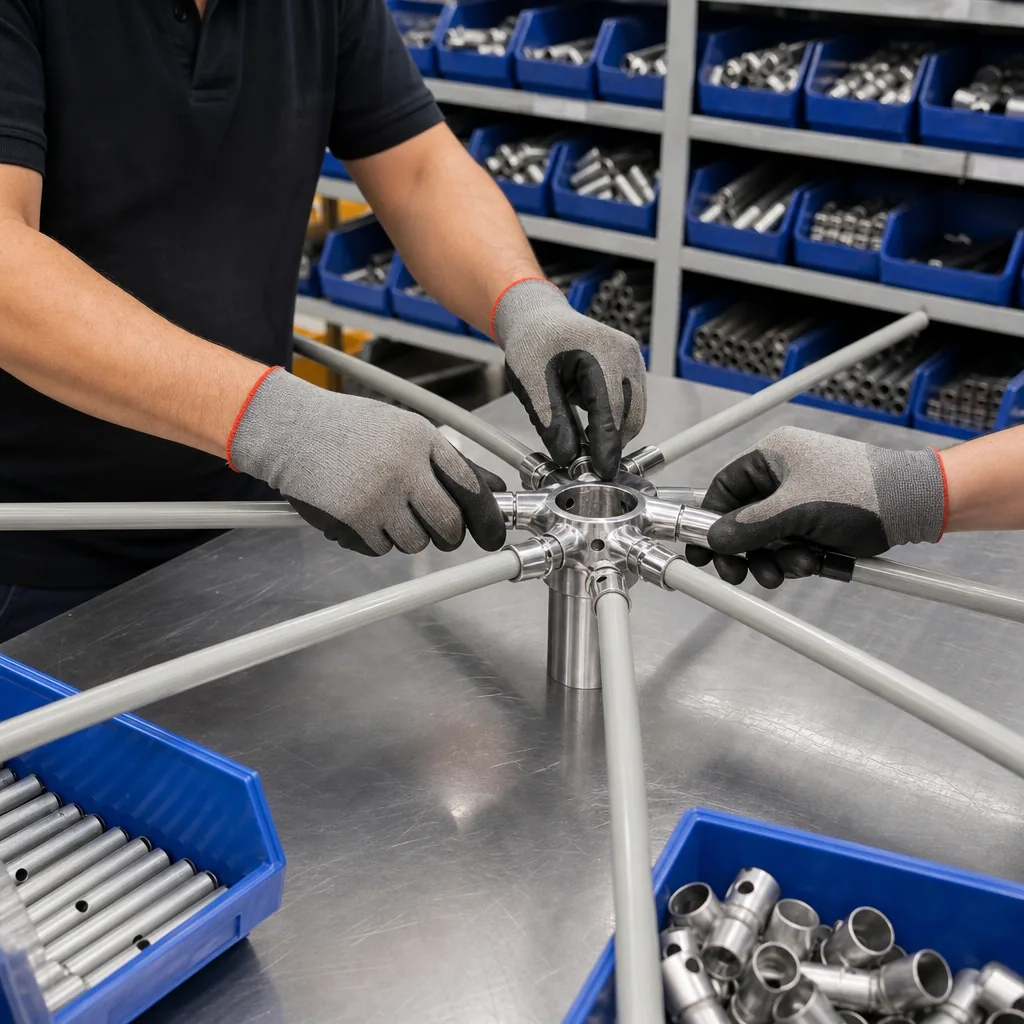
Umbrella Frame Assembly Tolerances for OEM Production
Define rib, shaft, runner, and canopy-fit tolerances for OEM umbrellas so bulk production opens smoothly, resists wind, ...
Read More »
Umbrella Frame Assembly Jigs: Tolerances for OEM Consistency
Learn how frame jigs, rib angle tolerances, runner fit, and in-line checks reduce wobble, canopy strain, and rejects in ...
Read More »