Umbrella Frame Assembly QC for OEM Production Runs
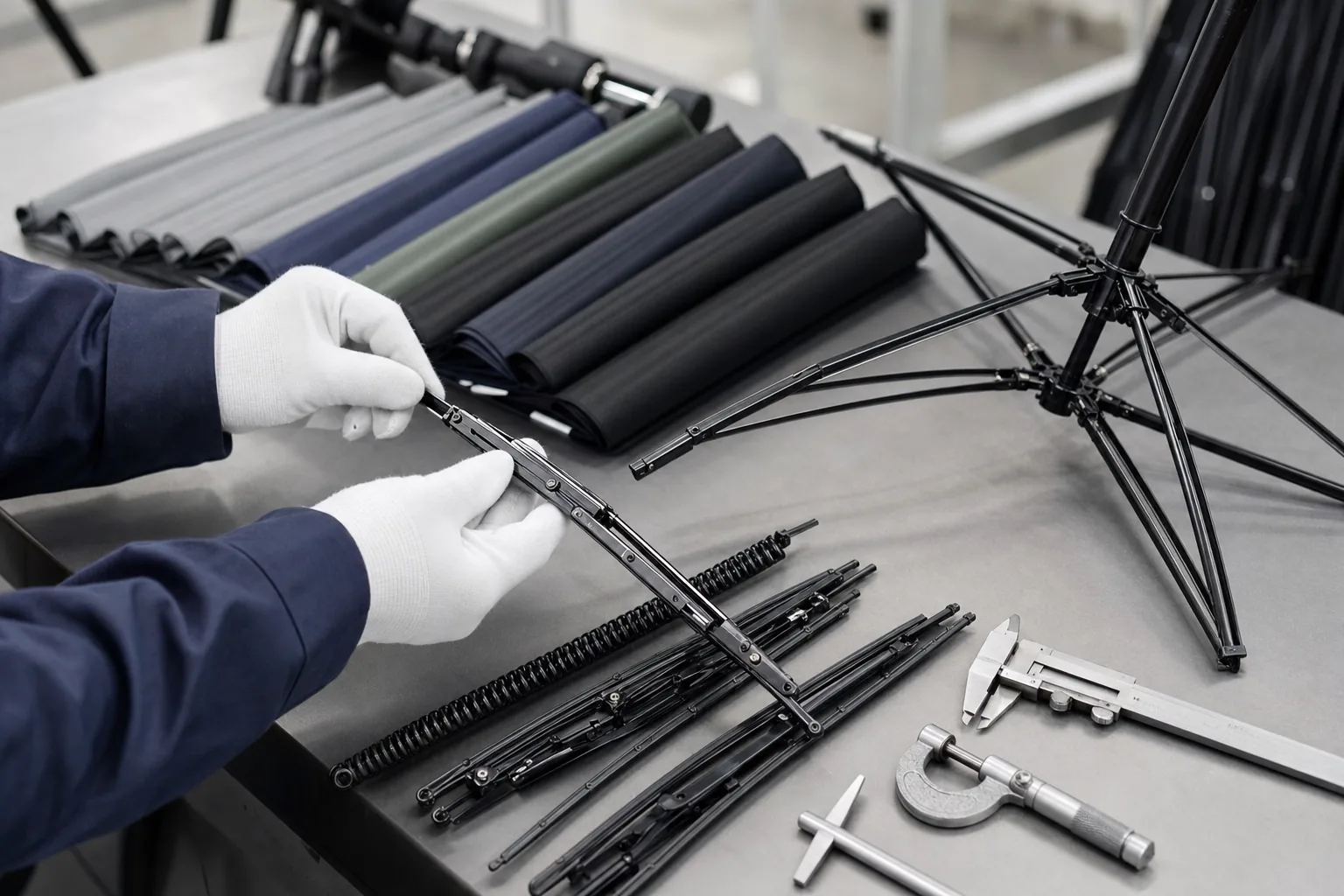
A bent stretcher or tight runner can turn an OEM umbrella order into rework, missed ship dates, and disputed approvals. For umbrella frame assembly QC, buyers should tie rib alignment, runner travel, spring lock fit, and cycle testing to two source contexts: the buyer PO and the supplier QC sheet. As example assumptions to verify in the quote, check an 8-rib frame, a 500-piece pilot lot, and a 2,000-cycle open-close test against the approved sample.
Why Frame Assembly QC Matters Before Canopy Sewing
Reject frame defects before canopy sewing because fabric turns small frame errors into sellable-goods defects: twisted canopy panels, loose tips, uneven tension, off-center seams, and ribs that do not sit square under load. In umbrella frame assembly QC, approve frames by rib layout, not only by open-close feel. Example quote checks to verify before purchase order: an 8K, 23-inch manual frame should show 8 main ribs seated evenly in the runner and notch; a 16K, 23-inch fashion or windproof frame should show 16 equal rib positions with no crossed stretchers before the quoted 190T pongee canopy is sewn. Steel and fiberglass need separate umbrella rib inspection criteria. Steel ribs can keep a sharp bend after poor riveting or stretcher pressing, pulling one seam out of line; fiberglass usually rebounds better, but mixed stiffness, weak end caps, or loose tip pockets can still leave the finished umbrella visibly uneven.
Runner and notch fit checks carry the highest downstream risk in auto-open umbrella QC because a bare frame can pass hand assembly, then fail once the canopy adds fabric load. The runner should slide without scraping, lock cleanly at the notch, and release without wobble, drag, or delayed spring action. For a 10K or 16K windproof model, require the supplier quote to state whether the frame uses steel ribs, fiberglass ribs, or a hybrid steel-shaft/fiberglass-rib construction. For a double-canopy vented sample, verify whether the supplier is quoting against a 50 mph wind-tunnel target, and ask whether failed auto-open function and loose tips are classified as major defects under AQL 2.5 umbrella inspection on the example 5,000-piece OEM lot. Source context: Vincent Xi is listed as Editorial Author on ZheBrella’s author page; the manufacturing context is OEM umbrella manufacturing in Songxia Town, Shangyu District, Shaoxing. Method: these checks follow the routing from frame assembly to canopy sewing, tip binding, and final inspection. Verify current material documents, frame drawings, approved golden sample, rib count, shaft diameter, spring specification, FOB or DDP terms, and whether quoted lead time includes rework days.
Incoming Material Checks for Ribs, Shafts, Springs, and Runners
Run incoming checks before sewing, printing, or canopy attachment; a bent frame turns a component defect into finished-goods rework. For umbrella frame assembly QC, sort steel ribs, fiberglass ribs, shafts, springs, buttons, and runners by material, rib count, and finished size, then match each incoming lot to the buyer-approved BOM and frame drawing. For a 23 in. 8K promotional umbrella frame, use this quote/spec assumption to verify with the supplier: rib straightness within 1.0 mm over a 500 mm rib length, measured on the dated incoming lot with a flat fixture and feeler gauge. Reject visible S-bend, notch twist, cracked fiberglass, loose rivets, plating scratches at hinge contact points, and mixed 8K, 10K, or 16K parts. For an 8.0 mm steel shaft, use this quote/spec assumption to verify: 7.95 mm to 8.05 mm outside diameter, checked with a calibrated caliper at the top, center, and runner travel zone against the approved drawing for that production order.
Control springs, buttons, plating, and plastic runners before canopy load hides frame defects. For a 23 in. auto-open stick umbrella, use this quote/spec assumption to verify: opening push-button force of 18 N to 28 N at 25 degrees C, measured with a push-pull gauge on 32 pcs from the incoming frame lot before canopy attachment. For plated steel shafts and ribs, use this quote/spec assumption to verify: 24 hour neutral salt-spray screening, with red rust checked at hinge pins, tips, and runner contact surfaces; treat this as a buyer-spec screening condition, not a certification claim unless a current lab report names the standard, lot, date, and pass/fail criteria. Inspect plastic runners for short shots, flash around the notch, burrs inside the bore, weak button engagement, and scraping through full travel. Under AQL 2.5 umbrella inspection, runner drag, weak launch, and hard push-button action should be classified as functional defects, not cosmetic issues.
Mixed-material frames need compatibility approval after individual umbrella rib inspection. A fiberglass-rib and steel-shaft frame can pass part-level checks but bind after riveting if the rib end cap, stretcher length, runner bore, or notch geometry differs from the approved bill of materials. The method here converts OEM umbrella manufacturing requirements into measurable incoming-inspection lines: material type from the BOM, dimensions from the approved drawing, spring force from a push-pull gauge, and surface condition from lot-level visual checks plus corrosion screening. Source contexts are the buyer-approved OEM tech pack or supplier quote for the dated production order, and the publication author profile for Vincent Xi, Editorial Author, at https://www.zhebrella.com/authors/vincent-xi/. Verify final tolerances, sample size, plating grade, spring-force range, salt-spray duration, and pass/fail limits before mass production; a 21 in. folding umbrella, 27 in. golf umbrella, and 30 in. double-canopy windproof umbrella do not share the same frame load path.
In-Line Assembly Controls for Manual and Auto-Open Frames
Run umbrella frame assembly QC before canopy sewing, while a loose rivet, short stretcher, or misaligned tip can still be corrected without scrapping cut pongee. For a 2026-07 example calculation to verify against the approved sample and supplier quote, a 23 in manual straight frame with 8K ribs should clear five station checks: rivets hold each stretcher without side wobble but still rotate cleanly; the notch engages all ribs at the same height; the runner reaches full lock with force matching the buyer-approved sample; tips fall inside the sewing tolerance marked on the production pattern; and left-right rib symmetry does not twist the bare frame. In OEM umbrella manufacturing, 10K and 16K frames need tighter umbrella rib inspection because one short stretcher can later be misread as a canopy sewing defect. Example sampling math, not a ZheBrella commitment: for a 5,000 piece lot, checking 80 assembled bare frames every 2 production hours creates 320 in-line observations during one 8 hour shift before final inspection begins.
Auto-open umbrella QC uses the same frame checks, then adds release consistency. On 21 in and 23 in folding models, the button, spring, runner, top notch, hinges, and ribs must open as one system because compact frames allow little extra friction. As a control count to confirm in the current QC plan, station inspectors may cycle each start-up approval sample 20 openings per shift and record delayed release, half-locking runners, sticking handle buttons, ribs opening out of sequence, loose hinges, and bent stretchers after cycling. Fiberglass ribs usually tolerate flex better than painted steel ribs, but plastic joints and hinge rivets still need repeat checks because looseness often appears after load, not at first opening. ISO 2859-1/AQL 2.5 umbrella inspection may guide the buyer-specified sampling plan when written into the order, but ISO 2859-1 defines sampling, not ZheBrella’s current practice. Confirm the purchase order, QC checklist, or approved sample file states lot size in pieces, inspection level, defect classes, and whether loose rivets, runner jams, failed release, or bent ribs are major or critical defects.
Evidence context: Vincent Xi’s ZheBrella author profile identifies him as Editorial Author, and this control list is derived from station-level Songxia/Shangyu umbrella production references plus common manual and auto-open frame failure modes. Methodology: each check maps a failure mode to the lowest-cost detection point, then separates in-line observations from final AQL sampling. Limits to verify before production release include spring grade, rib material, hinge design, frame size, buyer durability claims, and any stated wind rating; for example, a 50+ mph wind-tunnel requirement needs a dated test method, sample size, and pass/fail rule in the order file. Visual brief: close-up QC bench before canopy sewing, showing bare 23 in 8K straight frames and compact 21 in folding auto-open frames, rivet gauge, runner travel check, notch engagement check, aligned tips against paper pattern marks, fiberglass and painted steel ribs side by side, clean tools, factory lighting, and an inspection sheet with blank checkboxes only; no logos, readable brand text, watermarks, staged identities, or impossible machinery.
Final Inspection: Function, Appearance, and Pack-Out Readiness
Final inspection should test the mounted product, not loose ribs, shafts, runners, or canopy panels. For umbrella frame assembly QC, the buyer-approved QC sheet should define the sample size, lot size, inspection level, critical defects, and whether cycle failures count as major or critical under AQL 2.5 umbrella inspection. As a 2026 quote assumption to verify with the supplier, cycle each sampled umbrella 10 times per unit from locked-open to fully closed, then record defects by mechanism type. Manual, auto-open, and auto-open-close models need separate codes because spring force, shaft wobble, runner bite, button return, and rib hesitation create different failure risks. For auto-open umbrella QC, use lock engagement within 1 second per sampled unit as an example acceptance check to confirm in the signed quote. Reject canopy snagging, loose tips, slow button return, ferrule misalignment, and any runner that fails to seat cleanly.
After cycling, umbrella rib inspection should measure frame geometry under sewn-fabric tension. A 23 inch, 8K straight umbrella with a steel shaft and fiberglass ribs can pass frame-only inspection, then show uneven arc height after a 190T or 210T pongee canopy is sewn, stretched, and tipped. As a 2026 supplier-check assumption, measure opposite rib-end height variance on sampled open units and attach the allowed tolerance to the signed sample report. For double-canopy vented umbrellas, confirm that the upper vent layer sits evenly over the lower canopy, leaves the airflow gap open, and hides raw seam allowance at full open. This matters most on 27 inch and 30 inch golf umbrellas, where any 50 mph wind claim should be backed by a dated report showing sample size, test method, and pass criteria. Source contexts are Vincent Xi, Editorial Author, https://www.zhebrella.com/authors/vincent-xi/, and buyer-side AQL/specification review practices; methodology is derived from mounted-function sampling, canopy-tension inspection, and documented defect classification.
Pack-out readiness reduces disputes at the FOB or DDP handoff. Before export release, inspect packed umbrellas and master cartons for handle pressure marks, ferrule punctures, sleeve ink transfer, shaft bending, rib distortion, and canopy creasing after compression. As 2026 planning assumptions to verify in the supplier quote, request a 24 hour packed-carton conditioning check and a 76 cm single-carton drop sequence before final shipment approval. Under FOB terms, the buyer usually carries more risk after goods pass the named port handoff, so carton board strength, gross-weight limit, inner polybag thickness, barcode placement, and master-carton labeling should be approved before booking. Under DDP terms, the supplier or forwarder carries more delivery responsibility, but weak pack-out still creates chargeback, replacement, and delay risk. Verify the current AQL level, drop method, export carton size and weight, critical defect list, and lead-time checkpoints such as 3 days for pre-production sample review, 7 days for packaging sample approval, and 2 days for final inspection booking, all as quote assumptions rather than guaranteed timelines.
Evidence, Method, Limitations, and Buyer Checklist
Published under Vincent Xi, Editorial Author, this note uses the approved ZheBrella author page as the first-party attribution source as of the article publication date; no factory-visit, certification, or customer-performance claim is made. The method is document-based: compare supplier frame drawings, bills of materials, signed pre-production samples, purchase-order checkpoints, and buyer QC checklist items for OEM umbrella manufacturing. For umbrella frame assembly QC, lock the inspected SKU before sampling. Example size classes to verify in the supplier drawing are 21 in. folding, 23 in. stick, 27 in. golf, and 30 in. golf frames; these are article checklist examples to confirm in the supplier quote and signed sample. Treat 8K, 10K, and 16K as ribs-per-frame counts from the bill of materials for each SKU; a shipment mixing those counts in one carton is an assembly-control defect, not a cosmetic issue. Confirm fiberglass or steel ribs, 190T or 210T pongee canopy fabric, and manual, auto-open, or auto-open-close mechanism type against the same approved sample date.
Buyer checks should trace every finding to two source contexts: the supplier’s current specification package and the buyer’s inspection booking. For umbrella rib inspection, record rib material, shaft straightness tolerance, rib symmetry tolerance, stretcher rivet security, rib-tip alignment, runner lock engagement, ferrule tightness, handle pull strength, barcode/carton-mark accuracy, and carton drop condition. For auto-open umbrella QC, open and close the unit repeatedly only under the cycle count stated in the buyer’s approved checklist; any number not in the supplier quote should be treated as an assumption to verify before inspection. For AQL 2.5 umbrella inspection, state the sampling standard, lot size, defect classes, inspection level, and inspection date in the booking. AQL 2.5 is a unitless acceptance quality limit commonly referenced under ISO 2859-1:1999 for a defined defect class, often major defects; it is not proof of ZheBrella certification or supplier compliance without a current document naming the model, issue date, and issuing party.
Limit the purchase decision to verified documents. Before purchase order release, confirm the current AQL level, shaft and rib tolerances, MOQ by SKU and color, sample approval date, production lead time in calendar days, FOB or DDP terms where quoted, and any wind, salt-spray, UV, or cycle-test reports with lab name, issue date, sample size, and model number. Do not accept catalog photos, product titles, or proforma invoices as evidence for frame assembly. Visual brief/imagePrompt: close-up factory QC bench with a 23 in. auto-open umbrella frame used as an example inspection setup, no canopy, 8K fiberglass ribs, metal shaft, exposed runner lock, caliper checking rib symmetry, pass and fail trays, unreadable inspection sheet, neutral factory lighting, no logos, no watermarks, no staged faces, no impossible machinery.
Frequently Asked Questions
Should buyers inspect umbrella frames before canopy printing is approved?
Yes, for OEM orders the frame should be checked before final canopy artwork approval because poor frame symmetry can distort printed panel placement. Ask for a pre-production sample that confirms rib alignment, runner travel, and open diameter before mass printing.
Is AQL 2.5 enough for auto-open umbrella mechanisms?
AQL 2.5 can be used as a general inspection level when written into the purchase order, but mechanism durability often needs added function-cycle sampling. Specify the sample size, cycle count, failure definition, and whether the test applies before or after carton packing.
What frame assembly points should buyers approve before mass production?
Buyers should approve a sealed pre-production sample covering rib alignment, runner travel, spring force, shaft straightness, tip attachment, and open-close feel. For a 2026 supplier quote, treat the approved sample as the reference unit for bulk inspection and require written approval before frame assembly begins.
How should auto-open umbrella frames be cycle tested during production?
As an example assumption to verify in the supplier quote, request at least 30 open-close cycles per checked unit for inline testing, with no runner jamming, spring failure, rib deformation, or loose rivets. For higher-risk promotional or retail programs, buyers often specify a stricter cycle count in the QC checklist before production starts.
Can AQL 2.5 be used for umbrella frame defects?
Yes, AQL 2.5 is commonly used for major defects such as bent ribs, failed auto-open mechanisms, loose rivets, or poor runner fit, while critical safety defects should be set to a tighter acceptance level. The exact sample size and accept/reject numbers should be confirmed against the inspection standard and lot quantity in the buyer-approved QC plan.
Looking to Launch Your Custom Umbrella Line?
ZheBrella is a Zhejiang-based OEM/ODM umbrella manufacturer with 17 years of export experience. Free design, low MOQ from 100 pieces, windproof construction, full-color print.
Get Free Quote Now »People Also Search For
Related Articles
Umbrella Frame Assembly QC: From Ribs to Final Opening
Learn how factory line QC controls rib riveting, runner fit, frame tension, and opening cycles before AQL 2.5 final insp...
Read More »Umbrella Assembly Line QC Gates for OEM Manufacturing
Map the key QC gates in umbrella assembly, from frame prep to final packing, to cut defects, speed approvals, and protec...
Read More »
Umbrella Frame Riveting Process Controls for OEM Durability
See how rivet diameter, setting force, washer fit, and in-line pull tests prevent loose ribs, noisy frames, and AQL 2.5 ...
Read More »