Debossed, Engraved, or Printed Umbrella Branding Parts
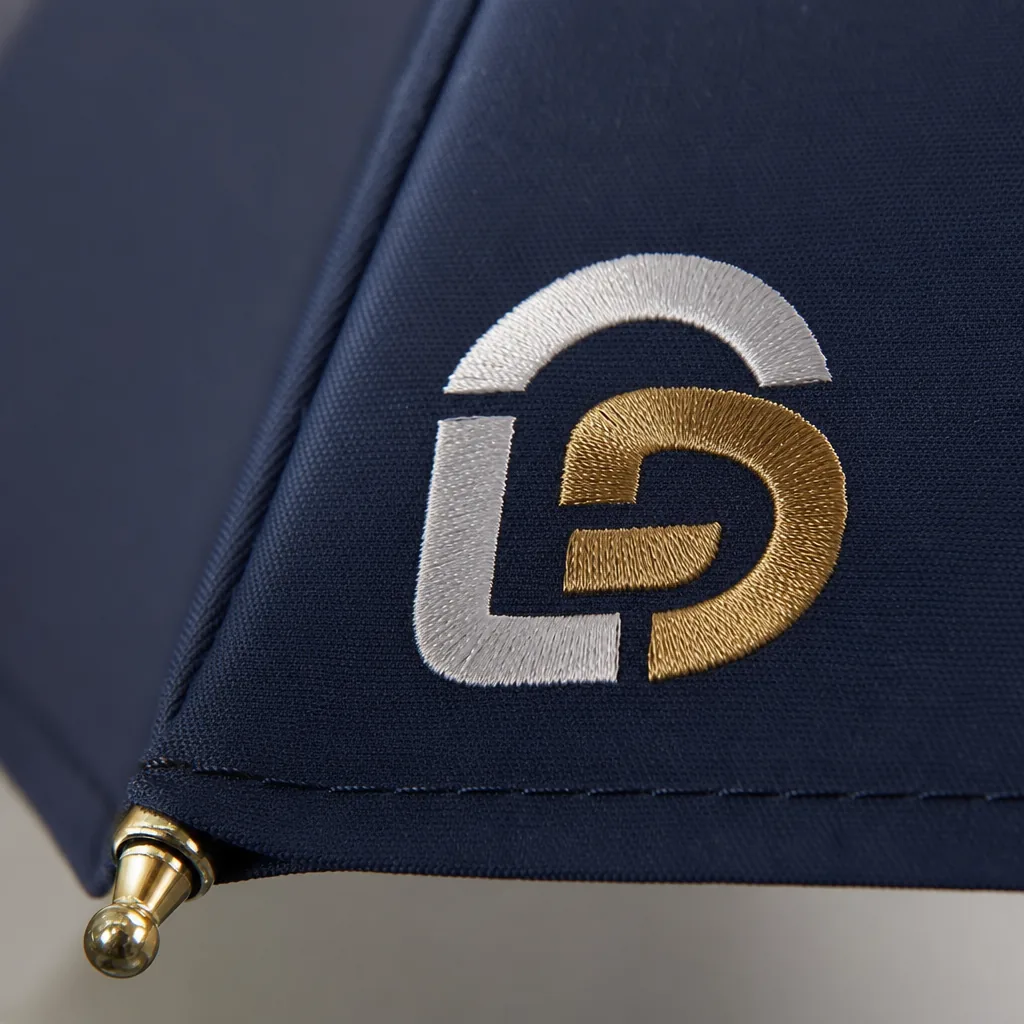
Choosing among debossing, engraving, and printing for umbrella branding parts affects more than appearance: it changes tooling cost, minimums, cycle time, and how the mark holds up on rubber handles, metal shafts, or woven straps. On the factory floor, each method has different depth control, setup tolerance, and material limits, so buyers who match the process to the specific component avoid rework, missed lead times, and inconsistent branding.
Which Umbrella Parts Can Carry Brand Marks
Beyond the canopy, the most practical umbrella branding parts are the handle cap, the handle body, the closure strap, the shaft, the runner button area, and a small woven badge sewn near the strap base or edge binding. On 21" and 23" compact folding umbrellas, the handle cap usually gives the cleanest result because the grip is short and broken up by the telescopic shaft. A debossed umbrella handle works best on EVA, rubberized ABS, and PU-wrapped grips; PU and softer rubber can take deeper detail, while glossy PP and other hard injection plastics usually give a shallower, lower-contrast mark. On 27" and 30" straight and golf umbrellas, straight handles and crook handles provide more usable area for debossing, pad printing, or a metal inlay, and the larger grip is easier to align consistently during assembly. For buyers comparing formats, compact styles support smaller, more discreet branding, while full-size manual and auto-open frames allow larger marks with fewer decoration compromises and lower setup risk.
An engraved umbrella shaft is worth considering only when enough shaft remains visible in normal use. On aluminum or steel shafts, laser engraving is realistic if the surface coating and wall construction can tolerate the mark, but on most 21" and 23" auto-open-close umbrellas the exposed shaft area is minimal once closed, so visibility is poor. Full-length straight umbrellas, especially 27" or 30" manual and auto-open golf styles, are stronger candidates because the lower shaft stays exposed. The runner button area can carry a small logo, but on 8K or 10K compact frames the button is often a very small ABS or plated zinc-alloy part, so branding stays subtle and painted finishes can scratch during cycle testing. The closure strap is often the best-value option in OEM umbrella branding: it stays visible in storage and suits one-color screen print, heat transfer, or a woven label on 190T or 210T pongee. On transparent POE, PVC, or EVA umbrellas, decoration usually narrows to the printed umbrella strap, woven badge, or hangtag, because clear canopies expose reinforcement patches and molded plastic handles rarely support premium marking. To reduce rejects at AQL 2.5, match each logo location to the frame type first and keep decoration clear of moving parts so button travel and opening performance are not affected.
Debossing, Engraving, and Part Printing Compared
Debossing is the right choice when umbrella branding parts include a soft-touch grip, especially a debossed umbrella handle in EVA foam or a PU-wrapped crook. A heated metal die compresses the surface to a controlled depth of about 0.3-0.8 mm, creating a recessed mark that outlasts surface ink under sweat, hand oils, and daily gripping. Material choice drives the result: PU wrap keeps sharper logo edges, while lower-density EVA can rebound after molding, making large solid marks look uneven. As a rule, strokes under about 1.2 mm and fine serif text are risky because the recess can close up. Color is the tradeoff. Debossing is effectively tone-on-tone unless you add foil fill or paint wipe, and those extra steps reduce the durability benefit. In use, repeated opening and closing is not the main failure point because the handle sees compression more than abrasion; the bigger risk is edge softening after prolonged heat exposure in cars or warehouses.
For hard parts, engraving gives the longest service life. An engraved umbrella shaft in aluminum or steel, along with wood crooks, beech handles, ferrules, or metal tips, carries a permanent mark with no ink film to chip. Laser engraving holds smaller text, finer lines, and QR-style geometry better than debossing, and it avoids steel-die cost on mid-volume OEM umbrella branding orders. Mechanical engraving cuts deeper on wood or thicker metal, but it needs rigid fixturing; on thin-wall shafts, poor setup can cause chatter. Finish matters: laser on powder-coated parts burns through to the base metal, anodized aluminum gives the cleanest contrast, and stainless usually needs a dark annealed mark for visibility. Color options remain limited to the substrate or burn contrast. Pad printing fits rigid plastic parts where color and speed matter more than maximum life: ABS end caps, top caps, safety runners, push buttons, and a printed umbrella strap tab or buckle area. It handles one- or two-color logos, Pantone matching, and white underbase on dark plastic, with practical MOQ starting around 500-1,000 pieces. Its weakness is cosmetic wear. On auto-open buttons or other touch points, standard ink can gloss, chip, or fade under fingernails and repeated thumb pressure unless the factory uses hardener and proper flame or corona treatment. Under repeated opening and closing, pad print usually degrades first visually, not structurally.
Material and Construction Choices That Affect Results
Material selection decides whether umbrella branding parts read as promotional-grade or retail-grade before any logo is applied. A debossed umbrella handle holds its shape best in beech, maple, crook-style solid wood, PU-wrapped wood, or dense molded EVA, where a 0.3 to 0.8 mm impression or laser mark stays clean at the edges. Low-density PP is cheaper, but it is a weak choice for premium decoration because heat and pressure can cause whitening, sink marks, and soft edge definition. EVA adds a softer hand feel and can still look upscale, provided foam density is uniform; if density varies, the logo rebounds unevenly after compression. For smaller components such as top caps, runners, and tips, ABS and nylon are usually more reliable than commodity PP for pad printing or UV printing because line control and ink adhesion are easier to keep consistent over production runs. For buyers, the tradeoff is straightforward: wood or dense EVA supports a stronger premium signal, while engineered plastics reduce print variability and rework risk at scale.
Construction limits where branding can go without creating failures. An engraved umbrella shaft is most practical on straight-stick steel or aluminum shafts with 14 mm to 16 mm outer diameters, where the surface is stable and there is more room to mark without affecting function. Folding umbrellas are tighter: 3-section and 5-fold telescopic shafts have more abrasion points, less clearance, and stricter nesting tolerances, so added thickness or deep marking creates more risk. Keep decoration away from spring holes, rivet stations, and auto-open latch zones; otherwise engraving can create stress risers, chip plating, or increase opening force. The same rule applies to printed umbrella strap artwork on 190T or 210T pongee with hook-and-loop: if the ink film is too thick, the strap can crack, block, or wrap stiff after repeated cycles. Fiberglass ribs outperform plain steel ribs for wind recovery and rust resistance, especially on 23 inch or 27 inch auto-open frames rated above 50 mph, but they are poor targets for decorative marking because flexing can fracture brittle coatings. Good OEM umbrella branding prioritizes cycle testing and AQL 2.5 inspection so the logo never compromises runner travel, canopy wear, or long-term mechanism reliability.
MOQ, Tooling, Sampling, and Production Timelines
For the fastest, lowest-risk launch, keep branding on stock umbrella branding parts and avoid changing part geometry. A printed umbrella strap, woven label, or pad-printed runner usually stays at MOQ 500 to 1,000 pcs because setup is limited to artwork screens, silicone pads, or laser files, not new molds. A debossed umbrella handle can also stay in a workable range if the factory already uses a handle with a leatherette wrap or soft TPR insert that accepts a brass stamp; in that case, MOQ is often about 1,000 pcs. The economics shift when the logo must be formed into a new ABS, PP, or wood-grain handle body. That typically means injection tooling, and MOQ moves to 3,000 to 5,000 pcs per style, sometimes higher if you also require Pantone-matched resin, separate inserts, or multiple surface textures. For buyers, the decision is straightforward: stock-part decoration reduces upfront cash, shortens approvals, and limits tooling risk; custom-molded parts make sense only when annual volume can absorb both the mold cost and the higher minimum.
Method affects both cost and lead time. An engraved umbrella shaft is usually simplest when laser marking a stock aluminum or black-coated steel tube; setup cost stays low and the process fits normal production flow. Deep mechanical engraving or etched stainless nameplates are slower because they need fixtures and tighter positioning. For OEM umbrella branding on molded tips, handle end caps, or badge medallions, new tooling charges commonly range from the hundreds to the low thousands of USD, depending on cavity count and surface texture. Sampling is where schedules slip most often: digital mockups usually take 1 to 2 days, pre-production samples on stock parts about 5 to 7 days, and first samples from new tools about 10 to 15 days after tool cutting. Once approved, bulk production is commonly 25 to 35 days for standard umbrellas, rising to 35 to 45 days when new molds, plated badges, or color-matched molded parts are involved. If the ship date is fixed, brand stock handles, straps, ferrules, or shafts first; custom-molded umbrella branding parts should follow only when the volume justifies the added lead time and tooling exposure.
Quality Control and Approval Standards for Branded Parts
Logo position causes more rejects on umbrella branding parts than print sharpness, so approval standards should lock orientation before production. Use a signed artwork sheet with reference points, viewing direction, and millimeter tolerances for each branded location: a printed umbrella strap centered within ±2 mm, a debossed umbrella handle aligned to the mold parting line within ±1.5 mm, and an engraved umbrella shaft clocked to face the push-button side when the umbrella is closed and tied. For OEM umbrella branding with multiple marks, add a logo map showing component code, Pantone reference, and assembly orientation. Pre-production approval should not stop at loose parts. Require dated photos and one fully assembled sample on the actual 21", 23", or 27" frame being produced, because shaft, handle, and strap alignment often shifts during assembly. This is the checkpoint that catches a common failure: engraving approved on a loose shaft but hidden under the runner or facing inward on the finished umbrella.
Printed parts need functional testing, not only visual sign-off under standard lighting. Screen-printed straps, pad-printed caps, and UV-printed nameplates should pass dry rub, wet rub, and tape adhesion checks, plus basic exposure to hand sweat, sunscreen, and rainwater. On a printed umbrella strap in 190T or 210T pongee, 20 to 50 abrasion cycles with a white cotton cloth is a practical baseline; reject visible ink transfer, edge lifting, or cracking. For an engraved umbrella shaft, inspect burrs, uneven depth, and inconsistent paint-fill or laser-blackened color. Set cosmetic inspection to AQL 2.5 with defect grading written in advance: critical for wrong logo or wrong brand color, major for crooked placement or incomplete print, minor for light scuffs outside the main viewing area. Inspect branded parts before assembly and again on packed umbrellas, since bulk packing often adds strap and handle scuffs.
Use four approval gates: artwork approval, branded-part approval, pre-production sample approval, and a sealed production sample retained for mass production comparison. Skipping separate branded-part approval increases replacement risk, because a defective debossed umbrella handle or custom strap often means remaking the accessory set instead of swapping one part. Replacement planning also changes by trade term. Under FOB, buyers commonly hold 1% to 3% spare components or extra umbrellas in their own warehouse because remaking custom handles, straps, or engraved shafts usually adds 20 to 35 days for branding, assembly, and export after cargo sails. Under DDP, replacement timing must also account for customs clearance and final-mile delivery. Before mass production, both sides should confirm who pays for remakes, whether partial air shipment is allowed for defective umbrella branding parts, and what claim evidence is required: dated photos, returned samples, or third-party inspection results.
Frequently Asked Questions
Does engraved branding last longer than printed branding on umbrella parts?
Usually yes on wood or metal components, because the mark is cut into the surface rather than sitting on top of it. Printed logos can still perform well, but they need the right ink system and QC checks for abrasion resistance.
Can folding umbrellas use the same handle branding methods as golf umbrellas?
Not always. Folding styles have smaller handles and tighter internal mechanism space, so logo area is more limited and some deep deboss or custom tooling options are less practical than on straight umbrellas.
When does a debossed handle require new tooling instead of using an existing mold?
If the logo is recessed directly into the handle shape, a new mold insert is usually required. Buyers typically see tooling charges from about $80 to $300 per handle design, with 7 to 15 days added before sample approval depending on material and logo size.
Is engraving better than printing for logos on umbrella shafts used in humid or outdoor conditions?
Yes, on aluminum or steel shafts, laser engraving generally lasts longer because it removes or marks the surface instead of adding ink. Printed shaft logos are lower cost for simple artwork, but they can wear faster from hand contact, abrasion, and moisture during repeated use.
What artwork limitations should buyers check before choosing strap printing?
Strap printing works best for one-color or simple two-color logos on narrow layouts, usually within a print area around 80 to 100 mm long depending on strap width. Very fine lines, gradients, and small text under about 5 pt often lose clarity, so suppliers normally confirm artwork by preproduction sample before mass production.
Looking to Launch Your Custom Umbrella Line?
ZheBrella is a Zhejiang-based OEM/ODM umbrella manufacturer with 17 years of export experience. Free design, low MOQ from 100 pieces, windproof construction, full-color print.
Get Free Quote Now »People Also Search For
Related Articles
Debossed, Engraved, or Printed Logos on Umbrella Handles
Compare debossing, engraving, and pad printing on umbrella handles by material, MOQ, cost, and durability for stronger b...
Read More »
Debossed, Engraved, or Printed Handles for Umbrella Branding
Evaluate debossed, engraved, and printed handle branding by material, durability, MOQ, and cost to select a logo treatme...
Read More »
Debossed, Engraved, or Printed: Branding Umbrella Handles
Compare debossed, engraved, and printed handle branding by material, MOQ, tooling, and lead time so buyers can match log...
Read More »