Double-Canopy Golf Umbrella Specs for Corporate Event Buyers
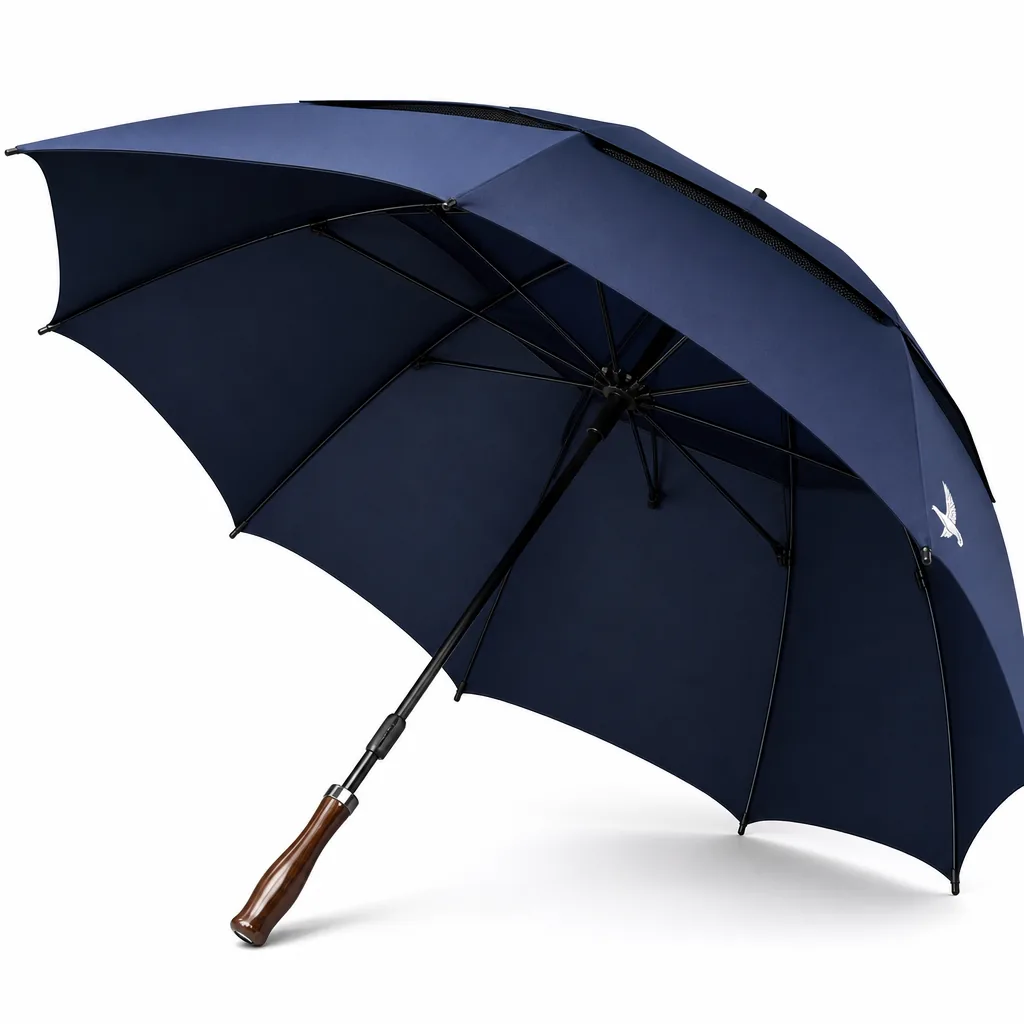
For corporate event buyers, the risk is not just choosing a golf umbrella that looks good on a mockup, but receiving cartons that arrive late, print inconsistently, or fail in the first windy parking-lot giveaway. On our Songxia production floor, double canopy golf umbrella specs come down to practical choices: rib material, vent construction, fabric weight, handle fit, packing method, and the QC points that keep a branded order consistent from sample to bulk shipment.
Why Corporate Events Choose Double-Canopy Golf Umbrellas
Corporate event umbrellas fail in public: golf tee boxes, VIP shuttle lines, stadium gates, resort activations, hospitality tents, and outdoor sponsor booths. A standard 23-inch rain umbrella usually gives one-person coverage and can invert when gusts hit an exposed venue. For tournaments and hospitality programs, a 60- to 68-inch arc double-canopy umbrella, typically using 30-inch ribs, covers two adults and leaves enough panel area for a readable sponsor logo. Practical double canopy golf umbrella specs should start with an 8K or 10K fiberglass rib frame, fiberglass shaft, 190T or 210T pongee canopy, and auto-open runner for one-handed use while guests carry badges, drinks, or gift bags. Compared with compact giveaways, this format costs more per unit but reduces replacement risk, improves guest experience, and keeps branding visible during the weather conditions that matter most.
A double-canopy build uses two fabric layers: a lower canopy and an upper canopy separated by a controlled vent gap. When wind pushes upward, air exits through the vent instead of loading the full canopy and flipping the frame inside out. That makes the double-canopy umbrella a safer choice for coastal golf courses, rooftop activations, open-air convention queues, and parking-lot arrivals where wind has room to accelerate. Frame and sewing quality decide whether the design works: uneven vent overlap, loose binding, weak rib tips, or unbalanced fabric tension can cause chattering, seam leakage, and frame twist. For a windproof golf umbrella OEM order, specify fiberglass ribs, reinforced tips, balanced canopy tension, and a tested wind rating, commonly 40 to 50+ mph depending on arc size and frame design.
For corporate event umbrellas, the buying case is operational, not decorative: the umbrella must stay open, protect guests, and present the sponsor mark cleanly through the event window. A branded event umbrella can use alternating-panel screen printing, full-panel heat transfer, or sublimation on white pongee when artwork requires gradients. At ZheBrella, we lock double canopy golf umbrella specs through a pre-production sample before mass production, checking vent symmetry, fabric tension, opening force, rib alignment, and logo registration. Bulk inspection follows AQL 2.5 so buyers can control risk before shipment. For fixed event dates, plan 7 to 10 days for sampling, 25 to 35 days for production after artwork approval, plus freight time under FOB Ningbo/Shanghai or DDP delivery to the venue warehouse.
Core Specs That Determine Field Performance
Start double canopy golf umbrella specs with the frame BOM, not the logo area. For 60 in. and 62 in. arc corporate event umbrellas, an 8K fiberglass rib structure is the safer default than steel because it cuts carry weight, rebounds better after inversion, and resists permanent bends at rib tips and stretchers. Steel ribs can reduce unit cost, but large outdoor canopies expose them to higher fatigue risk. Match the ribs to the shaft: use at least a 14 mm metal or fiberglass shaft for standard event programs, and move to a 16 mm fiberglass shaft for VIP gifts or retail-style builds where torsion resistance matters. Avoid 12 mm shafts on full-size golf umbrellas unless the order is mainly for indoor handout, photography, or short-term use.
Specify the canopy by fabric construction and coating compatibility, not only PMS color. 190T pongee fits cost-controlled branded event umbrella orders with moderate logo coverage; 210T pongee gives a denser hand, a smoother screen print or heat-transfer surface, and better resistance to pinholing around seams after repeated opening. On a double-canopy umbrella, vent geometry is a durability spec: the upper layer must overlap the lower canopy enough to block wind-driven rain, but leave enough exhaust area to prevent trapped air from loading the ribs. Many windproof golf umbrella OEM programs use double-canopy construction tested around 50 mph in controlled wind-tunnel conditions. Check grain direction and seam alignment on pre-production samples; off-grain vent panels can twist the open canopy, weaken the presentation, and affect closure.
The opening system affects both field failure risk and guest experience. Manual open remains the lowest-cost and most durable choice, but auto-open works better at shuttles, clubhouses, and registration tents when users have one hand occupied. For 60 in. to 68 in. golf umbrellas, auto-open requires a stronger spring, smooth runner travel, and a clean shaft notch that will not burr after cycling; weak mechanisms cause the half-open failure buyers notice first. ZheBrella cycle-tests production samples before bulk packing, especially when heavier 210T pongee and large logo panels add load. Choose handles by use case: EVA foam is light and comfortable, rubberized plastic looks sharper for retail, and straight wood feels premium but adds weight. Under AQL 2.5 inspection, verify opening force, lock stability, rib symmetry, vent spacing, print registration, and water shedding before shipment.
Size, Coverage, and Branding Trade-Offs
Treat size as a coverage and logistics specification, not an automatic upgrade. For corporate event umbrellas, the common golf range is 27" to 30" rib length, roughly 54" to 62" arc depending on panel cut and frame geometry. A 27" double-canopy umbrella is usually enough for one guest carrying a tote or laptop bag and can cover two people during a short transfer. A 30" frame suits golf outings, valet queues, sponsor tents, and outdoor conferences where guests stand in place. Going larger adds fabric cost, rib stress, packed length, and perceived bulk, so approve it only when the event use case justifies it. When reviewing double canopy golf umbrella specs, require both arc and open diameter; factories, distributors, and trading companies often describe the same frame by different measurements.
Oversizing becomes expensive at packing and freight. A 30" model with fiberglass ribs, EVA straight handle, and 190T or 210T pongee canopy presents well, but it usually fits fewer pieces per master carton than a 27" version and raises dimensional weight for DDP air or courier delivery. FOB Ningbo or Shanghai sea freight reduces that penalty, but fixed event dates often require partial air shipment. Before approval, check packed length, carton CBM, gross weight, and pieces per carton against the delivery plan, especially for 1,000-piece orders due in an 18- to 25-day window. Larger vented canopies also need a true windproof golf umbrella OEM frame: full fiberglass or fiberglass-steel hybrids are safer than low-cost steel ribs on wide double-canopy construction.
Larger canopies create more visible branding space, but artwork does not scale cleanly across a double-canopy umbrella. The upper vent, lower canopy, seams, rib-tip tension points, and panel curvature can break logos or distort straight lines. Keep large marks away from the crown, curved panel edges, and vent overlap. For a branded event umbrella, the safer layout is one or two large screen-printed or heat-transfer panel logos, smaller repeats on alternating panels, or a clean valance print for crowd visibility. Valance depth matters: too shallow limits artwork height; too deep adds weight and catches wind. Complete double canopy golf umbrella specs should list panel count, print method, maximum artwork area per panel, PMS color tolerance, and AQL 2.5 checks for print alignment, seam tension, and vent symmetry.
Order Planning: MOQ, Sampling, and Shipping Terms
For corporate event umbrellas, the event date controls the buying schedule. Work backward 75 to 100 days for a custom double-canopy umbrella: 5 to 7 days for artwork review and dielines, 7 to 12 days for a physical pre-production sample, 25 to 40 days for bulk sewing and assembly, then 25 to 35 days by ocean freight to the U.S. West Coast or 35 to 45 days to inland destinations after customs clearance and trucking. Air freight can cut transit to 5 to 10 days, but a 27" or 30" windproof golf umbrella with fiberglass ribs moves as bulky dimensional cargo, so freight cost rises quickly. Confirm the double canopy golf umbrella specs before sampling: 27" or 30" size, 8K or 10K rib structure, shaft material, handle type, 190T or 210T pongee canopy, vent construction, print method, carton dimensions, and packing ratio. Any post-approval change, including moving from 190T to 210T pongee or upgrading rib count, usually resets both pricing and delivery.
MOQ depends on how far the branded event umbrella departs from an existing frame. For a stock 27" or 30" double-canopy umbrella with one-panel screen printing, a practical MOQ is often 300 to 500 pieces per design. For PMS-dyed canopy fabric, custom molded handles, retail cartons, reinforced tips, shaft changes, or a full windproof golf umbrella OEM build, plan for 1,000 to 3,000 pieces. Treat the pre-production sample as the production control sample, not a loose visual mockup. It should confirm logo size, print opacity on dark pongee, canopy vent alignment, opening force, runner smoothness, rib-end stitching, handle fit, and carton drop resistance. At ZheBrella, we seal one approved sample for the sewing line and one for final AQL 2.5 inspection. That reduces subjective defect disputes when corporate event umbrellas arrive days before a tournament, campus event, sales meeting, or Q4 gifting deadline.
Use FOB when the buyer already has a freight forwarder, container consolidation plan, or multiple China suppliers shipping together. FOB gives the distributor control over freight, insurance, sailing schedules, and customs brokerage, but someone must track vessel changes, port congestion, customs holds, and final delivery appointments. Use DDP for time-sensitive event deliveries when the buyer needs one landed cost to a hotel, warehouse, university, golf course, or convention center. DDP reduces coordination risk, but the quote depends on accurate carton dimensions, gross weight, delivery address, and HS code classification before booking. Peak season changes the schedule. Before spring tournaments, summer promotions, and Q4 corporate gifting, bulk production can stretch from 30 days to 45 or 60 days. Lock the double canopy golf umbrella specs before sample approval, avoid late artwork revisions, and reserve a 10 to 14 day buffer for customs exams, weather delays, and domestic trucking.
Inspection Standards for Event-Ready Shipments
Lock the pass/fail standard before mass production, not at the port. For event shipments, the most useful double canopy golf umbrella specs are an approved pre-production sample, a one-page QC checklist, and an AQL 2.5 sampling plan agreed in writing. On each sampled unit, run 10-20 open/close cycles and record runner travel, spring force consistency, safety-notch engagement, and shaft straightness after cycling. For a 30-inch double-canopy umbrella, inspect vent alignment panel by panel; even 3-5 mm drift between the upper and lower canopy is visible in event photos and can compromise airflow. Add rib symmetry, ferrule seating, top-cap tightness, handle glue bond, and overall frame balance to the checklist. Buyers of corporate event umbrellas should also confirm smooth opening with no sticking, no pinched fabric at the runner, and no exposed sharp points at rib tips or stretchers. These checks are fast to repeat, easy to document, and directly reduce rework, claims, and last-minute hand sorting at the venue.
Apply the same discipline to print, fabric, and packing. Measure print registration from panel seams and vent cut lines, especially on 190T or 210T pongee, where sewing tension can pull logos off center after assembly. Standard screen print may hold within a few millimeters, but artwork placed close to vent edges needs tighter control because misregistration becomes obvious once the canopy is fully open. Test water repellency with a spray rating or controlled shower test after coating cure; the fabric should bead and shed water evenly across all panels, whether the finish is standard water repellent or Teflon-treated. For a branded event umbrella with UV coating, verify post-cure color shift on dark shades such as navy and black. Packing inspection matters just as much: check assortments by venue, event date, or sponsor SKU, not just total quantity, because that is where wrong-logo mixes create the highest event risk. Cartons should pass a basic transit drop test—one corner, three edges, and six faces from practical handling height—since 23-inch to 30-inch umbrella cartons fail quickly when board strength or staple count is weak. If goods ship FOB, carton marks must support destination resorting; if DDP goes direct to venues, pallet labels and carton sequence are part of quality control, not separate logistics.
Frequently Asked Questions
Are double-canopy umbrellas always better for windy events?
They usually perform better in gusts because the vented upper canopy helps release wind pressure. However, the frame still matters, and fiberglass ribs generally outperform steel when flexibility is critical.
What canopy fabric is better for branded event golf umbrellas, 190T or 210T pongee?
190T pongee is common for promotional event orders and balances cost with printability. 210T pongee offers a denser hand feel and can support a more premium retail or sponsor-gift presentation.
What umbrella size works best for sponsor visibility at outdoor corporate events?
For most corporate events, a 27-inch to 30-inch golf umbrella with a 60-inch to 68-inch arc gives the best balance of logo visibility and usability. Larger canopies show artwork better but also increase carton size and freight cost.
What wind-resistance specification should buyers request for a double-canopy event umbrella?
Ask the factory to define the frame construction and test standard, not just say "windproof." A practical B2B spec is a fiberglass shaft or ribs, double-canopy vented design, and internal wind-testing data in the roughly 30-40 mph range, depending on frame size.
How should QC be handled before shipping branded umbrellas for an event deadline?
For time-sensitive event orders, buyers usually require a pre-production sample, in-line logo check, and final random inspection based on AQL before balance payment. Confirm carton counts, opening/closing function, print color consistency, and rust or fabric defects at least 5-7 days before shipment.
Looking to Launch Your Custom Umbrella Line?
ZheBrella is a Zhejiang-based OEM/ODM umbrella manufacturer with 17 years of export experience. Free design, low MOQ from 100 pieces, windproof construction, full-color print.
Get Free Quote Now »People Also Search For
Related Articles
Double-Canopy Golf Umbrella Build Guide for Buyers
Learn how double-canopy golf umbrellas are built, which rib specs improve wind resistance, and what buyers should ask fo...
Read More »
Single-Canopy vs Double-Canopy Umbrellas for Buyers
Compare single- and double-canopy umbrellas for sourcing decisions on wind performance, cost, weight, print options, and...
Read More »
Double-Canopy Umbrellas for OEM Orders: Spec Guide
Learn how to specify double-canopy umbrellas for OEM orders, from vent gaps and rib materials to print limits, MOQ, QC, ...
Read More »