Retail Umbrella Assortment Planning: Specs by Price Tier
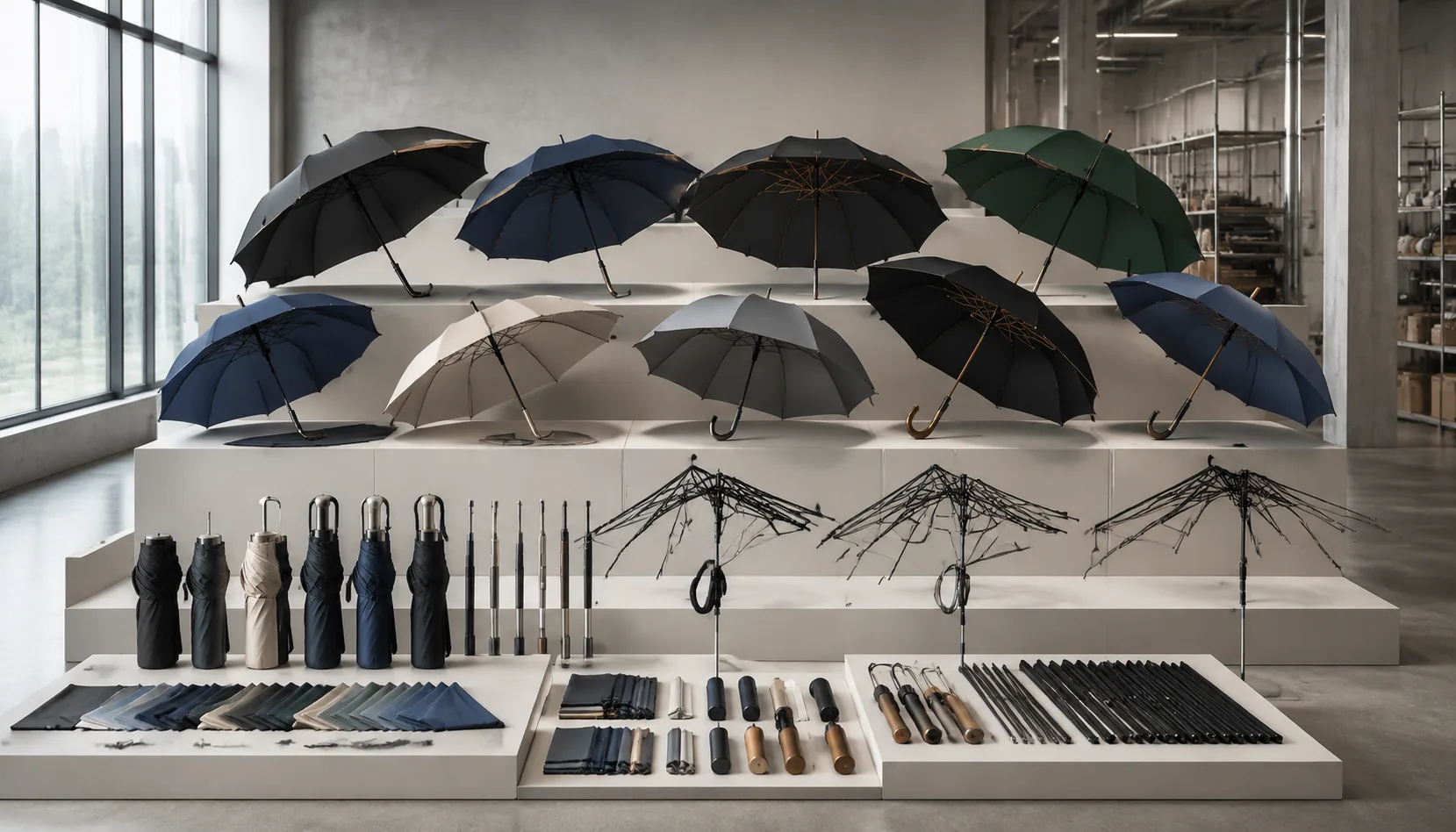
Retail umbrella assortment planning gets difficult when a buyer has to balance shelf price, MOQ, fabric grade, frame strength, and packaging across 3-fold, stick, and golf models. On our Songxia production floor, the problems usually appear before mass production: one tier is overbuilt, another cannot pass wind or leakage checks, and FOB targets drift after artwork, cartons, and QC gates are added.
Map Buyer Use Cases Before Choosing Models
Start retail umbrella assortment planning with use cases, not colors, because the frame and canopy spec decide whether a SKU earns repeat orders or becomes a return problem. For daily commute, I usually put a 21" or 23" 3-fold compact at the entry and mid tiers: steel shaft with steel ribs for opening-price retail, then fiberglass ribs or mixed steel/fiberglass for better wind recovery. A 190T pongee canopy is enough for supermarkets and convenience chains, while 210T pongee with Teflon water-repellent coating feels noticeably drier in department stores. Manual open keeps cost down, but auto-open is worth it when the target retail price is above about $12.99. If the buyer wants private label umbrellas for a branded rainwear line, reserve one neutral black/navy commute model and one seasonal print model so inventory does not fragment too early.
Travel umbrellas need a different spec tier because the customer is buying packability first and storm performance second. A 21" 3-fold auto-open-close model with 8K ribs, a metal/fiberglass frame, and sleeve packaging works well for airport shops, museum stores, hotel retail, and online bundles. Keep the canopy at 190T or 210T pongee; avoid cheap polyester if the brand promise is premium, because it wrinkles hard after compression. For executive gifts, move away from tiny compacts and use a 23" straight stick or 23" 3-fold with rubberized handle, matte black shaft, 10K fiberglass ribs, and subtle one-position screen print or heat-transfer logo. This is where umbrella spec tiers matter: a $4 FOB compact and a $9 FOB executive umbrella may look similar in photos, but the hand feel, opening speed, rib recovery, and AQL 2.5 defect rate after packing are not the same.
Family and golf/outdoor SKUs should carry the top end of the assortment because size and wind resistance are visible value. For family retail, a 23" or 27" straight stick with auto-open, 8K or 10K fiberglass ribs, safety runner, and POE or pongee canopy works for school runs and car storage; clear POE sells well in lifestyle channels, but it scratches more easily than pongee. For golf and outdoor, use 27" or 30" double-canopy vented windproof models, preferably 8K fiberglass shaft and ribs, EVA or straight foam handle, and 210T pongee with optional UV coating rated UPF 50+. Our standard practice at ZheBrella is to confirm wind-tunnel targets early, such as surviving 50+ mph gusts, because changing rib material after sampling can reset tooling and add 7 to 10 days. For wholesale umbrella MOQ, plan 600 to 1,200 pieces per color for custom canopy printing and 2,400+ pieces when handle or frame colors are private-molded.
Build Good-Better-Best Spec Tiers
Good-better-best only works when the spec differences are visible to the shopper and measurable for the buyer. For the entry tier, I usually keep it honest: 21" or 23" stick umbrellas, 8K steel ribs, steel shaft, manual or basic auto-open, and 190T pongee with a standard water-repellent finish. This is the tier for convenience retail, checkout bins, tourist shops, and low-cost event programs where the target FOB may be tight and the failure tolerance must still pass AQL 2.5 inspection. Do not overbuild this umbrella; spending money on 16K ribs while keeping a thin handle, weak runner, or low-grade sewing thread is wasted. In retail umbrella assortment planning, the entry item should survive normal city rain, open cleanly after 500-cycle testing, and look consistent in color across cartons. For private label umbrellas, this tier often carries a one-color logo, woven label, and simple sleeve because packaging upgrades can add more perceived value than hidden frame changes.
The better tier is where the assortment starts to earn margin. Move to 23" or 27" canopies, 8K or 10K fiberglass ribs, a stronger steel or aluminum shaft, smoother auto-open, and 190T or 210T pongee depending on retail price. Fiberglass ribs matter because they recover after inversion better than steel, especially on golf, commuter, and campus umbrellas. If the umbrella is part of a branded rainwear line, I would rather specify 210T pongee, color-matched tips, a rubberized handle, and a decent Velcro strap before jumping to exotic features. This is also the tier where umbrella spec tiers should be tied to packaging and replenishment logic: black, navy, and one seasonal color can carry stock, while prints should be ordered against forecast because wholesale umbrella MOQ for custom panels may run 500–1,000 pieces per design. A buyer who treats every color equally usually ends up with dead inventory in the slow shades.
Premium tiers should feel different the moment the customer opens the umbrella. Use 16K fiberglass ribs or a reinforced 8K/10K windproof frame, 210T pongee with Teflon or UPF 50+ coating, auto-open or auto-open-close mechanisms, and a larger 27" or 30" canopy where the channel supports it. Double-canopy vented windproof construction is worth the added cost for golf umbrellas, coastal stores, airport retail, and brands promising storm performance; it can help a frame survive 50+ mph wind-tunnel testing when rib geometry, runner strength, and canopy tension are engineered together. It is not always worth it on compact fashion umbrellas, where the extra sewing, vent alignment, and fabric weight can reduce margin without improving the shopper’s decision. For retail umbrella assortment planning, I like premium SKUs to justify their price with three clear claims: stronger frame, better fabric, and better weather performance. If those claims are not printed on the hangtag, the added factory cost often stays invisible on the shelf.
Set Color, Logo, and Packaging Rules by SKU
Color rules should be locked before sampling, not argued after bulk fabric arrives. For retail umbrella assortment planning, I recommend each SKU carry one approved Pantone TCX or TPX reference, plus an allowed Delta E tolerance if the buyer has a lab standard. Dark navy, black, forest green, and burgundy are forgiving on 190T pongee; light yellow, mint, and cream show shade variation faster, especially across 8K compact and 16K golf umbrella programs using different fabric lots. Budget SKUs should stay simple: one canopy color, one handle color, one ferrule color, and no mixed rib finishes unless the volume supports separate purchasing. If you are building private label umbrellas for chain retail, keep the same color name across the branded rainwear line, but do not assume the same dye recipe works on pongee, POE, PVC, and EVA materials.
Logo rules are where many umbrella spec tiers lose margin. Entry-price 21" or 23" manual umbrellas should usually use one-position, one-color screen printing on a single panel, placed 120-150 mm above the edge depending on panel shape. That keeps setup cost, registration risk, and AQL 2.5 appearance failures under control. Mid-tier auto-open and auto-open-close models can support two-panel logos or a small sleeve logo if the wholesale umbrella MOQ is at least 1,000-2,000 pieces per design. Premium 27" or 30" double-canopy vented golf umbrellas are the right place for multi-panel printing, heat-transfer gradients, or full sublimation, but only after confirming seam alignment, panel shrinkage, and whether the artwork crosses rib lines. Our standard practice at ZheBrella is to approve printed fabric panels before cutting, because checking logo scale on a finished umbrella is already too late.
Retail packaging must be specified by SKU as tightly as the frame, because stores reject cartons for boring mistakes. Each umbrella should define sleeve material, sleeve logo position, hangtag size, barcode type, country-of-origin wording, warning label, and whether the tag is tied to the wrist strap, runner, or sleeve zipper. For supermarkets and club stores, inner cartons often need fixed assortments such as 6 pieces per color or 12 pieces mixed, with master cartons marked by SKU, color, quantity, gross weight, net weight, and carton dimensions. For FOB programs, buyers may accept factory-standard five-ply export cartons; for DDP retail delivery, carton drop strength and scannable GS1 barcodes matter more because the goods pass through more warehouses. A clean packaging matrix prevents the common failure where the umbrella is correct, but the sleeve, UPC, or inner-carton assortment does not match the purchase order.
Plan MOQ, Sampling, and Production Windows
MOQ is not one number; it is driven by the part that forces the factory to stop, change tooling, or buy material separately. For a straight 23" auto-open umbrella with steel shaft, 8K steel ribs, and stock 190T pongee colors, a practical wholesale umbrella MOQ can be 500–1,000 pcs per color because fabric and frames are already flowing. Move to a 27" golf umbrella with fiberglass ribs, double-canopy venting, or 16K construction, and the MOQ often rises to 1,000–3,000 pcs because rib sets, runners, tips, and canopy panels are not interchangeable. Custom-dyed 210T pongee usually needs 2,000–3,000 pcs per Pantone color to justify dye-lot control. POE, PVC, and EVA clear canopies have different logic: MOQ is more about roll width, film thickness, and anti-stick packing than color, so small retail umbrella assortment planning should use stock transparent or frosted film before chasing custom tints.
Print method changes the MOQ almost as much as the frame. One-position screen printing on a stock 21" or 23" manual umbrella can run at 500 pcs if the logo is simple and ink coverage is modest. Heat-transfer logos normally start around 500–1,000 pcs, but large transfers on every panel add labor and rejection risk from misalignment. Full-panel sublimation is a different umbrella spec tier because it needs white polyester fabric, digital artwork control, panel cutting after printing, and tighter sewing matching; I would not plan below 1,000 pcs per design unless the buyer accepts a higher unit price. For private label umbrellas, keep the first branded rainwear line disciplined: one shared frame, two or three canopy colors, and controlled logo placements. That lets the factory consolidate components while the buyer still gets retail variety across opening mechanisms, such as manual, auto-open, and auto-open-close.
Sampling should be scheduled before the retail calendar is locked, not after the purchase order is already late. A blank pre-production sample using stock parts usually takes 5–7 days; a logo sample with screen print or heat transfer is more often 7–10 days after vector artwork and Pantone references are confirmed. Sublimation, custom woven labels, color-matched handles, or UPF 50+ / Teflon-coated fabric can push sampling to 10–15 days because the factory must verify color, coating hand-feel, seam tension, and packed appearance. Our standard practice at ZheBrella is to start production timing only after deposit, final artwork, and signed sample approval are complete. Normal production is 25–45 days, with 25–30 days for stock-frame promotional runs and 35–45 days for multi-SKU retail assortments. Add 3–5 days for AQL 2.5 inspection, carton marking, and FOB Ningbo/Shanghai booking; DDP orders need extra buffer for customs documents and destination delivery appointments.
Use QC Standards to Protect the Whole Line
AQL 2.5 final inspection is where retail umbrella assortment planning stops being a spreadsheet exercise and becomes risk control. For a mixed good-better-best line, I would use one master QC checklist across all umbrella spec tiers, then tighten or loosen pass criteria by price point. Canopy stitching gets checked for skipped stitches, seam puckering, loose threads over 5 mm, panel symmetry, and tip reinforcement security. Rib alignment is checked with the umbrella fully opened on a flat surface: 8K steel economy frames may allow minor visual waviness, but 10K fiberglass or 16K windproof frames should sit evenly without twisted ribs or exposed wire. Runner function must be smooth, with no catching at the notch, no sharp burrs, and no handle wobble after repeated opening.
Auto-open reliability deserves its own sampling discipline because it is one of the first defects a shopper notices in store. On manual umbrellas, we cycle the runner 10 times per inspected unit; on auto-open and auto-open-close models, we cycle the button mechanism 20 times and reject units with delayed release, weak spring force, incomplete lock, or unsafe rebound. For vented double-canopy umbrellas rated for 50+ mph wind-tunnel claims, rib flex and recovery must be tested after inversion, not just visually inspected. Fabric checks should include 190T or 210T pongee density, Teflon water repellency, UPF 50+ coating confirmation when specified, and no oil marks from frame assembly. POE, PVC, and EVA clear canopies need extra review for crease whitening and edge cracking.
Color matching and carton labeling protect the whole branded rainwear line, not just one SKU. Private label umbrellas should be checked against approved Pantone or lab dip standards under D65 light, with tighter tolerance for retail fashion colors than for black, navy, or gray promotional basics. Print QC should cover screen ink adhesion, heat-transfer edge lift, sublimation sharpness, logo placement tolerance, and barcode readability. Cartons need correct SKU, color, size such as 21 inch, 23 inch, 27 inch, or 30 inch, quantity, gross weight, PO number, destination marks, and any FOB or DDP routing labels. Our standard practice at ZheBrella is to keep the same inspection flow for all tiers, while adjusting defect severity and sampling focus by wholesale umbrella MOQ, order value, and retail consequence.
Frequently Asked Questions
How many umbrella styles should a new retail brand launch first?
Most buyers start with 3-5 SKUs: one 3-fold compact, one straight umbrella, one golf umbrella, and 1-2 color or print variations. This keeps MOQ and inventory risk manageable while covering the main customer use cases.
Can different price tiers share the same canopy fabric?
Yes. Many brands use 190T pongee across entry and mid-tier umbrellas, then upgrade premium SKUs with 210T pongee, fiberglass ribs, double-canopy vents, or better handles.
What is a practical starting assortment for a new private-label umbrella line?
A common starter range is 3 to 5 SKUs: one 3-fold compact, one stick umbrella, and one golf umbrella, each split into good-better-best spec tiers. That gives enough variety for retail testing without overextending inventory.
How do MOQ and pricing usually vary by umbrella tier?
Lower-tier 3-fold umbrellas often support smaller MOQs and lower FOBs, while stick and golf models usually need higher MOQs because of larger frames and canopy fabric usage. Many factories quote by tier, finish, and panel count, so final pricing depends on handle material, shaft strength, and print coverage.
What QC gates should a buyer request before shipment?
For a retail program, ask for frame opening/closing tests, wind-resistance checks, canopy stitch inspection, and printing alignment approval before mass packing. Buyers usually also request a pre-shipment AQL inspection with carton drop and barcode verification.
Looking to Launch Your Custom Umbrella Line?
ZheBrella is a Zhejiang-based OEM/ODM umbrella manufacturer with 17 years of export experience. Free design, low MOQ from 100 pieces, windproof construction, full-color print.
Get Free Quote Now »People Also Search For
Related Articles
Retail Umbrella Assortment Planning: SKU Specs That Sell
Plan retail umbrella SKUs by size, rib count, fabric, packaging, and MOQ to balance shelf price, durability, and repleni...
Read More »
Private Label Umbrella Line Planning for Retail Buyers
Plan a retail-ready umbrella line with good-better-best specs, MOQ tiers, fabrics, rib counts, packaging, and lead-time ...
Read More »
Private Label Umbrella Line Planning: SKUs, Specs, and MOQ
Plan a private label umbrella range with smart SKU tiers, shared frames, MOQ control, lead times, and specs that protect...
Read More »