Private Label Umbrella Line Planning for Retail Buyers
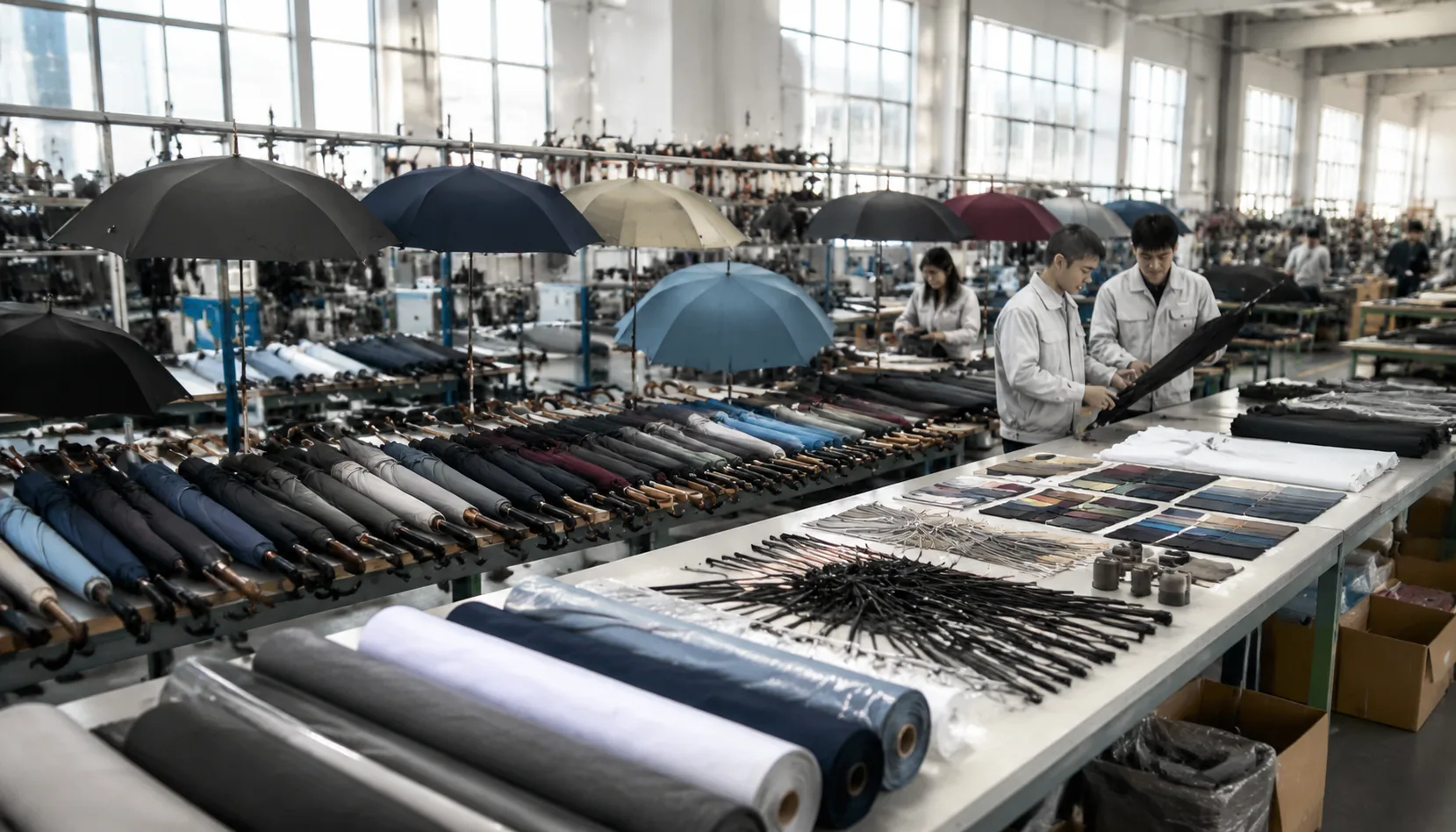
Retail buyers often lose margin before the first PO is placed: too many SKUs, mismatched rib counts, fabric upgrades that do not show at shelf, and packaging costs added after pricing is approved. As a private label umbrella manufacturer in Songxia, we plan good-better-best lines by working backward from target retail, carton efficiency, MOQ breaks, print methods, and the production checkpoints that control lead time.
Build a Good-Better-Best Product Ladder
A good-better-best ladder only works when each tier has a clear mechanical reason to cost more. For the entry tier, I usually recommend a 23 inch or 27 inch 8K steel frame with 190T polyester, manual-open or basic auto-open, straight plastic handle, and single-color canopy printing. Steel ribs keep the FOB price low, but buyers should understand the tradeoff: heavier hand feel, less rebound after inversion, and weaker corrosion resistance if the plating is thin. This tier is useful for price-point retail, tourist shops, campus stores, and emergency rain programs where the shelf ticket matters more than long service life. As a private label umbrella manufacturer, we would lock the entry spec tightly: rib thickness, shaft gauge, runner material, tip attachment, and 190T fabric weight tolerance must be written into the PO, not left as “standard.” That is how you prevent a cheap umbrella from becoming a return problem after the first windy weekend.
The better tier should not be just a nicer logo on the same frame. Move to an 8K fiberglass rib set, 190T pongee canopy, smoother auto-open mechanism, and a more comfortable EVA, rubberized, or matte plastic handle. Pongee has a tighter feel than basic polyester, sheds water better with a Teflon-style coating, and looks more retail-ready under store lighting. Fiberglass ribs are the key upgrade because they flex and recover instead of taking a permanent bend like low-cost steel. For a balanced retail umbrella assortment, this is usually the volume driver: 21 inch folding auto-open-close for handbags, 23 inch stick umbrellas for commuters, and 27 inch golf-style models for outdoor use. In umbrella MOQ planning, I would put the largest color spread here because mid-tier sell-through supports the line. Typical OEM umbrella specs should include AQL 2.5 inspection, 48-hour opening-cycle checks, colorfastness review, and carton drop testing before shipment.
The best tier needs visible and testable upgrades, not vague “luxury” language. A premium 16K fiberglass frame gives a rounder canopy shape, better load distribution, and a more substantial feel in hand; pair it with 210T pongee, double-canopy venting, reinforced rib joints, and either high-grade water-repellent finishing or UPF 50+ coating for sun-and-rain positioning. For golf and storm models, 27 inch and 30 inch sizes with vented construction can be designed to survive 50+ mph wind-tunnel testing when the runner, stretcher, and rib geometry are engineered correctly. For urban premium folding umbrellas, 10K or 16K fiberglass with auto-open-close and a black electroplated shaft often makes more sense than oversizing the canopy. This is where good better best umbrellas become easy for retail staff to explain: entry is price, better is durability, best is weather performance and finish. A disciplined private label umbrella manufacturer will keep the visual language consistent while changing the frame, fabric, coating, and mechanism by tier.
Match Umbrella Formats to Store Channels
Format choice should follow the channel, not the catalog photo. Supermarkets sell best with fast-grab, low-confusion SKUs: 21" or 23" straight umbrellas with manual or auto-open shafts, 8K steel ribs, 190T pongee or PVC canopy, and a retail sleeve that survives shelf handling. Department stores can carry a wider retail umbrella assortment because shoppers compare handle feel, canopy color, and opening action; this is where 23" straight, 3-fold auto-open-close, and 27" executive models make sense. Specialty retail should not chase every size. A bike shop, museum store, or outdoor boutique usually does better with one sharper story: fiberglass ribs, Teflon water-repellent coating, UPF 50+ black coating, or a double-canopy vented windproof build rated around 50+ mph in a controlled wind-tunnel test.
3-fold umbrellas are the workhorse for daily commuters and online replenishment, but mechanism choice changes sell-through. Manual 3-fold models hit opening price points and reduce warranty claims because the runner and spring system are simple. Auto-open 3-fold umbrellas feel better in supermarkets and department stores where the shopper tests the button in the aisle. Auto-open-close sells strongest in e-commerce bundles and department-store gift tables because the function is easy to explain in one product video, but buyers should budget for stricter inspection: button force, shaft lock, closing rebound, and 300-cycle open-close testing. As a private label umbrella manufacturer, our standard practice is to separate good better best umbrellas by frame first, not just fabric: steel 8K for good, fiberglass 8K/10K for better, and vented double-canopy fiberglass for best.
Golf umbrellas belong where the customer expects coverage, not pocketability: sporting goods, club shops, corporate gifting, and premium e-commerce bundles. A 27" or 30" golf umbrella with 8K or 16K fiberglass ribs, EVA foam handle, 210T pongee canopy, and manual or auto-open runner can carry a higher ticket if the carton, hangtag, and color story look retail-ready. Mini travel umbrellas fit checkout lanes, travel stores, and online two-packs, but the complaint rate rises if the buyer over-specifies auto-open-close on a tiny 6-rib frame. For umbrella MOQ planning, keep the first season tight: 2–3 colors per format, one shared logo position, and unified OEM umbrella specs for fabric, coating, carton drop test, and AQL 2.5 inspection. A practical launch often starts at 600–1,200 pcs per SKU for factory efficiency, with 30–45 days production after artwork and sample approval.
Set MOQ, Color, and Size Rules Early
MOQ should be set from the frame upward, not from the artwork downward. A 23" auto-open stick umbrella with steel shaft and 8K fiberglass ribs can usually share a frame across several canopy colors, while a 21" auto-open-close compact, a 27" golf umbrella, and a 30" double-canopy vented model each sit on different component programs. For a retail umbrella assortment, I normally separate MOQ by frame type first: 500-1,000 pieces for standard manual or auto-open stock frames, 1,200-3,000 pieces for auto-open-close compacts, and higher if the buyer wants a special runner, handle mold, or 10K/16K rib structure. A private label umbrella manufacturer will push for this logic because ribs, shafts, tips, ferrules, springs, and sleeves are purchased and staged by construction, not by the buyer’s merchandising story.
Color rules matter because fabric is where small SKUs quietly become expensive. Stock 190T or 210T pongee in black, navy, red, royal blue, and forest green can often run at lower MOQ because the fabric mill and dye house already carry repeat batches. Custom-dyed pongee, recycled PET, POE, PVC, or EVA canopy material usually needs 1,000-3,000 meters per color, and that can translate into 1,500-5,000 umbrellas depending on size, panel count, and cutting efficiency. Pantone-matched handles, coated shafts, colored tips, or branded soft-touch grips raise MOQ for the same reason: plastic injection, spray coating, and color masterbatch all need setup time, purge loss, and approval samples. For good better best umbrellas, keep the “good” tier on stock colors, reserve custom color for the “better” hero SKU, and spend special molds only on the “best” line.
Print process should be locked before final umbrella MOQ planning because screen printing, heat transfer, and sublimation do not consume inventory the same way. One-color screen logos on 8 panels are efficient at 500 pieces if the canopy fabric is stock; full-panel heat transfer is better when artwork varies by panel but adds film, alignment, and rejection risk; sublimation works best on white polyester and usually makes sense when the whole canopy design is the product. Our standard practice at ZheBrella is to consolidate OEM umbrella specs around two or three frame platforms, then let color and print create the retail story. For example, one 21" compact, one 23" stick, and one 27" golf frame can support 6-9 SKUs without opening unnecessary tooling. Buyers who approve too many sizes, handle shapes, and Pantone colors early often pay for leftover ribs, odd fabric rolls, and slow AQL 2.5 inspection because every micro-SKU has its own defect profile.
Specify Packaging for Retail Readiness
Retail readiness starts with packaging dimensions, not the last-minute artwork file. A 23" auto-open stick umbrella with a 190T pongee canopy may look finished in a poly sleeve, but retail buyers usually need a matched fabric sleeve, printed hangtag, UPC/EAN barcode sticker, warning label, and sometimes a color-coded size sticker for store replenishment. Folding umbrellas need tighter control: a 21" auto-open-close compact packed in a PET box looks premium, but the box can double the single-unit volume compared with a sleeve-and-hangtag pack. For a retail umbrella assortment, I normally separate packaging by tier: basic manual 8K steel models in OPP sleeves, mid-tier fiberglass 8K or 10K models with woven sleeves and hangtags, and good better best umbrellas at the top end in kraft boxes, window boxes, or gift cartons with printed care cards.
Inner cartons and master cartons decide whether the DDP quote survives contact with the warehouse. A common packing method is 12 pieces per inner carton and 48 or 60 pieces per master carton for compact umbrellas; golf umbrellas in 27" or 30" sizes often run 12 or 24 pieces per master because rib length and handle shape waste space. Every packaging choice changes CBM: adding a PDQ tray for a 12-piece counter display may improve sell-through, but it can raise carton volume by 15–30%, which directly affects ocean LCL, air freight, and last-mile delivery cost. Master carton markings should show PO number, SKU, color, quantity, gross/net weight, carton size, country of origin, and barcode if the retailer’s DC requires scan-in receiving. Our standard practice at ZheBrella is to lock carton specs before quoting FOB or DDP, because a 2 cm carton height change across 1,000 cartons is not a small cost.
A private label umbrella manufacturer should ask for the buyer’s routing guide before sampling, not after production. Large retailers often specify carton burst strength, maximum carton weight under 15–18 kg, pallet height limits, GS1-128 labels, suffocation warnings, and retail barcode placement within a fixed tolerance. These rules matter as much as OEM umbrella specs like fiberglass ribs, Teflon coating, UPF 50+ fabric, or a windproof double-canopy frame rated for 50+ mph. For umbrella MOQ planning, packaging also creates hidden minimums: custom hangtags may start at 1,000–3,000 pieces, printed sleeves at 3,000–5,000, PDQ displays at 500–1,000, and offset-printed gift boxes often need higher runs to avoid ugly unit costs. A serious private label umbrella manufacturer will build these thresholds into the line plan so the shelf presentation, freight math, and inspection under AQL 2.5 all match the retail launch calendar.
Control Sampling, Inspection, and Reorders
Sampling control starts with a spec sheet that is boring on purpose: size, panel count, rib count, shaft material, canopy fabric, coating, handle, runner, tips, strap, sleeve, barcode position, carton mark, and test standard. For a retail umbrella assortment, I want every SKU defined before artwork work begins: 21" auto-open-close compact with 190T pongee, 23" stick umbrella with 8K fiberglass ribs, 27" golf umbrella with double-canopy venting, or 30" event model with 10K steel/fiberglass hybrid frame. A serious private label umbrella manufacturer should turn that into a counter sample in 5–7 days if existing frames and fabric are used, or 10–15 days if color-dyed pongee, custom molded handles, or new heat-transfer films are required. The buyer should approve not just the look, but the opening force, rib rebound, seam tension, print registration, water repellency, UPF 50+ label claim if used, and packed weight.
The pre-production sample is the real checkpoint, not the showroom sample. After PO confirmation and deposit, we cut fabric from the booked bulk lot, assemble with the actual ribs, runner, spring, shaft, handle, ferrule, and sleeve, then run a small pilot of 20–50 pieces before releasing mass production. For good better best umbrellas, this prevents the common mistake of approving a premium sample and then producing the opening-price SKU with weaker steel ribs or thinner 170T fabric. Normal lead time is 25–35 days after PP sample approval for regular black/navy/gray 190T or 210T pongee; add 7–12 days for custom PMS dyeing, sublimation panels, or retail packaging with insert cards. OEM umbrella specs should also state acceptable tolerances: canopy diameter plus or minus 1 cm, logo position plus or minus 3 mm, carton weight, and frame fatigue test cycles. ZheBrella’s standard practice is to freeze a signed PP sample and sealed material swatches before bulk cutting starts.
Final inspection should be written into the order, not negotiated after cartons are sealed. For retail orders, AQL 2.5 for major defects and AQL 4.0 for minor defects is a practical baseline, with critical defects set at zero tolerance. Inspectors should check opening and closing action, broken ribs, loose tips, crooked logos, oil stains, skipped stitches, canopy leakage, color mismatch, barcode scanning, assortment ratio, and master carton drop condition. Umbrella MOQ planning matters here because repeat orders are easiest when the first program is built around stable materials: common 8K and 10K rib sets, repeatable 190T/210T pongee colors, shared handles, and standard carton sizes. For reorders, lock the fabric color standard, frame drawing, coating recipe, print file, and packaging dieline under a revision code. If the buyer forecasts 90–120 days ahead, the factory can reserve ribs, shafts, and dyed fabric greige, keeping replenishment lead time closer to 20–25 days instead of restarting the full development cycle.
Frequently Asked Questions
What is the best first assortment for a private label umbrella line?
A practical launch range is 3 to 5 SKUs: one compact 3-fold, one auto-open straight umbrella, one premium windproof model, and optionally a UPF 50+ sun umbrella or golf umbrella.
Can one factory produce multiple retail tiers in the same order?
Yes, but buyers should group shared colors, fabrics, and packaging where possible. Using the same 190T or 210T pongee across models helps control MOQ and shade consistency.
How many SKUs should a retail umbrella assortment include at launch?
A practical launch set is 3 to 5 SKUs: one entry price, one mid-tier, and one premium style, plus an auto-open or compact option if your channel needs it. That keeps inventory manageable while still covering different price points and usage cases.
What MOQ tiers are typical for good-better-best umbrella lines?
Many factories structure MOQ by style and color, with lower entry SKUs starting around 500 to 1,000 pieces and custom print or premium models often requiring 1,000 to 3,000 pieces. Mixing colors or canopy prints can raise the effective MOQ per variant.
Which specs most affect margin in umbrella sourcing?
Canopy fabric, frame material, rib count, handle type, and packaging have the biggest impact on landed cost. For retail buyers, small changes such as moving from 190T to 210T fabric or from 6-rib to 8-rib construction can shift both cost and perceived value.
Looking to Launch Your Custom Umbrella Line?
ZheBrella is a Zhejiang-based OEM/ODM umbrella manufacturer with 17 years of export experience. Free design, low MOQ from 100 pieces, windproof construction, full-color print.
Get Free Quote Now »People Also Search For
Related Articles
Retail Umbrella Assortment Planning: Specs by Price Tier
Plan a private-label umbrella range with 3-fold, stick, and golf models, clear good-better-best specs, realistic MOQs, F...
Read More »
Retail Umbrella Assortment Planning: SKU Specs That Sell
Plan retail umbrella SKUs by size, rib count, fabric, packaging, and MOQ to balance shelf price, durability, and repleni...
Read More »
Retail Umbrella Line Planning: Good-Better-Best Specs
Build a retail umbrella range with clear good-better-best specs, target costs, MOQs, AQL checks, and packaging choices f...
Read More »