Retail Umbrella Assortment Planning: SKU Specs That Sell
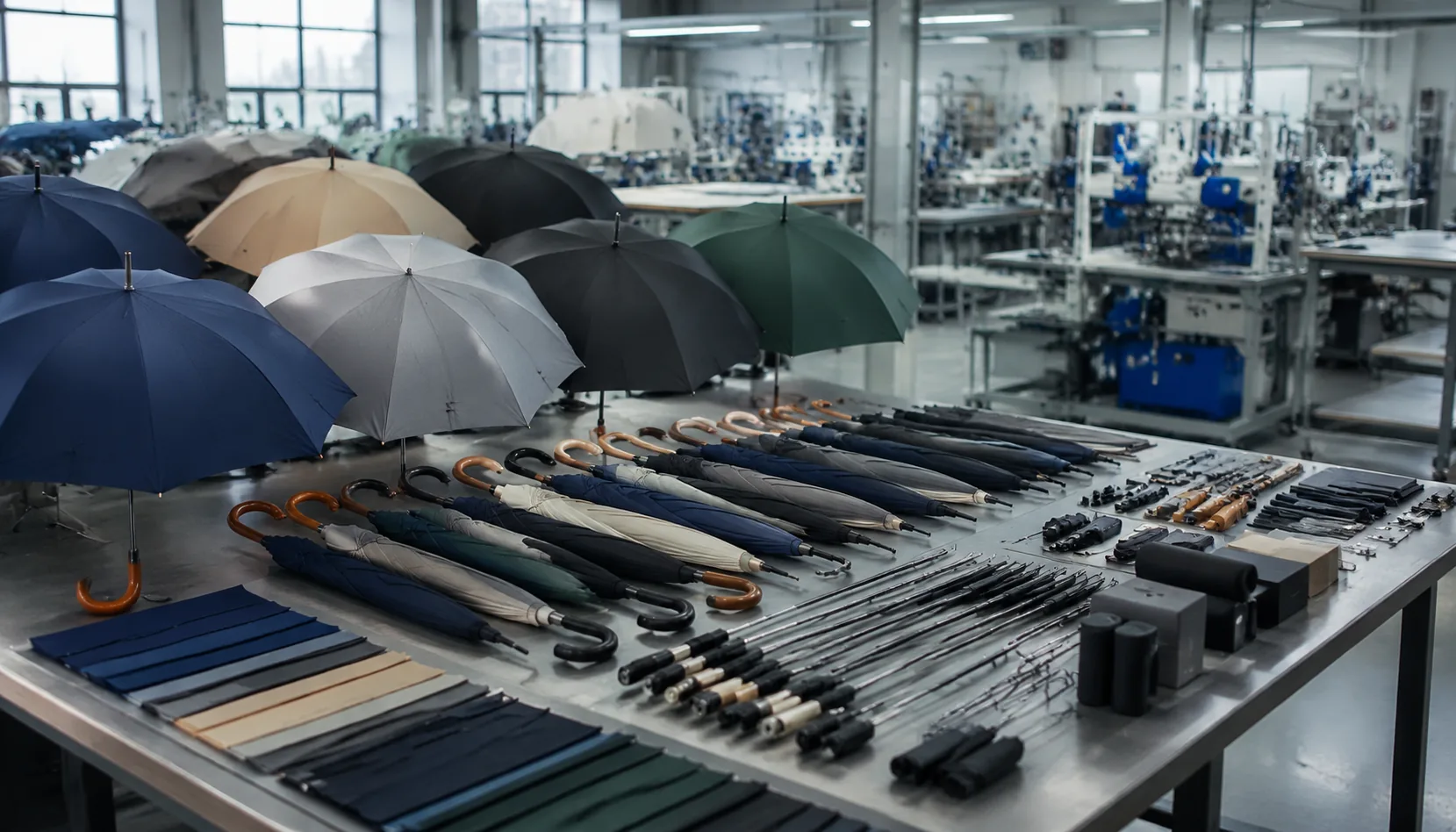
For buyers, retail umbrella assortment planning gets difficult when a nice-looking sample turns into slow-moving cartons, broken ribs, or a shelf price that no longer fits the channel. On our Songxia factory floor, the sellable SKU is usually decided by practical specs: canopy size, rib count and material, fabric coating, handle finish, hangtag or sleeve packaging, and MOQ that matches replenishment reality.
Match Umbrella Formats to Retail Price Tiers
Price-tier discipline matters more than having every umbrella shape on the rack. For entry-level wholesale rain umbrellas, I usually keep the hero SKU as a 21" or 23" 3-fold compact with 190T pongee, 8K steel ribs, manual or basic auto-open frame, and a straight plastic handle or rubberized hook. This format lands well for convenience stores, campus bookstores, travel counters, and checkout bins because the folded length is usually 9.5" to 11.5" and the perceived value is easy to understand. A 23" straight stick can also work at entry price, but freight cube rises quickly, so umbrella MOQ planning should separate compact replenishment cartons from stick umbrella seasonal buys. In retail umbrella assortment planning, do not overbuild the cheapest SKU with fiberglass ribs and premium coating unless the shelf price can absorb it; buyers notice landed cost, while consumers mostly notice open size, color, and whether the mechanism feels smooth.
Mid-tier assortments should carry the volume, not the extremes. A strong middle range is a 23" auto-open 3-fold compact in 210T pongee with black electroplated shaft, fiberglass end ribs, nickel tips, and a soft-touch crook or matte ABS handle. Add a 23" or 27" straight stick with 8K fiberglass ribs, EVA or rubberized J-handle, and Teflon water-repellent coating for customers who want something sturdier than a pocket umbrella without jumping to golf size. For private label umbrellas, this is where custom colorways, woven labels, heat-transfer logos, and retail sleeves add real shelf value without changing the frame tooling. The 8K rib count is still acceptable here if the ribs are thicker and the runner locks cleanly; a sloppy 16K frame feels cheaper than a tight 8K frame. Good umbrella SKU planning keeps mid-tier styles broad enough for men’s, women’s, and neutral color stories, but not so broad that each color misses MOQ.
Premium SKUs need visible engineering differences, not just a higher hangtag. A 27" or 30" golf umbrella with 8K or 16K fiberglass ribs, double-canopy venting, 210T pongee, UPF 50+ coating, and a straight EVA foam handle can justify a higher retail price because shoppers can feel the canopy tension and frame rebound immediately. For fashion or department-store programs, a 23" 16K straight stick with wood shaft, curved maple handle, metal tips, and dense 210T fabric looks premium even before printing. The jump from 8K to 16K ribs increases material, sewing alignment, and inspection time, but it also changes perceived value: more ribs create a rounder canopy, smoother panel fall, and stronger “quality” signal on the sales floor. In retail umbrella assortment planning, I would use 16K selectively for flagship colors or giftable displays, while keeping 8K fiberglass for dependable margin SKUs that need AQL 2.5 consistency and repeatable FOB pricing.
Specify Materials That Reduce Returns
Material choice is where retail umbrella assortment planning either protects margin or creates avoidable returns. Steel ribs are still the right call for opening-price wholesale rain umbrellas because they keep frame cost down, hold shape well in normal city rain, and make a 21" or 23" manual compact hit sharper price points. The tradeoff is recovery: once a thin steel rib bends in a gust, it usually stays bent, and the customer reads that as poor quality even if the canopy fabric is fine. For better mid-tier positioning, specify fiberglass ribs or at least fiberglass end ribs on an 8K or 10K frame. Fiberglass flexes under load, rebounds cleaner, and helps a vented 23" auto-open or 27" golf umbrella survive 50+ mph wind-tunnel claims when the runner, stretcher, and shaft are built to match.
For canopy specs, the writer should cite 190T polyester as the practical opening-price fabric and 210T pongee as the stronger retail fabric story. 190T polyester is acceptable for budget private label umbrellas, event programs, and umbrella MOQ planning where the buyer needs color variety without tying up too much inventory. It prints cleanly by screen or heat transfer, but the hand-feel is crisper and the surface can look cheaper under store lighting. 210T pongee costs more, yet it has a smoother hand, tighter weave appearance, better drape on the panel, and supports Teflon water-repellent or UV UPF 50+ coating claims more convincingly. In umbrella SKU planning, I would reserve 190T polyester for entry SKUs and move core fashion solids, auto-open-close compacts, and 30" golf umbrellas into 210T pongee because those are the products shoppers touch before buying and return when they feel flimsy.
Build a Color and Print Matrix Buyers Can Manage
The best color matrix starts with core shades that can carry 70–80% of volume: black, navy, charcoal, red, and one clean neutral such as beige or white, depending on the retailer’s floor set. In retail umbrella assortment planning, I prefer no more than 5 core colors per frame size for shelf-ready programs, because color depth matters more than color count when replenishment starts. Seasonal colors should be treated as controlled injections, not permanent SKUs: 2–3 Pantone-matched options per season, locked 45–60 days before bulk fabric dyeing. For 190T or 210T pongee, Pantone matching is normally approved by lab dip under D65 light, but buyers should expect a tolerance of about Delta E 1.5–2.0 between fabric lots. POE and PVC clear canopies are less forgiving; printed inks shift under transparency, so we confirm strike-offs on actual material instead of paper proofs.
Logo placement needs limits before the assortment is built, especially for private label umbrellas and wholesale rain umbrellas going into planograms. A safe shelf-ready rule is one outside panel print, 180 mm wide or less on a 21" compact, and 220–250 mm on a 23" stick umbrella; anything larger can distort over seams or ribs. Full-panel screen printing works on pongee, but it increases rejection risk if the artwork crosses the crown cap, tips, or double-canopy vent opening. Heat transfer is cleaner for small logos under 120 mm, while sublimation is better for all-over patterns on white polyester but requires higher MOQ because fabric is printed before cutting. Our standard practice at ZheBrella is to approve logo position on a sewn pre-production sample, not only on a digital mockup, because rib alignment changes how the mark reads when the umbrella is open.
Too many color and print combinations are where umbrella SKU planning usually breaks down. A buyer may think 3 sizes x 6 colors x 4 prints equals a strong wall, but the factory sees 72 SKU lines once manual, auto-open, and auto-open-close mechanisms are separated. That pushes umbrella MOQ planning in the wrong direction: instead of one 3,000-piece order running efficiently, each color may fall below 300–500 pieces, raising fabric dye costs, print setup charges, and AQL 2.5 inspection time. Carton packing also gets messy because 21" compacts, 23" sticks, and 27" golf umbrellas do not cube the same; mixed cartons slow warehouse receiving and create replenishment errors. A tighter matrix—core solids always available, seasonal colors pre-booked, and prints limited to proven frames—keeps FOB/DDP lead times closer to 35–50 days and makes repeat orders easier to ship without stock imbalance.
Plan Packaging, Barcodes, and Carton Efficiency
Packaging should be decided before final umbrella SKU planning, not after samples are approved, because sleeve type and retail presentation change carton cube, labor time, and landed cost. A 21" folding umbrella with a simple pongee sleeve can often pack 60 pcs per master carton, while the same item in a color retail box may drop to 36 or 48 pcs because the box creates dead space around the handle and tips. For 23" stick umbrellas, we usually plan inner packs of 12 pcs with a polybag or fabric sleeve, then 24 pcs per master carton; 27" golf umbrellas often run 12 pcs per carton, especially with EVA handles or double-canopy vented frames. In retail umbrella assortment planning, those pack counts matter as much as canopy fabric or rib count, because a beautiful 210T pongee auto-open umbrella that wastes 18% carton space will punish the buyer on every FOB and DDP shipment.
Sleeves, hangtags, and barcodes need retail discipline. Fabric sleeves look better on private label umbrellas, but they add sewing labor and must match the canopy color closely; PVC or POE sleeves are cheaper but can crease in cold storage and look low-grade for department store programs. Hangtags should sit near the handle, not on the canopy tie strap, because store staff scan and hang from the same side. UPC/EAN barcodes need a flat, scannable area: minimum 80% magnification, quiet zones left and right, and placement on the hangtag back or retail box bottom panel. I do not recommend putting the only barcode on a curved sleeve unless the buyer has tested it with their POS scanner. For wholesale rain umbrellas, a mixed carton also needs carton-level SKU labels that match the purchase order exactly: item number, color, size, quantity, gross weight, net weight, and carton dimensions.
Master carton marks are where many small programs lose money. If inner packs are not aligned with store allocation, the warehouse has to break cartons, relabel, and repack, which can add more cost than upgrading from steel to fiberglass ribs. For umbrella MOQ planning, I prefer color splits that match full inner packs: for example, 600 pcs MOQ as 200 black, 200 navy, 100 red, 100 green only works cleanly if the inner pack is 20 or 25 pcs, not 12 pcs. Carton cube and gross weight also affect freight class and DDP landed cost; a 30" golf umbrella carton may look efficient at 12 pcs, but if gross weight passes 22–24 kg, handling damage and courier surcharges become real. Our standard practice at ZheBrella is to confirm carton size, CBM per carton, gross weight, barcode artwork, and carton marks before mass production, then verify them during AQL 2.5 final inspection.
Set Quality and Reorder Rules Before Launch
Set the pass/fail rules before you approve the salesman sample, not after cartons are packed. For retail umbrella assortment planning, I recommend pre-shipment inspection at AQL 2.5 for major defects and AQL 4.0 for minor defects, with critical defects set to zero tolerance. Major defects should include broken ribs, loose runner springs, sharp exposed wire, crooked panels, canopy leakage, handle cracks, failed auto-open or auto-open-close function, wrong barcode, and color deviation beyond the approved lab dip. For umbrella SKU planning, separate inspection checklists by construction: a 21" compact auto-open-close with 8K fiberglass ribs fails differently than a 27" golf umbrella with a double-canopy vented frame and 10K steel/fiberglass hybrid ribs. Our standard practice at ZheBrella is to pull random cartons after final packing, open umbrellas fully, check rib symmetry, shake-test the frame, verify case pack, and match hangtags, UPC labels, and master carton marks against the PO before shipment release.
Function testing needs numbers, because “opens smoothly” means nothing on a factory floor. For wholesale rain umbrellas, require at least 20–30 open-close cycles per sampled unit for manual and auto-open styles, and 30–50 cycles for auto-open-close compact models because the spring, shaft lock, and runner button carry more stress. Fabric leakage testing should include water spray or shower testing on 190T/210T pongee, POE, PVC, or EVA canopies, especially along panel seams, top notch, and tip joints. If the canopy has Teflon, UV UPF 50+, or silver coating, check coating uniformity and do a dry/wet rub test. For printed private label umbrellas, run 3M tape adhesion checks on screen print and heat-transfer logos, plus light scratching around curved panels where ink often lifts. Sublimation is more stable on white polyester, but color migration can still happen if the artwork is too dark or the fabric lot changes.
Reorder rules should be tied to factory lead times, not only retail sell-through. Sampling usually takes 7–10 days for existing frame molds with stock 190T pongee colors, 12–18 days if you need custom Pantone fabric, molded handles, or revised artwork, and 18–25 days for new frame tooling or complex double-canopy windproof designs rated around 50+ mph. First production is normally 30–45 days after deposit and sample approval for standard MOQ programs, but private label umbrellas with custom packaging, printed sleeves, or multiple SKU colors can run 45–60 days. Repeat orders are faster: 20–35 days if fabric, ribs, shafts, handles, and cartons are already approved and the reorder stays within the same bill of materials. For umbrella MOQ planning, set reorder points by SKU velocity and shipping mode: FOB ocean programs need earlier triggers than DDP air replenishment, and slow colors should be consolidated before they create dead inventory.
Frequently Asked Questions
What MOQ should retailers expect for a private label umbrella assortment?
A practical MOQ is often 500–1,000 pieces per style/color for standard models, with higher MOQs for custom frames, molded handles, or full-canopy printing. Consolidating colors across the same frame can help control tooling and setup costs.
Which umbrella spec works best for an opening price point retail SKU?
A 3-fold manual or auto-open umbrella with 8K steel ribs and 190T polyester is usually the most cost-efficient. For fewer returns, buyers often upgrade to fiberglass ribs and 210T pongee on mid-tier SKUs.
How many umbrella SKUs should a retailer start with for a seasonal rain program?
A practical starter assortment is 4–8 SKUs: 2–3 compact folding umbrellas, 1–2 mid-size automatic models, 1 golf or stick umbrella, and 1–2 color or print variations. This keeps MOQ manageable while covering common shelf prices and customer use cases.
What MOQ should buyers expect when planning private label umbrella SKUs?
For most private label umbrellas, MOQ is often 500–1,200 pieces per SKU depending on fabric, frame, printing, and packaging. If several SKUs share the same frame and fabric, factories may sometimes support lower color-level quantities within a combined production run.
Which SKU specs affect retail umbrella pricing the most?
The biggest cost drivers are frame material, rib count, canopy fabric, opening mechanism, print coverage, and retail packaging. For example, upgrading from a manual 8-rib compact umbrella to an automatic 10-rib windproof model can significantly increase unit cost and carton weight.
Looking to Launch Your Custom Umbrella Line?
ZheBrella is a Zhejiang-based OEM/ODM umbrella manufacturer with 17 years of export experience. Free design, low MOQ from 100 pieces, windproof construction, full-color print.
Get Free Quote Now »People Also Search For
Related Articles
Retail Umbrella Assortment Planning: Specs by Price Tier
Plan a private-label umbrella range with 3-fold, stick, and golf models, clear good-better-best specs, realistic MOQs, F...
Read More »
Private Label Umbrella Line Planning for Retail Buyers
Plan a retail-ready umbrella line with good-better-best specs, MOQ tiers, fabrics, rib counts, packaging, and lead-time ...
Read More »
Private Label Umbrella Assortment Planning for Retail Buyers
Build a balanced private label umbrella range with clear SKUs, fabric specs, MOQ planning, AQL targets, and retail-ready...
Read More »