Retail Umbrella Line Planning: Good-Better-Best Specs
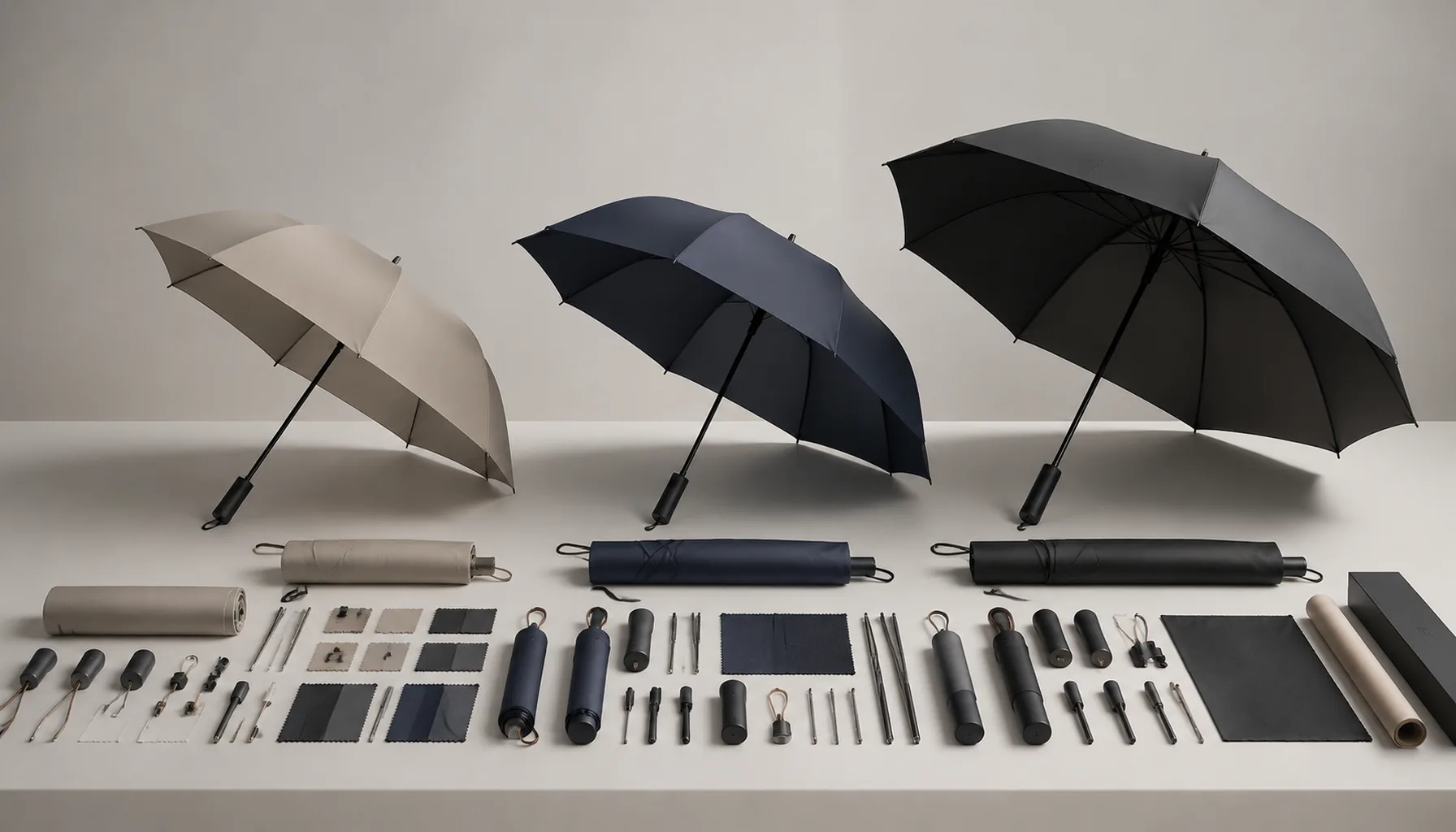
Retail umbrella line planning often breaks down when the price ladder looks clear on a spreadsheet but the frames, fabric, packaging, and inspection limits do not match the tier. On our Songxia factory floor, a good-better-best range starts with controlling rib gauge, shaft material, canopy coating, handle finish, carton count, and AQL points before sampling. That is how buyers keep target costs realistic while avoiding a “better” umbrella that costs like premium but performs like entry level.
Match Price Tiers to Umbrella Constructions
Start retail umbrella line planning with the frame, not the handle color, because frame cost and failure rate decide whether a SKU belongs at entry, mid, or premium price. For entry umbrellas, I would spec painted or chrome-plated steel shafts with steel ribs, usually 8K on 21" compact folders or 23" straight umbrellas. This construction keeps FOB cost tight and is acceptable for supermarket, event, and seasonal promotion programs where the buyer needs volume more than storm performance. Pair it with 190T polyester or basic 190T pongee, manual or simple auto-open mechanisms, and a standard plastic J-handle or EVA grip. Do not overpromise windproof claims here; a steel rib can bend permanently after inversion, and that is normal at this tier. For AQL 2.5 inspection, focus on rust spots, rib alignment, loose tips, canopy tension, and open-close smoothness rather than premium wind-tunnel performance.
The better tier is where private label umbrella specs need discipline, because buyers often add premium-looking features without upgrading the frame enough. A good mid-tier build uses a steel shaft with fiberglass ribs, or steel main ribs with fiberglass end ribs, typically in 8K or 10K layouts. This mixed construction gives better recovery after gusts than all-steel while keeping cost below full fiberglass. It fits 23" stick umbrellas, 27" golf umbrellas, and 21" or 23" auto-open compact models. I like 190T or 210T pongee here, with optional Teflon water-repellent coating and heat-transfer logo printing for clean retail presentation. This is the workhorse level for an umbrella assortment strategy: department stores, drugstore chains, and corporate retail programs can offer visible quality without pricing out the customer. Lead times usually sit around 30-45 days after artwork approval, depending on fabric color, printing method, and carton labeling requirements.
Premium SKUs should move to full fiberglass frames, not just a nicer canopy label. For serious retail umbrella sourcing, specify fiberglass shaft and ribs, 8K for compact and fashion umbrellas, 10K for stronger stick umbrellas, and 16K for premium golf or storm models where the rib count itself is part of the selling story. Add a double-canopy vented windproof design if you want credible 50+ mph wind-tunnel claims; full fiberglass ribs can flex and return instead of kinking like steel. Use 210T pongee, high-density polyester, or POE/EVA for clear fashion models, then add Teflon, UV coating, or UPF 50+ fabric when the retail ticket supports it. Auto-open-close mechanisms belong here only if the spring, runner, and shaft tolerance are controlled tightly. As an OEM umbrella supplier, ZheBrella normally separates premium samples from mass-production signoff with frame cycle testing, canopy leakage checks, and packed-carton drop review before FOB or DDP shipment.
Choose Fabrics, Coatings, and Canopy Sizes
Fabric choice should follow price tier, not personal preference. For entry retail umbrella line planning, 190T polyester is the honest budget fabric: it prints cleanly, keeps FOB cost down, and works for promo-heavy assortments, but the hand feel is flatter and the yarn density shows stress sooner around the rib tips. A better middle tier is 190T pongee, which has a softer touch, tighter drape, and better perceived value on shelf without a large cost jump. For best-tier private label umbrella specs, 210T pongee is usually the right call, especially on auto-open-close compact models and 27 inch stick umbrellas where customers notice canopy tension. I do not recommend mixing 190T polyester and 210T pongee under the same retail price point; returns usually come from perceived inconsistency, not lab failure. For AQL 2.5 inspection, we check fabric shade, pinholes, coating marks, seam slippage, and water beading after opening cycles, because canopy defects are visible immediately to shoppers.
Coatings are where many retail programs overspend or underspec. Standard water-repellent treatment is enough for most good-tier umbrellas if the buyer wants sharp screen printing or heat-transfer logos and a clean retail margin. Teflon-type water-repellent finishing improves roll-off and stain resistance, but it must be controlled during cutting and sewing because heavy coating can make needle holes more obvious. UPF 50+ coating belongs in the better and best tiers for sun-rain positioning, beach events, and pharmacy or outdoor retail channels; it is more defensible when paired with 190T or 210T pongee instead of basic polyester. Silver or black UV coatings can change the inside appearance, so artwork approval should include both exterior and interior photos under daylight. As an OEM umbrella supplier, our standard practice is to confirm coating choice before strike-off printing, because sublimation, screen printing, and heat transfer do not behave the same on coated fabric.
Canopy diameter should map to user scenario, carton efficiency, and frame strength. Compact umbrellas usually run 21 inch for handbags, 23 inch for mainstream daily carry, and sometimes 25 inch for oversized travel; 8K steel ribs keep cost low, while fiberglass or mixed fiberglass ribs reduce breakage complaints. Stick umbrellas commonly use 23 inch or 27 inch panels, with 8K or 10K frames depending on whether the umbrella assortment strategy is value, commuter, or executive. Golf umbrellas should start at 30 inch, with 30 inch single-canopy models for price-sensitive retail and 30 inch double-canopy vented windproof frames when the claim is wind resistance, often tested around 50+ mph in a controlled tunnel. In retail umbrella sourcing, avoid too many adjacent sizes in one launch. A clean good-better-best range might be 21 inch manual compact, 23 inch auto-open compact, 27 inch stick, and 30 inch golf, with MOQ and lead time set separately for printed and solid-color SKUs.
Set Mechanisms and Durability Expectations
Mechanism choice should be set before colors and prints, because it drives frame cost, warranty risk, and the customer’s first impression at retail. For opening-price goods, I usually keep manual-open on 21" compact and 23" stick umbrellas: fewer moving parts, lighter springs, and less chance of returns from rough handling. A good manual unit should pass 500 open-close cycles without shaft wobble, runner cracking, or rib tip disengagement. For the better tier, auto-open is the cleanest upgrade, especially on 23" and 27" models with 190T or 210T pongee canopies. The spring should fire cleanly after storage compression, the button should not sink below the handle shell, and the runner lock must hold after repeated impacts. In retail umbrella line planning, I would not accept auto-open production without at least 800 to 1,000 cycle tests on pre-production samples, plus drop tests from counter height with the canopy both open and closed.
Auto-open-close belongs in the best tier, not because shoppers always understand the mechanism, but because the internal structure is less forgiving. A 21" or 23" compact auto-open-close umbrella needs a stronger center shaft, a reliable reverse spring, smooth telescopic tube sections, and better handle assembly to avoid button jamming. Cheap versions fail at the closing stroke: the canopy collapses, but the shaft refuses to reset or requires excessive force. For private label umbrella specs, I normally set 1,000 cycle tests as the minimum and 1,500 cycles for retail programs with long shelf life or high return sensitivity. Test with wet fabric, not only dry samples, because water weight changes spring behavior. If you are doing retail umbrella sourcing through an OEM umbrella supplier, ask for cycle-test video, broken-sample photos, and AQL 2.5 inspection criteria covering button function, shaft straightness, runner lock, and rib deformation.
Double-canopy windproof designs justify higher retail pricing only when the frame is upgraded, not when a factory simply cuts vents into a weak canopy. A real better/best windproof umbrella uses fiberglass ribs or fiberglass tips, a steel or aluminum-fiberglass hybrid shaft, reinforced stretchers, and a vent gap that releases pressure without flipping inside out too easily. On 27" and 30" golf umbrellas, 8K ribs are standard, 10K improves roundness, and 16K is mostly a visual and stability upgrade if the ribs are correctly balanced. For a serious umbrella assortment strategy, I would position vented double-canopy models with 210T pongee, Teflon water-repellent finish, and optional UPF 50+ coating at the top of the line, with wind-tunnel targets around 50+ mph. ZheBrella’s standard practice is to test windproof samples after printing and coating, because heat-transfer logos, sublimation layers, and seam tension can all change how the canopy spills wind.
Plan MOQ, Packaging, and Landed Cost
MOQ is not one number; it changes by what actually forces a production setup. For retail umbrella line planning, I usually separate MOQ into three buckets: stock-color fabric, custom-dyed fabric, and custom hardware. If you choose existing 190T or 210T pongee colors from the mill card, a practical MOQ can be 500–1,000 pcs per SKU, especially for 21" folding or 23" stick umbrellas using standard black steel or fiberglass frames. Custom PMS fabric dyeing often pushes the fabric MOQ to 3,000–5,000 pcs per color because the dye vat, colorfastness test, and shade-band control all need volume. Printing adds another layer: one-position screen print may work at 500 pcs, heat-transfer logos usually start around 1,000 pcs, and full-panel sublimation is best planned at 2,000 pcs or more because cutting alignment and color calibration take time. Custom handle tooling is the biggest trap in private label umbrella specs; a new EVA, rubberized ABS, or molded wood-look handle can add 25–35 days and a tooling MOQ of 3,000–10,000 pcs depending on cavity count and finish.
Packaging should be costed as part of the umbrella assortment strategy, not treated as an afterthought after samples are approved. A basic export pack may use one polybag per umbrella, 12 pcs per inner carton, and 48 or 60 pcs per master carton, but retail needs more control: printed sleeve, sewn-in care label, hangtag, UPC/EAN barcode sticker, carton shipping mark, and sometimes a PDQ display tray. Retail sleeves for compact umbrellas often add $0.12–$0.35 per unit depending on paper weight and lamination; printed hangtags add $0.03–$0.08; barcode labeling is cheap per piece but expensive to fix if the data is wrong. For big-box retail umbrella sourcing, carton compression matters because a 30" golf umbrella with a curved EVA handle wastes space quickly. Our standard practice at ZheBrella is to confirm carton size, gross weight, CBM, and barcode placement before pre-production, because a nice umbrella that fails warehouse receiving is still a failed SKU.
FOB and DDP planning should be built side by side before the buyer locks retail price points. FOB Ningbo or Shanghai tells you the factory-side cost: frame, canopy, sewing, printing, packaging, AQL 2.5 inspection, and export carton. DDP tells you whether the SKU survives after ocean freight, duty, customs clearance, inland trucking, port fees, and final delivery to the retailer’s DC. A 23" auto-open pongee umbrella that looks profitable at $3.80 FOB may become weak after adding $0.35–$0.70 freight, duty depending on HS classification, and retailer compliance charges. An experienced OEM umbrella supplier should quote both unit FOB and carton CBM so your landed-cost model is not guessing. I advise buyers to plan good-better-best around landed cost bands: a good line with steel ribs and manual open, a better line with fiberglass ribs and Teflon coating, and a best line with double-canopy vented construction, UPF 50+ coating, and stronger wind performance near 50+ mph. That keeps margin, packaging, and MOQ aligned before purchase orders are issued.
Build QC Standards Before Purchase Orders
QC belongs in the spec sheet before the purchase order, not in an angry email after cartons reach the retailer. For retail umbrella line planning, I recommend AQL 2.5 for major defects and AQL 4.0 for minor defects as the default inspection base, with critical defects set to zero tolerance. Major defects include bent steel ribs, cracked fiberglass ribs, canopy leakage at panel seams, loose tips, failed auto-open-close buttons, and print misregistration beyond 2 mm on logos or all-over patterns. Minor defects are issues like slight thread tails, small color shading within approved tolerance, or a handle logo that is still readable but not perfectly centered. Put these definitions into the PO attachment, because verbal QC standards disappear once production pressure starts.
Pre-production samples should lock the real materials and construction: 190T or 210T pongee, POE/PVC/EVA canopy if transparent, Teflon or UV UPF 50+ coating if claimed, 8K/10K/16K rib count, shaft diameter, handle material, carton strength, and mechanism type. I want one signed sample for the buyer, one for the factory QC table, and one sealed in the packing area. Inline inspection should happen after frame assembly, after canopy sewing, and after mounting, not only when goods are packed. At ZheBrella, our standard practice is to test runner travel, rib alignment, tip stitching, cap tightness, and open-close cycles during production because a 23-inch auto-open umbrella can look fine folded but fail after 20 presses.
Final inspection should cover function, appearance, measurement, printing, packing, and transport resistance. For private label umbrella specs, check print registration against the approved artwork, especially on screen-printed panels, heat-transfer logos, and sublimation edge-to-edge designs where panel stretch can shift the image. Carton drop testing matters for retail umbrella sourcing because umbrellas are long, dense, and easy to damage at ferrules and handles; use export cartons with proper burst strength and run drop tests on corners, edges, and faces before approving shipment. A solid umbrella assortment strategy also separates QC by tier: a 21-inch compact promotional model, a 27-inch golf umbrella, and a double-canopy vented windproof model rated for 50+ mph should not share the same checklist even when they come from the same OEM umbrella supplier.
Frequently Asked Questions
How many umbrella SKUs should a new retail line start with?
Most buyers start with 3 to 5 SKUs: one compact, one auto-open stick, one golf or storm model, and optional UV or fashion color variants. This keeps MOQ manageable while testing demand.
What is a practical MOQ for private label retail umbrellas?
A practical MOQ is often 500 to 1,000 units per model for existing frames and fabrics. Custom molded handles, exclusive colors, or new canopy patterns may require higher MOQs.
How many umbrella SKUs should a good-better-best retail line include?
Most B2B buyers start with 3 to 6 SKUs: one compact entry model, one mid-tier auto-open style, and one premium windproof or golf umbrella. That keeps the assortment easy to buy, test, and replenish while covering three price points.
What AQL level is typical for retail umbrella orders?
For finished umbrella inspections, many importers use AQL 2.5 for major defects and 4.0 for minor defects, with stricter checks on canopy printing, opening function, and frame durability. Final sampling should be tied to order value and channel requirements.
How should packaging change between good, better, and best umbrella tiers?
Good tier often uses a simple polybag or hangtag, better tier usually adds a printed sleeve or retail carton, and best tier may include a rigid box, belly band, or gift-ready packaging. Packaging cost should be built into target FOB price from the start.
Looking to Launch Your Custom Umbrella Line?
ZheBrella is a Zhejiang-based OEM/ODM umbrella manufacturer with 17 years of export experience. Free design, low MOQ from 100 pieces, windproof construction, full-color print.
Get Free Quote Now »People Also Search For
Related Articles
Private Label Umbrella Assortment Planning for Retailers
Build a retail umbrella line with clear good-better-best specs, MOQs, materials, packaging, and lead times that reduce i...
Read More »
Private Label Umbrella Programs for Retail Brand Owners
Build a retail-ready private label umbrella line with the right SKUs, fabrics, frame specs, packaging, MOQ, and inspecti...
Read More »
Private Label Umbrella Line Planning for Retail Buyers
Plan a retail-ready umbrella line with good-better-best specs, MOQ tiers, fabrics, rib counts, packaging, and lead-time ...
Read More »