Double-Canopy Windproof Umbrella Builds for Retail Buyers
Retail buyers often see windproof claims on samples that look solid indoors but fail when a customer turns into a gust outside a station, campus, or parking lot. On our factory floor in Songxia, a reliable double canopy windproof umbrella starts with vent spacing, rib material, runner fit, and frame balance working together, not just an extra layer of fabric. The right spec sheet should make those details measurable before you commit to production.
How double-canopy vents reduce inversion risk
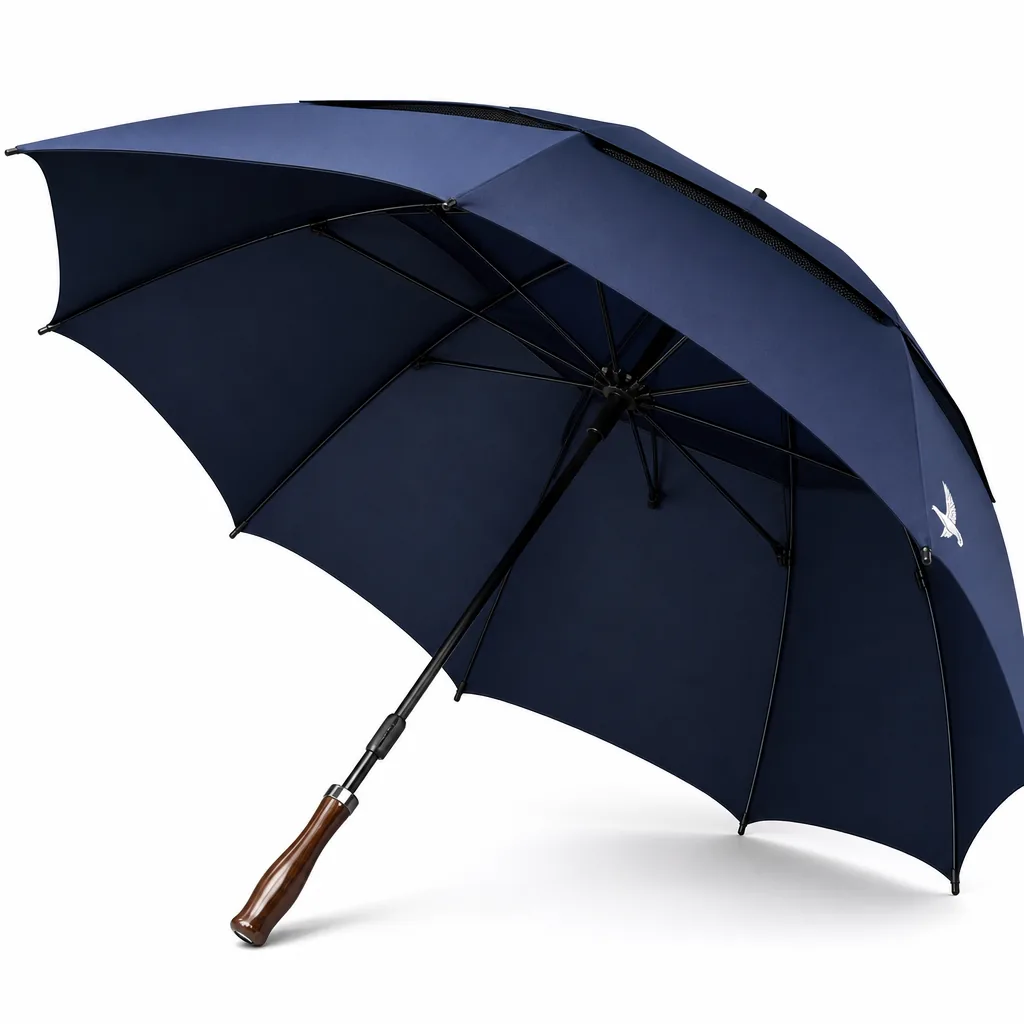
A double canopy windproof umbrella lowers inversion risk by moving gust pressure through a controlled exhaust path. The lower canopy stays as the rain barrier, while the smaller upper canopy covers the cut-out with enough overlap to stop direct water entry. In a sound vented umbrella design, air rises through the gap between the lower and upper canopy layers, then exits around the upper canopy edge. That reduces uplift on the runner, ribs, stretchers, and handle. The benefit is most visible on 23 inch retail umbrellas: a tight non-vented canopy can flip suddenly around 35-40 mph, while the same size with fiberglass ribs, a stiff shaft, correct rib geometry, and a properly spaced vent can remain stable past 50 mph in umbrella wind testing. The vent must be engineered, not just sewn on; poor spacing causes canopy flutter, leakage, uneven pressure release, and handle twist under gust load.
For 21 inch compact umbrellas and standard 23 inch commuter models, one circular or panel-based vent is usually enough when the buyer prioritizes light weight, closed bulk, and a sharp retail price. On a 23 inch canopy, 4-6 cm of vent overlap is a practical target, with the upper canopy tensioned slightly flatter than the lower canopy to reduce noise and rain entry. Larger umbrellas need more margin. For 27 inch, 30 inch, or 62 inch arc golf umbrellas, buyers should ask for deeper vent overlap and a stronger windproof umbrella frame, especially on 8K or 10K fiberglass rib layouts. More canopy area creates more lift, so a shallow vent may exhaust air unevenly and make the umbrella rotate under load. During retail umbrella sourcing, check the open sample profile and wind behavior, not only the vent depth listed on the spec sheet.
A single vent helps control sewing cost, packed thickness, and weight, especially on 190T pongee models with manual or auto-open mechanisms. Deeper overlap is a better fit for premium auto-open-close umbrellas, storm-positioned 23 inch stick umbrellas, and any fiberglass ribs umbrella sold with a windproof claim on the hangtag. Steel ribs may feel rigid in the store but can deform after repeated inversion; fiberglass ribs flex and recover better when rivets, stretchers, and joints are properly specified. Buyers should request fan-rig or wind tunnel video, open-close cycle checks, and AQL 2.5 inspection with added attention to vent stitching, symmetry, overlap, and leakage. A double canopy windproof umbrella that passes a staged 50+ mph test is usually engineered as a system; a model with only a layered canopy is a return, warranty, and margin risk.
Frame and rib construction that supports windproof performance
Wind resistance is decided first by the frame, not by the canopy tag. Steel ribs give a firm opening feel and help hold unit cost down, which suits basic 23" and 27" retail programs, but they can take a permanent bend when side gusts twist the canopy off-axis. For a double canopy windproof umbrella, fiberglass ribs are usually the lower-risk choice because they flex under torsion, release pressure through the vented umbrella design, and return closer to shape after inversion. A hybrid build, such as fiberglass outer ribs with a steel shaft, can control cost while improving storm recovery. During repeated inversion checks, 8K steel frames may pass early cycles but later show rib-set deformation near the runner, stretcher joints, or tips. A fiberglass ribs umbrella performs better only when rivet diameter, joint clearance, stretcher thickness, runner lock tension, and tip stitching are specified before sampling.
Rib count should match canopy size, opening feel, and retail price point. An 8K windproof umbrella frame remains the standard choice for many 23" and 27" retail umbrellas because it keeps weight, folding bulk, and labor cost manageable. A 10K frame adds support for heavier rain builds or larger panels without making the closed umbrella feel oversized. A 16K frame spreads load more evenly around the canopy, improves roundness, and gives a smoother, more premium opening action, especially on 30" golf umbrellas or shelf programs where hand feel matters. The tradeoff is real: 16K adds ribs, sewing points, inspection time, packed weight, and cost. In retail umbrella sourcing, treat 16K as a structural decision, not a premium label; it should be justified by size, canopy fabric weight, wind target, or perceived value at retail.
Approve the vent system and frame as one build. A double canopy windproof umbrella vents upward pressure through the canopy overlap, but side wind still loads the ribs, stretchers, shaft, runner, rivets, and tip attachments. At ZheBrella, frame approval checks rib material, stretcher gauge, rivet clearance, spring tension, runner lock engagement, and canopy attachment before bulk production. For umbrella wind testing, a practical retail-grade target is survival at 50+ mph controlled airflow with no rib fracture, canopy blow-off, runner failure, or visible rib-set deformation. Material choice alone will not protect the order: loose rivets, thin stretchers, weak locks, or poorly secured tips can make a fiberglass frame fail before it reaches the shelf. Buyers should confirm the tested sample matches the approved bill of materials before PO release.
Canopy fabric weight, seam quality, and water shedding
For a retail double canopy windproof umbrella, lock the canopy spec before approving color, logo, or packaging. 190T pongee is the usual value choice for 21-inch and 23-inch auto-open programs because it prints cleanly, folds tightly, and keeps FOB cost under control. Step up to 210T pongee for a tighter weave, stronger tear resistance at rib tips, and a smoother face for heat-transfer logos, especially on 27-inch golf umbrellas or premium lines tied to umbrella wind testing claims. POE, PVC, and EVA shed water but crease more after compression packing and recover poorly compared with pongee in a vented umbrella design. Specify a water-repellent finish that beads rain within 3 to 5 seconds and does not wet out along fold lines after one display cycle. Teflon-style coatings suit both 190T and 210T pongee; UPF 50+ UV coatings can stiffen the canopy, so approve full open-close samples, not swatches only.
Seam quality controls whether the vent releases wind or twists the frame. The upper canopy must align evenly over the lower layer so air exits through the vent gap instead of lifting one side of the windproof umbrella frame. ZheBrella checks panel symmetry before top cap assembly because a 5 mm edge mismatch can show as a skewed canopy after opening. For pongee, keep stitch density around 7 to 9 stitches per inch: looser seams can leak, while overly tight seams perforate the weave and create a tear path. Reinforce rib-tip pockets, vent attachment seams, crown patches, and runner contact zones, especially on 8K and 10K fiberglass ribs umbrella builds. On 16K models, the added ribs improve canopy shape but multiply stitch points, making sewing consistency a durability and QC risk, not a cosmetic issue.
Retail umbrella sourcing should qualify finished umbrellas, not fabric rolls. Open the sample, spray the crown and vent overlap, shake it, then inspect under normal store lighting for seam seepage, coating stains, skipped stitches, and loose threads longer than 3 mm. AQL 2.5 inspection should cover water beading, panel alignment, seam reinforcement near stress points, and visible coating defects before shipment release. If the claim is 50+ mph gust resistance, the canopy must not balloon unevenly during umbrella wind testing. A strong fiberglass frame reduces breakage, but weak stitching near the vent layer or rib tips usually fails first, especially on auto-open-close compact models with sharp repeated opening force. The buyer risk is simple: poor seam discipline turns a solid frame spec into returns, warranty claims, and margin loss.
Mechanism and opening system choices for stronger builds
Treat the opening system as a load-bearing choice, not a feature checkbox. On a double canopy windproof umbrella, the first two seconds of deployment stress the shaft, notch, runner, stretchers, ribs, and tips before the vented umbrella design can spill pressure. Auto-open models sell well because commuters can open a 23" or 27" umbrella with one hand, but the spring creates a sharper snap load than a manual runner. That impact can loosen rib joints, deform the runner, or wear the notch pin faster, especially with heavier 210T pongee, Teflon-treated water-repellent fabric, UPF 50+ black-glue coating, or POE/PVC clear panels. Auto-open-close adds another failure point because the spring package must both open and collapse the frame. It is usually a better fit for 21" travel umbrellas with fiberglass or hybrid ribs than for 30" golf umbrellas with larger canopy area and higher wind load.
Manual opening gives up some retail convenience, but it improves control in gusty locations such as subway exits, hotel entrances, coastal sidewalks, and outdoor events. A manual runner lets the user face the canopy into the wind, open gradually, and lock the frame with less shock. For 27" and 30" retail programs, 8K or 10K fiberglass ribs umbrella construction with a manual mechanism will often outlast an aggressive spring-open windproof umbrella frame. Umbrella wind testing should include repeated open-close cycling, runner wobble, spring force consistency, shaft wall thickness, notch pin wear, and rib joint movement, not only a clean first opening. A frame that survives 50+ mph testing can still fail in stores if the mechanism introduces impact fatigue before the vent system has time to work.
Specify reinforced runners when the build uses 10K or 16K rib counts, oversized panels, 210T pongee, coated canopies, or POE/PVC clear material that increases opening resistance. Request a thicker shaft when moving from a 23" street umbrella to a 27" or 30" golf size, or when pairing a steel main shaft with fiberglass ribs, because mixed-material frames can concentrate stress at connector points. For retail umbrella sourcing, put the mechanism decision into the sample approval sheet: manual, auto-open, or auto-open-close; shaft diameter and wall thickness; runner material; rib count; canopy fabric; coating; and open-close cycle target. Then verify production under AQL 2.5 inspection so the approved double canopy windproof umbrella matches the delivered cartons, not only the pre-production sample.
Buyer checklist for quotes, testing, and compliance
Build the RFQ around measurable construction data, not photos. Request finished arc size and canopy diameter as separate fields: a 23-inch stick model usually finishes near 102-105 cm, while a 27-inch golf umbrella often reaches 120-125 cm depending on rib curvature. Define the vented umbrella design precisely: fully floating top canopy, partial panel stitching, or edge-only venting. For the windproof umbrella frame, list rib count, rib material, shaft material, joint construction, runner type, and tip attachment. An 8K fiberglass ribs umbrella will not recover like 8K steel ribs; a 10K fiberglass frame with resin tips usually handles inversion better. Specify 190T or 210T pongee, POE, or PVC canopy material, plus the water-repellent finish. If the retail claim includes Teflon coating, black UV backing, or UPF 50+ protection, state that requirement before sampling so the factory quotes the correct fabric and coating cost.
Lock the test method before approving samples. For umbrella wind testing, define tunnel speed in mph or km/h, test duration, open direction, sample quantity, and whether inversion without breakage is acceptable. Set open/close targets by mechanism: 500 cycles for manual and auto-open models, and 300-500 cycles for auto-open-close compact umbrellas, followed by runner-lock and button checks. For a double canopy windproof umbrella, require a test video, retained sample, and one-page report covering rib-joint failure, frame deformation, fabric tearing, tip pull-out, handle looseness, and lock failure. Put inspection terms in the purchase order: AQL 2.5 for major defects, with zero tolerance for critical safety issues such as sharp burrs, exposed wire, failed locks, cracked handles, and broken rib joints.
Treat pricing, MOQ, and packaging as risk controls. Ask for MOQ by color and total order quantity, because 1,200 pieces across four canopy colors creates different fabric and setup pressure than 1,200 pieces in black. Confirm sample lead time separately: typically 5-7 days for stock fabric and 10-15 days for custom printed panels. Then confirm production lead time after artwork approval and deposit, commonly 30-45 days in peak season. Request FOB Ningbo or Shanghai pricing, and ask for DDP only when landed cost comparison matters; DDP must state destination country, duty assumptions, carton dimensions, gross weight, and transport mode. For retail umbrella sourcing, approve packaging before mass production: hangtag, sleeve, barcode sticker, color box, master carton quantity, drop-test requirement, and any recycled-content or polybag warning language required by the destination market.
Frequently Asked Questions
Is a double-canopy umbrella always stronger than a single-canopy design?
Not automatically. It usually improves wind handling, but overall performance still depends on rib material, shaft strength, vent construction, and stitching quality.
What should a buyer ask for when sourcing a windproof retail umbrella?
Request rib material, rib count, canopy fabric, vent style, and mechanism type, then confirm how the factory tests wind resistance. Also ask for MOQ, lead time, and whether the quote is FOB or DDP.
What wind-test result should a retail buyer ask for on a double-canopy umbrella?
Ask the supplier for the test method, wind speed, pass standard, and sample size, not just a single claim like "windproof." For retail programs, buyers commonly request video or lab data showing repeated exposure at defined speeds such as 15-20 m/s, plus open-close cycle results on the same frame.
How do fiberglass ribs change warranty risk compared with metal ribs?
Fiberglass ribs usually flex better under gusts and are less likely to stay permanently bent, which can reduce damage claims in windy markets. Many buyers use fiberglass on 23-27 inch umbrellas when targeting lower breakage rates, though they should still confirm rib diameter, wall thickness, and connector quality.
Which product specs matter most before placing a bulk order for windproof umbrellas?
The most useful checklist includes arc size, folded length, rib count, rib material, shaft material, vent structure, opening mechanism, fabric weight, and handle type. For OEM orders, buyers should also confirm MOQ, usually starting around 500-1,000 pieces per color, and production lead time, often 35-55 days after sample approval.
Looking to Launch Your Custom Umbrella Line?
ZheBrella is a Zhejiang-based OEM/ODM umbrella manufacturer with 17 years of export experience. Free design, low MOQ from 100 pieces, windproof construction, full-color print.
Get Free Quote Now »People Also Search For
Related Articles
Double-Canopy Windproof Umbrellas: Buyer Selection Guide
Compare double-canopy builds, vent vents, rib materials, and MOQ so buyers can source windproof umbrellas that match ret...
Read More »Double-Canopy Windproof Umbrella Specs for Retail Buyers
Learn how to specify double-canopy windproof umbrellas with the right ribs, vent size, MOQ, and pricing terms for retail...
Read More »
Double-Canopy Umbrellas: Venting, Stability, and Buyer Specs
Learn how double-canopy construction improves wind release, where vent size matters, and what buyers should specify for ...
Read More »