Double-Canopy Windproof Umbrella Specs for Retail Buyers
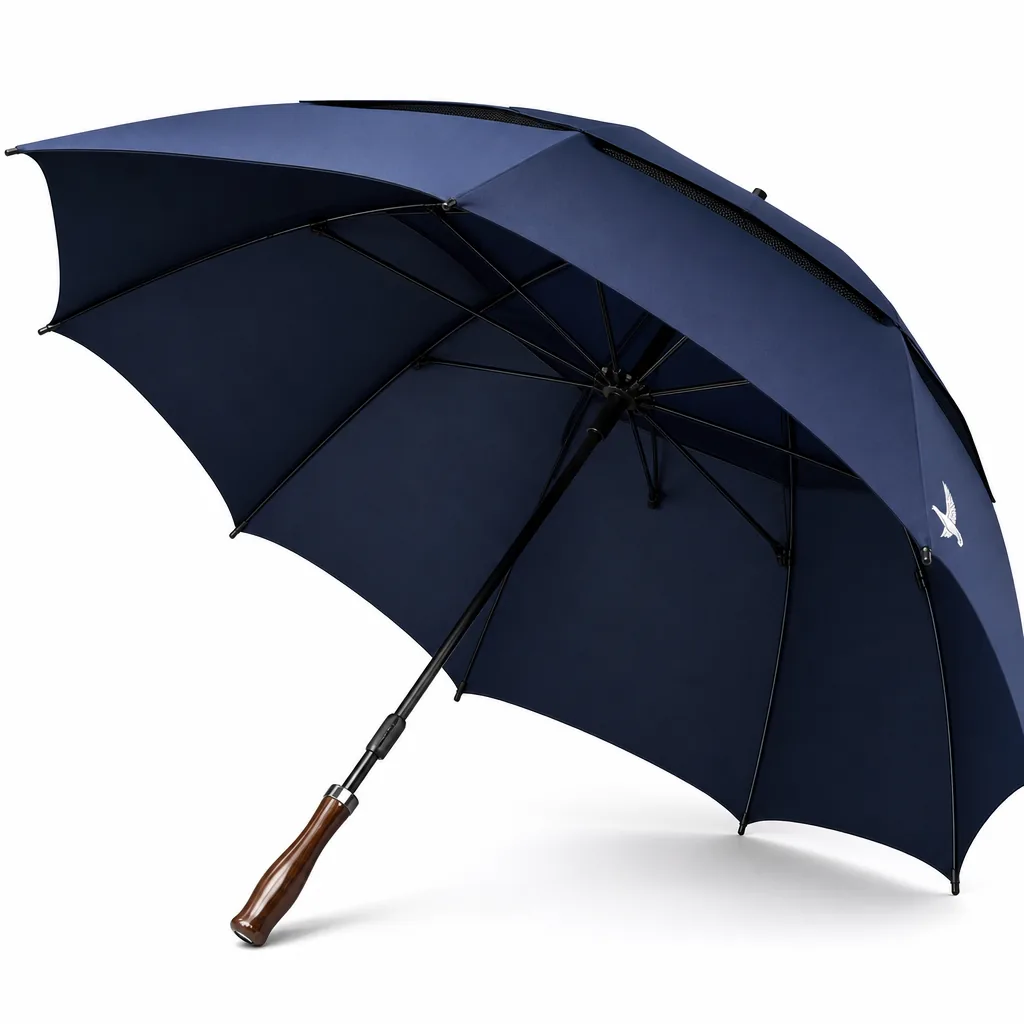
Retail buyers often ask for a double-canopy windproof umbrella because returns spike when a frame flips, a vent is cut too small, or the rib spec looks strong on paper but fails in gust testing. On our Songxia production floor, the real decisions come down to rib material and diameter, canopy overlap, vent opening, runner fit, and how those choices affect MOQ, lead time, and unit cost before the order reaches mass production.
Why double-canopy construction matters
A double-canopy windproof umbrella uses a lower rain canopy plus a vented upper layer that lets pressure escape when gusts hit the face of the umbrella. On a single-canopy build, wind loads collect under the fabric and can invert the frame, especially on 27 inch and 30 inch golf or patrol umbrellas. A vented canopy umbrella reduces lift by giving trapped air a controlled exit path while the overlapping top layer blocks rain entry. For buyers, the design makes the most sense for exposed use: golf retail, resort loaner programs, outdoor event staff, campus security, parking teams, and coastal stores where 25 to 35 mph gusts are common. For low-cost 21 inch or 23 inch city sticks used mainly for light rain, a single canopy usually lands cheaper and packs slimmer.
Frame and fabric specs decide whether the double-canopy windproof umbrella is worth the extra cost. Fiberglass ribs are preferred over steel ribs for gust recovery because they flex back instead of staying bent; 8K is standard for retail, while 10K or 16K ribs add stability on oversized models. A 210T pongee canopy with water-repellent or Teflon coating sheds rain faster than basic 190T polyester, and UPF 50+ coating is useful for golf, resort, and outdoor staff programs. Manual open is safest for 27 inch and 30 inch umbrellas, auto-open fits 21 inch to 23 inch retail sticks, and auto-open-close should stay with compact travel models where shaft tolerance is tightly controlled.
Treat the vent as a cost and risk decision, not a styling add-on. Umbrella MOQ can rise when the order uses custom vent panels, contrast under-canopy colors, or heat-transfer logos across both layers. FOB umbrella pricing moves with rib count, shaft material, handle mold, canopy fabric, and packaging, not just diameter. Normal lead times are about 25 to 35 days after sample approval for repeat materials, and 40 to 55 days when custom fabric color, new printing screens, or AQL 2.5 inspection scheduling is required before shipment. Buyers should specify the expected wind exposure, target retail price, inspection level, and delivery term early so the factory can balance durability against landed cost.
Canopy materials and vent layout
For a retail double-canopy windproof umbrella, 190T pongee is the cost-effective baseline for 23-inch auto-open programs: it sheds water cleanly with PU or Teflon water-repellent finishing, keeps packed weight down, and protects margin for promotional and mid-tier retail orders. 210T pongee gives a denser hand, cleaner solid-color printing, and better light blocking when paired with UPF 50+ coating, but it raises fabric cost and carton weight. The difference is modest on a 23-inch 8K frame and more visible on 27-inch and 30-inch golf sizes, where freight cost can change the landed unit price. Do not mix 190T outer panels with 210T vent panels unless the buyer accepts color variation and different shrinkage after finishing. That mismatch can affect both print registration and water shedding along the vent break.
Vent layout decides whether a vented canopy umbrella releases gust pressure or only adds sewing cost. On standard 8-panel retail frames, the upper canopy should usually overlap the lower canopy by 2.5 to 4.0 cm, enough to vent wind without exposing the inner seam to side rain. For 10K and 16K frames, overlap depth and stitch position need recalculation so each rib bay opens evenly under load. A narrow vent preserves print area but reduces inversion control; an oversized vent improves pressure release but can expose seam construction from below and interrupt logo placement. Keep screen print and heat-transfer graphics on continuous lower-canopy panels, away from the vent break, especially on pongee where tension and heat can make small alignment errors visible.
Specify panel count, seam direction, and fiberglass ribs as one system. Fiberglass ribs flex and recover better than steel ribs in gusts, but poor canopy tension still lets one bay sag, collect water, or twist when the runner locks. Radial seams should meet rib tips cleanly, and the top canopy should be balanced before bulk cutting so vent height stays consistent across the production lot. At ZheBrella, vent height, seam allowance, and fabric shrinkage are confirmed before FOB umbrella pricing because small layout changes affect cutting yield, sewing time, and reject risk. Buyers should also tie fabric choice to umbrella MOQ and lead times: stocked 190T colors can move through production in 25 to 35 days, while custom-dyed 210T or UPF-coated fabric often needs 40 to 55 days before final AQL 2.5 inspection.
Frame choices for wind resistance
For a double-canopy windproof umbrella, the vent reduces canopy pressure; the frame determines whether the product springs back or comes back bent. Steel ribs lower unit cost and give a firm hand feel, but they have limited elastic recovery after overload. The common failure points are bent stretchers, loosened rivets, and rust at runner contact points, rib tips, and exposed cut edges when plating is thin or the umbrella is packed wet. Fiberglass ribs cost more, but they flex farther under gust load and return closer to the original arc, which reduces visible distortion and warranty returns. A practical retail build is fiberglass ribs with a steel shaft when the buyer needs durability without pushing FOB umbrella pricing too high. Full fiberglass ribs and shaft make sense for coastal, outdoor, and premium lines where corrosion resistance, lower weight, and repeated flex recovery matter more than the lowest landed cost.
Do not buy rib count as a shortcut for strength. A well-riveted 8K frame with proper rib gauge and stretcher thickness can outperform a thin 10K frame that saves cost in the joints. For most 21-inch folding umbrellas and 23-inch stick umbrellas, 8K fiberglass ribs are enough if the canopy tension is balanced and the runner locks cleanly. A 16K frame is worth the added cost on larger 27-inch and 30-inch models, premium retail programs, or displays where a rounder canopy profile supports the price point. On a vented canopy umbrella, 16K also spreads crosswind load across more ribs, which helps during controlled wind testing, but it adds labor, material weight, packing volume, and freight cost. Buyers should approve 16K only when the retail price, return-risk target, or canopy size justifies it.
ZheBrella matches frame specs to channel risk instead of overspecifying every order. Promotional programs with strict umbrella MOQ and margin targets usually choose 8K fiberglass ribs, a 190T pongee canopy, and manual or auto-open construction to keep FOB umbrella pricing competitive. Retail brands that want fewer returns typically move to 10K or 16K fiberglass, stronger rivets, and double-canopy windproof umbrella construction tested around 50+ mph under controlled wind-tunnel conditions. Lead times are typically 25 to 35 days after artwork approval for standard colors. Add time for custom molded handles, special plating, UPF 50+ coating, or nonstandard fabric approvals. The buying decision should weigh four points together: frame recovery, corrosion exposure, target retail price, and the cost of returns if the umbrella fails after the first storm.
Mechanisms, handle options, and user experience
Match the mechanism to the retail channel before locking the spec for a double-canopy windproof umbrella. Department stores and travel retail usually need auto-open on 23" and 27" straight models because shoppers test the button and judge quality by the snap, button alignment, and shaft stability. Promotional distributors often choose manual release on 30" arc golf umbrellas because the spring load is lower, unit cost is easier to control, and forced-closing returns are less common. Compact 21" auto-open-close models sell on convenience but need tighter QC: request 500 open-close cycles, agreed button-force limits, and no shaft wobble after cycling. Check shaft length against rib count and canopy depth. An 8K 23" model can balance well with a standard steel shaft; a 10K or 16K vented canopy umbrella usually needs fiberglass or reinforced metal shaft construction to reduce twist under gust load.
Handle choice changes both perceived value and return risk. J-handles fit classic retail, hotel, and department-store programs, but the hook must clear the wrist and stay rigid when the umbrella is shaken open. Straight EVA foam handles suit golf and outdoor channels because they grip better when wet. Rubberized ABS or TPR-coated handles work for commuter styles where buyers want a cleaner, modern finish. Wood-look plastic is acceptable for price-sensitive retail; real wood needs moisture control because swelling can occur during ocean transit. Before quoting FOB umbrella pricing, confirm handle pull strength, button alignment, end-cap bonding, and runner travel, since these small components create many post-sale complaints. If the handle uses a logo plate, metal badge, or heat-transfer mark, request abrasion checks and salt-spray testing for coastal markets.
Do not approve only a beauty sample. Ask the supplier to test the mechanism, shaft, fiberglass ribs, runner, notch, spring, and handle as a complete system: 300 to 500 operating cycles, 50+ mph wind-tunnel or fan-assisted inversion testing, rib recovery after forced inversion, and handle torque testing after canopy soaking. Fiberglass ribs recover better than steel ribs, but the release parts decide whether the umbrella still feels solid after repeated use. For retail inspection, set AQL 2.5 for major defects and define critical failures clearly: button jam, sharp burrs, loose tips, canopy rubbing against the release button, and failed end-cap bonding. Umbrella MOQ depends on handle mold, fabric color, and logo method. Standard black pongee with an existing handle usually protects cost and lead times; auto-open-close builds or custom ergonomic handles add tooling review and pre-production testing days.
Ordering terms and QC targets
For a stock-frame double-canopy windproof umbrella, umbrella MOQ typically starts at 300-500 pieces per colorway if you use an existing 23" or 27" frame mold, standard 190T or 210T pongee, and a catalog handle. The economics change once you add custom parts. A custom ABS handle, metal badge, matte-finish shaft, or a nonstandard 10K or 16K frame usually lifts MOQ to 1,000-3,000 pieces so tooling and setup costs can be spread across the run. Sample timing is predictable when the spec is locked: 5-7 days for a blank fit sample, 7-10 days for a printed pre-production sample, and 12-15 days if Pantone matching is required across top and under-canopy panels on a vented canopy umbrella. Buyers who push a fully custom build into a very small run usually pay more per unit and take on more approval risk, especially around color matching and trim substitutions.
Bulk lead times depend more on fabric supply and print method than on packing style. For 1,000-3,000 units, screen-printed 190T or 210T pongee usually ships in 25-35 days after sample approval and deposit; sublimation or full heat-transfer graphics normally needs 35-45 days because panel registration and color verification add production steps. In peak season, fiberglass ribs supply can add 5-10 days, particularly for heavier rib stock intended to pass 45-55 mph wind testing. FOB umbrella pricing makes more sense when the buyer already manages freight, needs shipment consolidation, or wants clean ex-factory comparisons from Ningbo or Shanghai. DDP is usually the lower-risk option for smaller retail programs, Amazon replenishment, and first-time importers because customs, duty, and final delivery stay under one control point. Put QC terms in the PO: AQL 2.5 final random inspection; 100 open-close cycles; no rib inversion, shaft bend, or vent-seam tearing at the agreed wind speed; Pantone-approved color standard with panel-to-panel consistency; logo placement tolerance in millimeters; and checks for stitch density, top-cap alignment, runner lock reliability, coating uniformity, rust risk on steel parts, carton drop resistance, and barcode/carton mark accuracy.
Frequently Asked Questions
When does a double-canopy umbrella make more sense than a standard umbrella?
It is the better choice for exposed city use, coastal markets, and retail programs that need a stronger wind story. Buyers should ask for vent dimensions, rib material, and testing results rather than relying on the term alone.
Does a double-canopy build change print planning?
Yes. The vented top layer can reduce usable decoration space and may affect panel registration on complex logos. The art team should confirm print placement before sampling.
What vent size should retail buyers specify for a double-canopy windproof umbrella?
Most retail programs use a vent overlap of about 3 to 5 cm, depending on canopy size and fabric weight. The vent should release wind without exposing too much of the inner canopy or creating visible gaps when the umbrella is closed.
Are fiberglass ribs worth the added cost for bulk umbrella orders?
Yes, fiberglass ribs are usually preferred for windproof umbrellas because they flex under gusts better than steel ribs and reduce breakage claims. For mid-range retail programs, buyers often specify fiberglass ribs with a steel or fiberglass shaft to balance durability and FOB cost.
What MOQ and lead time should I expect for custom double-canopy umbrellas?
A typical MOQ is 1,000 to 3,000 pieces per color or design, depending on fabric, frame, and logo method. Production lead time is commonly 35 to 55 days after sample approval and deposit, with more time needed for custom molds, special colors, or complex retail packaging.
Looking to Launch Your Custom Umbrella Line?
ZheBrella is a Zhejiang-based OEM/ODM umbrella manufacturer with 17 years of export experience. Free design, low MOQ from 100 pieces, windproof construction, full-color print.
Get Free Quote Now »People Also Search For
Related Articles
Double-Canopy Windproof Umbrella Builds for Retail Buyers
Learn how double-canopy vents, rib choice, and frame layout improve wind resistance, and what specs retailers should req...
Read More »
Choosing Umbrella Venting, Ribs, and Frame Specs for Brands
Compare vented canopies, rib counts, and frame materials so buyers can match wind performance, cost, and branding to eac...
Read More »
How to Specify a Double-Canopy Golf Umbrella Build
Learn which vented canopy, rib, and fabric specs make a double-canopy golf umbrella genuinely wind resistant for retail,...
Read More »