How Umbrella Factories Test Ribs, Springs, and Openers
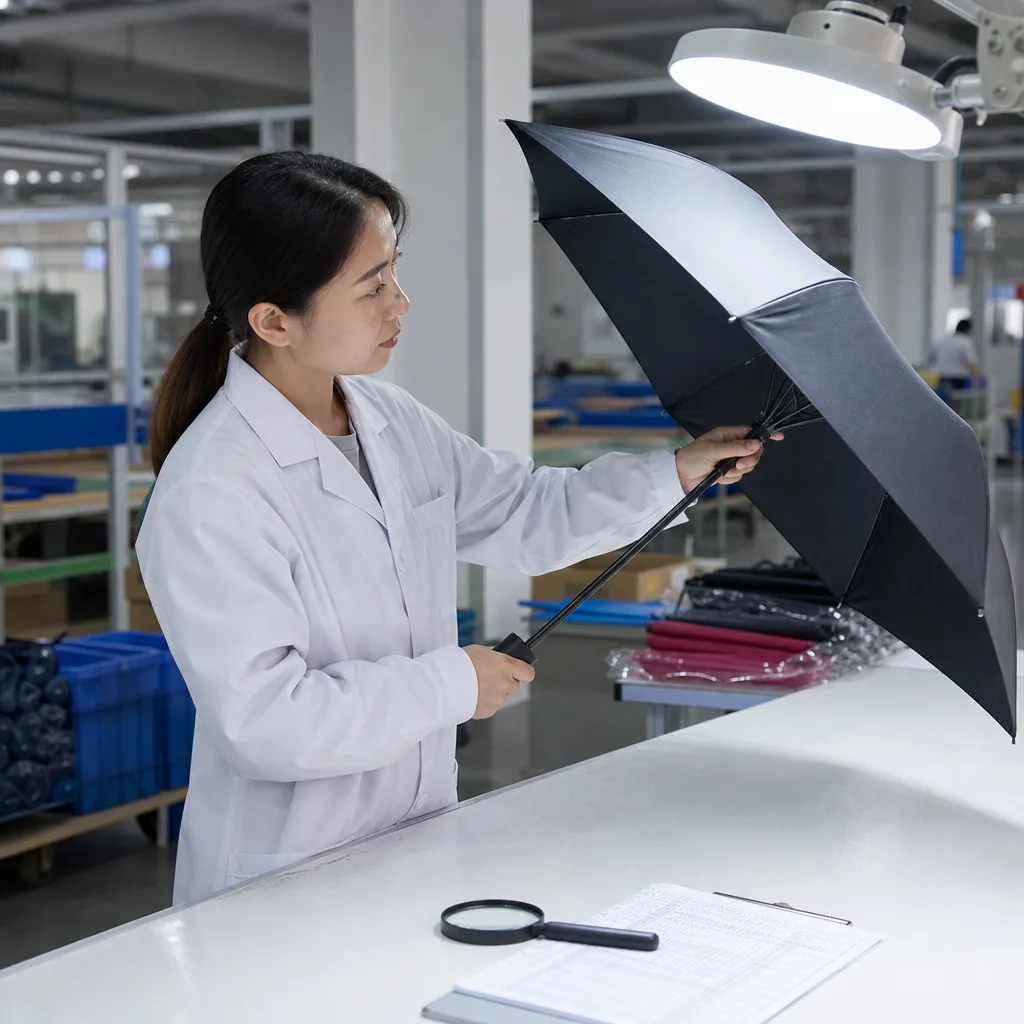
At an umbrella factory, the parts that fail first are usually the ones buyers never see: ribs that fatigue, springs that lose tension, and openers that stick after repeated cycles. In bulk programs, umbrella factory testing has to catch those weak points before cartons leave Songxia, because one bad mechanism can turn into returns, complaints, and costly chargebacks.
Critical Moving Parts in an Umbrella Build
The parts that fail first are usually the moving ones, not the canopy. In umbrella factory testing, ribs, stretchers, the shaft, runner, spring, and opener button are checked as one system because each one changes opening force and how the frame behaves under load. A straight steel shaft gives predictable alignment, but if the runner drags or the button sticks, the whole opening cycle feels rough and the customer assumes the umbrella is cheap. Fiberglass ribs flex better in gusts than plain steel wire ribs, but they still need the right tip alignment, rivet tightness, and stop position or the canopy will twist and tear at the stitch points.
The rib and stretcher set is where wind resistance is actually won or lost. Good fiberglass rib testing looks at repeated flex cycles, crack propagation at the joint, and whether the rib recovers to shape after a hard bend; if it does not, the umbrella will start to invert or wobble after a few storms. The spring matters just as much: umbrella spring durability is about consistent preload, clean return after thousands of open-close cycles, and no loss of snap in cold or humid conditions. On auto-open models, an auto-open mechanism test also checks the button travel, trigger release force, and whether the spring transfers energy without slamming the runner hard enough to deform the stretchers.
In production, I would inspect these parts before final assembly because a canopy sewn perfectly will still fail if the frame is weak. The opener button has to release smoothly, the runner must lock positively, and the stretcher joints need enough clearance to move without grinding; otherwise the user feels binding every time they open it. AQL 2.5 umbrella inspection is usually where these defects get caught in bulk lots, but the better factories screen the components earlier with cycle testing, manual pull checks, and tolerance checks on pins and rivets. That is the difference between an umbrella that survives regular daily use and one that comes back bent after the first strong wind.
Rib and Shaft Testing Methods
Rib and shaft work starts with bend and recovery checks, because that is where bad design shows up first. In umbrella factory testing, a fiberglass rib is judged differently from a steel rib: fiberglass should flex and spring back without a white stress mark, while steel can take higher straight-line load but is more likely to stay deformed if the temper or wall thickness is wrong. On 8K compact frames, the joints near the runner and stretcher ends are usually the first failure points; on 16K builds, the rib count increases the number of pivot points, so small tolerance errors stack up fast. Double-canopy vented frames add another layer of stress at the vent connector and tie points, so we check those areas separately instead of assuming the main rib results tell the whole story.
Cycle testing is the part buyers underestimate. A proper auto-open mechanism test is not just pressing the button a few times; it means repeated open-close cycles under controlled force to see whether the spring weakens, the latch slips, or the shaft stroke changes after wear. For umbrella spring durability, we watch for loss of return force, uneven release timing, and metal shaving at the trigger or inner tube. On steel shafts, the tube-to-tube fit and rivet holes need close attention because ovalizing begins long before a visible crack appears. For fiberglass rib testing, we also watch the ferrule ends and knuckle areas after cycling, since resin-rich parts can hold up in the first 50 or 100 cycles but fail once heat and repeated flexing build up.
Load checks are the last filter before an AQL 2.5 umbrella inspection lot moves forward. We hang or press the open frame against a set force to confirm the canopy load is carried through the shaft and rib geometry instead of concentrating at one weak hinge. That matters most on long-stick umbrellas and double-canopy frames, where wind load and hand torque meet at the center hub, not just at the tips. A good factory will record pass/fail by construction type, because a fiberglass rib testing spec that is acceptable on a 23-inch 8K umbrella may be too soft for a 27-inch 16K frame with steel shaft sections. The point is not to prove the umbrella is indestructible; it is to catch the exact failure mode before it reaches packing or shipment.
Auto-Open and Auto-Open-Close Mechanism Checks
In umbrella factory testing, the auto-open mechanism test starts with the spring, not the button. We check rebound speed, full-travel opening, and whether the shaft locks cleanly under repeated use, because weak umbrella spring durability shows up fast in real handling. A decent production target is 3,000 to 5,000 open-close cycles for sampling, with the button still snapping back without sticking, skipping, or softening. If the spring loses tension early, the canopy may open half-way, the runner may hesitate, or the latch may not catch at all, which is exactly the kind of defect that turns into customer complaints after the first week.
Button feel matters more than buyers usually think. The push force should be firm enough to avoid accidental firing, but not so stiff that it needs excessive thumb pressure; on auto-open-close models, the second-stage closing force must stay consistent so the user does not have to fight the mechanism. We also check jam resistance with slight misalignment, because poor assembly tolerance, bent wires, or burrs in the slider track can make the opener hang up under load. In fiberglass rib testing, we confirm that frame flex does not interfere with the runner path, since a rib set that twists too much can rub the shaft and create intermittent failures that are hard to diagnose later.
The real risk is not just factory rejection, it is return-rate risk after shipment. An umbrella that opens fine on the bench but binds after a few hundred cycles usually has a weak spring, poor lubrication, or an off-center assembly point that was missed during AQL 2.5 umbrella inspection. Our standard practice is to combine cycle testing with visual checks on the latch, rivets, and runner alignment, then re-test under light side-load to see if the mechanism still completes the stroke. If the opener feels acceptable only when new, it is not acceptable for bulk export, because retailers will see returns long before the canopy fabric fails.
Wind and Water Performance Validation
The first thing we check in umbrella factory testing is not the printed logo or handle finish, but whether the frame survives a controlled gust without flipping or losing tension. For wind validation, we run repeated opening and loaded-shaft cycles in a tunnel or fan rig, then push the canopy against staged air speeds that approximate 30 to 50+ mph depending on the design target. Fiberglass rib testing matters here because a good fiberglass section flexes and returns; cheap steel wire just bends and stays bent. For auto-open models, the auto-open mechanism test has to be done under load, not on an empty frame, because a weak spring that feels fine in hand often stalls when the canopy is already under pressure.
Water-shedding is evaluated separately, because a canopy that resists wind can still be a bad umbrella if it holds water or drips for too long. On pongee 190T and 210T fabrics, we check bead formation, runoff speed, and post-rain drying behavior after standard spray and soak cycles; the tighter 210T weave usually sheds water a little cleaner, while 190T is more common when buyers want lower cost without giving up basic performance. A vented double-canopy build reduces inversion in higher wind loads by letting trapped air escape between layers instead of ballooning the whole top. In practice, that vent is one of the few details that consistently improves survival in real gusts.
We finish with AQL 2.5 umbrella inspection on the production lot, because performance claims are meaningless if the batch has loose stitches, misaligned ribs, or springs with inconsistent tension. Umbrella spring durability is checked by repeated open-close or flex cycles, then we verify that the frame still locks cleanly and the canopy stays centered after exposure to moisture. If the product is meant to be a storm-style model, the test record should show both wind and water results together; otherwise you are only qualifying half the umbrella.
Quality Control Plan Before Shipment
Procurement should ask for a written quality control plan before the order is released, not after production starts. In umbrella factory testing, the critical point is whether the factory checks ribs, springs, push-button openers, and stitch quality during the line run, because once 5,000 pieces are finished, you are already paying for mistakes. A proper plan should name the inspection stages, the defect classification rules, the measurement tools used on fiberglass rib testing, and the acceptance method for each style, whether it is a manual stick umbrella, auto-open, or auto-open-close model.
For the inspection standard, specify AQL 2.5 umbrella inspection for major and minor defects, and ask for the exact lot size, sample size, and rejection logic in writing. Request inline inspection records, final random inspection reports, and defect photos tied to each issue category, especially broken tips, loose spring tension, failed canopy stitching, and opening-force problems from the auto-open mechanism test. For spring-heavy constructions, the factory should document umbrella spring durability with cycle counts, because a weak spring usually shows up after packing, not during a quick visual check. Use the same seriousness for rib material: fiberglass needs bend recovery and joint checks, while steel ribs need corrosion and rivet retention verification.
Before shipment, require carton drop tests on finished master cartons, plus a spare-part policy that covers ribs, tips, runners, springs, and ferrules in case of transit damage or warranty claims. The timeline should be staged: sample approval first, mass production checkpoint after the first 10% to 20% of output, and pre-shipment signoff only after all QC records are closed. For planning, I would treat the sample stage as 5 to 7 days, mass production as 20 to 35 days depending on canopy printing and rib count, and pre-shipment approval as the final 1 to 3 days before loading; that keeps umbrella factory testing aligned with the actual ship date instead of becoming a paperwork exercise.
Frequently Asked Questions
Why do auto-open umbrellas fail more often than manual ones?
They have more moving parts, so spring fatigue and button misalignment are common risk points. Good factories reduce failures with cycle testing and tighter assembly controls.
What should I ask for if I need windproof performance?
Ask for fiberglass ribs, a double-canopy or vented top, and evidence of wind testing rather than vague claims. It also helps to confirm whether the design was tested on 8K, 10K, or 16K structures.
How many open-and-close cycles should a buyer request for automatic umbrellas?
For most bulk programs, buyers should request at least 500 to 1,000 open-and-close cycles on representative samples, with no broken springs, jammed runners, or rib deformation. For promotional or low-cost models, the acceptable cycle target may be lower, but it should be agreed in the PO and inspection standard before production.
What failure rate is reasonable when checking umbrella springs and openers during final inspection?
Many importers use AQL 2.5 for major defects, but functional failures such as a non-opening auto-open mechanism or a spring that does not fully return are often treated as major or even critical depending on the sales channel. In practice, buyers should define whether any functional defect is rejectable at carton sampling stage, not just rely on a general AQL table.
Should buyers ask for testing by component lot or only by finished umbrella sample?
Both are useful: component-lot checks catch unstable spring force, rib thickness variation, or opener assembly issues before full assembly, while finished-sample testing confirms real-world function. For repeat OEM orders, many buyers ask for incoming component checks plus final random testing on 5 to 10 finished umbrellas per color or handle style.
Looking to Launch Your Custom Umbrella Line?
ZheBrella is a Zhejiang-based OEM/ODM umbrella manufacturer with 17 years of export experience. Free design, low MOQ from 100 pieces, windproof construction, full-color print.
Get Free Quote Now »People Also Search For
Related Articles
How Umbrella Factories Build Durable Auto-Open-Close Models
See how auto-open-close umbrellas are engineered, tested, and inspected so buyers can specify durable mechanisms and rea...
Read More »
Umbrella Opening Cycle Tests for Durable OEM Mechanisms
See how factories test manual and auto-open umbrellas for cycle life, spring stability, and field reliability before bul...
Read More »How Umbrella Frame Prototypes Are Tested Before Mass Production
See how frame prototypes are checked for cycle life, corrosion, wind resistance, and assembly accuracy before production...
Read More »