How Umbrella Factories Build Durable Auto-Open-Close Models
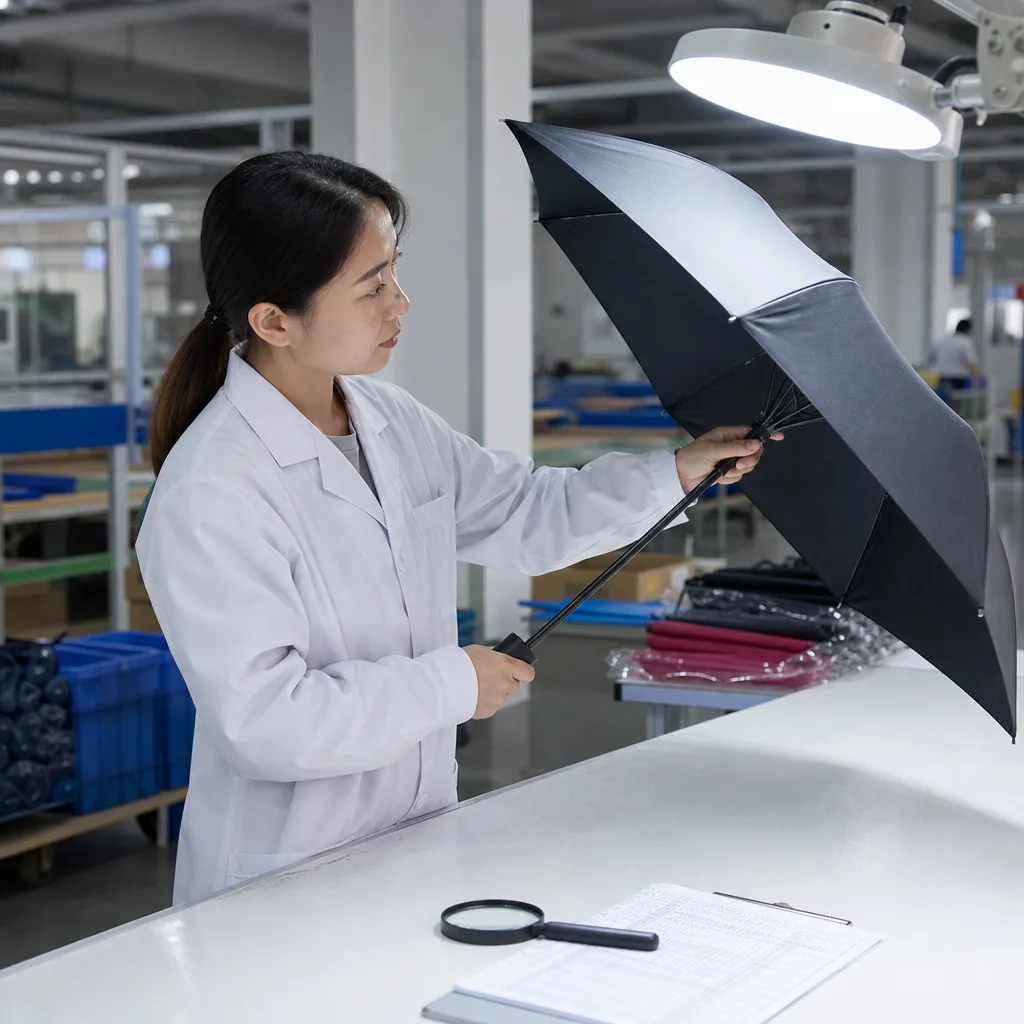
For buyers, the risk in auto-open-close umbrella manufacturing is rarely the button alone; it is the way spring force, runner travel, rib strength, fabric tension, and final inspection all interact after thousands of cycles. On our factory floor in Songxia, the models that last are built around controlled tolerances, matched components, and testing that catches weak shafts, sticky runners, and unstable closing action before bulk packing.
Map the mechanism from button to canopy release
Auto-open-close umbrella manufacturing depends on one handle button controlling two latch events, not a simple push-up frame. On a 23" or 27" folding umbrella, reset starts when the user compresses the telescopic shaft into the handle. That stroke preloads the main shaft spring and lets the lower latch capture the runner. The first button press releases the lower latch; spring tension drives the shaft sections outward while the runner travels up the center pole. As the runner rises, stretchers rotate the ribs open, and the canopy reaches working tension only when the upper notch locks cleanly. Runner travel must match the frame geometry within a few millimeters. Too little travel leaves loose 190T or 210T pongee at the crown and panel seams; too much travel overloads rib pivots and deforms 8K steel frames sooner than fiberglass ribs, which recover better after flexing. Assembly checks should measure spring load, runner height, upper latch bite, and button release force before canopy trimming hides the mechanism.
Closing is a second release sequence, not the opening stroke in reverse. The next button press disengages the upper latch, allowing the runner to drop as the closing spring and rib linkage fold the canopy inward; the shaft usually stays extended until the user pushes it back into the handle to reset the umbrella spring mechanism. In high-cycle use, failures cluster at the latch nose, button pin, runner collar, and rib-stretcher joints. Rough tube edges, uneven shaft plating, weak plastic collars, or poor spring temper cause scraping, twist, harsh reset force, missed lock-in, and accidental release. For automatic umbrella durability, a 21" promotional compact should not pass based on a few showroom clicks. Production samples should complete 500 to 1,000 open-close-reset cycles without partial lock, double-triggering, or canopy hang-up. Under UMBRELLA QC AQL 2.5, a custom umbrella factory should inspect cycling function, shaft straightness, canopy tension, and latch engagement, then retest heavier 210T pongee, UPF 50+ coatings, and heat-transfer logos because added canopy bulk raises closing resistance.
Choose frame materials that support repeated cycling
Frame material sets the failure curve in auto-open-close umbrella manufacturing because every press loads the ribs, stretchers, runner, shaft, crown, and umbrella spring mechanism. Fiberglass ribs are the better fatigue choice for the outer frame: they flex under side wind and recover, while thin painted low-carbon steel ribs are more likely to bend permanently before quality fiberglass fails. Steel still belongs in the center shaft, runner, spring housing, and selected stretcher links, where the system needs clean force transfer and repeatable lock engagement. The practical build for most programs is a hybrid frame: steel or aluminum shaft for mechanism stability, fiberglass outer ribs for wind recovery, and reinforced steel or zinc-alloy pivot joints at high-load stretcher points.
For 21-inch and 23-inch compact models, 8K and 10K layouts remain the default because they balance folded diameter, canopy tension, weight, and unit cost. An 8K frame folds tighter and keeps the handle practical for retail and promotional orders; a 10K frame improves canopy roundness and spreads load better, but adds ribs, sewing points, rivets, and inspection time. Premium compact umbrellas need the frame upgraded with the canopy. Heavier 210T pongee, black UV coating, POE/PVC panels, or a double-canopy windproof design should be paired with thicker fiberglass ribs, reinforced joints, stronger rivet heads, and tighter runner clearance. A compact model claiming 50+ mph wind-tunnel survival should not rely on thin ribs and light rivets after 500 to 1,000 open-close cycles.
Warranty risk usually starts with small frame defects: loose rivets, stretched notches, worn runner hooks, shaft wobble, or crown seats that shift under spring load. ZheBrella cycle-tests sample frames before canopy sewing because fabric can hide a weak frame until closing force, carton drop, or repeated opening exposes it. A custom umbrella factory should recheck the frame whenever the canopy changes from 190T pongee to 210T pongee, POE, PVC, or EVA, or when screen printing and heat-transfer logos stiffen the panels. Under UMBRELLA QC AQL 2.5, inspection should cover opening speed, lock engagement, rib symmetry, shaft wobble, closing force, and runner twist after carton drop. If the runner twists before FOB shipment, the buyer has a durability failure, not a cosmetic defect.
Match fabric weight and stitching to the opening force
Match canopy cloth to spring load before quoting an auto-open-close umbrella manufacturing program. 190T pongee works for many mid-range 21-inch and 23-inch folding models because it packs tightly and keeps closing resistance low at the runner. When the frame uses a stronger umbrella spring mechanism, especially 10K or 16K rib layouts, 210T pongee gives better dimensional control at the crown and rib tips. Its tighter weave stretches less during snap opening, so force spreads across the panel instead of concentrating at one seam, tip cup, or top notch. The first failure signal is usually not a snapped rib; it is needle-hole tearing near the crown, then loose panels after 200 to 300 open-close cycles. For buyers, fabric weight affects warranty risk as much as unit cost.
Seam density has to manage force without turning the stitch line into a perforation path. For automatic umbrella durability, specify reinforced crown stitching, locked tip stitching, and panel seams at about 8 to 10 stitches per inch on pongee canopies. Fewer stitches leave long stress gaps when the canopy snaps open; too many stitches weaken 190T or 210T cloth under compression. Folding models also need a controlled 6 to 8 mm seam allowance because narrow margins pull apart when wet fabric is rolled and pressed back into the sleeve. A custom umbrella factory should set thread tension against the fabric finish: overtensioned thread puckers panels and raises closing force, while loose tension lets panels shift so ribs stop sharing load evenly.
Water-repellent coatings change closing behavior after repeated use, so test the fabric and finish as one system. Standard WR treatment on 190T pongee is usually enough for promotional orders, while retail auto-open-close umbrella manufacturing often pairs 210T pongee with Teflon treatment or UV UPF 50+ coating. These finishes improve runoff, but they can stiffen the canopy; the folding pattern must be set during assembly and checked after cycle testing. At ZheBrella, open-close cycling comes before final UMBRELLA QC AQL 2.5 inspection, with checks for crown strain, tip alignment, seam slippage, and whether wet fabric still closes without forcing the shaft. A coating that beads water at inspection but cracks, sticks, or fights the spring after 300 cycles is a fabric-force mismatch, not a durability upgrade.
Control the failure points during assembly and testing
Release approval should combine lot sampling with fatigue testing because one open-close demo does not prove automatic umbrella durability. For export orders, ZheBrella inspects finished lots under UMBRELLA QC AQL 2.5 for major defects, then pulls separate samples for mechanical cycling. Standard promotional auto-open-close umbrellas should pass at least 300 full open-close cycles before release. Retail programs should raise the requirement to 500-1,000 cycles when using 23" or 27" frames, 190T or 210T pongee canopies, or any stronger windproof positioning. Cycling exposes failures that appearance checks miss: weak spring rebound, incomplete lock engagement, shaft separation, rib deformation, loose runner components, and canopy detachment after repeated compression and release.
Inspect the umbrella spring mechanism at three points: rebound speed, button return, and lock engagement after both opening and closing. The push button must reset fully without sticking, dragging, or stopping halfway; poor return often points to handle burrs, weak internal springs, or misaligned plastic parts. Check rib symmetry with the canopy fully open: all ribs should sit evenly around the shaft, with no high side, twist, off-center fabric pull, or runner wobble. In auto-open-close umbrella manufacturing, these small alignment defects become warranty risk after repeated cycling, especially on larger canopies. A custom umbrella factory should log each failure by defect type and cycle count, then hold shipment approval when the same fault repeats in tested samples, even if the AQL appearance result passes.
Define the buyer spec, MOQ, and production timeline
Freeze the mechanical spec before tooling because the umbrella spring mechanism determines shaft diameter, runner clearance, handle cavity, button travel, and cycle-life risk. For auto-open-close umbrella manufacturing, start with frame size: 21", 23", 27", or 30". Then lock the rib count and frame mix, such as 8K or 10K for compact models, steel ribs for lower cost, fiberglass ribs for better recovery, or a steel shaft with fiberglass ribs for a balanced build. A low-cost 3-fold frame may pass a showroom click test but fail after 300 to 500 cycles if spring force and runner lock are mismatched. Put the durability target in the purchase spec: 1,000 open-close cycles, 50+ mph wind-tunnel survival for vented designs, and no runner slip after drop testing. Confirm the handle at the same stage, whether straight plastic, rubber-coated, EVA grip, or wood-look ABS, because button position and spring housing are difficult to revise once tooling starts.
Control color and decoration before sampling, not after artwork approval. Canopy material changes cutting shrinkage, sewing tension, print adhesion, and inspection risk, so the first spec sheet should name 190T pongee, 210T pongee, POE, PVC, or EVA. Confirm Pantone color, panel layout, logo size, and decoration method at the same time: screen printing for one- or two-color logos, heat transfer for sharper multi-color marks, or sublimation for full-panel graphics. List coatings up front, including Teflon water repellent, black glue, silver coating, or UV UPF 50+ protection. At ZheBrella, pre-production samples use the same fabric weight, rib material, handle mold, and decoration process planned for bulk production. Approving a substitute visual sample can hide print, sewing, or frame-fit issues until UMBRELLA QC AQL 2.5 inspection, when rework costs more and shipping dates are already exposed.
MOQ and lead time depend on how far the buyer moves from an existing build. A stock-frame auto-open-close umbrella with a standard black shaft, existing handle, and one-position logo usually starts at 500 to 1,000 pieces per color. A custom handle mold, custom canopy color, 10K fiberglass upgrade, vented double canopy, or special retail packaging typically raises MOQ to 2,000 to 5,000 pieces. Sampling takes about 5 to 7 days for a stock frame with printed logo, 10 to 15 days for a modified build, and 20 to 30 days for new handle tooling or a nonstandard mechanism. After sample approval, bulk production usually runs 25 to 35 days for standard orders and 40 to 60 days for customized builds, before freight. A custom umbrella factory should confirm FOB Ningbo/Shanghai or DDP early because carton size, barcode labels, compliance checks, inspection booking, and landed cost all change with the delivery term.
Frequently Asked Questions
Why do some auto-open-close umbrellas fail after a few months?
Most failures come from weak springs, poor runner alignment, or ribs that flex too much under repeated use. Specifying stronger frame materials and cycle testing reduces that risk.
Can auto-open-close mechanisms be used on windproof umbrellas?
Yes, but the frame needs reinforcement so the mechanism does not become the weak point. Buyers should ask for wind-resistant ribs, not just the button feature.
How many open-close cycles should a durable automatic umbrella pass before shipment?
For retail-grade auto-open-close umbrellas, many buyers specify 500 to 1,000 open-close cycles during internal testing. Higher-end programs may require 1,500 cycles or more, especially for models with reinforced shafts and fiberglass ribs.
Which parts most often fail in auto-open-close umbrella mechanisms?
Common failure points include the compression spring, button trigger, runner lock, shaft joints, and rib tips. Buyers should ask the factory to inspect spring force consistency, smooth runner movement, and locking reliability during in-line and final QC.
What AQL level is practical for automatic umbrella inspections?
AQL 2.5 for major defects and AQL 4.0 for minor defects is commonly used for bulk umbrella orders. For automatic mechanisms, buyers often add function-specific checks such as 100% button operation testing or stricter sampling for open-close performance.
Looking to Launch Your Custom Umbrella Line?
ZheBrella is a Zhejiang-based OEM/ODM umbrella manufacturer with 17 years of export experience. Free design, low MOQ from 100 pieces, windproof construction, full-color print.
Get Free Quote Now »People Also Search For
Related Articles
How Umbrella Factories Test Ribs, Springs, and Openers
See how factories test ribs, springs, and openers before shipment, and what buyers should ask for to reduce failures in ...
Read More »
Umbrella Opening Cycle Tests for Durable OEM Mechanisms
See how factories test manual and auto-open umbrellas for cycle life, spring stability, and field reliability before bul...
Read More »
Inside the Automatic Umbrella Spring: Designing for Durability
Why automatic umbrella mechanisms fail, how spring and runner design drive cycle life, and how to spec a reliable auto-o...
Read More »